Travel and Logistics Support That Reclaims Hours
Discover how travel and logistics support turns disruptions into reclaimed hours. Practical strategies for executives, founders, and frequent travelers.
Lifestyle12 min read

A 2025 survey found that 89% of business travelers experienced a disruption in the prior 12 months, and more than half reported a delay longer than an hour. The survey covered business travelers in the United States, the United Kingdom, Germany, Spain, and Austria. That's the truth travel support has to address: not just choosing a flight, but rebuilding a working itinerary when the plan breaks.
Travel information is easy to find. What's scarce is someone able to act on it quickly, coordinate every dependent booking, and keep the traveler focused on the work that justified the trip. Treat travel as an operational workflow, not a transaction, and you can reduce missed commitments while reclaiming time otherwise lost to follow-ups.
The Real Bottleneck in Modern Travel Is Execution
Travel advice often focuses on booking: comparing fares, choosing a hotel, and using points. Those choices matter, but the greater operational cost comes when plans change and someone must coordinate the consequences. The scarce resource is not booking information. It is the time and attention required to keep the trip working.
A canceled flight can leave a traveler at an unfamiliar airport with a morning meeting still on the calendar and no clear route to get there on time. An airline app may show another seat, but someone still has to check the connection, notify the hotel, change the car pickup, and move the meeting if needed. Execution is what restores the trip and protects the work it supports.
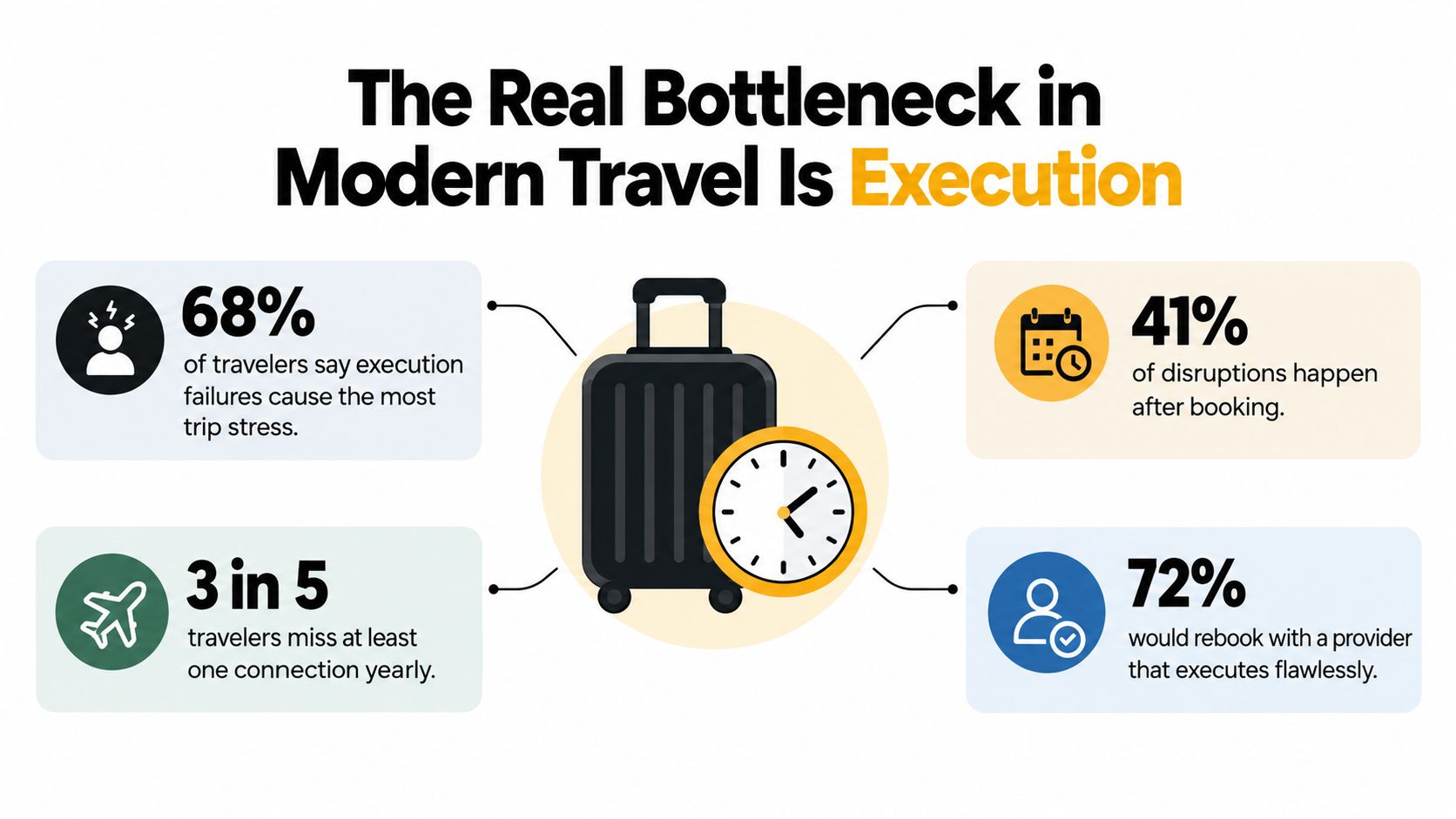
In a 2025 disruption survey, 36% experienced cancellations and 26% missed connections in the prior 12 months, alongside reported delays. Those figures make clear why disruption handling belongs in the travel plan from the start. Assign an owner before departure, agree on which commitments take priority, and delegate follow-ups that do not require the traveler. That reduces the risk of missed work and reclaims hours otherwise spent coordinating changes.
Preparation helps with the parts a traveler can control. HYDAWAY's travel packing tips can help make an unexpected change easier to manage. Packing cannot coordinate a hotel change or protect a client meeting. Assign ownership of the full itinerary, including the work that begins when a booking fails.
What Travel and Logistics Actually Means in Practice
Treat travel and logistics as a connected workflow: every reservation must support the traveler's schedule and the work waiting at the destination.
A flight, hotel, ground transfer, restaurant reservation, and meeting create dependencies. The arrival time determines when a driver should appear, whether hotel check-in fits, and how much room remains before an appointment. Booking information is easy to retrieve. Coordinating those dependencies under time pressure consumes attention that the traveler needs for the trip's purpose.
Consider a delayed arrival with a dinner reservation before a client meeting. Start by identifying which commitment must hold. Then check whether the transfer and check-in leave enough time to reach it, and adjust dinner around that constraint. Delegate that coordination as a connected task so the traveler receives a workable schedule rather than separate updates requiring further decisions.
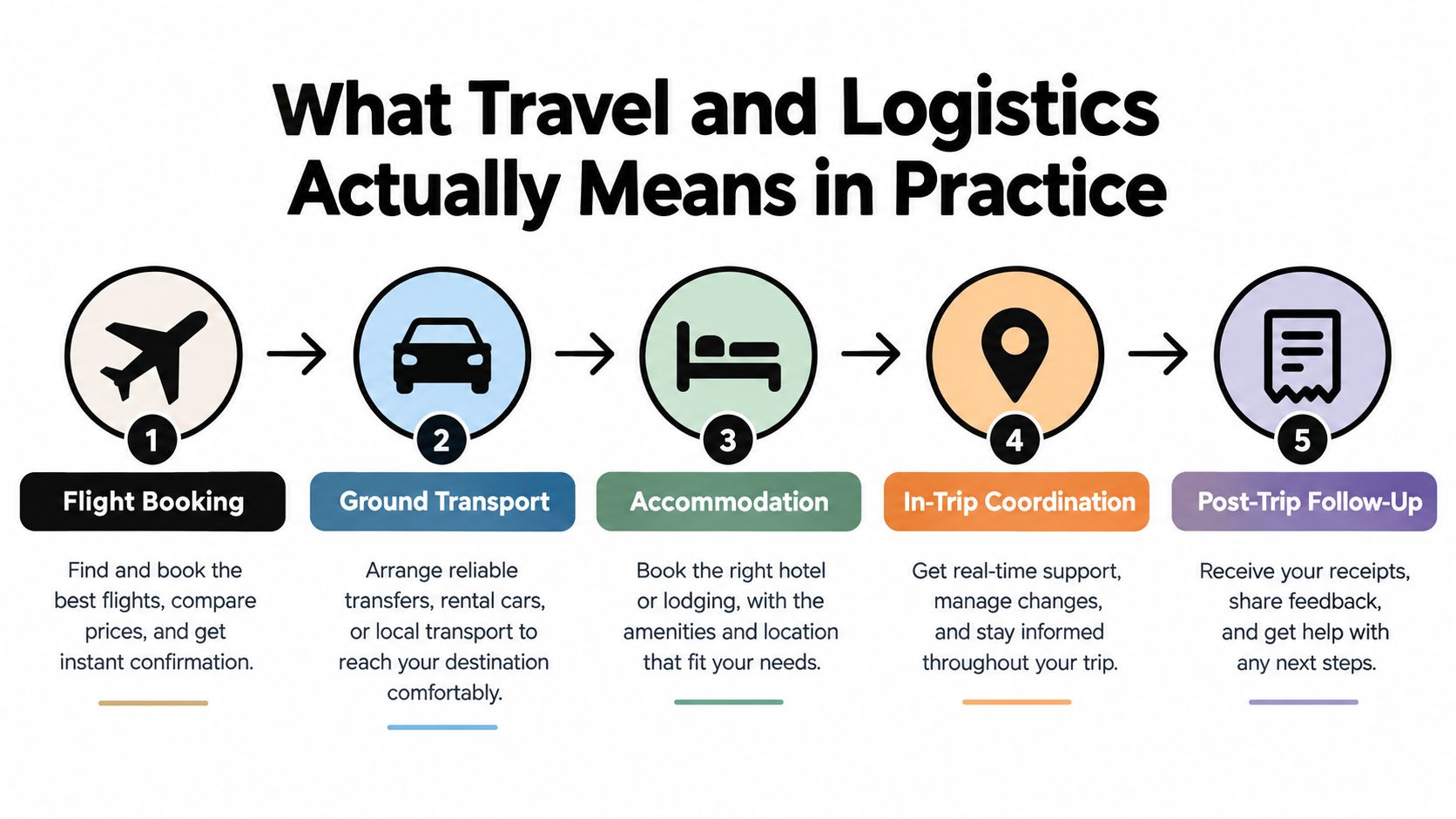
Map the dependencies
Give the person coordinating the trip a clear view of how each component affects the others:
- Flights establish the arrival and departure windows.
- Accommodation must fit those windows and the trip's purpose.
- Ground transport connects the airport, hotel, and appointments.
- In-trip commitments set the locations and deadlines the schedule must support.
- Follow-up closes expenses and unresolved changes, and records preferences for future trips.
Supply-chain measurement offers a useful parallel. The World Bank's Logistics Performance Indicators 2.0 use shipment- and vessel-level tracking data spanning 2023–2024 to assess international supply-chain speed and connectivity, as the World Bank dataset describes this approach. The relevant principle is reliable movement through a connected network.
Apply that principle before accepting an itinerary: check what each booking depends on and what would need to change if it slips. This makes risky connections visible and reduces the time spent reconciling reservations later. The return is fewer coordination interruptions and less risk to the commitments that justify the trip.
The Four Operational Pillars of Travel Support
Effective travel support has four jobs. Each one needs a clear owner and a useful measure of success. Counting bookings isn't enough. Measure how many decisions the traveler had to make, how quickly the plan recovered from disruption, and how many follow-ups remained on their plate.
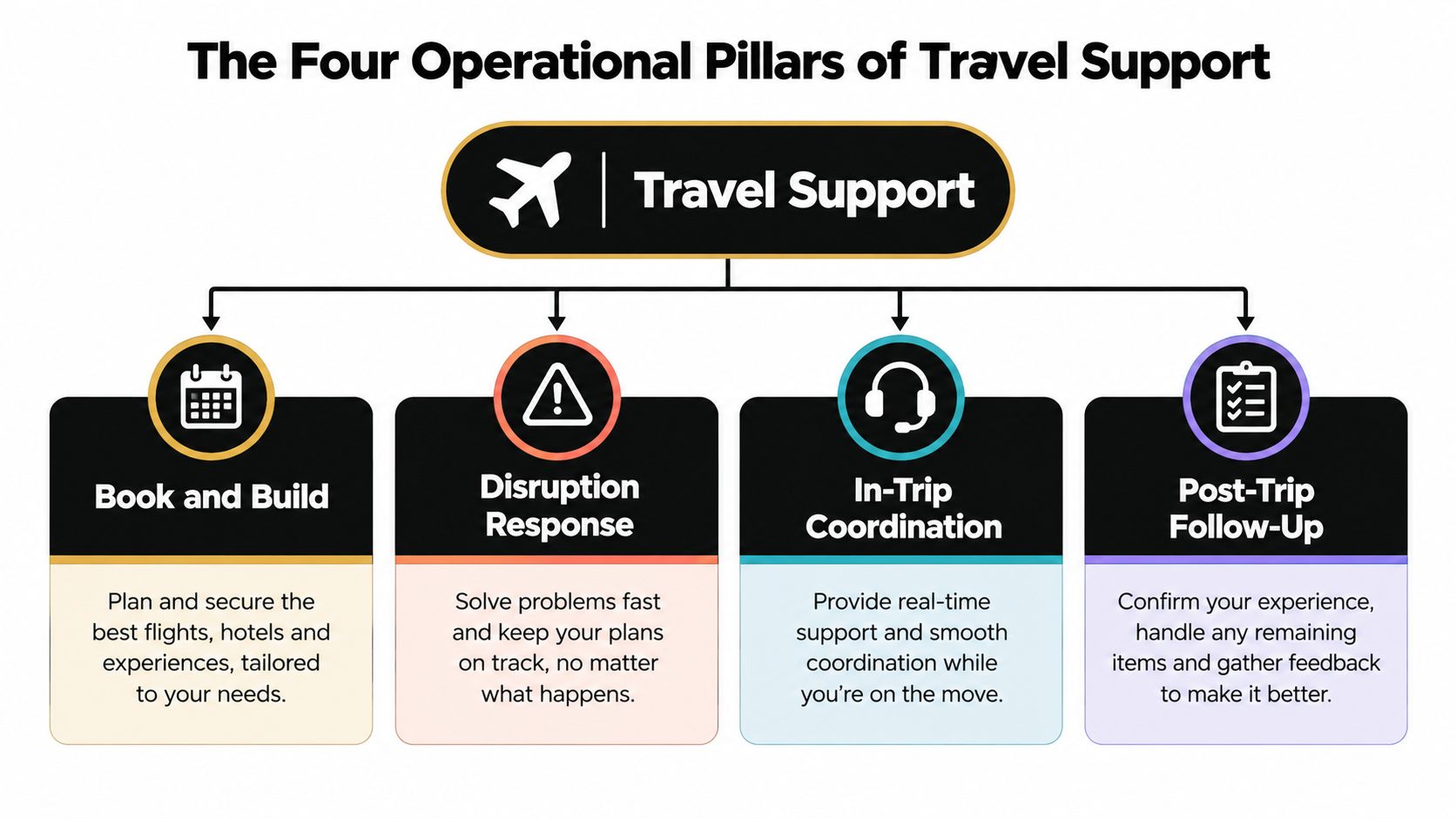
Book and build
Build an itinerary around the purpose of the trip, not just the lowest fare. Match flight timing to the meeting schedule, choose lodging that makes the day workable, arrange ground transport, and place meals where they support the agenda. If the traveler needs a transfer between airport and hotel, for example, check that its pickup plan matches the flight's actual arrival details. ROI: fewer decisions left for the traveler and less time spent reconciling disconnected bookings.
Disruption response
Monitor the trip and assess alternatives against the complete itinerary. The U.S. Department of Transportation's Air Travel Consumer Reports use Bureau of Transportation Statistics data to track delays, cancellations, mishandled baggage, and oversales. A replacement seat isn't necessarily the best answer if its arrival time breaks a hotel plan or puts a key meeting out of reach. The DOT report covers those service categories. ROI: restore the total plan sooner, with fewer calls and decisions landing on the traveler.
In-trip coordination
Handle live changes as they happen. If a client moves a meeting, the Assistant coordinating the trip can update the relevant transport and reservation plans instead of leaving the traveler to manage each change between appointments. For ground movements that need planning as part of the itinerary, review ground transportation services. ROI: preserve time for the work happening on the trip.
Post-trip follow-up
Close the loop. Reconcile receipts, note unresolved provider issues, clean up calendar changes, and capture preferences that can improve future trips. ROI: reduce leftover admin and avoid repeating decisions that have already been made.
Two Travel Problems That Look Simple but Aren't

A late cancellation before a board meeting isn't a single booking problem. It's a fast-moving decision about what the traveler must still accomplish and which parts of the plan can change. A useful response checks the next feasible flight against the meeting time, then handles the hotel, car, and calendar in a deliberate order. If the traveler is asleep or focused on the meeting, an Assistant team can monitor the issue and coordinate those dependent changes rather than waiting for the traveler to discover each one.
That kind of ownership matters to frequent travelers. In a 2026 survey, 61% of frequent business travelers said business-travel logistics were complicated, time-consuming, or more of a hassle than they should be; 45% said business travel didn't feel safe or predictable. The survey reports responses from 1,000 U.S. adults. The operational question isn't whether a person can eventually solve each problem. It's whether they should be the one doing it while the clock is running.
Routine complexity still needs ownership
A multi-city investor tour can create the same coordination burden without a dramatic failure. The traveler has to decide which airport fits each meeting, where to stay, how to reach each appointment, and where a dinner makes sense for a particular investor. One choice constrains the next. A hotel that's convenient for one meeting may create a longer transfer to the next; a late dinner may leave too little time to prepare for an early appointment.
The response is the same as in a cancellation: build the plan around the highest-value commitments, track dependencies, and keep the decisions moving. The difference is that routine coordination gives the team more room to make sensible choices before the traveler is under pressure.
The clip below offers a visual companion to the airport disruption scenario. Use it as a prompt to ask who owns the next action when a booking change affects the rest of the itinerary.
Why Afternoon Flights Fail and How to Plan Around It
Flight timing is a reliability decision, not a minor preference. An analysis of U.S. Department of Transportation data found that on-time arrivals across the 30 largest U.S. airports were typically in the mid-80% range for flights departing around 06:00–09:00, then fell to the 50%–low-60% range after 17:00. The analysis connects the difference to delays accumulating across the day.
Later flights inherit problems from earlier ones. Aircraft and crew rotations, air-traffic constraints, weather, and congestion can push a delay through subsequent legs. That doesn't make every evening departure a bad choice. It means a traveler with a fixed meeting shouldn't treat departure time as interchangeable.
Practical rule: When the meeting matters, choose the boring, reliable itinerary over the convenient-looking one.
Use three straightforward planning rules:
- Prefer morning departures when arriving on time is critical. They leave more room for the day's disruptions to be absorbed before the commitment.
- Protect connection time. Don't make a fragile connection the hinge on which an important presentation or client meeting depends.
- Keep high-value commitments away from late arrivals. If a late flight is necessary, avoid scheduling the most consequential meeting immediately afterward.
These choices may mean an earlier start or a longer gap in the calendar. That's a fair trade when it reduces the chance that a late arrival consumes the workday. A strong itinerary isn't the one with the fewest minutes between events; it's the one that still works when a flight runs late.
Travel Help Sources Compared Side by Side
No support option is right for every traveler. The decision turns on how much context, judgment, follow-through, and availability the trip requires. A traveler handling a straightforward booking may reasonably manage it personally. A complicated trip with tight commitments needs an owner who can do more than find an option.
The operational case for monitoring is clear: Bureau of Transportation Statistics airport data recorded an average delay of 77.02 minutes in June 2025, with 27.00% of flights delayed. The BTS airport data tracks delays and other flight outcomes. The issue is not just whether a traveler can find information, but whether someone can respond and coordinate the changes while the traveler is busy.
Source | Availability | Exception Handling | Follow-through | Accountability | Best For |
|---|---|---|---|---|---|
Do it yourself | Depends on your schedule | Strong personal context, but you handle every change | Requires your attention | Direct, personal ownership | Simple trips and travelers who want full control |
Corporate travel desk | Often tied to service hours and company process | Useful within policy, less flexible for unusual changes | Varies by desk and case | Clear organizational channel | Policy-driven bookings |
AI chatbot | Fast access to information | Helpful for options, limited when multiple vendors need coordinated action | You may still need to complete follow-ups | Depends on the tools and workflow | Research and straightforward planning |
U.S.-based human Assistant team | Can be available outside normal office hours | Can assess the itinerary and coordinate related changes | Can carry actions through across providers | Human ownership and direct communication | Frequent travel and trips with linked commitments |
Match the support to the work
Doing it yourself preserves personal context, but every booking and exception competes with your actual work. A corporate desk can enforce travel policy, yet policy support isn't automatically the same as end-to-end coordination. Chatbots can produce options quickly, but a traveler may still need to judge which reservation to change first and chase each provider.
A U.S.-based Assistant team adds human judgment and follow-through, especially when several constraints shift at once. For travelers weighing different planning resources, this guide to travel planning tools can help frame what software can handle versus what needs an accountable person.
A Decision Sequence for Travel Disruption
When a trip breaks, don't start by booking the first available seat. Start by protecting the outcome the trip exists to deliver. That could be a client meeting, a presentation, or an international connection. Once that priority is clear, each other decision can be tested against it.
Protect the commitment, then sequence the cascade
First, protect the highest-value commitment. Find out whether a new route preserves the essential meeting. A cheaper or earlier seat isn't useful if it arrives too late for the purpose of the trip.
Second, sequence the dependent changes. Decide which provider needs action first by identifying what creates the greatest downstream cost. A traveler stranded overnight may need lodging secured before ground transport; one with an early onward departure may need a transfer plan first. The sequence depends on the itinerary, not a generic checklist.
Third, delegate vendor follow-ups. Assign someone to contact the airline, hotel, ground-transport provider, and any other affected vendor in the right order. If a trip includes time to explore around a meeting, a one-day San Diego itinerary guide can help structure that plan, but disruptions still require someone to update the bookings when the schedule changes.
Fourth, document the residuals. Record vouchers, unused nights, changed reservations, and receipts that still need attention. Without a clear record, the traveler may have to reconstruct the story weeks later to resolve expenses or request follow-up.
Carrier history can inform preparation, but it shouldn't replace a fallback plan. BTS data for July 2024 through June 2025 showed cancellation rates ranging from 0.82% at Southwest and 0.89% at Alaska to 2.00% at American. The airline comparison explains the underlying period and cancellation measure. Check the operating carrier and keep alternatives in view, especially when a fixed commitment is at stake.
The standard isn't whether somebody found another seat. It's whether the itinerary and its follow-ups are back under control.
If you'd rather not own each decision personally, this travel emergency assistance guide can help clarify what to delegate when a disruption needs a coordinated response.
What to Delegate First and What It Returns
Cross-border travel is a substantial operational workload, not a niche activity. In 2024, approximately 1.4 billion international tourists were recorded worldwide, 11% more than in 2023, bringing global international tourism to 99% of its 2019 level. International tourism receipts were roughly $1.6 trillion. The global figures underline the scale of travel that people and organizations need to coordinate.
You don't need to outsource every detail at once. Start where delegation removes the most interruption and risk:
- Hand over the next itinerary build. Share the dates, destination, priorities, and fixed commitments. The return is fewer booking decisions and less time spent aligning flights, lodging, transport, and meetings.
- Delegate the next disruption. Set the expectation that the person handling it should protect the key commitment, coordinate affected providers, and report unresolved items. The return is less time spent switching between work and recovery tasks.
- Capture preferences once. Record the traveler's usual timing, seating needs, hotel priorities, communication preferences, and tolerance for tight connections. A team that applies those preferences can reduce repeated explanations and make future choices faster.
A useful way to choose the first task is to separate what's urgent from what's important. This Eisenhower Matrix for pet teams offers a prioritization framework that can be adapted to household or travel admin: handle the consequential work, and delegate tasks that don't need the traveler's direct attention.
Travel and logistics support is a strategic decision. The same itinerary can consume hours of coordination or become work someone else owns, freeing the traveler to focus on the meeting, client, or family waiting at the destination. Start with one trip, assign an owner for the full workflow, and track the hours and follow-ups that disappear.
Approved Lux Personal Assistant provides 24/7 access to a U.S.-based Assistant team by phone, text, or email, with travel planning and disruption coordination included in its subscription. If you want to reclaim time from the logistics around your next trip, visit Approved Lux Personal Assistant and see whether it fits the way you work.
Updated