Monthly Bookkeeping Service: What You Actually Get
See what a monthly bookkeeping service includes, what it costs versus hiring, and how to judge whether the close is decision-ready.
Lifestyle16 min read

The usual advice is to compare monthly bookkeeping packages and choose the lowest fee that covers your transactions. That's an incomplete comparison. A cheap close can still leave you collecting receipts, chasing invoices, explaining mystery charges, and arranging the accountant's review.
Judge a monthly bookkeeping service by the owner hours left after the close, not just the subscription price. You're buying usable records delivered on a dependable schedule. Receipt-chasing and scheduling belong in a separate coordination workflow, not hidden inside your expectations of the ledger.
What Arrives After a Monthly Close
A useful monthly package starts with completed work, not a dashboard login. Your bookkeeper closes the prior month by an agreed date, reconciles the accounts within scope, and hands you reports supported by transaction-level records.
For example, you might agree on delivery by the 10th or 15th, provided you submit the required statements and receipts beforehand. Those are proposed service deadlines, not universal bookkeeping standards. The agreement should say what happens when a missing statement or unanswered question prevents completion.
The records behind the reports
Reconciliation means matching the accounting records to bank and credit-card statements and explaining differences. Downloading a bank feed isn't the same thing. Transfers, processor deposits, outstanding payments, and duplicate imports still need attention.
The bookkeeper should classify income and expenses, resolve duplicates, and identify transactions that need your explanation. Receipts should be attached or indexed so someone can trace a ledger entry back to its supporting document.
The profit-and-loss statement shows income and expenses for the reporting period. The balance sheet shows assets, liabilities, and equity at the closing date. Double-entry bookkeeping records corresponding effects across accounts, but a balanced report alone doesn't prove every classification is correct.
The IRS's Publication 583 says business books must show gross income, deductions, and credits with supporting records, and employment-tax records generally must be retained for at least four years. Keep other records as long as needed to substantiate the reported income and deductions.
Monthly close deliverables versus common exclusions
Use this as a scope-negotiation checklist, not a promise that every provider includes the same work.
Work item | In a standard monthly close | Often billed extra or excluded | Still the owner's job |
|---|---|---|---|
Bank and card reconciliation | Yes | No | Provide access and flag unknown payees |
Income and expense classification | Yes | No | Confirm unusual or personal charges |
Duplicate and uncategorized cleanup | Yes | No | Answer the exception list |
Source-document indexing | Yes, if receipts are supplied | Chasing missing receipts | Send receipts before the close date |
Profit-and-loss and balance sheet | Yes | No | Read the exception report |
Invoicing and accounts receivable follow-up | Sometimes | Often excluded | Decide who collects |
Bill pay and accounts payable | Sometimes | Often excluded | Approve payments |
Payroll and sales-tax filings | Rarely | Usually excluded | Assign a tax professional or payroll provider |
Inventory counts | Rarely | Usually excluded | Provide counts |
Catch-up or cleanup of old months | No | Separate project fee | Approve the backlog scope |
Tax-return preparation and tax positions | No | Outside bookkeeping | Assign a qualified tax professional |
Published online bookkeeping service comparisons from Virtustant illustrate why buyers need explicit exclusions, including invoicing, payroll, inventory, and cleanup. Setup work can also sit outside the recurring fee.
Before onboarding, use the monthly checklist from Allied Tax Advisors to organize the handoff and turn each relevant task into an assigned responsibility. A consistent business expense-tracking process helps prevent missing documentation from becoming a month-end emergency.
Your remaining inputs are statement access, receipts, and answers to exceptions. A useful exception report names the transaction, explains the uncertainty, and asks a specific question. Bookkeeping records financial history; it does not provide tax, legal, or financial advice.
Monthly Fees Against an In-House Bookkeeper
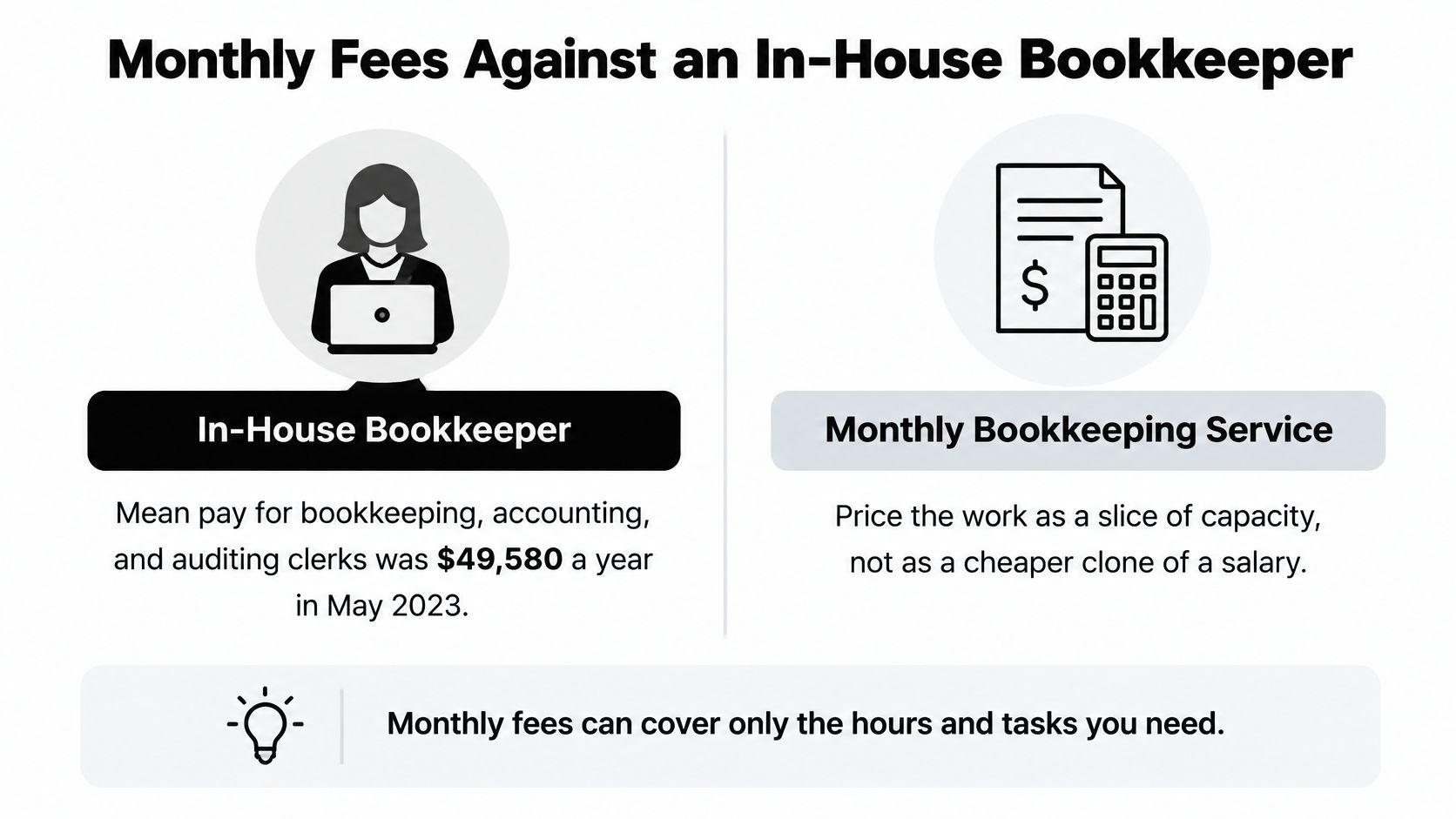
Price outsourced bookkeeping as a slice of operating capacity, not a cheaper clone of an employee. In May 2023, the Bureau of Labor Statistics reported mean pay of $49,580 annually, or $23.84 hourly, for U.S. bookkeeping, accounting, and auditing clerks. Dividing that annual wage across the year gives approximately $4,132 a month in wages alone.
That benchmark doesn't include benefits, employer payroll taxes, software, recruiting, or supervision. It also doesn't tell you what an outsourced package costs. For that, you need a written quote against your actual accounts, transaction volume, and reporting requirements.
The comparison below separates a staffed position from a defined recurring service.
Compare a complete month, not an advertised starting price
A basic package might work well for straightforward service revenue and ordinary operating expenses. Add inventory, processor clearing accounts, multiple entities, or substantial accounts payable, and the same transaction count can require much more judgment.
Transaction volume is a starting point, not the whole pricing model. A transfer between business accounts is different from a processor deposit containing sales, refunds, and fees. Ask the provider to inspect a representative period before confirming the ongoing scope.
2026 cost of monthly books versus hiring
The service amounts below are hypothetical budgeting examples, not verified market averages or provider quotes. They illustrate how to compare offers; the employee wage benchmark is historical, not a current hiring quote.
Option | Typical cost | What the money buys | Owner time left | Fits when |
|---|---|---|---|---|
Software only | Illustrative budget of $30-$80 per month | Feeds and reports the owner still codes | Most of the close | Simple books, for example under about 50 transactions |
Basic monthly close | Illustrative quote of $300-$600 per month | Categorization, bank reconciliations, basic statements | Invoicing, payroll, cleanup, tax filings | Simple steady books |
Full-service monthly close | Illustrative quote of $700-$1,500 per month | Reconciliations, statements, exceptions, contracted light receivables or payables | Payroll filings and tax positions | Growing small firm |
Cleanup then ongoing | Illustrative setup quote of $500-$2,000, then a separately quoted monthly fee | Catch-up plus a monthly close | Historical judgments and tax method | Books are months behind |
Part-time hire, 10 hours a week | Illustrative $30-$45 hourly rate gives about $1,300-$1,950 monthly in wages | Dedicated hours you still supervise | Hiring, coverage, and review | Volume is real but not full-time |
Full-time bookkeeping clerk | Historical mean-wage benchmark described above, plus employment overhead | A seat on payroll whether the month is busy | Management, benefits, software, turnover | Work fills most of a week |
An outsourced service avoids directly employing someone for capacity you don't need. You can contract for deliverables and negotiate expanded scope as the business changes. However, you still need a capable reviewer, clear communication, and a plan for approvals.
An employee offers closer day-to-day availability and can learn internal workflows. In return, you take responsibility for hiring, management, absence coverage, and continuity when that person leaves.
Buying rule: Compare the total fee, excluded work, and owner review time against the same operating month.
Use a bookkeeping service cost breakdown to organize those quote components. For a jurisdiction-specific comparison, renn's plans for self-employed professionals in Spain offer a separate reference point, but don't assume a Spanish professional's package maps to U.S. bookkeeping and filing responsibilities.
Decision-Ready Books Versus a Late Close
A reconciled bank account can coexist with a misleading operating conclusion. Say a service firm completes and bills a hypothetical $12,000 job in March, then receives payment in April. Under accrual reporting, assuming the revenue is earned in March, the revenue belongs in March; under cash-basis reporting, the receipt appears in April.
Neither report is automatically wrong. They answer different questions. The owner gets into trouble when they treat reported profit as spendable cash or interpret a collection-heavy month as evidence that current sales improved.
Separate profit from available cash
Cash-basis reporting recognizes income when received and expenses when paid. It can be easier to follow for a straightforward service business. Accrual reporting recognizes earned revenue and incurred expenses, helping an owner understand obligations and activity that haven't yet passed through the bank.
Inventory, advance payments, retainers, and longer collection cycles deserve particular attention. Don't choose an accounting method just because a software setting is convenient. Your tax professional should review method and filing implications, while your reporting package should clearly identify the basis used.
A practical owner packet separates these questions:
- Profitability: Did the business earn more than it incurred in expenses during the period?
- Collections: Which customer balances remain unpaid?
- Commitments: Which bills, payroll obligations, or other payments are approaching?
- Available cash: What cash figure has been checked, and what hasn't cleared?
More applications don't guarantee better visibility
In the 2025 Intuit QuickBooks survey of accounting professionals, firms reported an average of eight applications for core operations, and 66% felt overwhelmed by technology complexity at least weekly. Adding another dashboard won't necessarily remove the manual handoffs between those systems.
Name who maintains each integration. A disconnected bank feed, delayed processor payout, or payroll posting problem needs an accountable person, not a generic instruction to contact support.
Alongside the closed month, request a lightweight cash check appropriate to your business. It should identify included operating accounts, the activity reviewed through a stated time, uncleared items, and known commitments not reflected in the displayed bank balance.
A historical report explains what happened. A usable cash check explains what you can rely on now.
For example, an agreement could specify that the cash check includes prior-business-day bank activity, subject to review of outstanding items. That's a proposed service standard, not a claim of real-time reporting. Don't accept a real-time label unless account feeds, reconciliation controls, and human review support it.
Measure time to decision from the moment you request a cash answer to the moment you receive a checked figure with its limitations explained. Then test the packet against an actual decision, such as whether to start a contractor or defer equipment spending. If you still have to reconstruct unpaid bills yourself, the reporting isn't decision-ready.
How to Vet a Monthly Bookkeeping Provider
Ask a prospective provider to demonstrate the work before discussing automation features. A polished sales presentation tells you little about whether someone will investigate an unexplained balance or deliver a usable close.
Use the following buying checks before committing to an ongoing relationship.
Inspect the work and assign responsibility
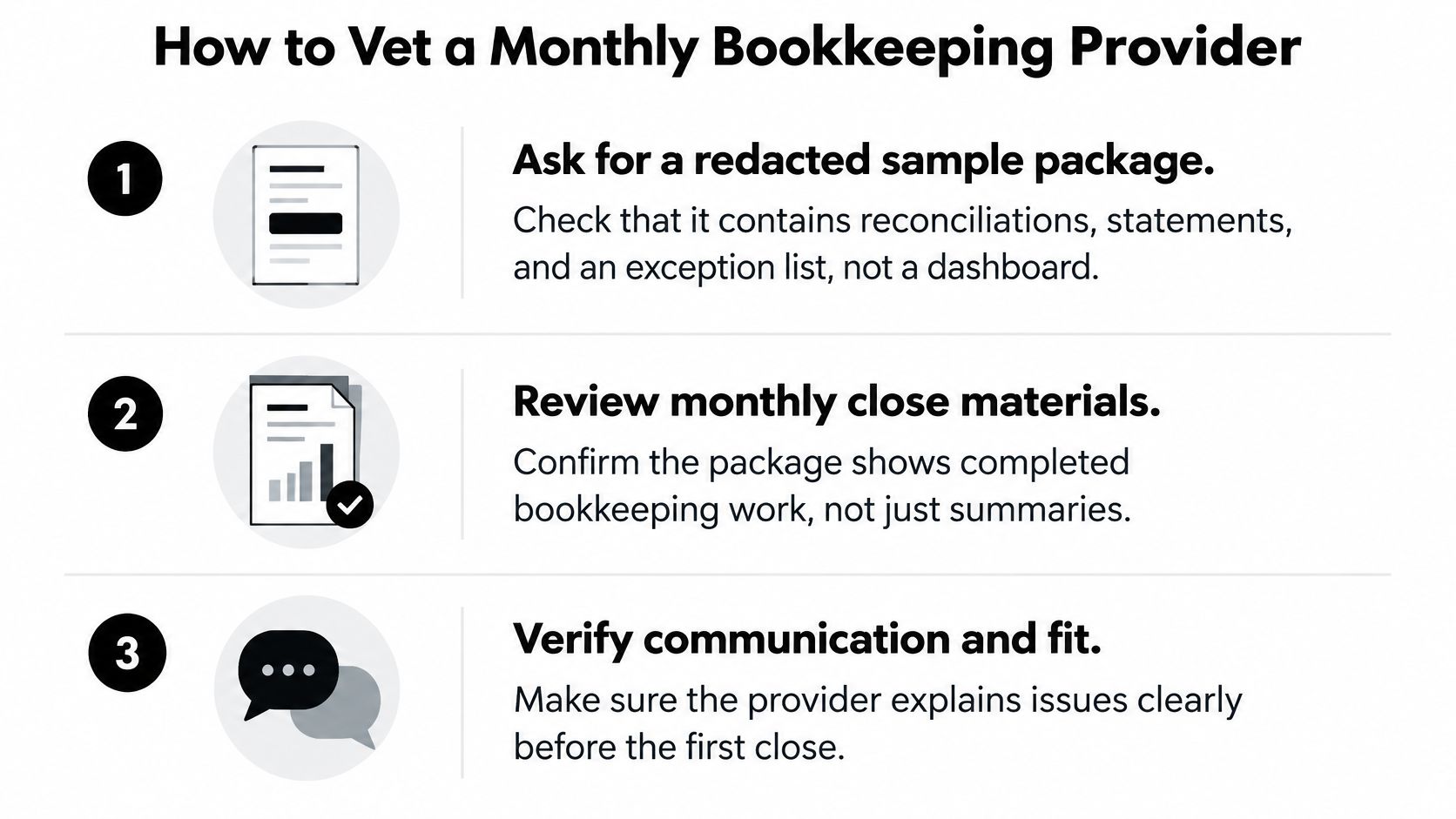
- Ask for a redacted sample package. Look for reconciliations, a profit-and-loss statement, a balance sheet, and an exception list. A dashboard screenshot doesn't show whether the underlying work is complete. Ask how the reviewer distinguishes an unresolved item from a harmless timing difference.
- Put delivery and communication in writing. Name the close date, the reviewer, and the response standard for questions. Include your own input deadline so neither party can treat missing information as someone else's invisible problem.
- Map every financial connection. List banks, credit cards, payment processors, payroll systems, and relevant sales platforms. Assign who connects each feed, repairs broken connections, and confirms imported activity is complete. Use appropriate permission-based access rather than casually sharing unrestricted credentials.
- Get exclusions and cleanup scope before signing. Identify sales-tax work, inventory adjustments, bill payment, collections, and historical corrections separately. If prior periods need repair, ask what completed cleanup means and whether opening balances will be reviewed.
These checks focus on evidence and accountability rather than sales language.
Protect continuity before the first handoff
- Confirm custody and export rights. Establish where receipts, statements, workpapers, and the accounting file live. Ask the provider to describe the actual export process, including attachments and account history. You shouldn't discover during cancellation that your replacement bookkeeper can't obtain usable records.
- Identify the accountable reviewer. Ask where reviewers are based, what business context they understand, and who takes responsibility when a number is wrong. Offshore coding capacity can be suitable, but location alone doesn't establish quality. A reachable person must own the sign-off and explain corrections.
- Draw the boundary around professional judgment. Specify that tax-method decisions and filing positions go to the responsible tax professional. A bookkeeper can organize the question and supporting transactions without deciding the answer. The same distinction applies to legal and financial advice.
- Trial a complete reporting cycle. Use a short initial agreement where available and define acceptance criteria before work begins. Check whether delivery matched the promise, exceptions were specific, and your review stayed within a target you chose, such as under an hour. That's a trial goal, not an industry performance standard.
A useful trial includes a realistic complication. Ask how the team handles a missing receipt, an owner-funded purchase, or a processor deposit that doesn't match recorded sales. You're testing explanation and follow-through, not whether the salesperson can say the software uses AI.
Decline the provider if they can't name the close date, explain the export path, or distinguish recording from advice. Those answers determine whether you can run the relationship and leave it cleanly.
Hours Saved in Three Operating Cases
In 2023, small-business owners spent an average of about 20 hours weekly on accounting functions, according to Cornerstone Advisors' survey of 750 owners and executives, published by Tight. That measure includes invoicing, expense tracking, reporting, and tax management, not just bookkeeping.
The cases below use hypothetical fees, workloads, and billing rates. They show how to test a purchase against a calendar without promising the same savings to every owner.
The practical target is a shorter review, not a finance-free business.

A founder trades a Sunday for an exception review
Say a founder runs a $3 million services firm, with two bank accounts, one processor, and about 200 monthly transactions. Assume the monthly coding and reconciliation take eight hours, and a $900 close reduces the founder's involvement to 45 minutes.
That returns 7.25 hours. At an assumed value of $150 per hour, the recovered capacity is worth $1,087.50, exceeding the fee before considering other benefits. The owner still contributes the review time, supplies missing explanations, and keeps payroll filings with the payroll vendor.
The value is capacity, not automatic revenue. The founder must use those hours productively or deliberately value them as time off.
A solo attorney protects a billable afternoon
Suppose an attorney billing $400 an hour spends a four-hour Friday afternoon preparing records. A hypothetical $400 basic close could release capacity worth $1,600 if the entire afternoon becomes billable.
But assume the attorney still spends 30 minutes supplying receipts and reviewing questions. The net recovered capacity becomes 3.5 hours, with a potential billing value of $1,400, leaving $1,000 after the fee if that capacity is sold and collected. Receipt submission and professional obligations remain the attorney's responsibility.
For a worksheet approach, BankStatementWizard's guide to calculate ROI from accounting automation can help organize the comparison. Include retained review time rather than counting every former accounting hour as saved.
A household side practice needs separation first
A dual-career household runs a side practice through a personal card that also carries school purchases and household spending. The bookkeeper can't reliably infer business purpose from merchant names. Someone must label the charges before classification can be completed.
Separate payment methods going forward and identify the mixed historical activity before requesting a recurring quote. Here, the owner's remaining hours and cleanup dollars must be measured first, not guessed.
Monthly close returns in three operating cases
Case | Owner time returned | Still on the owner |
|---|---|---|
Founder, $3M services firm | Hypothetically 7.25 hours, worth $1,087.50 at the assumed rate, against a $900 fee | A 45-minute review; payroll filings stay with the payroll vendor |
Solo attorney | Hypothetically 3.5 hours, with $1,400 potential billing value against a $400 fee | Receipt supply, review, and filling the released capacity |
Dual-career household with side practice | Hours spent splitting charges must be measured before savings can be estimated | Labeling business and personal charges; approving cleanup dollars |
Use the same discipline when considering tools demonstrated in video form: identify the exact task removed before assigning it a time value.
If the remaining work is chasing documents and booking the accountant, that's coordination, not more ledger work.
Pairing Books With a Subscription Assistant
Keep the ledger with the bookkeeper and the chase with someone who isn't coding it. Collecting receipts, following up with vendors, assembling an expense packet, and arranging the accountant's meeting are coordination tasks. They can delay a good close without requiring accounting expertise.
At Approved Lux, our US-based Assistant team can support that coordination layer. We're not a bookkeeping provider, and we don't give tax, legal, or financial advice. Our role is operational noise reduction around the professional's work.
Give the Assistant a defined handoff
A useful request names the output and preserves the accounting boundary. For example, ask the Assistant team to collect missing vendor receipts into your designated expense packet, arrange the review meeting, and remind you about a deadline your CPA has already established.
Don't ask the Assistant to decide whether an expense is deductible or determine how a transaction should be posted. Our guide to a virtual assistant for bookkeeping support helps distinguish administrative support from responsibility for the books.
Triple-channel access means you can call, text, or email, with each channel monitored at equal priority. The human Assistant team is available around the clock, so you can delegate the follow-up when it occurs to you rather than hold it in your head until office hours.
We work alongside your email and calendar accounts, not inside them, and don't become your accounting system of record. Customers don't get one fixed Assistant. Preferences and history stay with the account, and Proactive Preference Learning helps whoever responds understand how you like tasks handled.
Compare recovered capacity with the actual subscription
Lux Solo costs $99.99 per month for one account holder, about $3.33 a day. Lux Solo and Lux Circle are month-to-month plans that can be cancelled at any time. Treat that flexibility as a way to test whether delegation works for your routine, not as a promise of unrestricted capacity.
For a labor benchmark, the Bureau of Labor Statistics' administrative-assistant occupational guide reports median pay of $48,310 annually, or $23.23 hourly, in May 2025. At that benchmark, 10 hours weekly, approximately 520 hours annually, represents roughly $12,080 before payroll taxes, benefits, and supervision.
That calculation values a block of labor. It doesn't predict how many hours a subscription will deliver or suggest that an Assistant replaces an employee.
Track the work that leaves your calendar:
- Requests completed: Count finished outcomes, not just messages exchanged.
- Hours reclaimed: Subtract briefing and review time from the work delegated.
- Expenses processed: Track documentation assembled without treating it as accounting approval.
- Meetings scheduled: Include rescheduling and conflict resolution.
- Follow-ups closed: Record which open loops no longer require your attention.
At approximately $1,200 annually, Lux Solo should be evaluated against the value of the time it returns. A cleared afternoon can justify the subscription only when that afternoon's value exceeds the relevant cost. Keep the bookkeeping fee and coordination subscription separate so you can see what each purchase accomplishes.
Pick the Setup That Clears Your Calendar
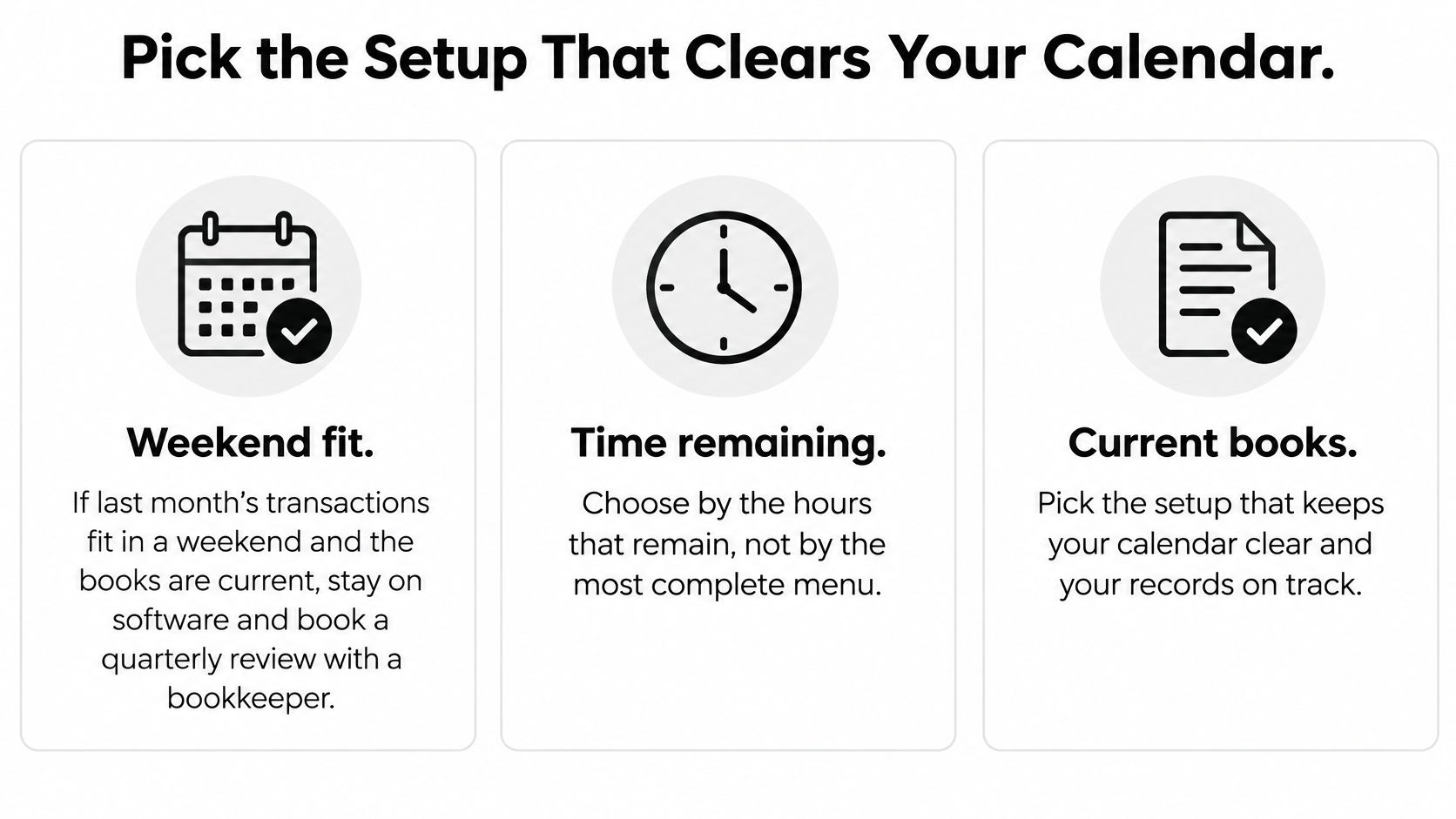
Choose the smallest arrangement that keeps records current and leaves you with a manageable role. The most complete service menu isn't automatically the best purchase. Your business may need careful monthly reconciliation without daily bill payment, or strong coordination support without another accounting application.
Match the setup to your situation
Keep software when the work fits a contained block. If last month's transactions fit comfortably into a weekend and your books are current, software with a planned quarterly professional review may be enough. Reserve the time and use a repeatable checklist so the work doesn't drift until filing season. Don't buy a recurring service solely because doing the books feels unfashionable.
Buy a monthly close when accounting work keeps escaping that block. Request a defined package when classification and reconciliation repeatedly interrupt client work or consume time you can't protect. Select a basic or fuller scope based on account complexity and the operational work you want delegated. Write the delivery date and acceptance criteria into the agreement before comparing final quotes.
Hire when the role is a role. In-house capacity makes sense when recurring work occupies most of a week, someone can manage the employee, and absence coverage is practical. Don't use a full-time salary comparison to justify a small amount of intermittent coding. Consider whether your real requirement is daily availability, internal process ownership, or dependable month-end completion.
Add coordination support when the remaining work is follow-up. Approved Lux belongs beside the close when receipts, vendor messages, and scheduling still fragment the owner's day. Keep posting decisions with the bookkeeper and professional judgments with the appropriate adviser. Use the Assistant team as a force multiplier for execution, not as a substitute for accounting oversight.
The right choice protects both record quality and working time.
Make a one-page workload count
Your next step is a one-page inventory, not another round of browsing package names. Gather enough detail that a provider can price the actual job and you can recognize a useful result.
- Accounts: List each bank, card, processor, and other financial source.
- Activity: Estimate monthly transactions and flag inventory, mixed personal spending, or unusual revenue arrangements.
- Time: Record the hours you spent last month on coding, reconciliation, review, and follow-up.
- Backlog: Identify incomplete periods separately from the ongoing workload.
- Coordination: Mark receipt collection, vendor chasing, document assembly, and scheduling as their own category.
- Decision needed: Name the cash or profitability question you need the finished packet to answer.
Final test: A successful setup leaves you with deliberate approvals and decisions, not an unassigned pile of administrative work.
Use that page to trial the bookkeeping relationship and compare the full year of proposed work, including cleanup and excluded services. Price the close and the chase separately. Retain each service only when the completed work and your hour log show that it earns its place.
Approved Lux Personal Assistant offers a US-based human Assistant team to handle receipt coordination, vendor follow-up, and scheduling around your bookkeeping workflow. Visit Approved Lux Personal Assistant to explore support for the administrative work that remains after your bookkeeper closes the month.
Updated