What Is Marketing Assistant? Tasks, KPIs and Hours Saved
What is marketing assistant? Learn the role, typical tasks, KPIs and when to delegate, plus a hire-vs-subscription comparison for busy professionals.
Lifestyle13 min read

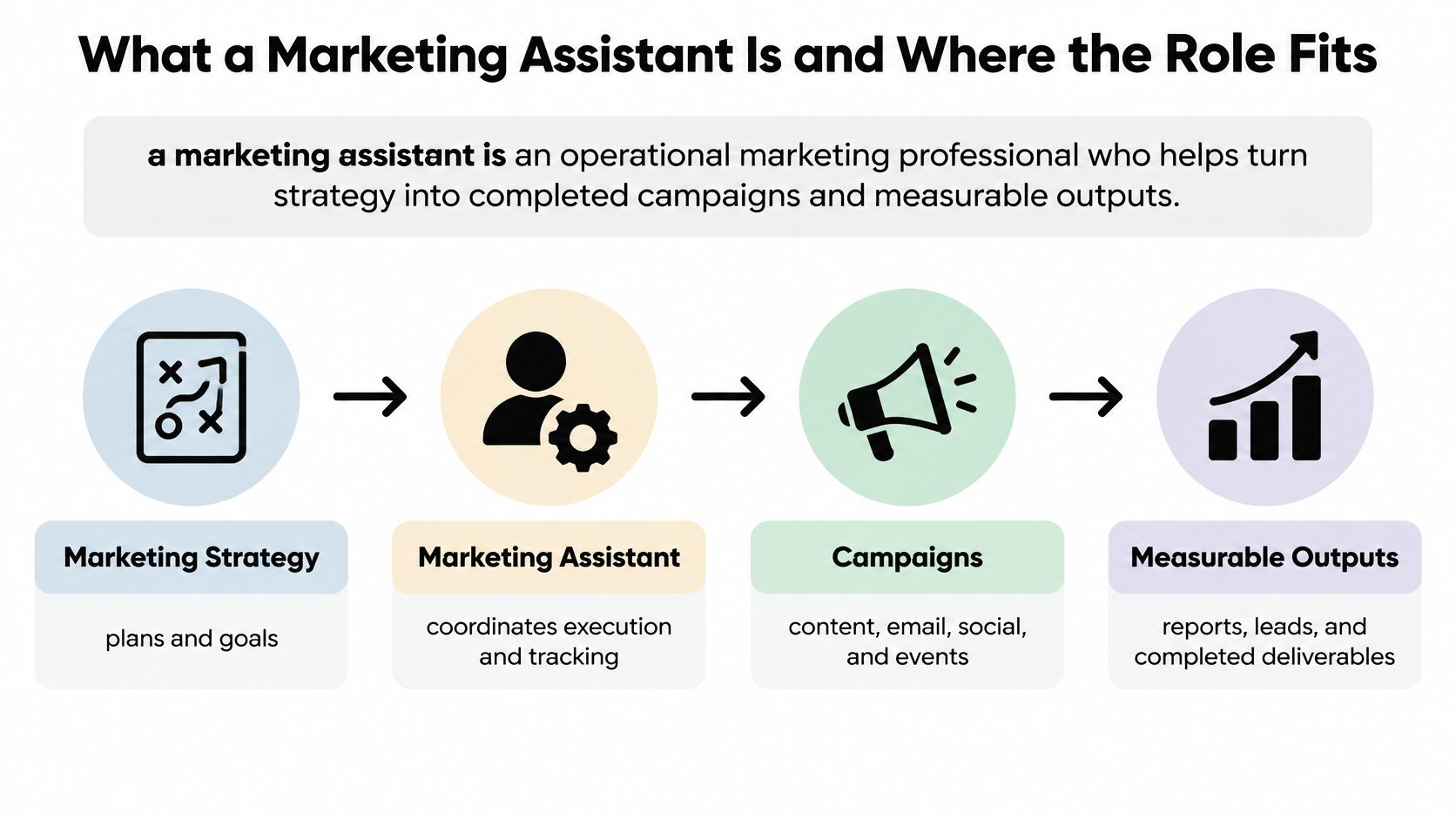
A marketing assistant is an operational marketing professional who turns marketing strategy into completed campaigns and measurable outputs, sitting between general admin support and marketing management.
Your campaign may already be planned, but the designer still needs feedback, the email hasn't been tested, and the printer hasn't confirmed delivery. If you're spending your afternoon chasing those details instead of deciding what the business should say next, you need execution capacity, not another strategy meeting.
What a Marketing Assistant Is and Where the Role Fits
Think of the marketing manager as a director and the marketing assistant as a stage manager. The director sets the vision; the stage manager makes sure the assets, people and deadlines line up so the performance can happen.
The American Advertising Federation describes marketing coordination as an entry point into the profession, identifying market research, content creation, social-media management and campaign execution as core activities. That combination explains why a capable assistant needs more than calendar skills.
Where the role sits
The assistant connects a marketing decision to the work needed to deliver it. If the manager approves a webinar campaign, the assistant might organize the registration page, collect speaker biographies, prepare email drafts and track outstanding approvals.
The workflow is easier to understand when you follow it from the initial plan to the final report.
Assistant, coordinator or administrator
Job titles aren't reliable boundaries. Smaller companies often use marketing assistant and marketing coordinator for overlapping responsibilities, especially when someone supports several channels.
Use the work itself to distinguish the roles:
- General administrative support keeps people and office processes organized, including meetings, correspondence and records.
- Marketing assistance keeps audience-facing work moving, including campaign assets, publishing schedules and performance reports.
- Marketing management owns priorities, positioning, resource allocation and the decisions behind the campaign.
An assistant booking a trade show isn't judged only by whether the reservation appears on a calendar. The useful outcome is a ready booth, approved materials, confirmed shipping and an agreed process for collecting leads.
Practical test: If the work changes how an audience sees the brand or how a campaign performs, it belongs within marketing operations.
As marketing has expanded across websites, email and social platforms, the execution work has become more interconnected. A missing image can delay an email; an unapproved claim can block a landing page.
Give the assistant a visible workflow rather than a collection of disconnected requests. SleekPost's guide to Track marketing workflow performance offers useful context for making handoffs and bottlenecks visible.
The role becomes a force multiplier when the manager no longer has to remember every unfinished detail. Senior attention can return to positioning and revenue decisions instead of chasing files.
Core Responsibilities by Marketing Area
A marketing assistant turns campaign plans into finished, reviewable work. Define each assignment by its deliverable so both the assistant and manager know what “done” means.
Core marketing assistant responsibilities by work area
Work area | Typical activities | What the manager receives |
|---|---|---|
Market research | Competitor scans, audience and pricing research, trend summaries | Briefing notes with sources |
Content creation | Drafting posts, blog outlines and ad copy variants; sourcing images | Drafts ready for approval |
Social and email | Scheduling posts, building email sends and maintaining list hygiene | Live content calendar and send log |
Campaign coordination | Updating campaign calendars, tracking tasks and handing assets between teams | Status view with owners and deadlines |
Events and trade shows | Booking booths, shipping materials and coordinating speaker logistics | Event checklist and budget tracker |
Sales data and reporting | Pulling dashboard numbers and building weekly performance sheets | Weekly report delivered on schedule |
Vendor communication | Following up with agencies and printers, requesting quotes and checking order status | Confirmed vendor schedule |
A clear deliverable sets the finish line. “Research competitors” could mean anything from a quick scan to a lengthy report. “Prepare a sourced comparison of competitors' offers, pricing and positioning” tells the assistant what to produce and gives the manager something specific to review.
For social media, specify the accounts, who approves replies and which messages must be escalated. A guide to social media assistant responsibilities can help clarify the difference between routine publishing and channel ownership.
Why the role is specialized rather than clerical
Built In's U.S. salary figures put the average marketing assistant salary at $55,171 annually, with reported pay ranging from approximately $43,000 to $110,000 depending on experience, location and employer. These figures describe an employment investment, not a guarantee of skill. Assess candidates through relevant work: can they produce a clean draft, explain a spreadsheet discrepancy and follow a campaign checklist without losing the deadline?
Useful practical skills include:
- Writing and editing that preserve the intended message without adding unsupported claims.
- Tool fluency in systems such as Google Sheets, a content management system and an email platform.
- Coordination judgment about when to follow up, flag a blocker or pause publication.
An assistant can prepare material for a decision, but an accountable manager should set strategy and approve changes to the brand promise. For example, during launch week, the assistant can build the campaign calendar, gather approved assets, follow up with the printer and send the performance sheet. The manager decides whether the launch message still fits the business objective.
KPIs That Show a Marketing Assistant Is Working
Counting posts can reward activity without improving execution. You need to know whether approved work ships reliably and whether the manager spends less time rescuing it.
Approval delays deserve particular attention: in 2025, Adobe and Advanis found that 46% of more than 400 Australian marketing, advertising, creative-design and customer-experience professionals spent over 40% of their time on administrative tasks, reviews and approvals.
KPIs for measuring a marketing assistant's impact
KPI | What it measures | How to calculate | Healthy trend |
|---|---|---|---|
Campaign on-time rate | Launches shipped by the planned date | On-time launches divided by total launches | Rising and stable over eight weeks |
Approval cycle time | Days from ready-for-review to approved | Average days between the two status changes | Shrinks as review checklists improve |
Output per week | Approved assets published | Count of approved assets shipped each week | Holds steady while manager review time falls |
Reporting turnaround | Time to deliver weekly performance numbers | Hours from data cutoff to report sent | Meets the agreed cutoff every week |
Manager hours freed | Admin time moved off the leader | Logged hours before versus after delegation | Rises, then holds as scope grows |
Interruptions avoided | Ad hoc questions routed away from the leader | Count of tasks closed without the leader | Fewer leader interruptions per week |
Treat the time windows in this table as suggested operating checkpoints, not industry benchmarks. A useful KPI improves or holds while the leader's handling time falls.
Establish a baseline before changing the workflow
Use a two-week baseline, then schedule reviews at 30 and 60 days. These are practical measurement intervals: record task type, handling time, review status, revision rounds and whether the manager had to intervene.
Keep the definitions consistent. If reporting turnaround begins at the agreed data cutoff, don't restart the clock when someone finally downloads the spreadsheet.
For publishing, a social media scheduler from iHatePosting can support a repeatable queue. The assistant still needs to check approval status, destination links and the final preview before scheduling.
Connect your tracking to the actual marketing plan implementation, rather than maintaining a separate dashboard nobody uses. A task board with owners, deadlines and review statuses is often more useful than an elaborate report.
More output isn't an improvement if the manager has to rewrite more of it.
Track revision rounds alongside completed assets. If output rises while corrections also rise, investigate rushed briefs, unclear acceptance criteria or missing checks before expanding the workload.
Hour-Savings Examples for Busy Professionals
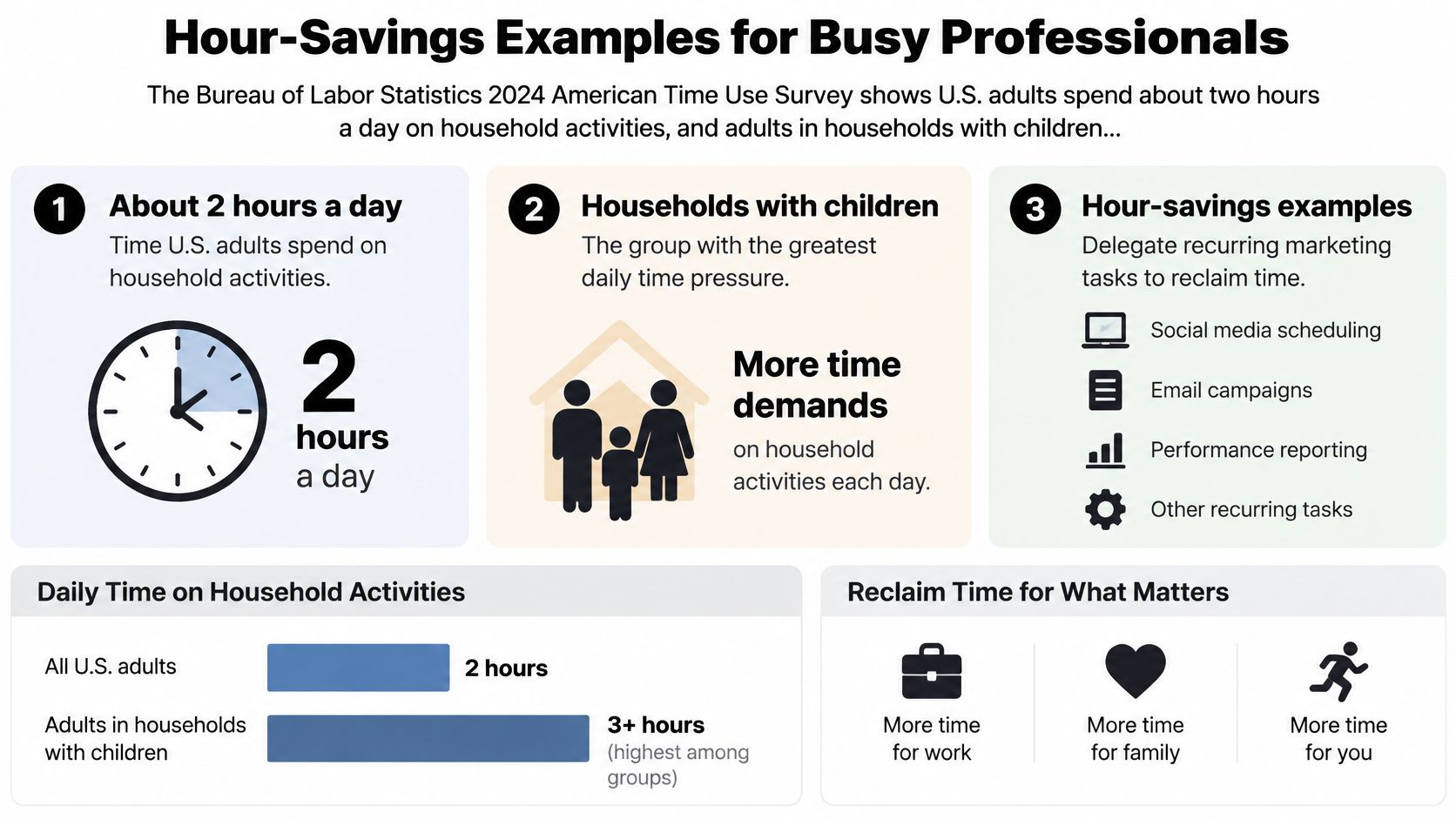
The Bureau of Labor Statistics' 2024 American Time Use Survey reports that U.S. adults spend approximately two hours daily on household activities, while adults in households with children under six spend an additional average 2.5 hours daily providing primary childcare; reclaiming 30 minutes would equal 25% of the two-hour household-activity benchmark.
That benchmark includes cooking, housework and other activities an Assistant cannot remove. Use it to identify coordination around the work, such as booking a repair, comparing service providers or arranging appointments, rather than treating the whole category as delegable.
The visual below frames the categories to examine, not a guaranteed daily saving.
Illustrative assumptions to replace with your own log
These scenarios are hypothetical calculations, not measured service results. Replace their inputs with your own two-week task log.
- Solo consultant: Assume a consultant billing $300 an hour spends six hours weekly on scheduling, intake emails and invoice chasing. Delegating the routine coordination might clear four hours, representing roughly $1,200 of potential billable capacity if paying work fills that time.
- Founder: Assume the founder of a $5 million company spends ten hours weekly on vendor follow-ups, research sourcing and inbox triage. Clearing six hours could create uninterrupted space for customer conversations and hiring decisions.
- Working parent: Assume seven weekly hours go to enrollment deadlines, camp registration and appointment scheduling. Delegating forms, calendar updates and follow-ups might clear four hours while the parent retains decisions about providers and family priorities.
The distinction matters: capacity isn't automatically revenue. A consultant only earns more if the reclaimed time becomes paid work, while a parent may reasonably value fewer workday interruptions instead.
Count the handoffs, not just the minutes
Marketing work follows the same logic. A documented content creation workflow lets an assistant collect inputs and organize review without repeatedly asking where a draft belongs.
Use the following video as a discussion prompt while deciding which recurring coordination tasks you want to hand off.
For every cleared block, identify a decision you no longer need to handle: which approved appointment slot to book, whether a vendor has replied or where the latest asset lives. That's a more useful measure of mental bandwidth than an optimistic hours-saved estimate alone.
Which Tasks to Delegate, Verify or Keep
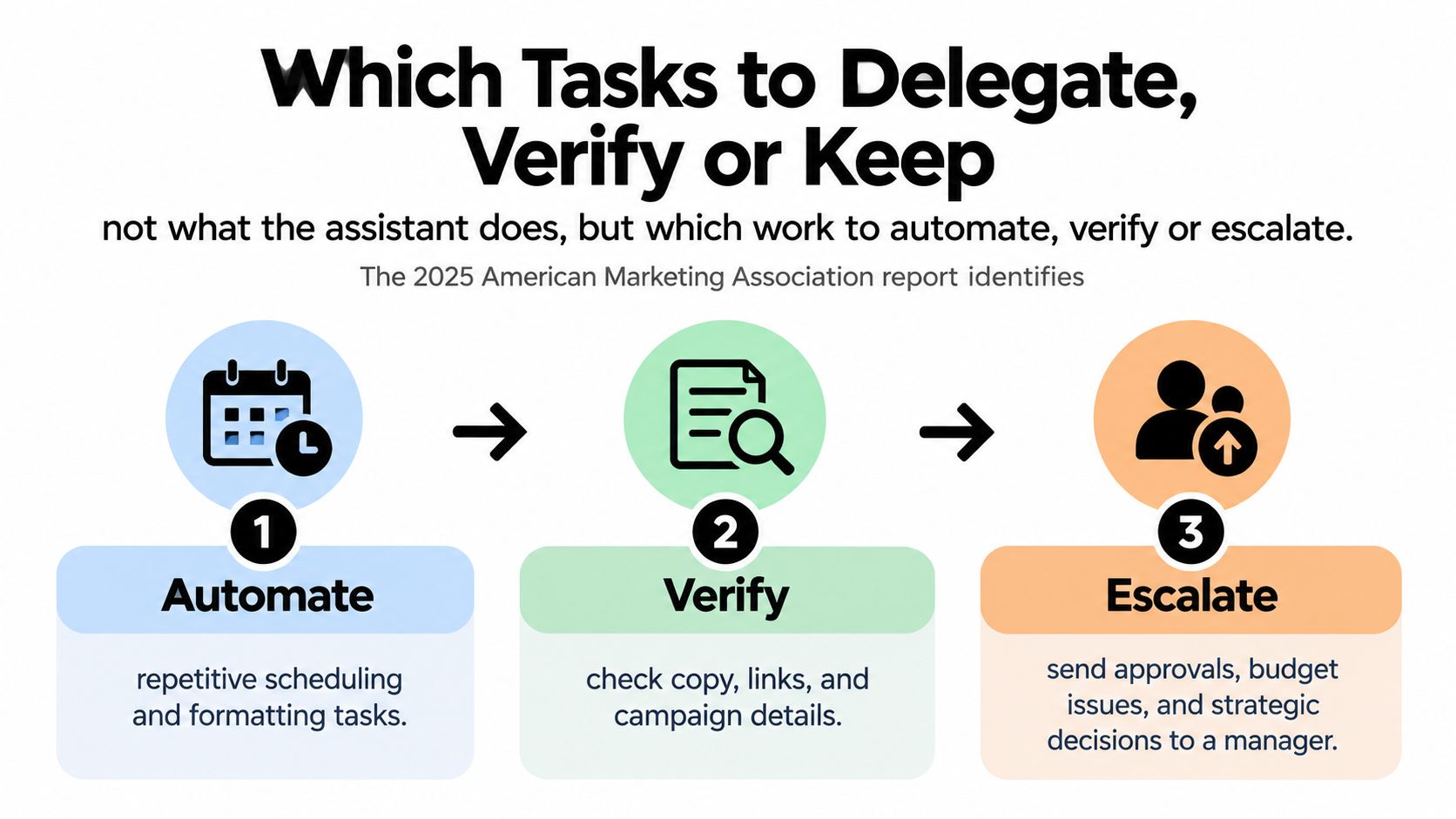
A marketing assistant can schedule an approved campaign, but the person accountable for its results should decide what the campaign promises and who it targets. The distinction is simple: delegate repeatable execution, verify work that reaches customers, and keep consequential decisions with an accountable owner.
The 2025 American Marketing Association skills report identifies generative AI as the top future skill, with 43% of surveyed marketers expecting it to become more important within five years. That makes clear task boundaries more useful: an assistant can prepare work with AI, while a human checks its accuracy and makes the decisions that carry business risk.
Use risk to choose the handoff
Follow this decision path before assigning access or publishing authority.
- Does the task only reformat, organize or move information? Delegate it within a documented process. Resizing approved assets, filing reports and scheduling approved posts do not require the assistant to create a new message. Specify the right destination and what counts as complete.
- Will customers or leadership see the result? Delegate preparation, then verify it. Check drafts, ad variants and performance summaries for factual accuracy, approved claims and brand voice before release.
- Does the task interpret audiences, approve spending or handle sensitive messages? Keep the decision with a named owner. An assistant can collect evidence, summarize a complaint and prepare response options, but should not improvise a pricing exception or commit budget without authority.
- Does it set positioning or priorities? Keep that decision with the leader. Choosing whom the business serves and what it promises requires accountability, not just task completion.
Use the same test to set the assistant's authority: the more judgment a task requires, the narrower the delegated decision. The workflow below separates routine execution from work that needs review or escalation.
Verify the parts that can cause harm
Suppose an AI-drafted campaign email includes a discount nobody approved. The copy may read well, but sending it would create an unauthorized promise to customers.
Review the offer against the approved campaign brief, rather than proofreading the sentence alone. Remove the discount or get explicit approval before the assistant schedules the email.
Check these risks before release:
- Inaccurate copy and unsupported claims: Compare product details, offers and evidence with approved source material.
- Privacy exposure: Remove unnecessary customer information and use only authorized systems.
- Brand inconsistency: Check tone, terminology and whether the message promises something the business can deliver.
- Poor-quality analytics: Confirm date ranges, filters and metric definitions before interpreting a dashboard.
Automation can handle a first pass, but a human reviewer still owns the release decision. Give the assistant a clear escalation route and permission to pause work when the facts do not match.
The more an output reaches a customer or affects spending, the more review it needs.
W-2 Hire or Subscription Assistant Team Compared
A marketing hire can own campaign work inside your organization. A subscription assistant team can take recurring logistics off your plate. The right choice depends on the work you need done, the hours it takes, and how much direction it requires.
W-2 executive assistant versus subscription assistant team
Factor | W-2 Executive Assistant | Subscription Assistant Team, such as Approved Lux |
|---|---|---|
Annual cost | Wages plus benefits and payroll taxes | Monthly subscription fee, without a payroll or benefits layer |
Time to start | Recruiting, interviews and onboarding, often weeks to months | Account setup, then requests can be made |
Coverage hours | Set working hours with time off and sick days | US-based team available 24/7/365 |
Management load | You supervise, review, train and manage performance | A managed team handles requests; you set standards and priorities |
Continuity | One person, until they leave or change roles | Preferences and history stay with the account |
Scope | Job description and team requirements | Family and household management, travel, errands and research |
Best fit | Full-time workload needing deep internal integration | Recurring work and home logistics below a full-time load |
Hidden costs | Recruiting, equipment, workspace and manager time | Out-of-scope work still needs another owner; the role isn't advisory |
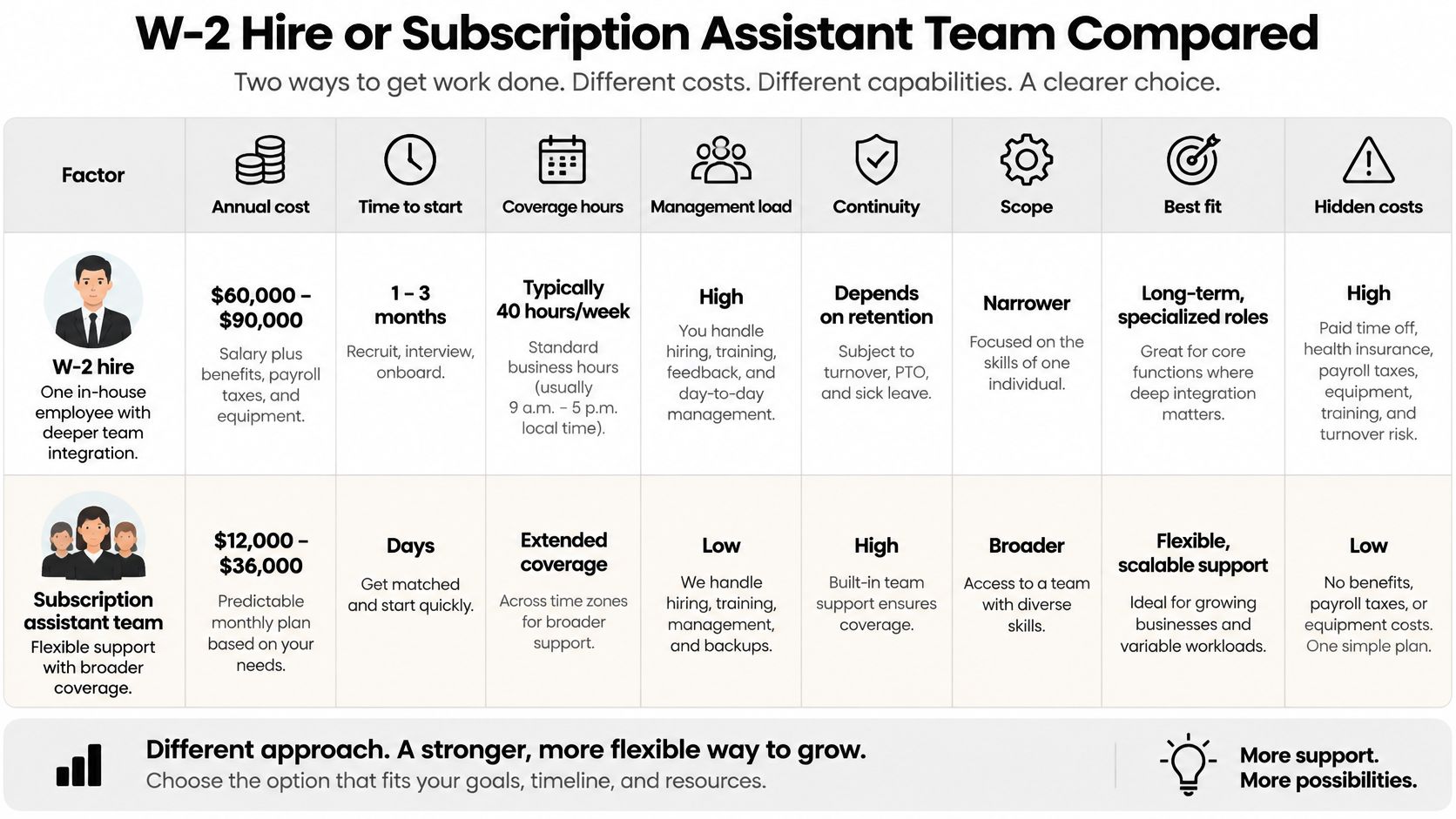
Compare the full employment burden
A TeamShift analysis using Bureau of Labor Statistics figures reports a median U.S. executive assistant wage of $76,590 annually, or $36.82 hourly, and estimates approximately $100,300 in annual employer cost after adding roughly 31% for benefits and payroll taxes, before recruiting, equipment, workspace and management time.
That is an executive-assistant benchmark, not a marketing-assistant salary estimate. It shows why comparing a subscription fee with wages alone leaves out part of the employment cost.
A marketing assistant supports campaign execution. A general assistant team handles logistics across work and home, which may be the capacity constraint for a founder who already has marketing expertise.
Use these criteria to decide:
- Hire for embedded campaign work. Daily involvement in launches, systems and internal knowledge points toward a marketing employee.
- Choose managed support for recurring logistics. A subscription team can handle ongoing work and household tasks that do not fill a full-time role.
- Consider when requests arise. Travel disruptions and after-hours scheduling make coverage relevant alongside task volume.
- Include supervision in the calculation. Hiring someone does not remove the time needed to train, direct and review their work.
Approved Lux is a managed, US-based assistant team members can call, text or email around the clock. Customers do not get one fixed assistant. Preferences and history stay with the account, so whoever responds can follow the customer's established preferences.
The team can help with family and household management, errands, travel and research, but it does not replace marketing strategy or provide legal, medical, financial or tax advice. If you need specialist campaign ownership, compare the available marketing agency engagement models.
Confirm Your First Delegation This Week
Choose a recurring task with a clear result and an obvious point for escalation. A small, well-defined handoff is easier to assess than a long list of requests.
Build a small delegation test
- Log five working days. Record administrative and marketing tasks, time spent, and whether each task supports revenue or a launch.
- Sort your ten most frequent tasks. Decide which to delegate, which to verify, and which need to stay with an accountable owner.
- Assign execution. Formatting, scheduling, research, and vendor follow-ups are practical starting points. Keep decisions that require marketing judgment with a named owner.
- Review after 30 days. Compare time spent handling the tasks with time spent briefing and correcting them.
Use a recurring task that interrupts your work often, so you can see whether the handoff reduces operational noise.
Make the handoff concrete: State the desired outcome, approved inputs, deadline, and conditions that require your decision.
Match the plan to the people using it
Approved Lux provides a managed, US-based Assistant team available around the clock by phone, text, or email. Lux Solo costs $99.99 a month for one person. Lux Circle costs $299.00 a month and covers up to four people on one account.
Choose according to the recurring work you want off your plate. Start with one task category, review how the handoff works, then expand its scope when the process is clear.
Approved Lux Personal Assistant supports scheduling, research, vendor follow-ups, and other logistics that compete with marketing work. Visit Approved Lux Personal Assistant to choose support for a recurring task category while keeping campaign strategy and approvals with the accountable owner.