Meeting Conflict Resolution: A Practical Playbook
Meeting Conflict Resolution. Resolve meeting conflicts faster with a practical playbook on prioritization, outreach scripts, escalation paths, and how Approved
Lifestyle11 min read
You're looking at a launch review where product says the date is fixed, sales says the customer commitments are already out, and nobody can agree on what was decided last week. The meeting invite is still on your calendar. So are the follow-up calls you'll need if the room ends without a decision.
That's why meeting conflict resolution is an operational workflow, not just a difficult conversation. The executive's job is to make the substantive call and keep the discussion fair. The preparation, scheduling, neutral briefing, decision capture, and follow-up can be managed as a repeatable process.
Why Meeting Conflict Is an Operational Problem First
Employees spend an average of 2.1 hours per week dealing with conflict, roughly one full workday per month, and conflict accounts for an estimated 385 million working days annually in the United States, according to the CPP Global Human Capital Report, which also found that 36% of U.S. employees dealt with conflict always or frequently compared with 29% across the overall sample, that 10% of respondents spent at least six hours per week on conflict-related activity, and that a broader measure counting employees and managers together put the average at 4.3 hours per week.
The tense hour in the room is the cheap part. An unresolved dispute spills into clarification threads, duplicated decisions, stalled approvals, and manager hours spent rebuilding agreement after everyone has left. The meeting ends. The conflict keeps running on your calendar and in your inbox.
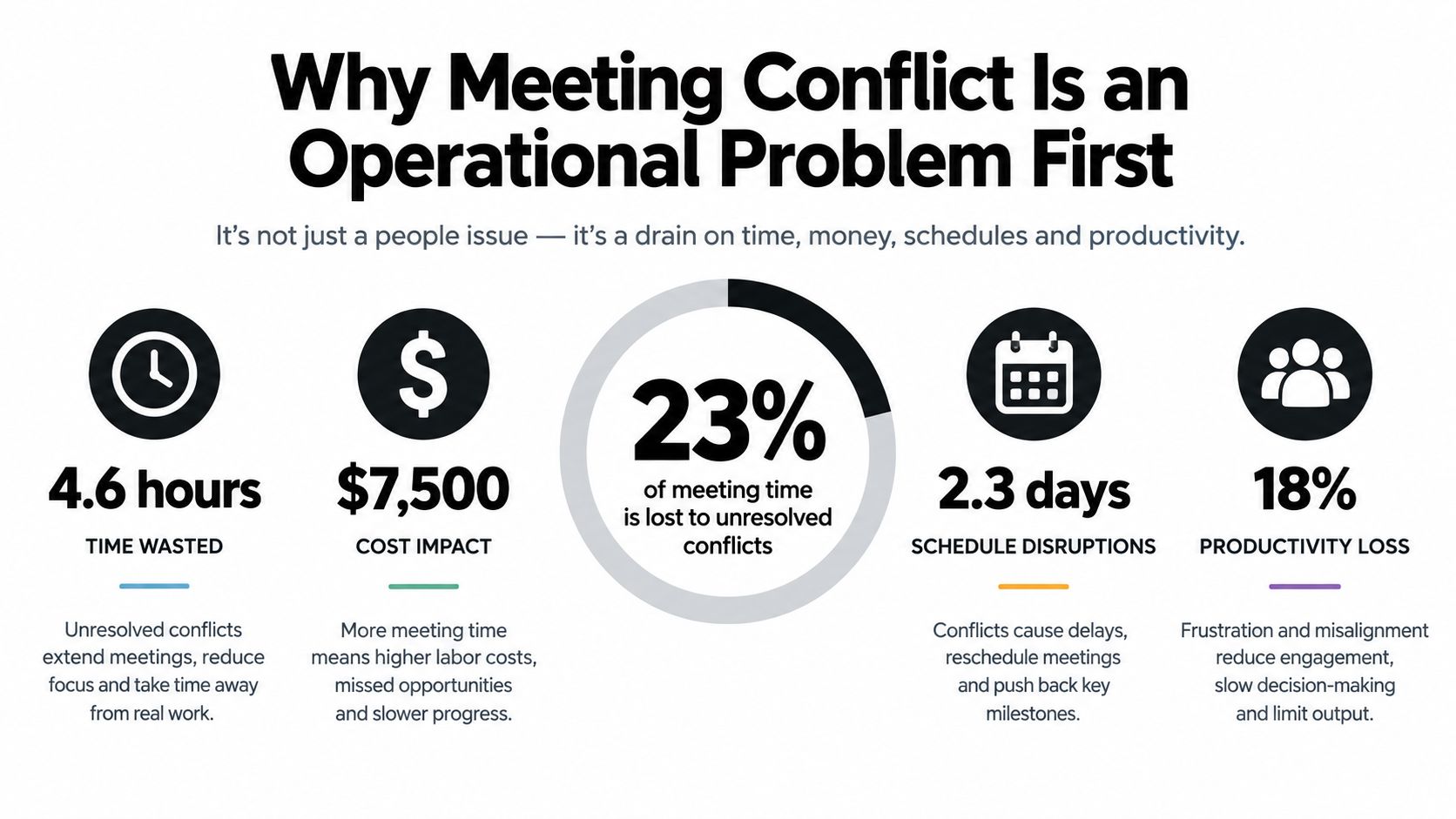
Judge the outcome by one test: did the disputed issue become a documented decision without generating a fresh round of coordination work? If the answer is no, the meeting cost you twice. Before you book another one, triage the problem.
Five checks before you schedule
- Name the disputed decision. Write one sentence, such as, "Do we launch on the current date or move it to complete testing?" If the sentence describes a person's attitude instead of a decision, keep clarifying.
- Separate task conflict from relationship conflict. A disagreement about launch readiness is a task issue. Interruptions, blame, or a pattern of dismissing one colleague point to relationship friction. They can overlap, but treating them as the same problem sends the conversation off course.
- Identify who owns the decision. If the product lead has authority over launch readiness and sales owns customer communication, put those roles in the decision framework. Inviting people to settle a decision they can't authorize wastes the hour.
- Gather neutral facts. Collect the current launch plan, customer commitments, open risks, and the source of any disputed information. For a vendor renewal or interdepartmental deliverable, bring the contract terms, delivery dates, and accountable owners rather than a recap of who said what.
- Choose the lightest workable channel. Send a written summary when the facts and decision rights are clear and participants can resolve the point asynchronously. Use a private conversation for a contained issue between two people. Convene a facilitated meeting when the decision needs several stakeholders, the facts are contested, or direct discussion has stalled.
Run this triage in fifteen minutes. The output is a neutral brief containing the disputed decision, the decision owner, the verified facts, the proposed channel, and the desired outcome. The executive walks in with that document instead of a calendar invite loaded with assumptions and a personal stake in the grudge. That is the difference between refereeing a fight and closing a ticket.
Three Real Calendar Conflicts and the Outreach Scripts That Resolved Them
These scenarios show how an Assistant team can turn a messy calendar problem into a clear decision path. The examples are practical templates, not documented client case studies or performance claims.

The launch review is double-booked. Product has scheduled a readiness review, while sales has booked the same leaders to prepare for a customer call. The Assistant checks who must make the launch decision and whether the customer commitment depends on it. The outreach can be direct: “Product and sales have competing meetings on the launch date. Which decision must happen first, and who has authority to make it? I'll hold one focused review with the required decision-makers and send the other group a written update.” The agenda lists the launch decision, known risks, and customer impact. The record captures the decision rationale and next owner.
Engineering and customer success dispute a deadline. Instead of asking which team is being unreasonable, the Assistant gathers the delivery estimate, customer impact, and known constraints. The note might say: “Please send your current estimate and the constraint behind it. We'll compare feasible dates against customer impact and operational risk, then record the decision and owner.” The meeting ends with a date, a responsible person, and the condition that would trigger escalation.
Two senior leaders have booked the same stakeholder separately. The Assistant checks whether both meetings need a live discussion or whether one can become a written update. The message: “You're both seeking input from the same stakeholder. I'll combine the shared questions into one agenda and preserve separate time only for confidential items.” The follow-up documents which questions were answered and who owns the remaining actions.
The Assistant team handles the scheduling, outreach, and action record. An executive can use calendar management practices for clearer scheduling to make this coordination easier to maintain.
The operating outcome is a cleaner calendar and fewer loose ends, not a promised number of hours saved. When the discussion closes, the record should identify the decision, rationale, owner, and follow-up. This video offers another perspective on structuring a productive conversation.
Choosing the Right Channel, the Right Room, and the Right People
Channel choice affects who speaks, what gets misunderstood, and whether the eventual decision can be audited. A sensitive disagreement about status or power usually needs live discussion, in person or by video, where participants can hear tone and see reactions. A written summary then provides the record. If someone may not speak candidly in front of a senior colleague, hold a separate preparation conversation before bringing the group together.
Research on communication in hybrid teams found that employees tend to prefer face-to-face communication for conflicts involving status, power relations, or interpersonal incompatibility, in part because body language and tone reduce misinterpretation. The same body of work reports that nearly one in five UK professionals spends more than 10 hours per week in meetings, and almost one in ten spends more than 15 hours. The practical rule: match the channel to the risk, and treat every added attendee as a cost.
The meeting itself should be small enough for direct participation. Invite the people who own the decision, the people with necessary evidence, and anyone whose work will change because of the outcome. Brief observers and optional stakeholders in writing unless their input will alter the decision. If the conflict involves misconduct, safety, or a serious power imbalance, route it through the relevant HR or formal process. A standard team meeting is not a safe substitute.
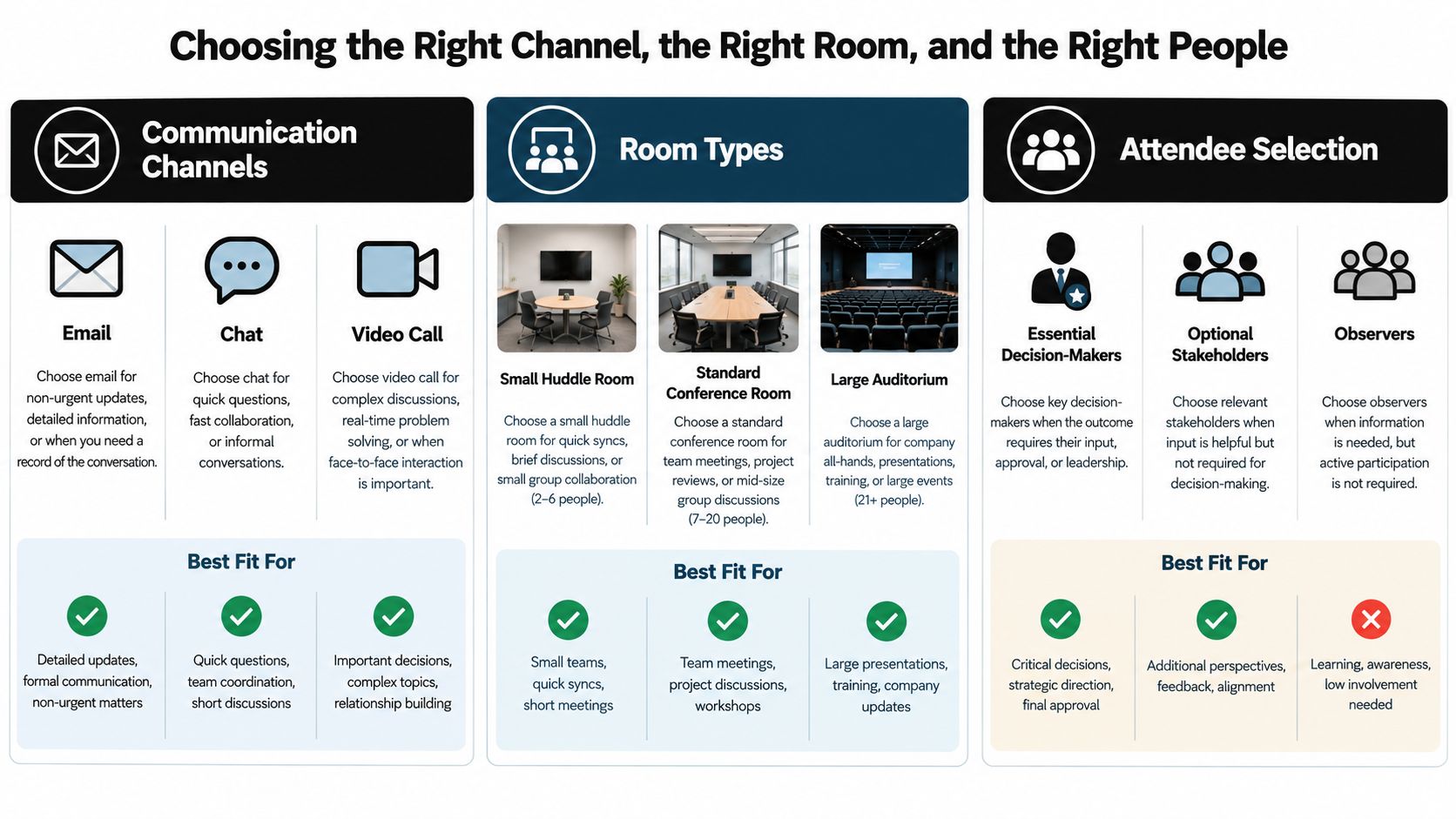
Selection rules like this are operational decisions, and they benefit from operational support. An Assistant team can coordinate the logistics across phone, SMS, and email, book the right room or video link, and send written briefs to the people who do not need a seat at the table. The executive walks in with a neutral summary of the dispute rather than a thread of frustrated replies. Judgment and the final decision stay with the executive; the coordination work does not have to.
Running the Room So the Conflict Stays on the Issue
Open by stating the disputed decision, the decision rule, and the meeting norms. A team's norms should be explicit: challenge proposals, not people; offer evidence before conclusions; give affected participants room to speak; and record dissent without treating it as disloyalty. A meeting norms and psychological-safety guide describes psychological safety as a shared belief that people won't be embarrassed, rejected, or punished for speaking up.
The facilitator should then separate positions from interests. “We can't ship Friday” is a position. “We need time to complete a test that could affect customer data” reveals the constraint behind it. Give each participant uninterrupted time to describe facts, impact, and constraints; then paraphrase neutrally: “I'm hearing that the date matters because of the customer commitment, and the test matters because of the release risk. Is that accurate?”
Generate options before choosing
List multiple workable options before evaluating them. Compare each against agreed criteria such as customer impact, deadline, cost, risk, and reversibility. Problem-solving should be the default when the dispute points to a recurring process defect; compromise may help when interests are partly compatible, but a quick midpoint can leave the underlying problem intact.
A practical guide to facilitating a meeting can help the chair keep the agenda focused. For teams weighing how conflict styles interact with their working culture, find culture-fit conflict strategies offers a complementary perspective.
Write the behavior, not the aspiration. “Send the revised forecast by 3 p.m. every Friday” can be checked. “Communicate better” can't.
Close by documenting the selected action, its rationale, the owner, deadline, escalation trigger, and follow-up date. Capture why the group chose that option, not just what it chose. An Assistant team can prepare the agenda and pre-read and record the agreement, freeing the chair to listen and facilitate instead of typing through the dispute.
The Escalation Ladder and When to Climb It
Escalation shouldn't be a manager's way of passing along an uncomfortable problem. It should follow evidence that the current approach isn't working or that the decision requires authority the meeting doesn't have.
Rung | Use it when | Record to prepare |
|---|---|---|
Direct conversation | The issue is contained, the parties can speak safely, and decision rights are clear. | A brief issue statement and any agreed action. |
Facilitated meeting | Several stakeholders need to resolve a shared operational issue, or direct discussion has stalled. | Neutral facts, decision owner, options, and meeting outcome. |
Internal mediation | The same issue persists, trust is deteriorating, or the parties must continue working together but need a neutral third party. | Written issue statement, evidence list, confidentiality boundaries, and a shared definition of resolution. |
Formal mediation or HR intervention | The matter involves serious power imbalance, conduct concerns, formal policy, or a decision the meeting cannot authorize. | Relevant documentation, decision rights, and the appropriate formal process. |
Workplace mediation outcomes vary by setting. Reported resolution rates are approximately 75–86% for individual issues handled through internal or external mediation inside organizations, compared with 50–70% for some telephone, pre-adjudication, or interpersonal services; these are benchmarks, not guarantees. The CIPD workplace mediation report notes that outcomes depend on the context and how resolution is defined.
A separate study of 41 workplace mediations found that 32 ended in agreement, a 78% settlement rate. The workplace mediation research review also cautions that signing an agreement doesn't prove it was implemented or sustained. If direct discussion becomes unsafe or strategically unproductive, a mediator may use separate caucuses, then return to joint problem-solving when possible. For practical ideas on approaching a difficult conversation, Be Your Best Self conflict advice can complement the operating process.
An Assistant team can prepare the issue statement, evidence list, decision rights, and confidentiality boundaries. It shouldn't replace trained mediation or HR judgment. For complex stakeholder handoffs, use a clear stakeholder coordination process so escalation doesn't create a new scheduling problem.
Follow-Up Cadence That Closes the Loop
Set the check-ins before anyone leaves the room. A resolution only becomes real when calendar holds, owners deliver, and the same dispute stops resurfacing. Treat agreement, implementation, and relationship continuity as three different outcomes. A team can say yes in the meeting, miss the handoff on Friday, and still sit in the same tension a month later.
Within 24 hours, send the recap. Keep it plain: decision, rationale, owner, deadline, escalation trigger, and next check-in. Ask for corrections to facts only. New information can reopen a point; frustration cannot.
At seven days, verify the work. Look for artifacts: the revised forecast went out, the approval path was used, the handoff happened. If a commitment slipped, record the cause and choose the next step: reset the owner, tighten the process, or escalate.
At 30 days, audit durability. Ask whether the workflow changed and whether the two sides can operate without refereeing. Score implementation and working relationship separately, and collect both supervisor and team-member views because they often rate compliance differently.
The cheapest follow-up is the one that prevents the same meeting from happening again.
A US-based Assistant team can run the clock: schedule the checks, send the recap, log open actions, flag misses, and assemble the evidence before each review. The executive steps back in for judgment calls and escalation decisions while assistants absorb the calendar chasing. That keeps follow-through tight and keeps the next contentious meeting from being scheduled by accident.
Delegating the Operational Noise Around the Meeting
Keep the human judgment in-house. The executive or authorized leader should decide what matters, facilitate or sponsor the substantive conversation, and own any consequential decision. Delegate the surrounding work: calendar triage, outreach, neutral briefs, agenda distribution, decision capture, and follow-ups.
Approved Lux is a monthly subscription with 24/7 access to a US-based Assistant team by phone call, SMS text, or email. Triple-channel access means all three channels are monitored at equal priority, so scheduling and follow-through can happen in the way that suits the member. The team can work from defined availability, meeting priorities, buffer preferences, and escalation rules; Proactive Preference Learning helps it adapt to routines over time. This is operational support, not a substitute for trained mediation, HR processes, or professional advice.
The plans are Lux Solo at $99.99 per month for individual access and Lux Circle at $299 per month for up to four people on one account. The useful calculation isn't a promised return. It's whether the delegation removes enough recurring coordination from the executive's calendar and mental load to justify the subscription.
Start with a small handoff:
- Delegate: Triage the invite and identify the decision owner.
- Delegate: Prepare the neutral brief and distribute the agenda.
- Delegate: Record the decision, rationale, owners, and deadlines.
- Delegate: Schedule the recap and implementation checks.
- Keep in-house: Substantive judgment, facilitation, and any formal employment or legal decision.
The executive should enter the room prepared to decide, not still reconstructing the dispute from a crowded inbox. The Assistant team absorbs the operational noise; the leader stays accountable for the outcome.
Approved Lux Personal Assistant provides US-based human Assistant support for scheduling, meeting preparation, documentation, and follow-up through phone, SMS, and email. Visit Approved Lux Personal Assistant to see whether its operational support fits the conflict and calendar load you need to delegate.
Updated