How to Negotiate Price with Vendor Like a Pro
Learn how to negotiate price with vendor using proven scripts, prep checklists, and concession tactics that save busy founders and households real money
Lifestyle13 min read
A vendor quote lands in your inbox. The number feels high. You know you shouldn't just accept it, but your fallback move is usually weak: “Any flexibility on price?” That email almost never gets the best result because it asks the vendor to solve your problem without giving them a reason.
That moment matters more than most buyers realize. It's often the strongest point in the whole relationship, whether you're a founder renewing software, a household manager hiring a contractor, or a solo practitioner staring at a monthly retainer that keeps creeping up. If you want to learn how to negotiate price with vendor the right way, treat negotiation as a process, not a talent. Good negotiators aren't born smoother. They're better prepared.
My view is simple. Don't start by begging for a discount. Start by defining scope, building a target, and deciding what you'll trade. Then open with a specific ask, push on total cost instead of just the sticker price, and lock every win into writing before the vendor has a chance to reinterpret the deal.
The Vendor Quote Moment and What to Do First
Most buyers make one of two mistakes the second a quote arrives. They either accept too fast because they don't want friction, or they send a vague message that signals they haven't done any homework. Vendors can smell that instantly.
The better move is to stop reacting and start diagnosing. Ask three questions before you reply. What exactly am I buying? Which parts are essential? Which terms matter besides price? That's where influence begins. McKinsey's research on public-sector contract negotiations makes the practical point clearly: buyers get stronger outcomes when they define required scope first, separate essentials from add-ons, compare alternatives, and negotiate the full contract, not just the headline price.
Read the quote like an operator
A quote is rarely just a quote. It's a bundle of assumptions.
A SaaS renewal might hide higher renewal terms, unused seats, support tiers you don't need, or weak cancellation language. A renovation estimate may fold materials, labor, disposal, and change-order exposure into one number. If you're pricing home work, it helps to compare kitchen remodel estimates so you can spot when one proposal is padded or structured differently from the next.
Don't answer the number until you understand the package.
That applies everywhere. A founder renegotiating software should separate licenses, onboarding, support, and overage exposure. A household buyer should split labor, materials, haul-away, permits, and timeline commitments. A solo professional reviewing a retainer should isolate recurring scope from ad hoc work.
Your first move in the next 72 hours
Do this before you make contact:
- Mark the must-haves: Write down what can't change without hurting the outcome.
- Strip out the nice-to-haves: If the vendor bundled extras, identify what you can cut.
- List your pressure points: Renewal timing, cash flow, service reliability, cancellation risk, and hidden fees matter.
- Pick your preferred outcome: Don't say “better pricing.” Say what “better” means.
If you skip this step, you'll negotiate emotionally. If you do it, you'll negotiate commercially.
Build the Case Before You Make the Call
Preparation is where most savings are won. Not on the call. Not in the clever comeback. Before you contact the vendor, you need a target, a benchmark, and a walk-away point.
That's not theory. McKinsey reports that a global steel manufacturer generated 12% savings through 20 supplier summits over six months, and the decisive preparation took 4 to 6 weeks per summit with supplier and market analysis, should-cost models, negotiation prep, and dry runs. You don't need weeks for a household contractor or small business renewal, but the principle is the same. The buyer who walks in prepared usually controls the discussion.
Build a simple should-cost view
You don't need procurement software. You need a clean breakdown.
For a maintenance contract, split the quote into labor, materials, travel, emergency-call charges, and recurring fees. For software, separate license cost, onboarding, support, overages, and renewal terms. For a contractor, isolate demolition, install, materials, disposal, and change-order language. If you're managing home projects, this contractor payment and quality check guide is useful because it forces you to think beyond the base quote and into payment control, inspection points, and what gets documented.
A practical example is straightforward. If you're renewing a $50,000 annual maintenance contract, don't ask, “Can you do better?” Build a case for $46,000 by collecting comparable quotes, normalizing the scope, and showing that response times and deliverables remain unchanged, exactly the kind of fact-based preparation described in McKinsey's maintenance-contract example in the same procurement excellence analysis.
Your pre-call checklist
- Define scope tightly: If the scope is fuzzy, the price discussion will be fuzzy too.
- Normalize quotes: Align fees, terms, and included work so you're comparing like with like.
- Find the market midpoint: One cheap quote and one inflated quote don't tell you much by themselves.
- Write your target and your floor: Your target is what you want. Your floor is the highest total cost you'll accept.
- Document your alternative: It can be another vendor, reduced scope, or delaying the work.
Practical rule: Never contact a vendor until you can explain your target in one sentence.
Evidence Weight by Vendor Category
Vendor Category | Strongest Evidence | Moderate Evidence | Weakest Evidence |
|---|---|---|---|
SaaS renewals | Comparable quotes with matched seat counts and terms | Actual usage data | General complaints about budget pressure |
Contractors and home services | Line-item estimates with scope alignment | Local market ranges | “Another contractor seemed cheaper” without paperwork |
Professional service retainers | Defined deliverables and hours by workstream | Past invoices and usage patterns | Asking for a loyalty discount without revised scope |
Maintenance vendors | Cost breakdown by labor, materials, travel, emergency charges | Renewal history | A generic request to hold price flat |
For a broader operating system on keeping suppliers organized after the deal, this guide to vendor management best practices is a useful companion.
Open the Negotiation With a Specific Ask

Most buyers open too softly. They ask if there's “room” instead of stating a number. That gives the vendor control of the frame.
Open with a target, evidence, and a deadline. That's the sequence that works. McKinsey reports that advanced procurement analytics can generate 3% to 8% cost savings versus traditional pricing approaches, and in one manufacturing example, a fact-based negotiation process reduced cluster prices by 8% in its first month. The lesson for ordinary buyers is obvious. Facts outperform vague pressure.
Use a written opening, not just a call
Put the ask in writing first. Calls are useful for tone and discovery, but a written request forces precision and gives you something to anchor back to.
Here's a strong opening email for a $30,000 order:
We'd like to move forward if we can align on scope and pricing. Based on three comparable quotes and a normalized review of fees, our target is a 5% reduction, with the same deliverables and approval within 60 days. Please send your written best-and-final proposal by Friday.
That message works because it does three things. It shows you've done the work. It states a concrete target. It creates a timeline without sounding theatrical.
Timing changes the balance of power
If this is a renewal, start early. Waiting until the opt-out window is close is how buyers trap themselves. The practical reason is simple. Early outreach gives you time to gather alternatives, fix scope, and push non-price terms before urgency kills your negotiating power.
When you need category-specific ideas for travel suppliers, this piece on how to negotiate hotel rates shows how the same logic applies when timing and written benchmarks matter.
After the vendor replies, use the first call to test resistance:
- If they question your number: “Walk me through which cost component has changed.”
- If they say the budget won't allow it: “Then let's adjust scope or terms to reach the right total cost.”
- If they stall: “I need a written revision, not a verbal indication.”
Here's a good explainer on handling the opening conversation with control:
A weak opener says, “Can you do better?” A strong opener says, “Here's the scope, here's the benchmark, here's the number, and here's when I need your revised proposal.”
Negotiate the Total Cost, Not the Headline Price
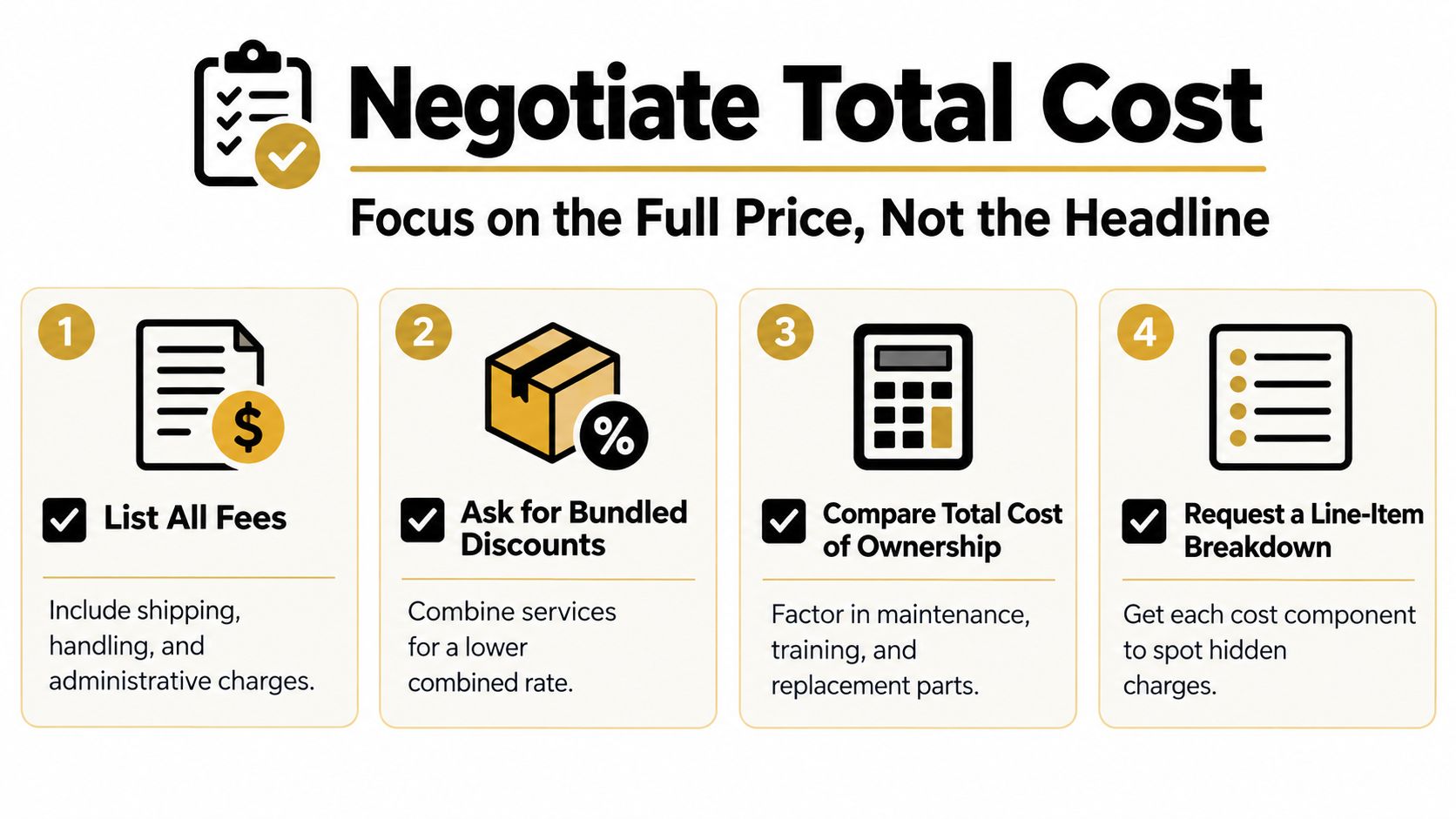
This is the part most buyers miss. If the vendor says price is fixed, the negotiation is not over. It has barely started.
The quote is only one part of the economic package. Implementation fees, minimum commitments, payment timing, renewal increases, overages, service levels, cancellation rights, and credits often matter more than a small discount. Recent procurement guidance explicitly highlights inflation caps, predetermined rates, and contract measures that manage price increases, while current contract-negotiation advice emphasizes converting fees into defined deliverables, capping overages, and tying service failures to credits or termination rights in S&P Global Market Intelligence's procurement guidance.
Run the deal through four scenarios
Before you negotiate, calculate expected annual cost under these conditions:
- Normal use, what you'll likely spend in a routine year.
- High usage, where overages, rush work, or premium support kick in.
- Renewal, where annual increases or repricing can wipe out the initial discount.
- Cancellation, where exit fees, notice periods, or lost prepaid value hurt you.
That's how you spot bad “deals.” A 5% discount can lose to flat pricing with clean exit rights if the discounted offer hides uncapped increases or ugly overages.
Worked example on a vendor agreement
Suppose you're evaluating a $120,000 annual vendor agreement. One vendor offers a 4% price reduction, quarterly billing, fixed pricing for 12 months, defined delivery windows, and credits for missed service levels. Another vendor offers a 7% headline reduction but keeps weak cancellation terms, looser delivery commitments, and exposure to future increases. Based on the total-cost logic outlined in McKinsey's value-capture discussion of supplier negotiation events and harmonized contract conditions, the lower sticker price isn't automatically the better deal.
A discount that creates future risk is often more expensive than a smaller discount with better contract discipline.
That's especially true in household services and remodeling, where change orders and vague exclusions wreck budgets. If you're pricing a renovation, it's smart to study how to budget a bathroom remodel because it forces the right question. Not “What's the cheapest quote?” but “What will this cost when the project moves, changes, or runs long?”
What to ask for when price is fixed
- Cap future increases: Don't accept open-ended escalation.
- Convert vague fees into deliverables: If there's a setup fee, ask what exact work it covers.
- Cap overages: Especially for software, consulting, and service calls.
- Tie failures to credits: If service levels slip, the contract should say what happens.
- Clean up exit rights: Better cancellation language is real money.
Build Credibility When You Are the Small Buyer
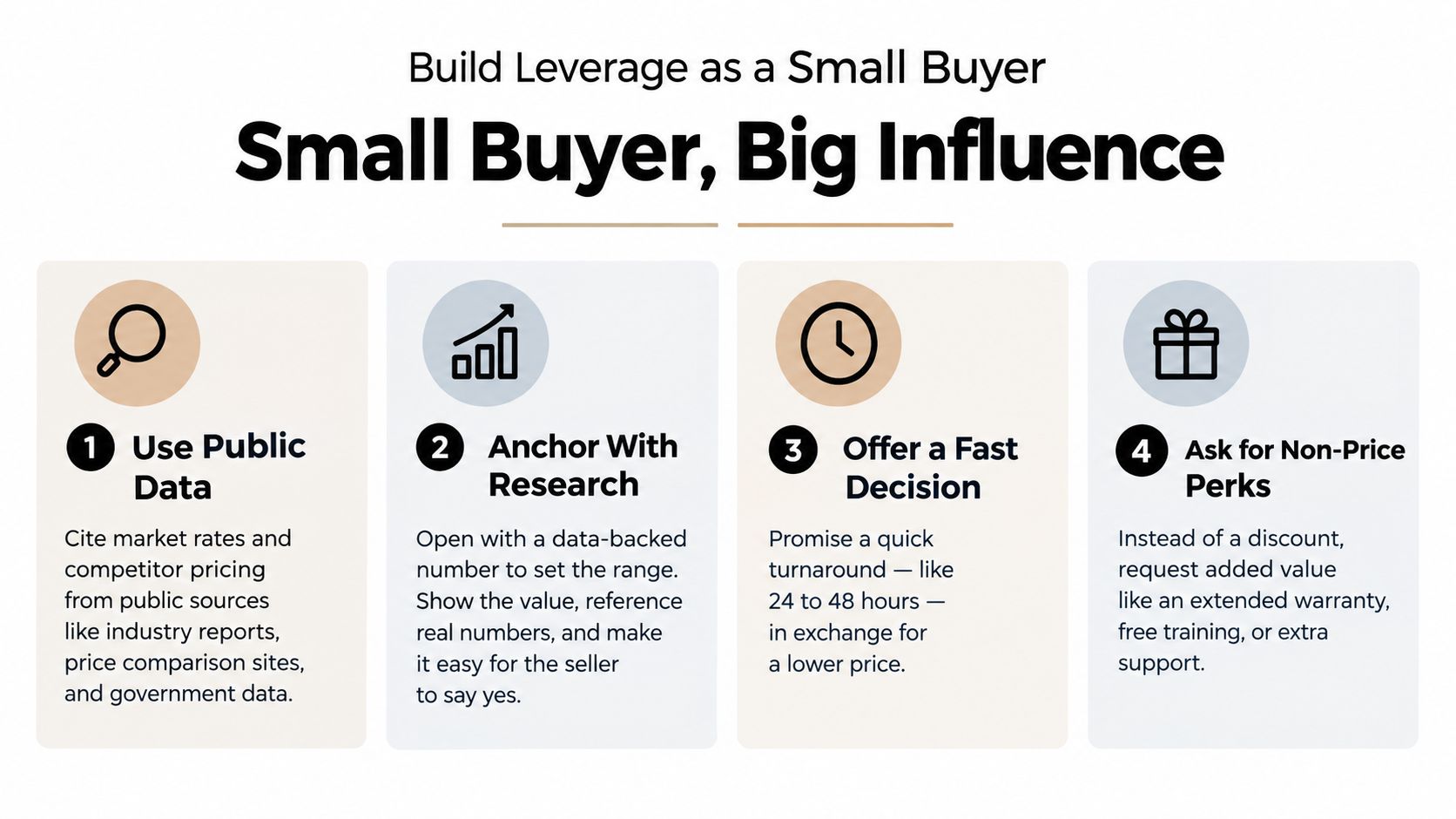
The weak moment comes right after the quote lands. A small buyer feels pressure to sound bigger than they are, hint at other options, or threaten to walk. That move usually fails. If the vendor tests your story and you cannot back it up, your position gets worse.
Without volume, your strongest asset is documented credibility. Practical guidance in this vendor negotiation guidance from Data Magnet points to the right inputs: consumption data, separate target and floor prices, documented renewal dates and escalation clauses, and exchanging term length for a locked rate instead of giving away a multiyear commitment for an unprotected discount. That is how founders, families, and independent professionals create pressure without bluffing.
What a small buyer can bring to the table
A small buyer still has chips to play, and good vendors care about them.
- Actual usage data: Show what you use now, not what the package was built to sell.
- A defined budget: Serious buyers name a range and stay inside it.
- A clear walk-away point: You do not need a perfect backup. You need a real limit.
- Certainty: Fast approval, clean requirements, and easier scheduling save vendors time.
- Scope discipline: Tightening the work is often easier than cutting the rate.
Don't invent an alternative. Build credibility instead.
Three examples that work
A solo practitioner renegotiating software should stop pretending they might switch tomorrow. A better line is: “We use the core features only. Reprice this to match usage, and if we renew, lock the rate.” That gives the vendor something concrete to respond to.
A household manager dealing with a contractor can get better terms without pushing for a bare price cut. Narrow the service window, specify materials, and offer scheduling flexibility in exchange for fewer fees or a cleaner quote.
A founder reviewing a service retainer can package predictable work, strip out ad hoc extras, and ask for a trial-and-review checkpoint before agreeing to a longer commitment. That lowers the vendor's uncertainty while protecting your side.
Credibility beats bluffing. Vendors test stories. They respect documented facts.
If you need help running this process, vendor management services can take the administrative load off. Approved Lux Personal Assistant can also help with factual tasks such as vendor research, quote comparison, review synthesis, and price-negotiation support when your calendar is packed.
What to offer besides more volume
Money is only one variable. Small buyers win better deals by trading certainty and ease for protection.
Try these:
- Faster payment, but only when you get a measurable return.
- Forecast visibility, which helps service vendors plan staff and schedule.
- Standardized requirements, which reduce delivery friction.
- Reference permission, if the vendor values it.
- Flexible scheduling for home services or recurring work.
- Longer relationship, but only in exchange for a rate lock or cleaner terms.
Use a simple rule. Any time you give the vendor more certainty, get something specific back.
Trade Concessions the Way Professionals Do
Negotiation falls apart when buyers make random concessions. They drop their number, then drop it again, then throw in faster approval for free. That's not strategy. That's leakage.
Harvard's Program on Negotiation advises exchanging concessions on issues that matter less to the buyer for concessions on issues that matter more, and notes that negotiators commonly make larger concessions early and reduce their size as discussions progress. That last part matters. Your movements should get smaller, not looser.
A worked trade sequence
Use this on a $30,000 order.
You open by asking for a 10% reduction.
The vendor pushes back and says they might consider 2%.
You don't split the difference casually. You trade.
Your response: “If you can move to 5%, we can fast-track approval.” That gives them something they may value while keeping your movement conditional.
If they return to 2%, your final move should be smaller, not bigger: “I can move to 3% only if you remove the setup fee or extend payment terms.” That structure follows the exact concession pattern Harvard describes. Bigger moves early. Smaller moves later. Every movement tied to a return.
Script library for the middle rounds
Use plain language. It works better.
“If you can waive the implementation fee, I can approve this week.”
“I'm not moving on scope and price at the same time. If the price stays, we need stronger terms.”
“That concession only works if it's written into the revised agreement.”
When the vendor asks for a longer commitment, don't give it away. Ask what you're getting back. When they ask for quick approval, tie it to a revised number. When they want to preserve price, move the conversation to fees, billing, credits, or exit rights.
Know your stopping point
The strongest negotiators don't keep talking just because the conversation is still alive. They stop when the next concession costs more than the value they'd receive.
A visible stopping point sounds like this:
- Accepting: “That works if the revised contract reflects the billing change and service credits.”
- Rejecting: “That doesn't close the gap enough to justify the commitment.”
- Pausing: “We're at the point where my next move would need materially better terms.”
That's disciplined. It tells the vendor you're not negotiating for sport. You're evaluating value.
Lock It In and What to Do Next Time
A negotiated win isn't real until it's documented. Verbal yeses disappear. Revised contracts don't.
Close with a one-page checklist. Confirm the final number in writing. Make sure every concession appears in contract language. Define service levels and what credits apply if the vendor misses them. Cap renewal increases where possible. Clean up cancellation terms. Then put the next renewal date on the calendar well before the pressure window.
If the vendor won't move, don't thrash around. Escalate to a decision-maker, reduce scope, or use your alternative. Sometimes the right move is to walk. Sometimes the right move is to bring in a second pair of hands because vendor negotiation is one more recurring task fighting for space on an already overloaded calendar.
Your next move is simple. Pick one vendor renewal or quote in front of you now. Build the evidence today, send the first written ask this week, and book the conversation before the vendor controls the timing.
If vendor quotes, contractor back-and-forth, and renewal deadlines keep eating your time, Approved Lux Personal Assistant can take that operational noise off your plate. Their US-based Assistant team handles vendor vetting, quote comparison, negotiation support, and follow-up across call, text, or email, so you can reclaim the hours you'd otherwise burn chasing revisions and terms. See how it works at Approved Lux Personal Assistant.
Updated