How to Book Shore Excursions Without Missing the Ship
Learn how to book shore excursions by checking port timing, cancellation rules, accessibility and operator risk before you pay for a tour.
12 min read
You've got the shore excursion page open in one tab and the ship's itinerary in another. The tour runs four hours, the ship is in port from eight until five, and the price looks reasonable. Then you notice the listing never says whether those four hours include the bus ride, or whether 8 a.m. is when the ship ties up or when you're allowed off.
That gap is where port days go wrong. Not dramatic weather, not a missed flight, just a four-hour tour that became a six-hour day once clearance, tendering and traffic got added to the total.
The decision that matters isn't price or how good the photos look. It's who absorbs the loss when something slips: the cruise line, the operator, or you. Everything below is that question asked in a different way.
Work Out Your Port Day Timing First
A ship can be alongside while guests are still held onboard. That delay, plus the return buffer, decides whether a shore excursion is safe to book. The Destination NSW guidance on building cruise shore experiences sets out the working sequence: confirm scheduled arrival, clearance time and all-aboard time, then check whether the excursion quotes ship time or local time before choosing an activity that starts after realistic disembarkation. It also pins the two figures travelers most often underestimate. Shore excursions commonly run 2 to 6 hours, and transfers consume 30 to 60 minutes each way.
A one-hour mismatch between ship time and local time decides whether you make it back. So does the gap between docking and guest access, because passengers can wait on local-authority clearance before anyone leaves the vessel. Port operations also shift for ordinary reasons such as pilot availability or berth conditions. Treat the timetable as a moving part, and put the risk of each delay on the booking option you choose.
A tour that fails the test
Say the ship docks at 8:00 and all-aboard is 16:30. Guests are held until 9:00 for clearance. A six-hour tour with 60-minute transfers each way can't start before 10:00, so the return transfer puts you at the gangway around 17:00, thirty minutes after all-aboard. Reject it. The listing looked fine. The arithmetic did not. The operator may still sell the seat, but you carry the consequence if the day slips.
A tour that passes
Same port, same clearance delay. Planning your cruise itinerary around port timing means testing the tour against the usable window before comparing prices. A four-hour tour with 45-minute transfers starts at 9:45 and returns you to the ship by roughly 14:30, which still clears the 15:30 personal deadline. Set that deadline at least an hour before all-aboard, and keep only tours that still meet it after a late clearance. This one clears it with room for a slow tender.
Practical rule: Write down three times before you shortlist anything. Earliest you can realistically be ashore, latest you can be back at the ship, and the buffer you chose between them. Every tour then gets measured against that window.
The window shapes the rest of the day. A ship-linked option, a shorter independent tour, or a walkable port day all become viable once those three times are written down.
How to Book a Shore Excursion Step by Step
Shortlisting is a filtering exercise, not a shopping exercise. Run these eight steps in order, because each one narrows what the next can use, and the whole of how to book shore excursions collapses into skipping one of them.
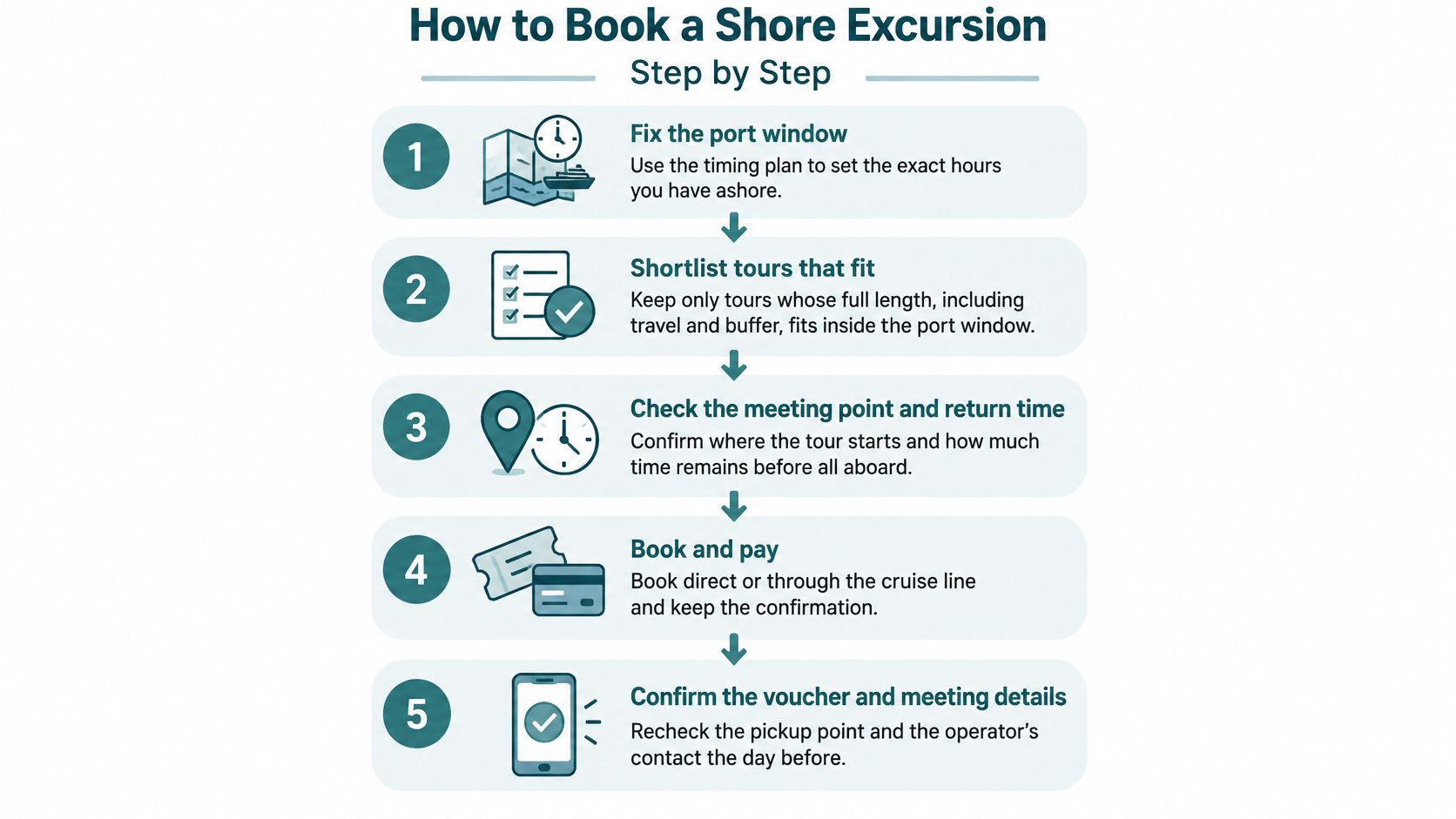
- Fix the port window. Use the three times you wrote down. This prevents the failure where a traveler books against the docking time and never accounts for clearance.
- Shortlist tours whose full length fits. Add the excursion duration to both transfers and the buffer. Anything that overshoots the window is out, which prevents the sunk-cost decision of "we've already paid, we'll rush back".
- Move early on sell-out risk. Popular activities can sell out months before departure, so pick your top two rather than one. This prevents paying a premium for whatever is left onboard.
- Choose the channel. Ship-booked or independent, decided on the risk criteria rather than the sticker price. It prevents buying a cheap tour that leaves you carrying every delay yourself.
- Read the cancellation deadline and the minimum-passenger rule before paying. These are contractual, not advisory, and they prevent a late-cancellation penalty you didn't know existed.
- Run the accessibility check for every traveler and get answers in writing. One inaccessible transfer can sink a multi-generational booking. It prevents rebooking an entire family group at the pier.
- Pay, then save the confirmation, meeting point, operator emergency contact and return plan in a place you can open without signal. It prevents the pier-side scramble when the meeting point turns out to be a five-minute walk from where you're standing.
- Recheck the tour 48 hours before the port call against the ship's updated itinerary. It prevents showing up for a tour that moved with the port.
For water-based ports, read the operator's own notes before you commit to a departure slot. Captain Cook Snorkeling Tours booking tips explain how departure timing and boat assignments work on their runs, which is the kind of detail a generic excursion listing leaves out.
A confirmed booking should show three things: a written return time, a named operator contact, and a refund rule you've already read. If any of those is missing, you're holding a reservation, not a plan.
Ship-Booked Versus Independent Tours and Who Carries the Risk
The ship-versus-independent argument usually gets reduced to price and a warning about all-aboard time. The Government of Canada cruise travel guidance frames it more usefully: independent operators put meeting points, payment terms, transport, emergency contacts and return timing on the traveler, and official advice points to the cruise line or a reputable, insured tour company, with accessibility needs checked before booking.
The question is narrower than that. Compare three variables: schedule buffer, recovery options, and accountability when the ship is late or the port is missed.
Factor | Cruise line booked | Independent operator |
|---|---|---|
Return timing if the ship is delayed | Cruise line coordinates the return against the ship's schedule | Operator must monitor vessel arrival; confirm this in writing |
Recovery if you miss the tour | Cruise line may rebook or offer a ship-linked option | Set by the operator's refund or rebooking policy |
Accessibility requests | Submitted through the cruise line's accessible tour form | Requested directly with the operator; verify each detail |
Pace and route | Standardized group tours | Often private or small-group and tailored |
Best fit | Tight port windows, tender ports, mobility needs | Longer port days, specific routes, tolerance for managing disruption |
Two scenarios show how the table resolves.
A three-generation group with a wheelchair user, arriving at a tender port, generally does better with ship-booked inventory even at a higher price. The tender alone introduces a variable the family can't control, and the cruise line's accessible tour process gives them a documented channel for vehicle and boarding requirements rather than a series of verbal assurances. Verdict: book through the line.
A couple whose terminal sits fifteen minutes from the town center, with a five-hour window and a simple walking route, usually gets better value from a private operator with a documented return plan. They aren't managing a tender, the geography is forgiving, and a small-group format lets them set the pace. Verdict: book independent, with a fixed return time materially earlier than all-aboard and the operator's contingency plan confirmed in writing.
Choose the channel that keeps you ahead of the schedule, not the one with the lowest sticker price. The price difference is a one-time number. A missed sailing is a flight, a hotel and a lost day.
If you're still uncertain about how boarding works at the end of a port day, the cruise ship boarding process explained is worth ten minutes, because knowing the cut-off sequence changes how much buffer you want.
Cancellation and Minimum Rules to Check Before You Pay
The most expensive mistake is assuming your tour follows the general cancellation window. It often does not. The Royal Caribbean shore excursion FAQ allows most excursions to be modified or canceled without penalty up to 48 hours before arrival at the port, but tours involving flights, trains, special events, overnight stays, hotels or Private Journeys generally need to be canceled 30 days before sailing to avoid penalties. Carnival uses its own rules, so confirm the exact cutoff directly with Carnival before paying. Do not transfer one cruise line's deadline to another.
A helicopter tour or rail excursion booked nine days out, then canceled because a port day got rearranged, is exactly where a long special-excursion cutoff bites. The risk sits with you once the date passes, even if the reason feels outside your control.
Cruise line | Standard excursion cutoff | Special excursions | Penalty if late |
|---|---|---|---|
Royal Caribbean | Up to 48 hours before arrival at the port | Flights, trains, special events, overnight stays, hotels and Private Journeys: 30 days before sailing | Penalties apply after the cutoff |
Carnival | Confirm the cutoff directly with Carnival before paying | Confirm any flight, event or overnight tour directly with Carnival before paying | Confirm the late-cancellation charges directly with Carnival before paying |
MSC | Set per excursion; confirm the cutoff before you pay | Confirm separately for flights, events and overnight stays | Full refund if the operator cancels for low passenger numbers |
A minimum-passenger rule shifts a different risk. You may be ready, pay, and still lose the tour if the operator does not reach its required headcount. MSC Cruises terms and conditions state that an excursion may be canceled if the minimum number of passengers isn't reached, and the reserving passenger then receives a full refund of the money paid for that excursion. Availability on a booking screen is not a guarantee of operation.
For a group of eight, ask three questions before paying: does our reservation count toward the minimum, when does the operator make the final operating decision, and will an alternative be offered if the tour is withdrawn. Also confirm whether the refund returns to the original payment method or arrives as onboard credit, and whether the canceled tour affects transport or a meal booked separately.
Backup plan: Keep one low-cost, low-logistics activity per port, walkable from the terminal, that needs no reservation. It turns a withdrawn tour into a changed plan instead of a wasted day.
Record the special deadline next to your embarkation date, not next to the general policy, and save the terms where you saved the confirmation. That one habit makes the risk split clear before you pay: which delays you absorb, which cancellations the operator refunds, and which access failures need a plan already in hand.
Booking Accessible Excursions End to End
An accessible cabin guarantees nothing about the pier. Celebrity Cruises' accessible shore excursions guidance treats accessibility as an inventory constraint with real deadlines: its Accessible Shore Excursions Form must be submitted no later than 10 business days before the cruise begins. For other operators, request access as early as you can, because vehicle, lift, tender and guide arrangements are usually not created on request at the pier.
This is the walkthrough for a port day where one step decides whether a grandparent joins the group. The practical question is who absorbs the risk before money changes hands: the cruise line, the tour operator, or your party.
Send this questionnaire to the operator before the deadline, not at the desk on the morning of the tour. Each question exists because of a specific failure mode.
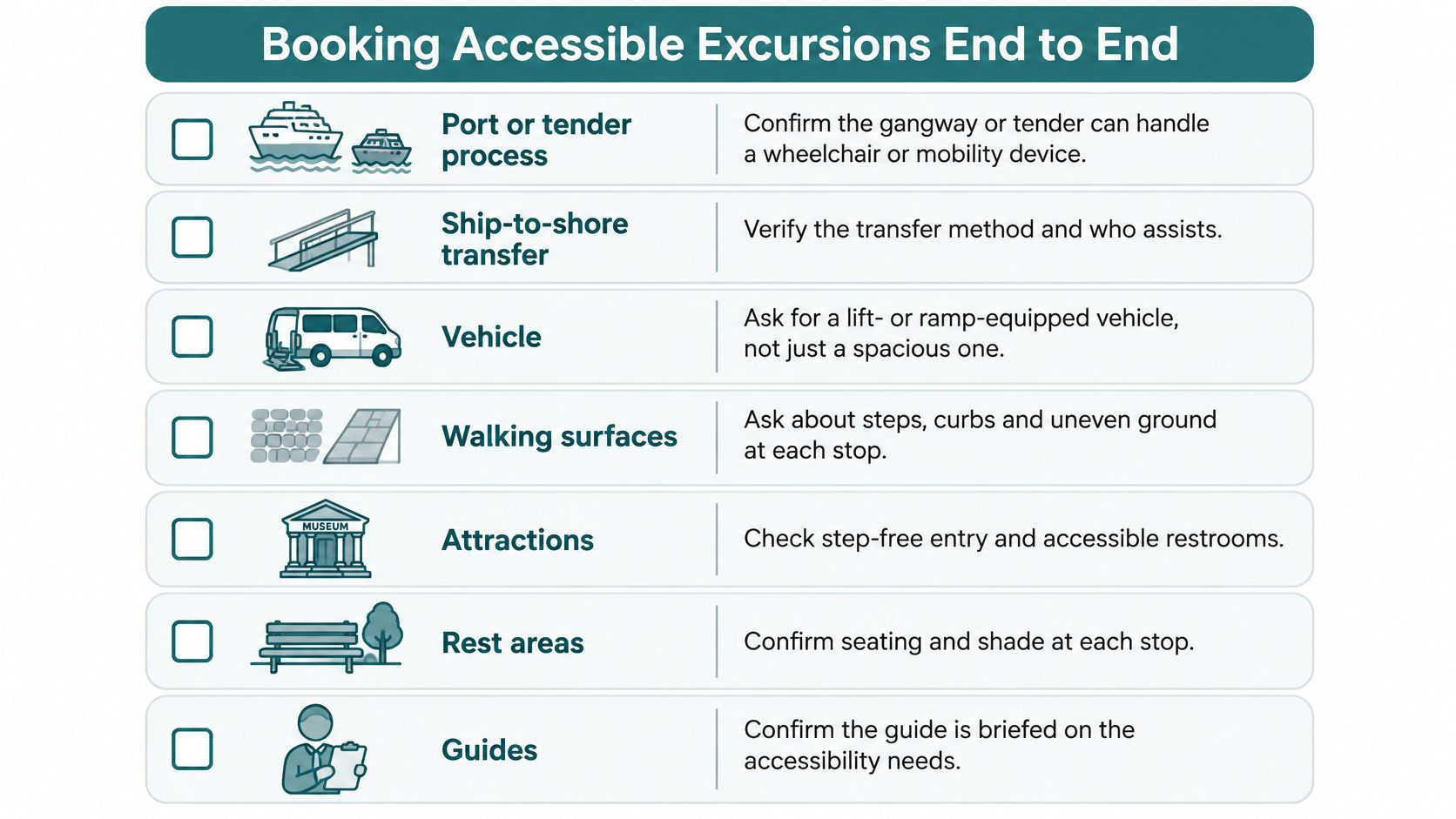
- Wheelchair or scooter dimensions and weight. A vehicle lift or door width can reject a larger device even when the operator advertises accessible transport.
- Steps and curbs at the pier, the tender and the attraction. One step stops the entire group, and the group will not split.
- Transfer assistance in and out of the vehicle. Drivers are not automatically permitted or trained to lift a passenger.
- Bathroom access and distance to it. A tour with no accessible toilet often has to end early.
- Maximum walking distance and rest stops. A short walk on a map can be a long climb in a walled city.
- Tender use. A tender boat can be impossible for many mobility devices, and the ship's own accessible cabin doesn't change that.
- Whether equipment stays with the traveler in the vehicle. Storage in a separate luggage van removes the mobility aid for the whole day.
Ask one more question beyond the list: what happens if the ship arrives late, changes port, or can't disembark passengers at all. Those contingencies determine whether an independent booking is still usable on the day. If the operator can't move a vehicle, guide or accessible stop after a ship change, your party carries that loss. I would rather pay for a tour with a clear access plan than save money on one that goes quiet when the pier changes.
If your group is comparing ship formats before committing, the differences between river and ocean cruising explain why river itineraries usually mean a walk-off gangway while ocean ports can mean a tender, and that difference alone reshapes the accessibility conversation. Verify each traveler separately, including the one who only joins a single transfer, and keep the operator's direct details in case the standard tour can't accommodate you.
Confirm Every Port Booking Before You Sail
Run a sign-off the day before each arrival, and treat it as a final check rather than a formality.
- Reconcile the times. Confirm arrival and all-aboard against the ship's latest itinerary and compare them with the return deadline you set. Port calls move.
- Check the whole party on one confirmation. Every traveler listed, accessibility answers in writing, no one relying on a verbal promise from a driver.
- Save the paperwork offline. Cancellation terms, the minimum-passenger rule, the operator's emergency contact and the meeting point in one document you can open without signal, along with a copy of the refund rule.
- Keep the backup activity ready. A walkable option for the port, needing no reservation.
- Confirm the return time with the guide on the day, and note who to call if the group runs late.
- Ask the source, not a forum. Cancellation and return rules belong to the operator or cruise line, so confirm them directly with that party.
Hotels, flights, cruises, cars, tours and homes all sit in the same activity and travel inventory, which means port confirmations can live in one place rather than in four inboxes. Inside the Approved Traveler member portal, those bookings sit under a single login.
That's the whole discipline: measure the window, choose who carries the risk, read the cancellation terms before money moves, verify access end to end, and sign off before the gangway opens.
Approved Experiences Traveler gives members a consolidated booking channel for the same tours and port-day activities this article walks through, alongside wholesale-tier access to hotels, flights, cruises and cars, all under one login in the Approved Traveler member portal. If you're the person organizing a multi-generational port day, that means shore excursions, flights and pre-cruise hotel nights sit in the same inventory instead of scattered across separate platforms, backed by the 110% Best Value Guarantee on every booking. Visit Approved Experiences Traveler to compare the Traveler and Lux Traveler plans and start building your port days from inventory that's already in one place.