Cruise Ship Boarding Process: A Day Timeline
Use this cruise ship boarding process timeline for documents, security, luggage, family groups, and hard all-aboard cutoffs.
Travel13 min read
“Arrive two hours early” is incomplete cruise advice. It doesn't tell you whether the clock runs back from departure, embarkation, or an assigned terminal appointment, and it doesn't account for a grandparent who needs assistance or a family carrying everyone's documents in different cars.
The cruise ship boarding process works best when you plan around three things: your line's hard deadline, the terminal's slowest control point, and the time your particular party needs to move. Your arrival target should leave room for a problem without creating an exhausting wait outside your assigned window.
Arrival Windows and All-Aboard Cutoffs
A single “arrive two hours early” rule can leave a party waiting too long or getting to the terminal too late. Plan around the strictest deadline for your sailing, the terminal step that may take longest, and the time your group needs to move through each stage.
Cruise line | If online check-in is done | If online check-in is not done | Hard cutoff | What the window actually controls |
|---|---|---|---|---|
Norwegian Cruise Line | Arrive no later than 1 hour before scheduled embarkation | Arrive at least 2 hours before scheduled embarkation | Complete terminal check-in and be onboard no later than 1 hour before departure | Terminal check-in and onboard presence; late guests may be refused sailing |
Royal Caribbean | Complete check-in before sailing; see booking documents for the deadline | Complete check-in before sailing; see booking documents for the deadline | Check-in must be completed before sailing | Check-in completion; use the deadline printed in the booking documents |
Disney Cruise Line | Arrive during the designated Port Arrival Time | Without online check-in or a Port Arrival Time, arrive roughly 90 minutes to 1 hour before published all-aboard time | Complete registration and boarding before the guest-onboard deadline | Port Arrival Time is document check-in; boarding group is the later call to the ship |
Norwegian distinguishes arrival before scheduled embarkation from being onboard before departure. Its Norwegian Cruise Line boarding-times guidance specifies the one-hour arrival rule after online check-in, the two-hour arrival rule without it, and the one-hour-before-departure onboard cutoff. Royal Caribbean requires check-in to be completed before sailing. Use the exact deadline in your booking documents.
Disney separates your terminal appointment from your boarding call. Its boarding-time guidance distinguishes the Port Arrival Time from the Boarding Group. Guests without advance check-in or an arrival appointment are advised to arrive roughly 90 minutes to one hour before the published all-aboard time, while still meeting the guest-onboard deadline.
Read the clock labels before doing the math
Open the documents for your sailing and identify the scheduled departure, terminal check-in deadline, guest-onboard deadline, and assigned arrival window. These are separate milestones, not alternate names for the same time.
Use the strictest deadline that applies as your hard boundary. Then count backward from it, allowing time for the slowest control point, such as document checks or security, plus baggage handoff, parking, and the transfer to the port. Book transport to arrive within your assigned window with enough time left for processing.
Planning rule: A deadline tells you when processing must be finished. It is not a sensible target for reaching the curb.
A larger party needs more coordination. A missing bag tag or a bathroom stop may be minor on its own, but can delay everyone if the document holder, children, and an assisted traveler are in different parts of the terminal. Set a shared arrival target and keep the group together through the steps that depend on one another.
If your preferred arrival target falls outside the assigned window, contact the cruise line before booking transport. Arriving early does not automatically mean you can enter the terminal.
A family calculation
Consider a family of eight booked on a noon Royal Caribbean sailing. The booking documents give the check-in deadline. The family works backward from that time to choose a curbside target, rather than treating check-in completion as the time to arrive.
They set 9:00 a.m. as their planning target, provided it fits the assigned terminal window. That leaves time for unloading, bag handoff, document verification, and possible secondary screening. The target is a buffer for the family's route through the terminal, not an extra boarding deadline.
The organizer shares the same target with everyone and confirms the terminal address. No one books a separate ride timed to arrive at the cutoff. A ship's departure time is not extra time for a late party to finish check-in.
Documents That Must Match the Manifest
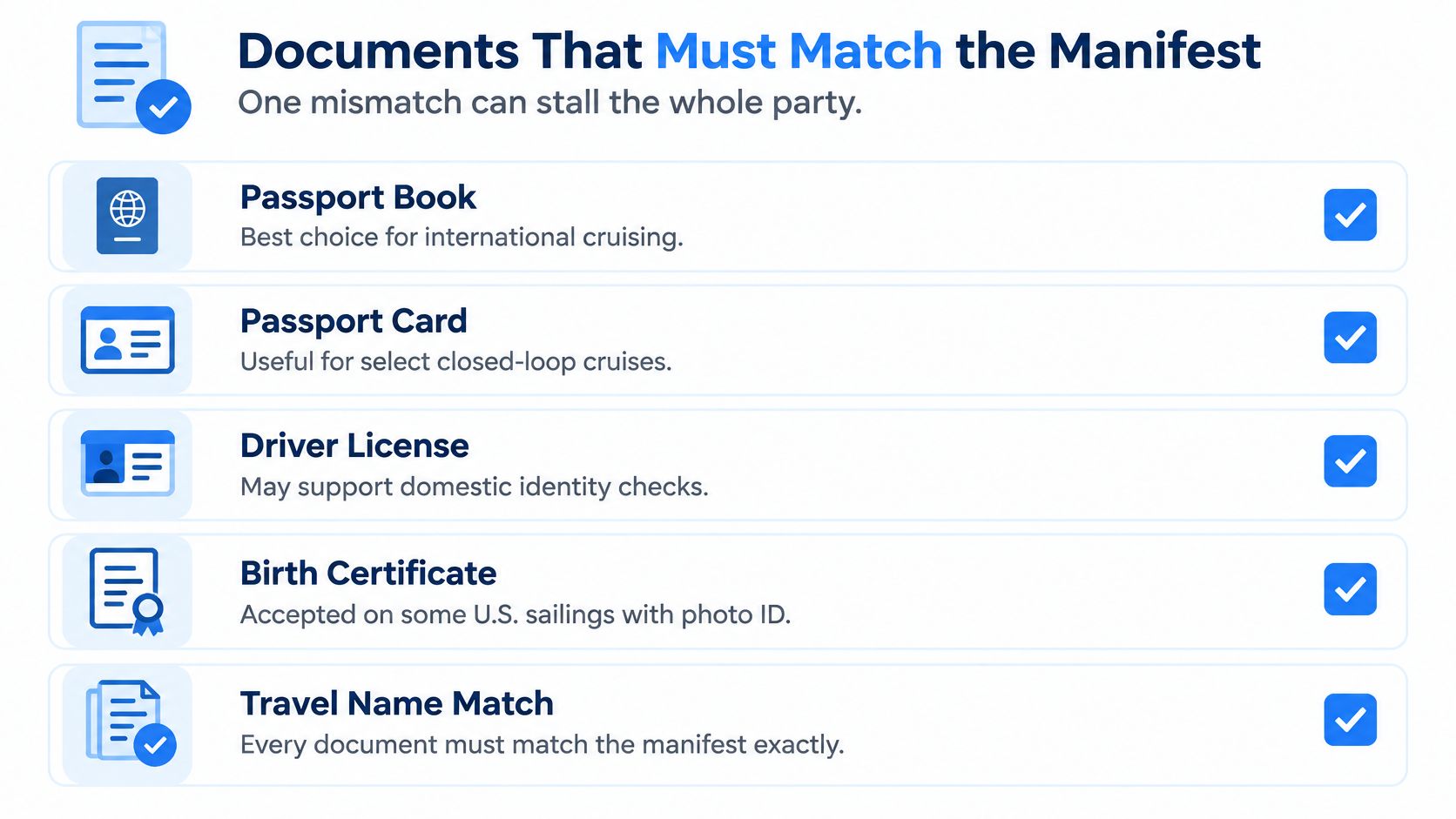
A passport book is the most resilient default for international cruising because your return journey may not unfold exactly as planned. The State Department's cruise-travel guidance recommends passport preparation, explains that some U.S. citizens on closed-loop sailings may travel without a passport book, and warns that a passport card cannot be used for international air travel.
That distinction matters if you must fly home from a foreign port. A document accepted for your planned cruise isn't necessarily sufficient for an unplanned flight, so check the citizenship requirements for your nationality and every destination rather than relying on another family's experience.
Use this checklist to organize the document review, then confirm the accepted combinations for your sailing.
Compare each traveler across every record
Place the booking confirmation beside the passport or other required original document. Compare the traveler's name and date of birth with the online check-in record and any required travel authorization.
A child's reservation under “Ben” when the passport says “Benjamin” can require correction. A dropped hyphen in a parent's surname is another discrepancy to resolve before reaching an agent. Don't assume the terminal employee can amend every record immediately.
- Names and birth dates: Review each traveler individually, including children whose details another adult entered.
- Travel permissions: Confirm any itinerary-specific visas, authorizations, or supporting documents.
- Original documents: Keep them accessible. Phone photographs are backups, not substitutes for originals.
- Reservation backups: Save an offline copy and carry a paper copy for each cabin.
Use a cruise planning checklist to track unresolved items by traveler. Mark an item complete only after someone has checked the actual document, not merely confirmed that it exists.
Separate the document packet from checked luggage
Your carry-on set should contain required identification, boarding credentials or QR codes, medications, a printed medication list, emergency contacts, and essential valuables. Checked bags may not be available when you first board, so nothing needed for verification or immediate medical care belongs in them.
Inspect bags before leaving home, including pockets in luggage used for other trips. Firearms, ammunition, and pepper spray permitted in some U.S. settings may be illegal abroad and can lead to arrest during cruise-port screening.
Give each adult a same-day packet in a secure cross-body bag or neck wallet. Include originals and the cabin's reservation backup, then record who holds each child's documents in a shared household note. Keep that holder with the child through verification rather than sending the packet ahead with another car.
How Embarkation Day Moves From Door to Muster
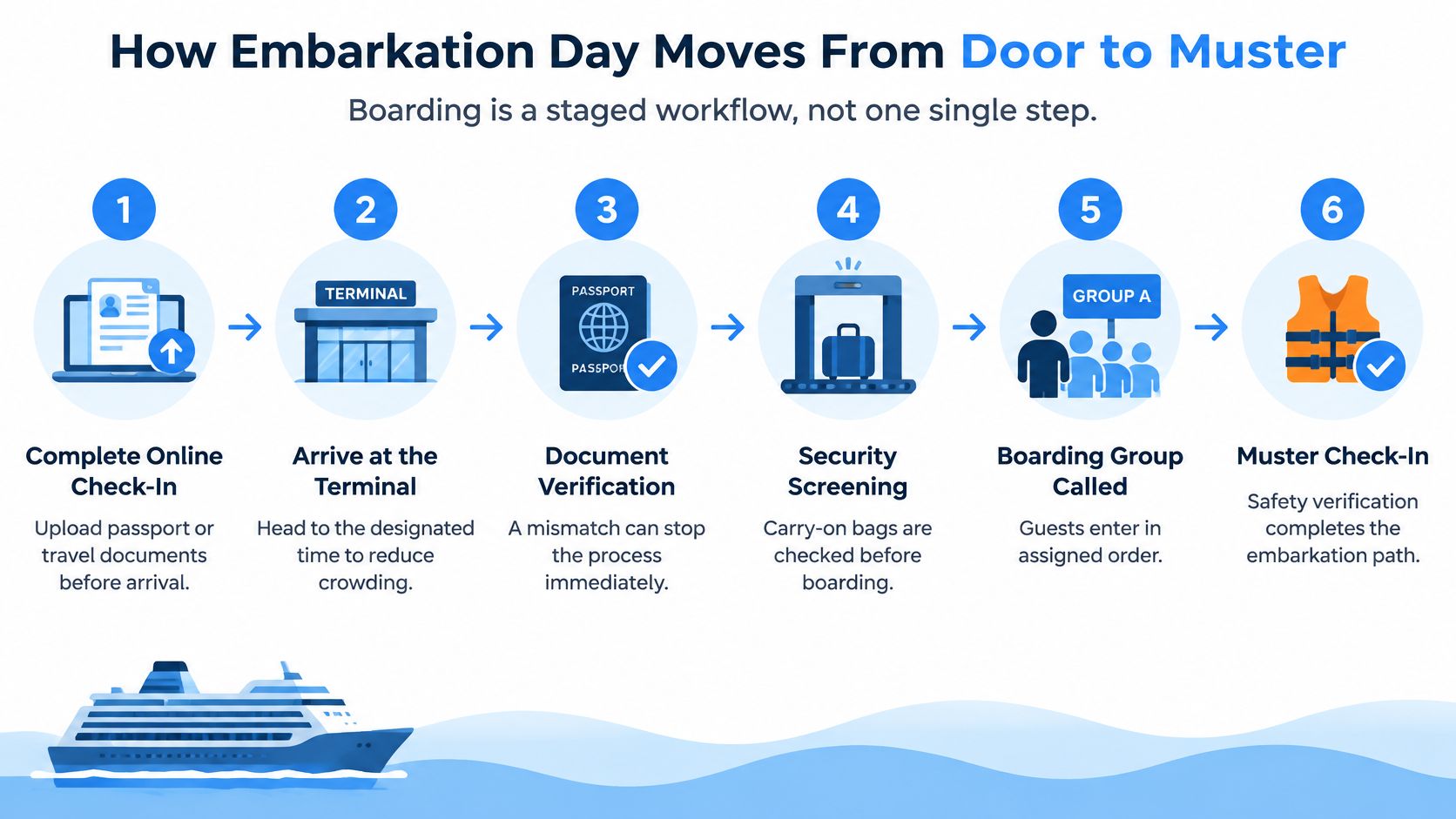
Boarding is a sequence of permissions, not a single walk onto the ship. Terminal staff may arrange the desks and screening lanes differently, but guests still need to clear document, identity, security, and shipboard safety controls.
The MSC Cruises embarkation guidance describes the practical requirements, including advance check-in, an embarkation credential, document verification, a security photograph, and screening. Follow the instructions issued for your ship rather than assuming another cruise line's sequence will be identical.
This visual summarizes the main handoffs.
Complete each stage before moving on
- Finish online check-in before departure. Enter the identification details and upload the requested information. Incomplete fields leave work for the terminal agent and can prevent the system from issuing a usable credential.
- Generate the boarding credential. Save the digital pass or print the required form, and keep it beside the original documents. A confirmation email isn't necessarily the QR code staff need to scan.
- Reach the terminal during your assigned window. Use the correct terminal entrance, not the port's general address. Arriving outside the window can leave you waiting before processing even begins.
- Present credentials and travel documents. Have each traveler ready when called, including children. Missing paperwork or mismatched passenger information can send someone into an exception process while the rest of the party waits.
- Complete identity-photo capture. Staff may take a security photograph for your onboard record. Follow their positioning instructions and keep your face unobstructed; an unusable image may need to be taken again.
- Clear passenger and baggage security. Prepare carry-ons for inspection and tell staff about medical equipment that needs particular handling. A prohibited article can interrupt the flow even when the travel documents are perfect.
- Receive or activate the onboard credential. Confirm how your ship issues its card or digital identity. This credential connects you with shipboard functions such as cabin access and the onboard account, so a boarding pass isn't necessarily its replacement.
- Proceed through the gangway when released. Stay available for the boarding call instead of assuming completed check-in grants immediate access. A relative who wanders away can miss the party's turn.
- Complete the safety briefing and muster-station check-in. Follow the vessel's instructions for the briefing and assigned assembly point. Skipping this process leaves embarkation unfinished, even if you've already found your cabin.
Know what facial comparison actually changes
Facial comparison doesn't remove the need to carry documents. In a cruise implementation, U.S. Customs and Border Protection described identity verification in under two seconds, with passengers who didn't match continuing through traditional inspection.
Those figures primarily concern debarkation and U.S. entry, not a promise that initial embarkation takes seconds. During boarding, follow the identity procedure offered at your terminal and keep originals available for manual checks.
For a multigenerational party, the useful distinction is between finishing a stage and receiving permission for the next one. Disney's appointment-and-group system is a clear example: citizenship checks occur at the terminal, but the party must remain together and attentive for the ship-access call.
Before anyone heads for lunch, screenshot the boarding credential, note the assigned muster station, and complete the required safety tasks. Cabin availability is a separate operational matter, so keep immediate essentials with you until staff confirm access.
Security Lanes and the Separate Bag Chain
The gangway isn't usually the best place to judge boarding speed. Your party can only move as quickly as the slowest active control point, which may be identity verification, passenger screening, or baggage handling.
A Future Travel Experience account of the Oasis of the Seas terminal operation described a facility designed for up to 12,400 passengers, using 10 security lanes, reporting a 2–2.5-minute queue-to-exit security interval, and sorting as many as 12,000 luggage pieces immediately on receipt. Those are operating details from that documented facility, not a guaranteed waiting time for your sailing.
Follow the correct flow
Terminals separate work because passengers, suitcases, and exceptions need different handling. Sending everything through the same desk would force routine guests to wait while staff resolved unrelated problems.
Flow | What staff process | What the traveler should do |
|---|---|---|
Passenger identity and check-in | Credentials, documents, passenger records | Keep the party's documents accessible and follow the assigned lane |
Checked baggage | Tagged bags routed for delivery | Attach the cruise line's identifiers before handoff |
Exceptions | Document discrepancies or additional screening | Stay with the affected traveler and follow staff instructions |
A busy luggage area doesn't necessarily mean the passenger line has stopped. Likewise, handing off suitcases doesn't mean you've completed check-in. These are separate chains with separate handoffs.
A fast-moving security belt can't compensate for a document problem at the next desk.
Give yourself control over what happens before the belt. Complete online registration before its cutoff, compare booking details with original documents, attach the correct cabin tags, and remove restricted articles at the hotel rather than discovering them during screening.
If your cabin assignment changes, check that your bag identifiers reflect the current cabin. Don't hand over luggage with conflicting tags and expect a porter to know which reservation is current.
A shared-transfer luggage example
Suppose relatives sharing a transfer occupy two cabins. At the curb, they hand four correctly tagged suitcases to porters while retaining two carry-ons containing insulin, a child's inhaler, passports, and a change of clothes.
The adult supervising the children keeps the inhaler accessible rather than buried beneath electronics. The traveler managing insulin keeps it with the supplies needed to use it. Nobody has to retrieve a suitcase to answer a document request or manage a medical need.
Ask staff how to present a medical device for screening instead of dismantling it without instruction. A tightly packed carry-on can also take longer to inspect, so organize small items where you can remove and replace them without emptying the entire bag.
A missed ship cutoff isn't a delayed flight. The vessel may leave without you, and port-entry requirements can prevent you from arranging independent late boarding.
Treat the documented lane interval as a best-case operating reference, not your personal allowance. If anyone carries medical equipment or a dense bag likely to need inspection, retain the earlier arrival target you've chosen rather than trimming it because the terminal has many lanes.
Boarding Plans for Families and Assisted Guests
Arriving excessively early can make embarkation harder for someone who can't stand comfortably in a queue. An assisted guest may spend that extra time managing fatigue, heat, or limited seating without gaining earlier access to document processing.
Use the cruise line's departure-day instructions to establish where assistance begins. Norwegian Cruise Line's departure-day guidance is a useful starting point for checking terminal arrangements alongside the instructions for your own reservation.
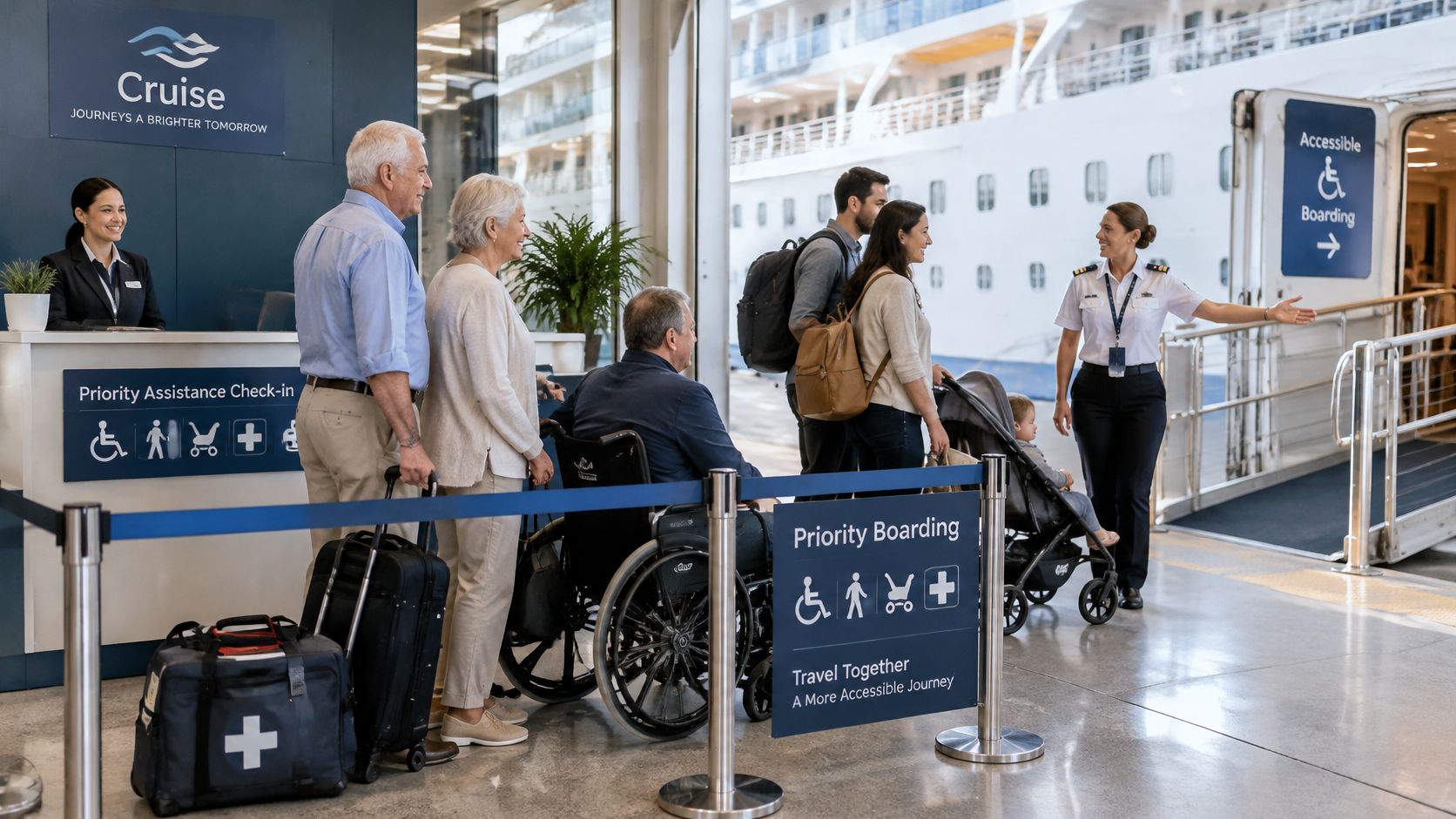
An accessible boarding plan starts before the family reaches a priority lane.
Plan the handoffs around the person
Consider grandparents traveling with a wheelchair and their school-age grandchildren. The organizer requests assistance before embarkation day, confirms the meeting point, and schedules a shared vehicle to reach the terminal within the assigned window.
An adult stays with the grandparents and children while another handles the tagged luggage. The bag handler returns before the boarding-group call, and the document holder never leaves in a separate car. The wheelchair in use, medicines, cleared prescribed equipment, and document packet remain with the travelers who need them.
Pre-arranged assistance isn't the same as an improvised curbside request. Staff may need time to locate a chair, escort, or suitable route if they haven't been told about the need. Explain functional requirements clearly, including an inability to stand for long periods or difficulty navigating a noisy queue, even when the disability isn't visible.
For powered equipment, DME Superstore's guide to cruise ship mobility scooter rules can help you prepare questions about the device. Confirm acceptance, storage, and charging arrangements with the actual cruise line before travel.
Prepare for an interrupted route
An accessible plan needs a fallback, not just a preferred path.
- Elevator unavailable: Ask staff for the alternate accessible route instead of leaving the queue to search independently.
- Shuttle delayed: Keep the assistance coordinator informed and the party together at the designated meeting point.
- Gangway access interrupted: Wait for staff instructions rather than attempting a route unsuitable for the mobility device.
- Communication difficult: Present readable reservation details, medical information, emergency contacts, and medication lists.
Build these responsibilities into your family cruise plan so companions know who stays with an assisted traveler and who can leave briefly to manage bags.
Use the video as an additional visual reference while discussing the terminal plan with your companions.
Group agreement: Share an arrival slot, name the person watching the cutoff clock, and make sure everyone knows how the party will complete muster.
Knowing the muster plan doesn't mean knowing every onboard direction in advance. It means agreeing that nobody disappears for lunch until the required safety instructions are understood and each traveler's assignment is confirmed.
Lock the Party Timeline Before You Travel
Close out the household plan during the week before sailing. Use a shared note that opens offline, not a message buried beneath restaurant suggestions and packing photos.
Complete the household closeout
- Set the arrival target. Pull the stricter applicable cutoff from the cruise documents and work backward with room for screening delays, not just an ideal passage through an open lane.
- Confirm the transfer. Book transport for the assigned terminal window, then send the pickup time and terminal address to every traveler.
- Finalize assistance. Record the meeting point and list the medicines, mobility devices, and cleared equipment that stay with the assisted guest.
- Assign accountable adults. Name the document holder, cutoff-clock watcher, and bag-tag checker. Make custody of children's originals explicit.
- Save the boarding note. Include the arrival target, document-holder list, and instructions for adding muster assignments once issued.
For the wider itinerary, use a cruise vacation planning guide to connect the sailing with flights and the pre-cruise stay. If the household needs connectivity abroad, RedSim's explanation of eSIM basics for international travel can help you assess phone compatibility before departure; keep boarding essentials available offline regardless.
Our Approved Traveler member portal brings hotels, flights, cruises, cars, tours, and homes under one login. Lux Traveler covers up to 10 household members and lets a member hand a problem during a trip straight to the Lux team. Check current membership details on the business website before relying on a particular benefit.
Approved Experiences Traveler offers travel infrastructure for consolidating the sailing, pre-cruise accommodation, and ground-transport bookings instead of managing separate accounts. Visit Approved Experiences Traveler to review the membership options, then keep your cruise line's confirmed arrival window and hard cutoff at the center of the household plan.
Updated