River Cruise vs Ocean Cruise: Which Fits Your Trip in 2026
River cruise vs ocean cruise compared on ship size, destinations, onboard life, itinerary pace and accessibility, with a clear verdict for each traveler.
15 min read
The most popular advice about river cruise vs ocean cruise is also the least reliable: choose a river cruise for an easier, more relaxing vacation. Calm water doesn't guarantee an easy trip. A schedule packed with walking tours, early departures and stepped gangways can be harder on a family than an ocean itinerary with deliberate downtime.
I would choose by usable vacation time and physical access, not the number of inclusions on a brochure. For a multigenerational group, the right ship is the one that lets everyone participate without turning the organizer into a full-time transfer coordinator.
River Cruise vs Ocean Cruise at a Glance
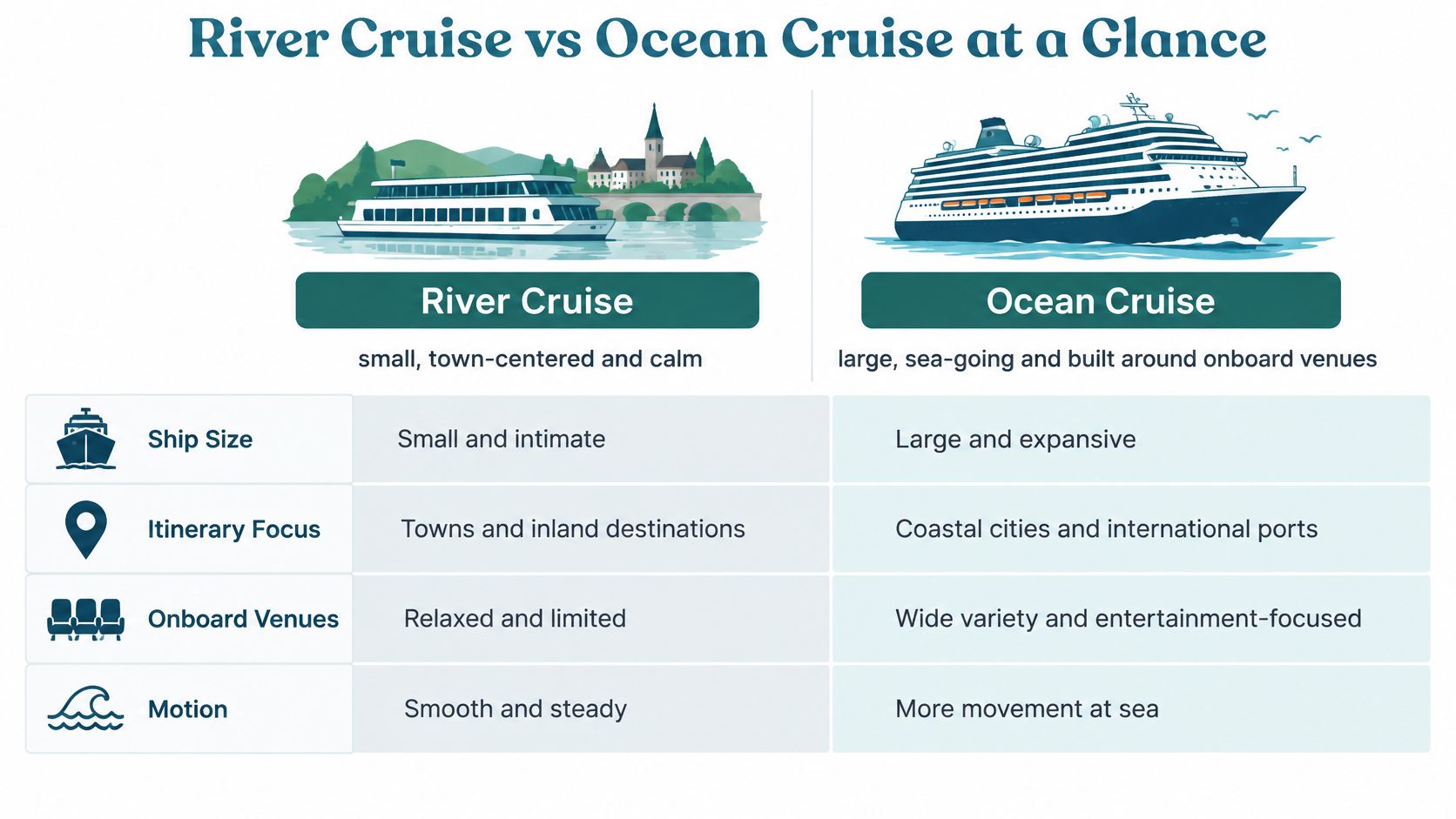
River cruises are small, town-centered and calm; mainstream ocean cruises are large, sea-going and built around onboard venues. Start there, but don't mistake either description for a promise about your particular sailing.
River vs ocean cruise at a glance
Criterion | River Cruise | Ocean Cruise |
|---|---|---|
Typical passenger count | About 100 to 190 | 3,000 to 5,000, largest over 7,000 |
Typical ship length | About 440 ft (135 m) | Check the named vessel; Oceania Riviera is 785 ft |
Typical trip length | 7 to 14 nights, some shorter | 3 to 4 nights up to two weeks or more |
Port access | Town-center docks, frequent calls | Commercial terminals, tenders in some ports |
Sea motion | Calm inland waterways, little rocking | Open-water motion affected by weather |
Main regions | Rhine, Danube, Douro, Seine | Caribbean, Mediterranean, Northern Europe, Alaska |
Best fit | City depth and low-motion travel | Sea days, onboard venues, large groups |
Each row is a trade-off, not a ranking. The same feature can favor different formats: fewer venues can simplify family coordination or leave independent teenagers frustrated.
Compare named sailings, not categories
Ocean cruising offers a much larger operating network: 34.6 million passengers sailed worldwide in 2024, according to the CLIA global annual report. That scale creates choice, but ocean ships aren't interchangeable, and a smaller premium vessel won't feel like a mainstream floating resort.
Likewise, a river ship's compact footprint doesn't automatically make it suitable for someone using a walker. Short corridors help only if the traveler can reach the dining room, leave the ship and manage the day's excursion.
For an initial shortlist, give each traveler a nonnegotiable requirement. A grandparent might need a step-free cabin route, a teenager might want independent activities, and the organizer might need everyone to share dinner without complicated reservations.
The useful questions are concrete:
- Daily logistics: How does ship size change walking distances, meeting points and supervision?
- Route and rhythm: Does the itinerary provide the right balance of exploration and downtime?
- Physical access: Can everyone manage the ship, cabin, port transfer and excursion?
A sailing that fails a nonnegotiable requirement shouldn't survive because its fare includes more activities.
How Ship Size Sets Your Itinerary Limits
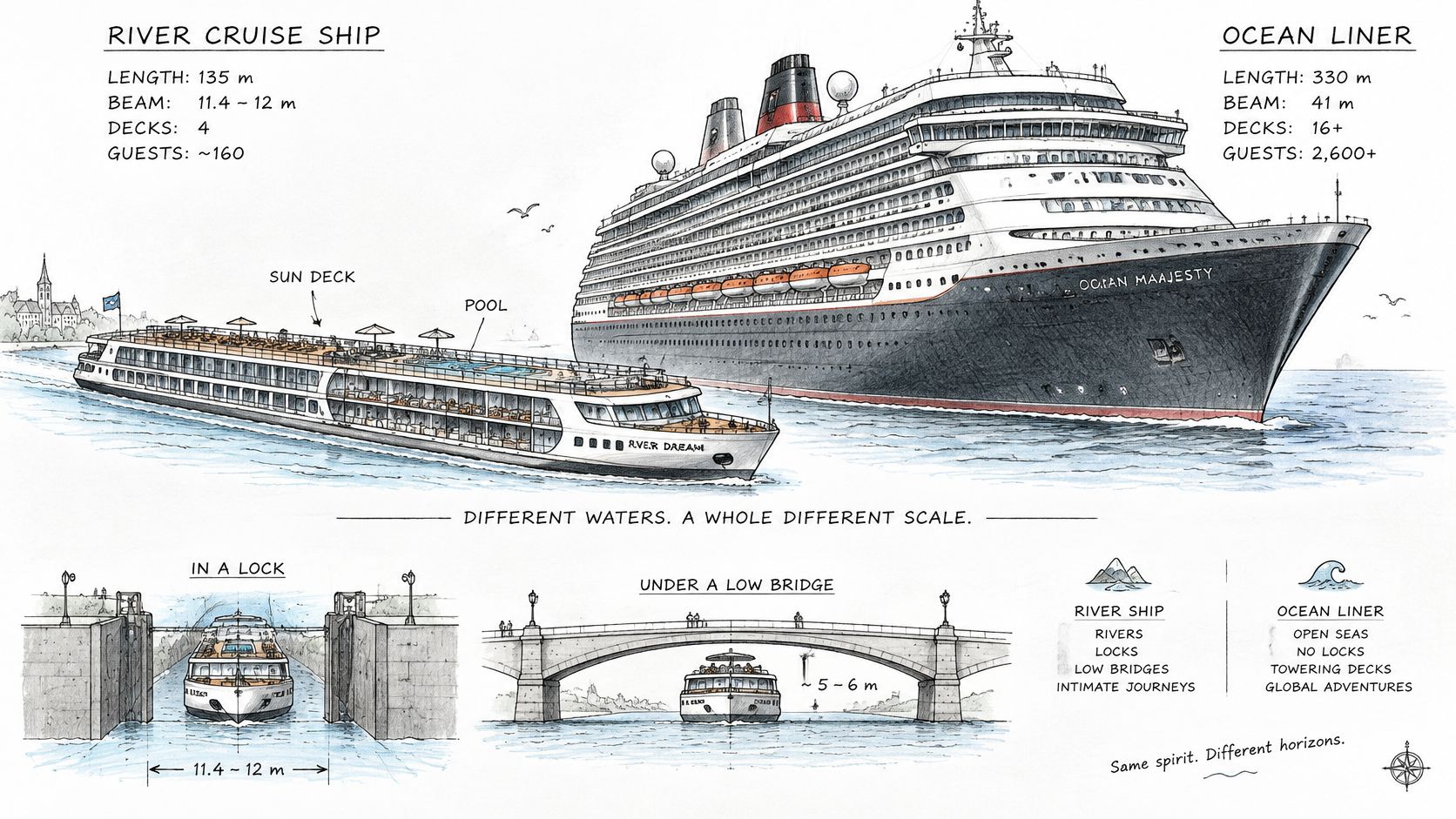
A lock, a bridge, and a shallow channel set the itinerary before any brochure does. Width and length have to fit the lock. Clearance above the water has to fit the bridge. Hull depth has to fit the channel.
The Amadeus Riva fleet information puts a representative Rhine-Danube ship at approximately 135 m long, 11.4 to 12 m wide, 174 to 210 passengers and a maximum ballast draft near 2.1 m. An ocean ship on the scale of the Oceania Riviera draws considerably more water and carries far more passengers and crew, so it needs deeper water and a berth built for that hull.
Those measurements describe two operating environments, not two grades of holiday. A shallow river hull can use inland corridors an ocean ship cannot enter. The ocean ship stays where the port has the depth and the quay.
What a changed river itinerary means
A family of nine books a Danube sailing and, days before departure, low water forces part of the route onto coaches.
The cities may stay on the list. The usable day does not. Someone has to move the luggage, confirm a coach a relative with a walking aid can board, and find out whether the family sleeps on the same ship or splits to a hotel or a second vessel. That is mobility at four levels at once: moving on the ship, using the cabin you booked, making the port transfer, and still reaching the excursion.
Request the revised daily schedule, hotel or replacement-ship details, luggage handling, and the walking distance on each replacement transfer. I would not treat "the cruise is operating" as an answer.
Practical rule: A destination remaining on the itinerary doesn't mean the original journey to it remains intact.
Ocean arrivals need the same scrutiny. A commercial terminal can sit well away from both the airport and the city named on the ticket, so compare the transfer you will ride. Time spent in a coach or a tender queue is vacation time you do not get back.
Before comparing cabins, confirm these points:
- Lock and bridge notes: Which passages can close, and what the operator substitutes when they do.
- Draft and berth limits: Where this named ship is scheduled to dock, and what replaces that berth.
- Tender ports: Where passengers board a small boat instead of a terminal gangway, and how long that boat ride runs.
Size limits are not a reason to skip either format. They are the reason a changed operating plan changes the holiday you thought you bought.
Where Each Format Takes You
River cruising follows a corridor model. Rhine itineraries connect places such as Amsterdam and Basel, while Danube itineraries link Budapest and Vienna through an inland cultural route.
That geography supports city-focused travel, but don't translate a city name into guaranteed old-town docking. Confirm the berth, the distance to your intended sights and whether the excursion begins with a coach ride.
European river cruising carried approximately 1,385,800 passengers in 2024, up 14% from the previous year; about 571,000 were North Americans and approximately 506,000 came from Germany, Austria and Switzerland, according to the European Barge Union annual report. The report also records 14,066 crew positions and places European river volume at roughly 4% of global ocean-cruise volume, a comparison between a regional river market and a worldwide ocean market.
Match the geography to the purpose
Ocean itineraries serve coastlines, islands and fjords through regions including the Caribbean, Mediterranean, Northern Europe and Alaska. They suit travelers who want the ship to connect maritime destinations rather than follow an inland chain of cities.
A history-focused couple might prioritize cathedral visits, museums and evenings ashore. A family interested in coastal scenery, swimming and time aboard has a different map, even if both groups describe their goal as seeing Europe.
Use this geography test before filtering by cruise line:
- Name your must-see places. Write down the places themselves, not broad labels such as Europe or the Mediterranean.
- Identify the access route. Mark each as an inland river destination, coastal port or destination requiring a tender or onward transfer.
- Check whether the route connects them. Places on the same navigable corridor may suit a river sailing, but verify the berth and excursion transport before assuming you can walk everywhere.
Our guide to cruise line itineraries can help organize that comparison around the route rather than brand familiarity.
Read the destination name carefully
For example, a sailing can advertise a major cultural city while docking outside its historic center. If your priority is returning independently for an evening concert, the final departure time and return transport matter more than the city appearing in bold type.
Choose river for a coherent inland route and ocean for maritime reach. Neither format compensates for a wish list scattered across places the itinerary doesn't conveniently connect.
Itinerary Pace and Usable Vacation Time
Trip length and pace by cruise format
Trip Length | Ocean Cruise Option | River Cruise Option | Pace to Expect |
|---|---|---|---|
3 to 4 nights | Growing short-break entry point | Rarely offered | Check the actual sea-day count; river usually offers less choice in a short window |
7 nights | Weekly itinerary with sea and port days | Standard length with several calls | Ocean can balance downtime and visits; river often emphasizes daily exploration |
10 to 14 nights | Longer coastal and sea-going routes | Longer Rhine and Danube programs | More time doesn't automatically mean a slower excursion schedule |
Booking-search demand for three-night ocean cruises rose 60% year over year and four-night cruises rose 30% for 2026, while one- and two-week itineraries remained popular, according to CLIA's State of the Cruise Industry presentation. Those search figures indicate interest in shorter trips, not a guarantee that a short sailing provides substantial rest.
Usable vacation time is what remains after embarkation, transfers, mandatory meeting times and recovery from demanding outings. Don't count arrival and departure dates as full leisure days without looking at the actual schedule.
Compare the daily rhythm
A river day might begin with an early guided excursion, continue with lunch and an independent old-town walk, then end with sailing overnight. That can be efficient for an energetic traveler and relentless for someone who needs a quiet morning after each substantial outing.
An ocean itinerary can alternate port visits with days built around pools, shows and deck time. But a port-heavy ocean route can be just as demanding as a river program, particularly when transfers begin early.
For a remote worker, the important distinction is uninterrupted time, not just time aboard. A sea day can provide a longer focus block, whereas river sightseeing may split the day into awkward fragments; neither format guarantees reliable connectivity, so verify the internet package and avoid promising critical calls without a backup.
Count the hours you can use in the way you want, not just the nights printed on the booking.
Build a usable-time worksheet
Take a shortlisted sailing and mark each day with arrival time, departure time, excursion meeting time and transport requirements. Then reserve recovery periods before adding optional activities.
- Port days: Separate independent walk-off visits from outings that require organized transport.
- Sea days: Identify unscheduled blocks rather than assuming every day aboard is free.
- Early departures: Flag mornings that would prevent a slow breakfast or uninterrupted work.
- Travel days: Include airport transfers, embarkation procedures and onward connections.
Use our cruise itinerary planning guide to turn that information into a schedule everyone can understand.
Before choosing, count port days, sea days and early departures for the actual sailing. A longer trip with no recovery space can deliver less relaxation than a shorter, better-paced one.
Onboard Experience and Venue Choice
A mainstream ocean ship gives different family members something to do simultaneously. Pools, theaters, specialty restaurants, children's facilities and spas can support separate plans without requiring everyone to enjoy the same activity.
The scale is substantial: CLIA's cruise information describes typical river vessels carrying approximately 100 to 190 passengers, at about 440 feet long and 38 feet wide, compared with mainstream ocean liners carrying 3,000 to 5,000 guests across roughly 15 to 18 decks, with the largest exceeding 7,000 passengers. European river locks help explain the narrower river footprint.
A river ship usually concentrates social life around a lounge, main dining room and sun deck. That makes the evening decision simpler, but travelers seeking several distinct entertainment options may find the selection restrictive.
What the family actually experiences
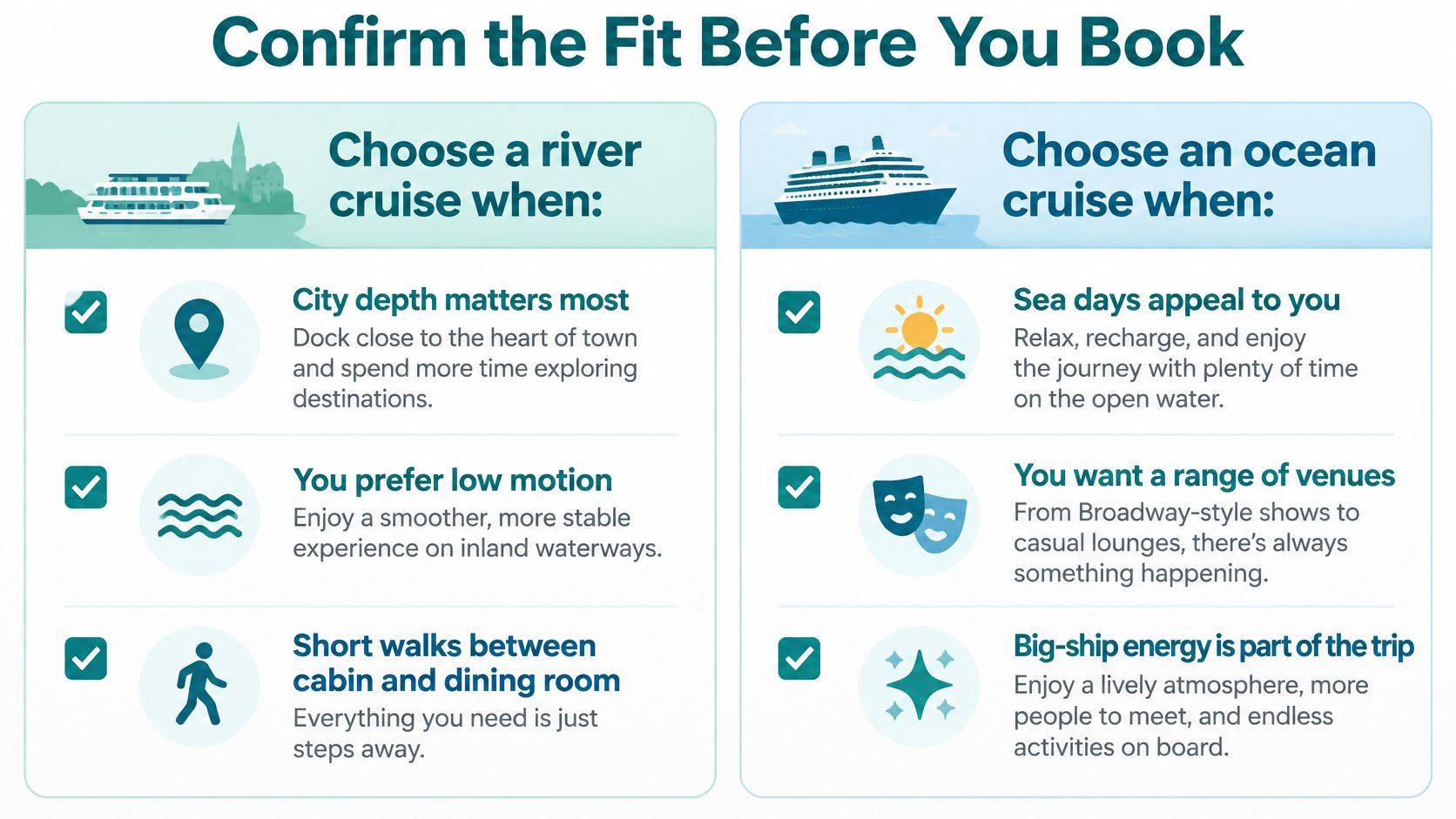
Consider grandparents who value a straightforward walk from cabin to dinner. A compact river ship may suit them well, provided their particular route doesn't involve stairs they can't manage.
Now consider teenagers who want shows, sports or age-appropriate organized activities. A mainstream ocean ship is more likely to offer that choice, but verify the specific age groups, opening hours and participation rules rather than assuming a children's program also serves older teens.
The organizer must also account for peak-hour friction. Ocean buffet queues and elevator waits can complicate a tightly timed meeting, while a smaller river dining room can make spontaneous family regrouping easier.
On a river ship, the destination is outside the window. On an ocean ship, the ship is part of the destination.
Plan independence deliberately
More venues help only when the group can use them comfortably. Establish meeting points by an unmistakable venue or landmark, not instructions such as meet near the elevators.
- For independent adults: Agree on shared meals and let daytime plans separate.
- For children and teens: Confirm supervision rules and how family members will communicate aboard.
- For relatives needing support: Choose cabin locations around the places they'll use.
- For quieter travelers: Inspect the deck plan for separation from entertainment venues and high-traffic areas.
Don't choose a larger ship solely to satisfy the most energetic person. Equally, don't choose a quiet river vessel because it makes the organizer's job simpler if the rest of the group wants a resort-style holiday.
The best onboard environment gives travelers enough autonomy without creating an unreasonable coordination burden.
Accessibility at Four Levels
Accessibility by level for each format
Access Level | River Cruise | Ocean Cruise |
|---|---|---|
Ship | Some vessels lack elevators and have multiple staircases | Elevators and accessible common areas offer a stronger starting point; confirm the vessel |
Cabin | Limited accessible inventory; some vessels cannot accommodate wheelchairs or scooters | Broader accessible-cabin choice; confirm layout and door width |
Port transfer | Quayside gangways, steps and potentially uneven docks | Terminal transfers; tenders can create barriers |
Excursion | Some programs require substantial unaided walking and steep stairs | Assess each tour's walking grade and transport access |
Low motion and step-free access are different requirements. A river cruise can reduce seasickness through calmer inland travel while still presenting serious obstacles for someone using a mobility device.
Some river vessels have narrow corridors, multiple staircases or restrictions on mobility aids, and certain programs require passengers to walk up to a mile unaided and manage steep stairs, as explained in Saga's river-cruise accessibility guidance. That makes the named ship and program more important than a general claim that river cruising is easier.
Test a complete journey
Consider a couple in which one partner uses a walker. A river cabin might look suitable in photographs, but a stairs-only route from its deck to the dining room makes the arrangement unworkable.
An ocean ship might pass the onboard test through elevators and a suitable cabin. Yet if a priority port requires a tender that the traveler cannot board safely, the couple still loses the visit they most wanted.
Don't evaluate those problems separately from the booking decision. A workable cabin doesn't repair an inaccessible transfer, and an accessible terminal doesn't make a steep cobbled walking tour manageable.
Ocean ships may provide a stronger baseline for medical facilities and mobility-device accommodation, but medical support isn't interchangeable between vessels. Describe your actual needs and obtain a ship-specific response.
Get written answers before payment
Request documents rather than accepting a broad assurance that staff will help:
- Ship feature list: Confirm elevator coverage, stair-only areas, accessible public toilets and device restrictions.
- Cabin layout: Obtain door widths, bathroom configuration, thresholds and storage arrangements for the actual mobility aid.
- Port access policy: Request gangway or tender arrangements for every call, including what happens when conditions change.
- Excursion walking grade: Check surfaces, steps, gradients, standing time, seating opportunities and vehicle boarding.
Include the mobility aid's dimensions and whether the traveler can climb steps, stand unaided or transfer into a vehicle. Those details allow a meaningful answer; the phrase limited mobility doesn't.
If a response remains unclear, treat the requirement as unconfirmed. Paying first and hoping the crew can improvise leaves both the traveler and the organizer exposed to an avoidable problem.
Which Format Fits Each Traveler
The useful verdict is a starting recommendation plus the condition that could reverse it. A traveler's label matters less than what they need to do comfortably each day.
First-time cruisers and mixed-age families
First-time cruisers who enjoy city walks can start with river itineraries. If their real goal is entertainment, restaurant choice and a holiday centered on the ship, ocean is the stronger starting point.
For a multigenerational family, begin with the least flexible access requirement, then decide how much independent activity everyone needs. River can simplify regrouping; ocean can support different interests, but neither advantage matters if a relative can't participate in the essential parts of the trip.
Use our guide to family-friendly cruises to distinguish useful family facilities from amenities that nobody in your group will use.
- What reverses the first-timer verdict: A preference for unstructured days rather than organized sightseeing.
- What reverses the family verdict: A ship or shore-access restriction affecting a traveler who needs support.
Repeat cruisers and history-focused couples
A repeat ocean cruiser who wants a different travel pattern should consider river rather than selecting another sailing solely to preserve loyalty benefits. The reversal point is simple: if shows, sea days and extensive dining choice are central to the holiday, changing format may remove the very things they enjoy.
A history-focused couple is a strong river candidate when the desired cultural sites sit along the route and are practically reachable from the berth. Choose differently if the key sights require lengthy transport regardless of format, or if their wish list is mostly coastal.
Judge the actual sightseeing route, not the cultural theme in the itinerary title. A museum-heavy program can still leave little time for independent visits.
Motion-sensitive travelers and remote workers
Someone prone to seasickness will often prefer sheltered river travel. Review the full route, including any exposed crossings, and discuss personal prevention options with a qualified clinician rather than assuming the category eliminates symptoms.
A remote worker who needs predictable focus blocks may prefer ocean sea days. That verdict reverses if connectivity can't support the work or if the traveler can comfortably work around shorter river intervals and skip selected outings.
No format wins across the board. Choose the requirement the trip cannot compromise, then reject sailings that fail it before comparing secondary benefits.
Confirm the Fit Before You Book
The right cruise is the one that preserves usable vacation time and lets each traveler move comfortably through the ship, cabin, port transfer and excursion. Compare named sailings against those four levels of mobility, not just the itinerary highlights or included activities.
Run the pre-booking checklist
- Match the vessel to the route. Compare ship length and maximum draft with the itinerary's operating requirements. Confirm the actual terminal or berth for each stop, not only the destination name.
- Review river restrictions for your travel month. Check lock and bridge notes, and get the operator's arrangements for altered sailings in writing. Ask whether replacement transport changes access or adds transfer time.
- Confirm cabin access. Request the accessible layout and door width in writing. Check the route from the cabin to dining, public areas and embarkation, including any steps or changes in level.
- Count port days and sea days. Read arrival and departure times before treating a call as a full sightseeing day. A short stop leaves less usable time than a leisurely visit.
- Check each intended excursion. Review walking grade, transport access and whether travelers can leave early or choose an easier alternative. An included tour is not a good fit if its pace or access requirements rule someone out.
- Agree on independence and supervision. Decide who can explore alone, who needs accompaniment and who is responsible during each transfer. Consider crowd tolerance when comparing larger ships.
- Calculate usable vacation time. Account for embarkation, transfers, early departures and realistic recovery periods. Choose the sailing that best fits the family's priorities, rather than the one with the longest activity list.
If the trip includes independent paddling before or after the cruise, PADL's pre-trip planning steps for paddlers offer a separate preparation resource. Plan that outing on its own; the cruise arrangements may not cover it.
Consolidate the surrounding travel
Compare the travel around each sailing, too: flights, hotel nights and ground transport affect how much time the trip leaves for the cruise itself. Approved Traveler provides access to hotels, flights, cruises, cars, tours and homes under one login in the member portal, with wholesale rates on those travel categories.
Approved Traveler and Lux Traveler are backed by the 110% Best Value Guarantee. If a member finds a lower publicly available price, the refund equals 110% of the difference. Assess that guarantee separately from the practical question of whether the sailing fits your group.
Before booking, write down the places each traveler wants to visit and the access needs that affect their day. Run the checklist against the shortlisted sailings, then keep written confirmations with the booking documents.
Approved Experiences Traveler provides wholesale-rate travel access and consolidates cruises with flights, hotels and transport in one member portal. Visit Approved Experiences Traveler to compare options against your must-see places, usable vacation time and family's access requirements.