Executive Assistant vs Virtual Assistant in 2026
Executive assistant vs virtual assistant is a choice about who owns follow-ups and cost. See 2026 wages, overhead, and when a managed team fits.
14 min read

Search executive assistant vs virtual assistant and you'll get the same article forty times: a task menu, a price column, and a verdict that the virtual assistant wins on cost. That verdict is technically true and practically useless. It prices the task and ignores who owns it.
A $25-an-hour assistant who waits for your brief, executes it, and waits again has not removed work. They've moved it. You still write the brief, catch the error, send the reminder, and carry the context in your head at 11 p.m. Your card gets charged less. Your week doesn't change.
Picture the founder whose flight is canceled at 11 p.m. while a school form sits due at 8 a.m. That person does not need another inbox or a cheaper hourly rate. They need both loops closed by someone who noticed the gate change before they did. That's a staffing decision, not a pricing decision, and it's the one this comparison is built around.
Why the Job Title Misses the Real Choice
The popular comparison treats this as a build-versus-buy decision about administrative hours. It isn't. It's a decision about who owns the coordination loop: who tracks dependencies, follows up without being prompted, resolves the calendar collision, and remembers that your daughter's camp form needs a signature and your mother's cardiology follow-up needs booking.
Three models show up in that comparison, and only one of them is a job title.
- Executive assistant: a continuing employment relationship inside one company or household. Salary, benefits, judgment, physical or system proximity, and availability during working hours.
- Virtual assistant: a delivery model for remote execution. Scope is set task by task, hours are agreed in advance, and the vendor's time zone shapes the day.
- Managed Assistant team: subscription capacity with a shared account history, US-based, reachable by call, text, or email around the clock. Not one assigned person, and not a W-2 seat.
Five tests separate them, and they're the same five you'd use to judge any hire: scope, communication, accountability, cost, and management overhead. Run a candidate through all five and the ambiguity usually collapses. Skip to the rate card and you'll pick the cheapest row and keep the mental load.
The job title tells you what someone is called. The ownership question tells you whether your Sunday evening gets shorter.
That's the whole argument in one line. A directly employed assistant can own the loop when trust, decision rules, and real calendar access exist. A task-scoped virtual assistant usually executes what was assigned this morning and waits for the next ticket. A managed team sits in between by design, which is why the next section puts all three side by side before anything else gets argued.
Side by Side on Scope Cost and Coverage
Choose the model by who owns the coordination loop, not by the job title or the lowest visible rate. This table compares the options across five practical tests. Start with the row that best matches your week, then check whether the cost and coverage fit.
Test | Executive assistant | Virtual assistant | Managed Assistant team |
|---|---|---|---|
Scope | Embedded judgment, calendar, and projects for one principal or household | Remote tasks defined by contract | Travel, scheduling, errands, and research across work and home |
Communication | In person or on the company's systems during working hours | Email or chat within agreed hours and time zone | Call, text, or email, 24/7/365 |
Accountability | One employee can retain context and own follow-ups | The client often assigns, checks, and reminds | Shared account history helps whoever responds follow preferences |
Cost shape | Salary, plus taxes, benefits, and leave | Hourly or retainer, with no single US wage for the model | Lux Solo costs $99.99 a month; Lux Circle costs $299 a month |
Management overhead | Recruiting, payroll, reviews, and coverage during absences | Briefing, quality checks, and handoffs | Record preferences once; a team covers requests when a member is off |
For an employed executive assistant, the wage data gives a useful benchmark. The U.S. Bureau of Labor Statistics occupational data for executive secretaries and executive administrative assistants counted about 483,570 workers in May 2023, with a mean annual wage of $73,680, a median of $70,310, and a 90th percentile of $104,000. The range reflects different levels of judgment and responsibility, not just typing speed. Those figures describe wages, not the full cost of employing someone.
The role has changed over recent years. The May 2023 figures show the current scale and pay of the occupation, while the decision for a buyer remains whether a continuing salaried seat is the right commitment.
Virtual assistance is a delivery model, not a single occupation, so it has no one wage figure that represents the market rate. A related labor benchmark is the broader administrative group, excluding legal, medical, and executive roles. Those workers earned a mean annual wage of $47,940, according to the BLS analysis of office and administrative support employment. Use that as context for labor costs, not as a freelance rate card. Hourly billing can look cheaper, but the client may still own the brief, quality checks, and follow-ups.
Approved Lux provides a US-based Assistant team available 24/7/365. Lux Solo at $99.99 a month covers travel, scheduling, errands, and research. Lux Circle at $299 a month covers up to four people on one account. Customers do not get one fixed Assistant: account preferences and history help whoever responds understand how the customer wants requests handled. The service works alongside members' email and calendars, rather than logging into those accounts. For a closer look at the responsibilities associated with the role, read the tasks of an executive assistant.
For a break-even check, divide the monthly plan price by the hourly rate you would otherwise pay for virtual assistance. The result is the number of assistant hours at which the virtual option matches the subscription price, before accounting for your time spent briefing, reviewing, and following up. For an employed assistant, compare the subscription against salary and employment costs, then weigh the additional coverage and management work each model requires. The cheapest hourly option wins only when those hours include the coordination you need.
Who Owns Follow-Ups and Shared Context
A low hourly rate does not shrink the load if you still do four things: write the brief, check the result, send the reminder, and hold the context in your head. Most virtual assistant comparisons assume the principal keeps doing all four. That assumption is where the savings live, and it's usually false.
The mental-load research makes the pattern visible. A 2025 study of 2,133 partnered US parents found mothers carried an average of 13.72 mental-load tasks versus 8.18 for fathers, about 68 percent more, even when the mothers had higher incomes and did less physical housework, as the University of Bath's summary of the mental load research reports. The lesson transfers straight to work: the task count barely moves if the same person keeps assigning, checking, and reminding.
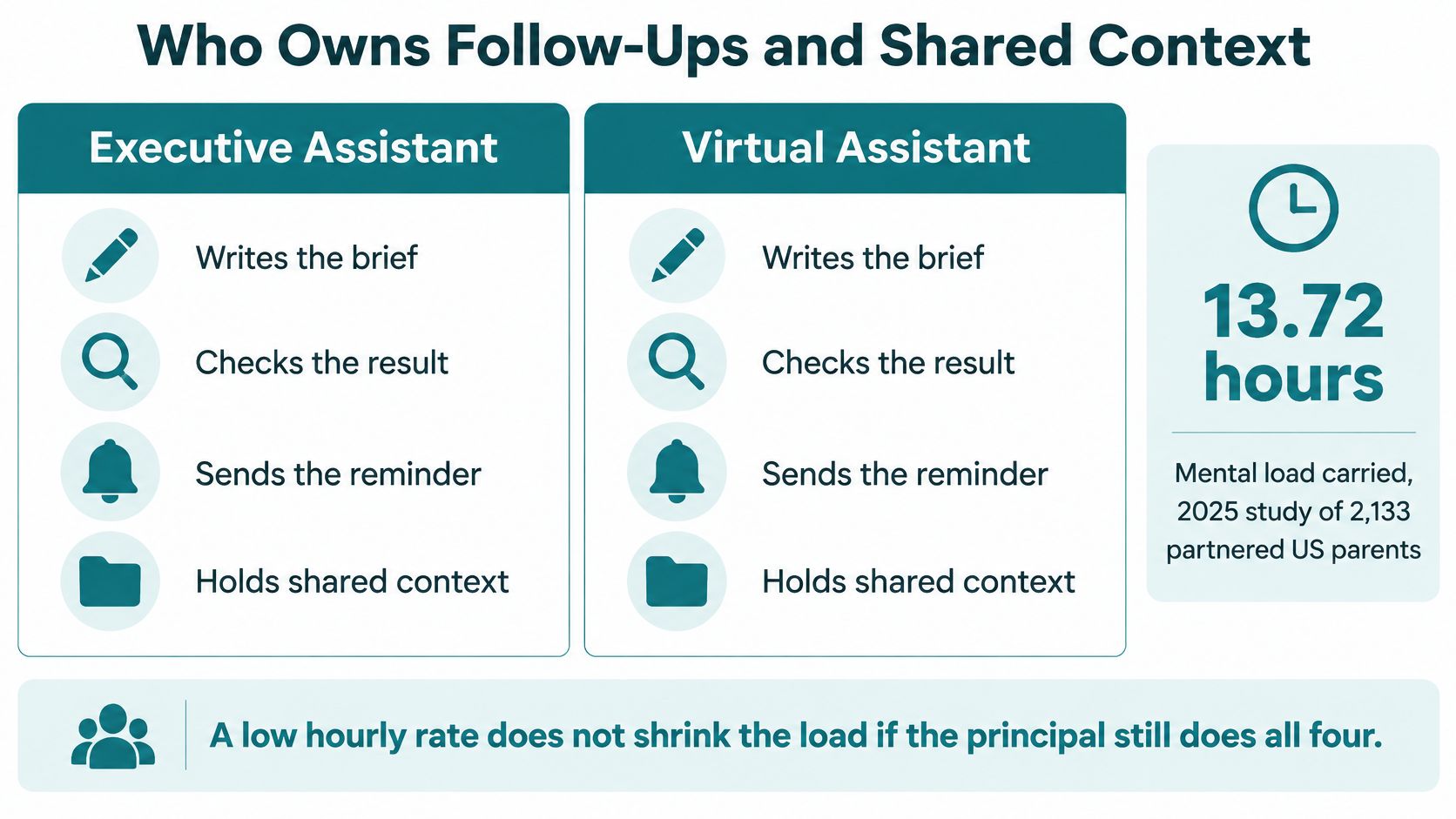
One person's memory versus account-level context
An executive assistant can own the loop, but only under conditions people rarely name. Trust has to be real, decision rules have to be written down, and calendar and inbox access have to exist. When those are in place, one person learns how you think and starts closing items before you raise them. When the assistant leaves, the context usually leaves too.
A virtual assistant model runs the other way by default. The work arrives as a ticket, gets executed, and stops. Across a time zone gap, "can you check whether the venue confirmed" lands tomorrow morning and you've already chased it yourself.
Delegating execution while keeping the checklist is not the same as handing off the loop.
Approved Lux is built around the second idea. Customers don't get one fixed assistant; preferences and history are kept with the account, so whoever responds already knows how you like flights booked and which appointments can't move. Because members get a team rather than one assigned person, requests are covered when a team member is off. Triple-channel access means a phone call, an SMS text, and an email are all watched at the same priority, which is the difference between solving a gate change and reading about it later. The team never logs into members' email or calendar accounts and works alongside those tools rather than inside them. Proactive Preference Learning is the compounding piece: routines get easier because context stays with the account, not because someone memorized your preferences in month one.
The check you can run this week
Before you buy anything, measure what you carry.
- Count the nudges. How many times this week did you follow up on something you'd already delegated? That number is your open-loop count.
- Count the re-explanations. How many times did you re-describe a preference you'd already stated? Each one is context that didn't stick anywhere.
- Count the after-hours saves. How many problems got solved between 8 p.m. and 8 a.m., and by whom? If the answer is you, business-hours coverage is the wrong product.
The target isn't more tasks completed. It's fewer open loops, fewer interruptions, and bandwidth that comes back to you.
What Each Model Costs and What Management Adds
Start with the number that decides whether a hire is even on the table. The BLS Occupational Outlook Handbook entry for secretaries and administrative assistants reports a May 2025 median wage of $76,590 for executive secretaries and executive administrative assistants, about $36.82 an hour, with the middle 50 percent between $61,390 and $94,390 and the 90th percentile above $109,850.
That's the sticker, not the bill. Add employer payroll taxes, benefits, recruiting, equipment, paid leave, supervision time, and someone to cover the two weeks your assistant is on vacation. The number that matters is fully loaded cost per productive hour of delegated work, and it always runs higher than salary divided by 2,080.
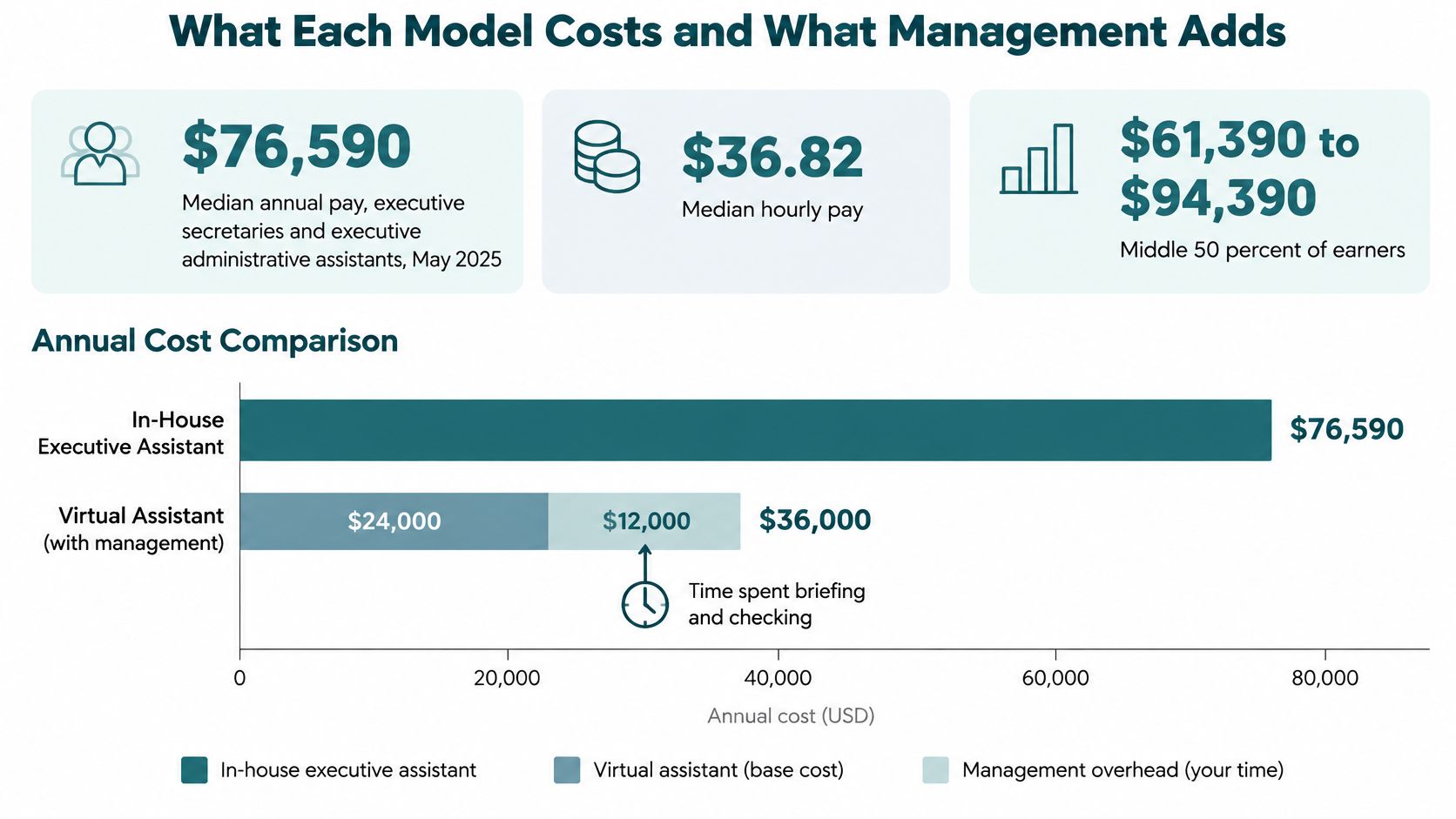
The 8 percent productivity hurdle
Harvard Business Review gives the cleanest threshold available. For a senior executive earning $1 million a year working with an assistant paid $80,000, the assistant needs to lift the executive's productivity by about 8 percent to break even, roughly five hours saved in a 60-hour week, as HBR's analysis of the case for executive assistants lays out.
That reframes the whole comparison. Measure hours and decisions, not messages handled. Five recurring hours of travel changes, scheduling conflicts, research, and follow-up clears the hurdle, but only if those hours move into revenue, leadership, or strategic work. Refill them with email and you bought relief, not meaningful progress.
The test that survives a real week: count the hours you can hand over and never think about again. Anything you still check isn't delegated. It's queued.
The same analysis names two operating conditions that decide whether any model works. The principal has to hand over meaningful work, and the assistant has to take responsibility beyond narrow execution. Both are process decisions you make in week one, not features you buy.
Break-even hours for a subscription
Say an independent consultant bills between $300 and $800 an hour and loses one afternoon to two vendor calls and a rescheduled flight. Three hours at $400 is $1,200 of billable time that never got billed. That's the unit of loss, not the hourly rate of whoever eventually helps.
The subscription math is simple enough to do on a napkin. Lux Solo at $99.99 a month breaks even at roughly 20 minutes of time valued at $300 an hour, or about 2 hours at $50 an hour. Lux Circle at $299 a month breaks even at roughly 1 hour at $300 an hour, or about 6 hours at $50 an hour. These are decision frameworks, not promised workloads.
Option | Sticker figure | What else sits on the bill | Break-even test |
|---|---|---|---|
Executive assistant, median | $76,590 a year (May 2025) | Payroll taxes, benefits, leave, equipment, recruiting, coverage | About 8 percent productivity, roughly five hours in a 60-hour week for an $80,000 assistant |
Pay band around the median | $61,390 to $94,390 middle half; above $109,850 at the 90th percentile | Same employment stack at every band | Higher salary raises the hours that must move into higher-value work |
Lux Solo | $99.99 a month | No W-2 benefits or payroll for this seat | About 20 minutes at $300 an hour, or about 2 hours at $50 an hour |
Lux Circle | $299 a month for up to 4 people | Same subscription shape, shared across the account | About 1 hour at $300 an hour, or about 6 hours at $50 an hour |
If you want to model the other side before committing, this breakdown of virtual assistant pricing structures compares hourly, retainer, and monthly shapes.
What management adds
A direct hire carries a stack most spreadsheets miss.
- Search and interview time: posting, screening, two rounds, a reference check, and the weeks where the seat sits empty.
- Payroll and benefits administration: filings, contributions, enrollment windows, and the paperwork that arrives every January.
- Coverage: vacation, sick days, and the gap between one assistant leaving and the next starting.
- Supervision: someone has to set priorities, review output, and run a performance conversation.
A virtual assistant looks lighter on paper and shifts a different cost onto you: briefing, quality checks, and handoffs. You become the project manager for your own support. A managed team moves that weight into shared account context, but it still needs your approval thresholds in writing. Set them once: how flights get booked, which calendar conflicts resolve without asking, and which spends need a yes before anyone commits. We don't sit in your house, but we find, vet, and schedule the people who do, and research requests come back as compared, vetted, and shortlisted vendors rather than a page of links.
Which Model Fits the Work You Actually Have
Match the pattern of your week, not the job title you were comparing.
The case for flexible capacity is strongest when personal logistics leak into professional hours. One recent study of employed parents found women think about household organization during work hours at 41.10 percent versus 9.58 percent for men, with childcare organization at 47.26 percent versus 13.51 percent, according to survey coverage of working parents. That's context switching with a measurable cost, and it's why handling home logistics can produce a professional return. The same logic explains why 24/7/365 availability and phone, SMS, and email access matter: work and family problems don't check the clock.
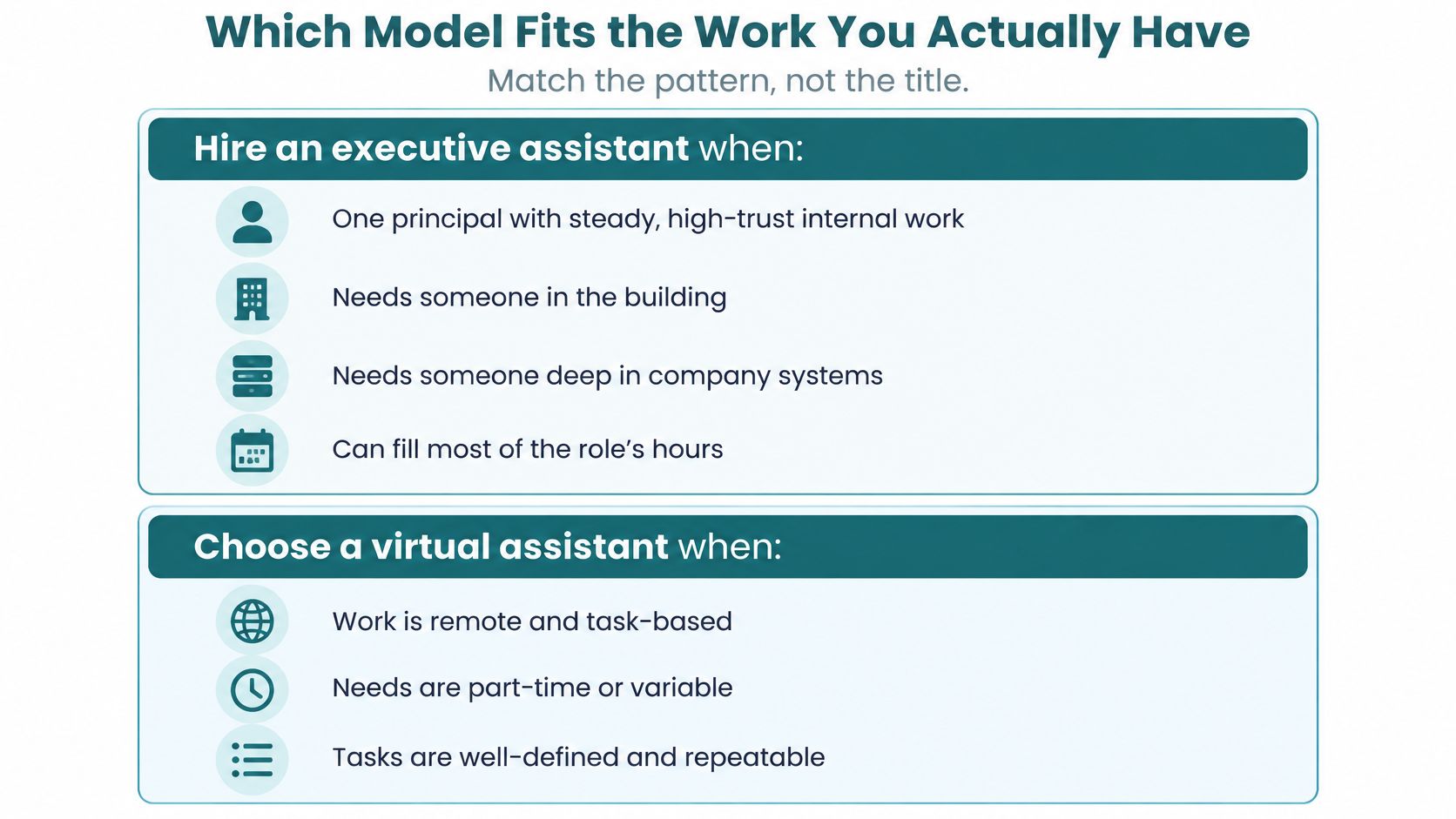
Four patterns and what they call for
The founder at $1M to $50M in revenue. You spend 8 to 15 hours a week on logistics that don't move the business, and a full-time assistant at $80,000 to $120,000 plus benefits isn't justifiable yet. Lux Solo is the first hire without payroll, and the test is whether it returns the hours you're already losing.
The practitioner billing several hundred an hour. You lost an afternoon to tasks worth $25 an hour. Here the subscription pays back the first time it clears a full afternoon, not the first time it clears a month.
The traveler at 50 to 150 nights a year. A 9-to-5 desk can't touch a midnight flight change or ground transport in an unfamiliar city. Travel here means car services, rentals, and rideshare coordination, arranged by someone awake when the airline isn't.
The dual-career household. Lux Circle covers requests for anyone on the account and books and de-conflicts appointments for the whole group, which is what makes a four-person household workable on one subscription. Errands cover scheduling cleaning, maintenance, and repairs, so the plumber stops being a third job. The team doesn't provide in-home caregiving; it finds, vets, and schedules the people who do.
A virtual assistant is the right answer when the work is bounded, repeatable, and easy to verify. It's the wrong answer when your problem is that nothing is bounded.
Pattern | Best model | First check |
|---|---|---|
Steady internal work for one principal | Executive assistant | Salary plus benefits fits the hours you can move to higher-value work |
Bounded, repeatable tasks you can check | Virtual assistant | You are willing to keep assigning and reviewing each task |
Variable demand, multiple time zones, office plus household | Managed Assistant team | Open loops, not a missing full-time seat, are the main cost |
One professional, 8 to 15 hours a week of logistics | Lux Solo | Break-even at about 2 hours a month at $50 an hour |
Household of up to four people | Lux Circle | Shared scheduling across the group justifies $299 a month |
Then run the honest test. Log one week of the tasks you'd hand over, mark the ones you still assign and chase, and count the open loops. If that count is high, the answer isn't a cheaper assistant. It's a model that owns the loop.
Choose a Managed Assistant Team or a Hire
Three questions, in order, and they usually settle it without a spreadsheet.
- Can you hand over five recurring hours a week? Travel changes, scheduling conflicts, research, and follow-up. If not, neither a hire nor a subscription will pay back yet.
- Is the work steady and internal enough to fill a salary? Near the May 2025 median of $76,590 plus benefits and coverage, hire. If the load spikes, lands after hours, or splits across a household, skip the W-2 seat.
- Will you still assign and chase every task? If yes, a virtual assistant only moves execution. Choose a managed team to reduce the loops themselves.
The options are concrete. Lux Solo at $99.99 a month for one professional. Lux Circle at $299 a month for up to four people on one account. If you also want the travel marketplace bundled in, Lux Traveler at $1,799.99 a year includes a 24/7 US-based personal assistant, the full travel marketplace, and coverage for up to 10 household members, instead of buying two separate memberships.
This is a force multiplier and a first hire without overhead, not household staff. We don't guarantee a table at a named venue, and we don't give legal, medical, financial, or tax advice. If the bounded work you're outsourcing is document-heavy and legal in nature, go to a specialist pipeline and hire virtual legal assistants trained on the format instead of teaching a generalist from zero. If you're leaning toward the employment route, this walkthrough of hiring an executive assistant covers the search, the trial period, and the decision rules to document in week one.
Log one week of admin hours, mark the loops you still own, and match that log to Lux Solo, Lux Circle, or a full-time hire. Two of those three answers cost less than a single billable afternoon.
Approved Lux Personal Assistant puts a US-based Assistant team on call, text, and email at any hour, so the flight change, the school form, and the vendor callback land with someone whose job is to close them rather than queue them. Lux Solo is $99.99 a month for one professional and Lux Circle is $299 a month for up to four people, with preferences and history held on the account so you explain your routines once. Visit Approved Lux Personal Assistant and pick the plan that matches your week.