
←All Articles
The Journal
A Complete Guide to Virtual Assistant Pricing Models
February 3, 202619 min readva rateshire virtual assistant
Struggling with virtual assistant pricing? Our guide demystifies hourly rates, retainers, and packages to help you budget and hire with confidence.

When you start looking into virtual assistant pricing, you'll see rates all over the map—anywhere from $15 to over $75 per hour. It really depends on the assistant's skillset, where they're located, and how complex your tasks are.
The best way to think about it isn't as just another expense, but as a smart investment in getting back your most precious resource: your time.
Decoding Virtual Assistant Costs
Figuring out what you should pay for a virtual assistant isn't about finding some magic number. It's about finding the right pricing model that fits what you actually need. There’s no "one-size-fits-all" price because the title "virtual assistant" covers a massive range of skills and services. The cost is a direct reflection of the value and expertise you're looking for.
Think of it this way: you wouldn't pay a general handyman the same rate you'd pay a master electrician, right? It's the same with VAs. An assistant who's just doing basic data entry is going to have a very different price tag than one who can manage complex project workflows or provide specialized paralegal support. Before you even start looking at prices, the first step is to get crystal clear on what you want to delegate.
Virtual Assistant Pricing Models At A Glance
To help you get a quick read on which approach might work for your budget and workload, here’s a look at the most common ways VAs structure their pricing. Each one is built for a different kind of working relationship, from needing a bit of help here and there to having someone fully embedded in your daily operations.
This table breaks it all down.
| Pricing Model | Typical Cost Range | Best For |
|---|---|---|
| Hourly Rate | $15 - $75+ per hour | Unpredictable workloads, short-term projects, or just trying out a VA for the first time. |
| Monthly Retainer | $400 - $5,000+ per month | Consistent, ongoing support where you need to know someone is available for you each month. |
| Task-Based/Project | Fixed price per project | Well-defined, one-off projects like setting up a website or planning an event. |
| Subscription Service | Varies by provider | Accessing a team or platform for a flat monthly fee, perfect for handling a wide variety of tasks. |
Once you understand these models, you can start to see where the real value is. For instance, hourly rates for skilled VAs can hover between $15 to $50 globally, with assistants based in the US typically at the higher end of that scale. To see what specific tasks fall under these models, you can explore a full breakdown of virtual personal assistant services.
This kind of flexibility allows busy founders, executives, and even families to build a complete "operations layer" for their life at a fraction of what it would cost to hire a traditional, in-house assistant. For a great real-world example of how a modern assistant service packages its offerings, take a look at Elyx AI's pricing structure.
Breaking Down the Three Core Pricing Models
So, how do virtual assistants actually charge for their time and skills? It can feel a little confusing at first, but most VAs and agencies build their pricing around three main models. Each one is really designed for a different kind of working relationship and workload.
Getting a handle on these is the first step to finding a support system that truly fits your needs and your budget. Let's dig into the 'big three' of VA pricing.
The Hourly Rate: Pay As You Go
The most straightforward model is the simple hourly rate. Think of it like a pay-as-you-go phone plan—you only pay for the time you actually use. This makes it a fantastic starting point for anyone with an unpredictable or fluctuating workload.
This approach is perfect if you’re just starting to hand things off. Maybe you need a hand launching a social media campaign one week, but then you're all set the next. With an hourly rate, you’re not paying for that downtime. It gives you total flexibility to ramp support up or down as your projects demand. For general admin tasks, you'll typically see rates from $15-$50 per hour, while more specialized skills can easily command $75 per hour or more.
The main catch, however, is a lack of guaranteed availability. Since you aren't reserving a VA's time in advance, they might be busy with other clients right when you have an urgent request. It can also make budgeting a bit of a moving target since your monthly costs will change.
- Best For: Entrepreneurs with unpredictable needs, one-off projects, or anyone just testing the waters with a VA.
- Potential Downside: Can get pricey for steady, heavy workloads, and you're not guaranteed a spot on their calendar.
The Monthly Retainer: A Subscription for Support
A monthly retainer is basically a subscription service for professional support. You pay a set fee each month, and in return, you get a pre-agreed block of your virtual assistant's hours. This is the go-to model for anyone who needs consistent, ongoing help.
Think of it like reserving a VIP seat at your favorite restaurant. By committing to a retainer, you guarantee that your VA sets aside a specific chunk of their schedule just for you. This naturally leads to a much deeper working relationship, allowing them to really learn your business, anticipate what you need, and manage your tasks proactively. Plus, retainers often come with a slightly discounted hourly rate compared to paying as you go.
A retainer shifts the dynamic from a simple transaction to a real strategic partnership. Your VA becomes an integrated member of your team who knows your goals inside and out, which dramatically boosts their effectiveness and your return on investment.
This model gives you a predictable monthly cost, making it a breeze to budget for support. It’s the ideal setup for a busy executive who needs consistent help with calendar management, email filtering, and meeting prep every single week.
The flowchart below is a great visual for figuring out which model fits your workload. It makes it pretty clear when a retainer is the right move for your consistent needs.
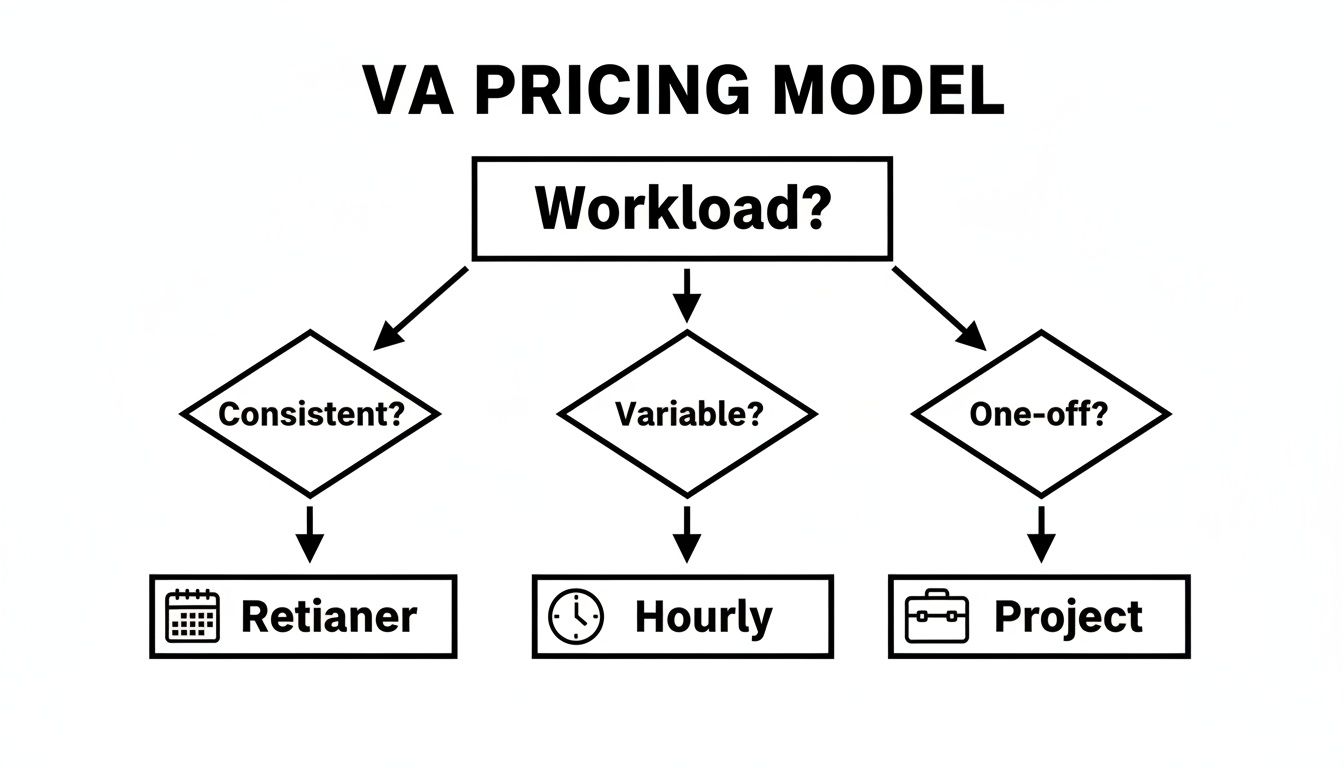
As you can see, if your workload is steady and ongoing, a retainer is almost always the most efficient and cost-effective way to go.
Task-Based and Project Pricing
The third common setup is task-based or project pricing. Here, it’s less about the hours clocked and all about the final outcome. It’s a lot like hiring a contractor to complete a specific, well-defined job for a fixed price.
This works beautifully for one-off projects with a clear beginning and end. You wouldn't hire a wedding planner by the hour; you hire them to plan the whole event for a flat fee. The same logic applies here.
Common Scenarios for Project Pricing:
- Website Setup: Building out a 5-page website for a small business.
- Event Coordination: Planning and running a company retreat from start to finish.
- CRM Migration: Moving all your customer data from an old system to a new one.
- Content Creation: Writing a series of 10 blog posts on a particular topic.
The biggest advantage is cost certainty. You know the exact price tag from day one, which takes away any risk of surprise hourly bills. It also focuses the entire engagement on the result, not the process. The VA is motivated to work efficiently to deliver a great final product.
The secret to making this model work is a rock-solid scope of work. You and the VA must agree on every deliverable, timeline, and revision round before starting to avoid scope creep and extra charges down the line. It's not the right fit for ongoing, evolving admin support where tasks are different every day.
What Really Drives Virtual Assistant Costs

You’ve probably seen virtual assistant rates all over the map, from a head-scratching $15 per hour to a premium $80 or more. This isn't random. The wide range is a direct reflection of the value, expertise, and specific skills an assistant brings to your world. Figuring out these cost drivers is the key to finding the right person without overpaying.
Think of it like hiring a chef. You wouldn't expect a local line cook to charge the same as a Michelin-starred expert, right? It's the same deal here. The price tag on a VA tells you a lot about their background, their skills, and the kind of work they're equipped to handle.
Skillset and Specialization
The single biggest factor in what you'll pay is the VA’s skillset. A generalist who handles basic administrative tasks is naturally going to have a lower rate than a specialist who's a wizard in a specific industry or a piece of complex software.
General admin support—think email management, scheduling, and basic data entry—sets the baseline for pricing. These tasks are absolutely essential, but they don't demand niche expertise.
On the flip side, specialized skills always command a premium. If you need someone who can run your social media ad campaigns, manage your books in QuickBooks, or provide paralegal support, you’re paying for their advanced knowledge and the high-impact results they can deliver.
Examples of Specialized (and Higher-Priced) Skills:
- Bilingual Communication: A non-negotiable for businesses with clients around the globe.
- Advanced Bookkeeping: This goes beyond data entry and requires a real grasp of accounting principles.
- Graphic Design: Involves proficiency in tools like the Adobe Creative Suite to produce professional visual assets.
- SEO and Digital Marketing: A strategic skill focused on making you more visible online and bringing in new business.
Experience Level and Proven Track Record
Just like in any other job, experience matters. A virtual assistant who’s just starting out will likely charge less as they build their portfolio and collect testimonials. Their main goal is getting their foot in the door and proving themselves.
But a seasoned VA with five or ten years under their belt? They have a proven history of getting things done. They've likely seen it all, navigated tricky situations for dozens of clients, and perfected their workflows for maximum efficiency. That reliability costs more because you're buying certainty and peace of mind.
A veteran VA often needs less hand-holding, anticipates what you need before you ask, and solves problems you didn't even know were coming. You aren't just paying for their time; you're investing in their accumulated wisdom.
Geographic Location: Onshore vs. Nearshore
Where your virtual assistant lives has a huge impact on their rates, mostly because of the differences in the cost of living. This is one of the most straightforward factors to understand.
- Onshore (US-Based): Assistants in the United States typically have the highest rates, often from $30 to $75+ per hour. You're paying for native English fluency and a shared cultural context, which can make communication seamless.
- Nearshore (Latin America): VAs from countries like Mexico or Colombia hit a sweet spot between cost and skill. They often have strong bilingual abilities at rates 40-60% lower than their US counterparts.
- Offshore (e.g., The Philippines, India): This is where you’ll find the most competitive rates, sometimes as low as $8-$15 per hour. However, you might need to be more hands-on with management due to major time zone differences and potential communication nuances.
The nearshore talent market, in particular, is exploding. Executives are finding they can reclaim 15-20 hours per week, making location a critical strategic choice. For a deeper dive into this, it's worth exploring the different ways you can go about outsourcing to a virtual assistant.
Task Complexity and Urgency
Finally, the work itself plays a big part. A simple, repetitive task like transcribing audio is less complex—and therefore costs less—than a project that requires strategic thinking, creativity, and independent judgment.
Urgency is also a factor. If you need a presentation built overnight or a project finished over the weekend, expect to pay a rush fee. That extra charge compensates the VA for dropping everything to meet your tight deadline. Once you understand these drivers, you can look at a VA’s proposal and know if their price truly matches the value you’re getting.
What's a Virtual Assistant Really Worth?
When you start looking at virtual assistant pricing, it’s so easy to get fixated on the hourly rate. But that’s like judging a car solely on its monthly payment without considering where it can take you. The real question isn’t "what does a VA cost?" It's "what is my time worth?"
The true value of a virtual assistant is all about the return on your investment (ROI)—and I'm not just talking about money. It's about reclaimed time, lower stress levels, and a renewed sense of focus. Every hour you sink into administrative muck is an hour you aren't spending on the things that actually grow your business or make your life better.
Let's reframe the cost. Say you bill clients at $150 per hour. If you're spending five hours a week just scheduling meetings and wrestling with your inbox, you’re actively losing $750 in potential income. Now, what if you paid a skilled VA $40 an hour to handle that for you? That’s $200 spent to get $750 worth of your time back—a net gain of $550. Simple as that.
How to Calculate the Value of Your Own Time
Before you can really grasp the ROI, you have to know what an hour of your time is actually worth. This isn't just some business metric; it's a life metric.
Here’s a quick and dirty way to get a baseline number:
- Figure Out Your Annual Income: Start with your total salary or business revenue. Let's use $200,000 as an example.
- Estimate Your Working Hours: A standard work year comes out to roughly 2,000 hours (that's 40 hours a week for 50 weeks).
- Do the Math: Just divide your income by your hours.
Formula: ($200,000 / 2,000 hours) = $100 per hour
This $100 is your magic number. Any task you're doing that could be delegated for less than that is, financially speaking, a bad deal. This one calculation can completely shift your perspective. A VA stops looking like an expense and starts looking like a powerful investment in your own productivity.
Real-World Scenarios: Unpacking the ROI
Abstract numbers are fine, but let's look at how this plays out for real people drowning in logistics. The value here goes way beyond the balance sheet; it's about getting your mental energy and your opportunities back.
Scenario 1: The Startup Founder Buried in Admin
A founder figures her time is worth $200/hour. She’s currently losing 15 hours a week to non-critical tasks like scheduling investor calls, managing her inbox, and basic bookkeeping. That’s a staggering $3,000 a week in opportunity cost—time she should be spending on product development or fundraising.
- The Cost of Doing Nothing: 15 hours/week stuck in the weeds.
- The VA Solution: She hires a VA at $45/hour for those 15 hours a week (a $675 investment).
- The ROI: She instantly gets 15 hours of high-value time back. For an investment of $675, she reclaims time worth $3,000 to pour back into the business. That’s a no-brainer.
Scenario 2: The Busy Executive Juggling Work and Family
An executive earns $300,000 a year, making his time worth $150/hour. He easily loses 10 hours a week arranging complex travel, booking personal appointments, and coordinating household vendors. This isn't just lost work time; it's stolen family time.
- The Cost of Doing Nothing: 10 hours/week of personal and professional chaos.
- The VA Solution: He brings on a VA for $50/hour for 10 hours a week ($500).
- The ROI: He literally reclaims an entire workday every single week. That time is suddenly free for his kid's soccer game or for prepping a critical board presentation—things that are truly priceless.
Scenario 3: The Road Warrior Managing Logistics
A consultant who travels constantly values her time at $120/hour. Between flights, she's burning 8 hours a week booking hotels, juggling loyalty programs, filing expense reports, and rebooking flights that inevitably get canceled.
- The Cost of Doing Nothing: 8 hours/week of pure travel-related stress.
- The VA Solution: She hires a VA at $35/hour for those 8 hours ($280).
- The ROI: For less than the cost of one night in a decent hotel, she offloads a massive source of anxiety. Now, her travel time can be used for billable client work or just some much-needed rest.
Thinking Beyond a Single Assistant

Hiring a virtual assistant is a great first step, but anyone who has done it knows it comes with its own hidden workload. You aren't just offloading tasks; you're stepping into the role of a manager. That means you're now responsible for hiring, onboarding, training, and course-correcting when things go sideways.
What happens when your VA gets sick, takes a well-deserved vacation, or just doesn't have the niche skill you need for a new project? You’re right back where you started—scrambling for a solution and watching precious time evaporate. This is where the classic VA model hits a wall.
Thankfully, there’s an evolution of this model, one built for busy professionals and families who need things to just get done without the management headache. It's time to think past hiring a single person and start thinking about an integrated personal operations layer.
From Freelancer to Managed Team
Let’s use an analogy to make this clear. Say you need a website for your business. Your first thought might be to hire a freelance web developer. They’re talented, and they get the site built. Great.
But what happens when the site crashes at 3 AM? Or when you want to add a complex e-commerce feature that's beyond their skillset? You're stuck. Your single point of contact has become a single point of failure.
The smarter approach is to work with a managed web development agency. They have a team: a front-end expert, a back-end engineer, a security specialist, and a project manager keeping it all together. There's built-in backup, a deep well of skills, and a system for handling whatever comes up. You don't manage the individuals; you plug into a reliable machine that works.
This is precisely the difference between hiring a solo VA and partnering with a managed service. One gives you a person; the other provides a complete, always-on operational system for your life.
A platform-based approach acts like that expert agency. It removes the friction of managing one person by providing reliability, quality control, and access to a wide bench of specialists on demand.
The Power of an Operations Layer
An integrated operations layer is built for total support. Instead of being constrained by one person's schedule and abilities, you tap into a collective intelligence. This model is a game-changer for people whose needs are dynamic and often unpredictable.
This system offers a robust, reliable alternative to the traditional solo VA, especially for those who value flawless execution over playing manager. If this model sounds right for you, exploring different virtual assistant companies can give you a clearer picture of how these powerful platforms are structured.
This approach is especially powerful for handling:
- Complex Travel Planning: One specialist can book flights while another researches unique local experiences, all perfectly coordinated.
- Household Management: The system can juggle vendors for home repairs, schedule weekly services, and plan family events all at once.
- Business and Personal Overlap: You can have an expert managing your professional calendar while another specialist researches the best summer camps for your kids.
Why It Changes the Pricing Conversation
When you hire a solo VA, you're paying for their time. With an integrated operations layer, your investment buys something far more valuable: guaranteed outcomes. The virtual assistant pricing here reflects the powerful infrastructure working for you behind the scenes.
This includes:
- Built-in Redundancy: If your main point of contact is unavailable, another qualified pro seamlessly takes over. Nothing gets dropped.
- Scalable Support: Need to suddenly plan a last-minute international conference trip? The platform instantly allocates more resources to the task.
- Quality Assurance: Layers of oversight are built into the process, ensuring every task is completed to a high standard, every single time.
Ultimately, this model reframes the cost. It's not an hourly rate; it’s an investment in your own operational resilience. You aren't just buying back your time—you're buying peace of mind, knowing your life is supported by a system designed to handle anything you throw at it. It’s the difference between simple delegation and true operational freedom.
Common Questions About Virtual Assistant Pricing
Diving into the world of virtual assistants naturally brings up a lot of questions, especially when it comes to the price tag. As you think about getting help, it’s completely normal to have some lingering uncertainties. Let's walk through the most common questions we hear to clear up any confusion and help you move forward with confidence.
Think of this as your final checklist. We’ll get into the nitty-gritty of rates, contracts, and the real differences between hiring models so you can make a decision that feels right for you.
What Is a Reasonable Hourly Rate for a Virtual Assistant?
There’s no single "right" answer here—what’s reasonable really depends on the skill level, experience, and where your VA is located. But there are definitely some reliable benchmarks.
For general administrative tasks, a great starting point is $15-$30 per hour for skilled VAs based in talent-rich regions like Latin America or the Philippines. If you’re set on hiring someone in the US, you’ll see those rates jump to the $30-$60 per hour range.
Of course, when you need more than just the basics, the price adjusts to match the expertise.
- Specialized Skills: If you need help with graphic design, bookkeeping, or paralegal work, you're hiring a specialist.
- Premium Rates: Don't be surprised to see these experts charge anywhere from $50 to over $100 per hour.
The main takeaway? You’re not just buying an hour of someone’s time; you’re investing in a specific skill set. The more complex the job, the higher the investment.
Is a Monthly Retainer Better Than Paying Hourly?
This one comes down to your personal workflow. Neither model is inherently better, but one will almost certainly be a better fit for how you work.
A monthly retainer is perfect if you have a steady stream of ongoing tasks—think 10 or more hours per week. It secures your VA's availability and often includes a slight discount on their hourly rate. It turns the relationship from a simple transaction into a real, integrated partnership.
On the flip side, paying by the hour gives you ultimate flexibility. It’s ideal for one-off projects or if you're just dipping your toes into the VA world. The only catch is that your assistant might not be available at a moment's notice if you're not on a retainer.
Key Takeaway: A retainer buys you consistency and a proactive support system. An hourly rate buys you on-demand flexibility for an unpredictable workload.
Are There Hidden Costs When Hiring a Virtual Assistant?
When you hire a freelance VA directly, a few "hidden" costs can definitely sneak up on you. They aren't always about money, but they always cost you resources.
Be on the lookout for things like:
- Software Licenses: Your VA might need access to specific tools to do their job, and you'll likely be the one footing the bill.
- Payment Processing Fees: Many payment platforms take a small cut of every transaction.
- Your Management Time: This is the biggest one. The time you spend recruiting, interviewing, onboarding, and managing your VA is a significant cost that doesn't show up on an invoice.
This is where managed services come in. They typically wrap all these costs into one predictable monthly fee. It’s a much cleaner approach that saves you from the administrative drain of managing the very support you hired to reduce your administrative load. For more detailed answers, including pricing-related queries, you can often find helpful information on resources like the buddypro FAQ page.
How Is a Managed Service Different From Hiring on Upwork?
Hiring someone on a marketplace like Upwork puts you squarely in the manager's seat. You’re responsible for everything: writing the job post, sifting through candidates, running interviews, handling the onboarding, and then finding a replacement if they suddenly disappear.
A managed service, however, acts as a complete "operations layer." You're not just hiring a person; you're plugging into a team. This means you get built-in backup if someone is sick, access to a wider pool of skills, and quality control handled for you—all without the HR headaches. The entire system is built for reliable, uninterrupted support.
At Approved Lux, we provide that always-on operations layer for your life. We step in to manage the coordination, planning, and logistics so you can get back to what you do best, without the burden of managing an assistant.
Want the wider view?
Ten categories. One report. Every quarter. The Approved List tracks what's rising and what's fading: data-backed signals, not opinions.
Free to join · Delivered by email