Business Trip Plan: How to Build a Perfect Itinerary
Create a business trip plan that covers every step from departure to return, with practical checklists and tips to keep your travel organized and stress-free.
Lifestyle11 min read

Your flights are booked, the hotel confirmation is in your inbox, and the client has accepted the meeting invite. You're still wondering who'll handle a cancellation while you're asleep, whether the return flight leaves enough room for an overrun, and what happens to school pickup if you get home late. A useful business trip plan answers those questions before you leave, not while you're standing at a service desk.
The Trip That Falls Apart Mid-Air
Consider a hypothetical Tuesday roadshow. A regional director wakes at 3 a.m. to discover that her onward flight has been canceled, leaving her stranded between destinations. Her client breakfast starts in five hours, but her booking portal's staffed support doesn't open until 8 a.m. local time.
She can search for another flight. What she can't easily do is coordinate that flight with a hotel extension, a replacement driver, and a client who needs to know whether to keep the breakfast appointment. Every change creates another call, another approval question, and another decision she shouldn't have to make half-asleep.
Where the failure actually happened
The cancellation wasn't the planning failure. Sending her away without an executable response was.
Her confirmations tell her what she purchased, but not which meeting takes priority, who can authorize a replacement ticket, or whether she should abandon the onward leg. Meanwhile, a colleague back home assumes the travel provider is handling everything.
Practical rule: A reservation tells you what should happen. An operating plan tells someone what to do when it doesn't.
A prepared colleague would already have enough context to act:
- Meeting priority: Preserve the client conversation, even if that means changing its format.
- Booking authority: Know which changes require approval and which fall within delegated limits.
- Downstream dependencies: Identify the hotel, driver, and meeting organizer affected by the revised arrival.
- Traveler instruction: Send a clear next action rather than forwarding a pile of possible flights.
That colleague still can't manufacture an available seat. But they can stop the traveler from becoming the coordinator for every supplier involved.
The ROI isn't just a smaller rebooking bill. It's keeping the director available to prepare for the client instead of negotiating transportation logistics. Treat travel coordination as an operational function, with ownership and decision rights, rather than a clerical task that ends when someone forwards the confirmations.
Pre-Trip Planning Window That Drives Most of the Savings
I recommend opening the planning window 10 to 14 days before departure, rather than waiting until the final 48 hours. Treat that as an operating cadence, not a claim about the cheapest booking date. Start earlier whenever entry requirements, complex routing, or stakeholder availability demand it.
The financial context warrants attention. GBTA's business-travel spending forecast projected $395.4 billion in U.S. business-travel spending for 2025 and reported average trip spending of $1,128. The latter is a reference point, not a budget ceiling for your particular destination.
Give each phase a deliverable
Use this recommended timeline to separate decisions that people often cram into the booking session.
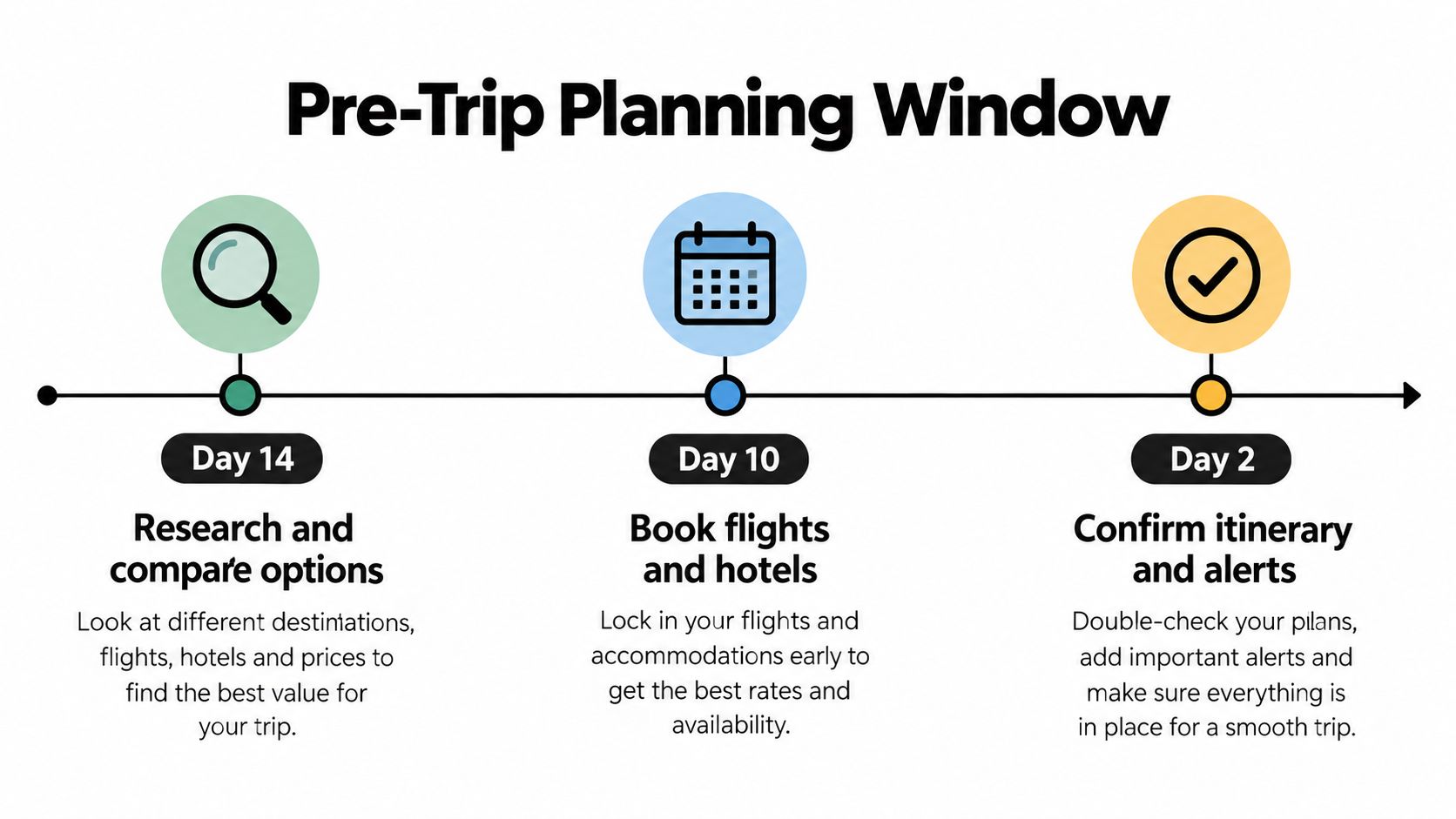
Phase | Required output |
|---|---|
Research | Business objective, essential participants, meeting dependencies, acceptable risk |
Book | Approved route, accommodation, ground arrangements, spending authority |
Confirm | Checked reservations, current contacts, traveler acknowledgment, coverage handoff |
Start with the commercial question: What outcome requires being there? A negotiation with essential stakeholders may justify travel. An update meeting that everyone could attend remotely needs a stronger argument.
Set the budget around the complete trip: transportation, lodging, meals, ground movement, and potential changes. Resolve policy exceptions before buying anything, using a review of corporate travel policy best practices to structure the approval conversation.
Include the departure workload
For a working parent, preparation also includes packing and household handoffs. Urban Totes' travel packing advice for busy moms is a practical companion resource to review while organizing carry-on essentials, rather than adding another task to departure night.
Close planning with explicit ownership: who maintains the document, who validates alternatives, and who takes the overnight call? Name those people before departure.
To a skeptical CFO, defend this preparation as controlled decision-making, not guaranteed savings. The team is spending time before departure to avoid improvising approvals and supplier coordination when the traveler's working time is most valuable.
Building the Itinerary as an Operating Document
ISO 31030 provides the right scaffold: establish objectives and risk appetite, identify hazards, assess likelihood and impact, select proportionate treatments, communicate responsibilities, and monitor outcomes. Its travel-risk-management framework covers policy, program development, assessment, prevention, mitigation, evaluation, and review.
Apply that rigor to time as well as safety. A route can be technically bookable and still be unsuitable for a meeting that can't move.
Build the control sheet
Keep a concise operating summary with secure access to supporting documents. Don't scatter sensitive traveler information across forwarded email chains.
- Traveler and purpose: Record identity, emergency contacts, trip objective, and the meetings that determine whether travel succeeds.
- Entry and destination flags: Track passport and visa requirements, verification status, and relevant health, security, and information-security concerns.
- Reservation controls: Include booking references, cancellation terms, rebooking rules, payment arrangements, and approval limits.
- Accommodation criteria: Record location requirements, safety considerations, acceptable hotel chains, and late-arrival arrangements.
- Movement requirements: Specify the traveler's minimum connection buffer, rebooking airline priority, pickup instructions, and backup ground option.
- Accountability: Name the escalation owner and covering colleague for each critical leg.
Don't substitute a generic connection preference for a route-specific assessment. The traveler's minimum buffer should reflect the actual transfer, baggage arrangements, border procedures, and meeting stakes.
Give every critical movement a fallback
The most useful itinerary fields sit beside the booking, not in a separate document nobody opens.
Movement | Primary option | Fallback and trigger |
|---|---|---|
Flight | Approved routing | Alternative routing if cancellation threatens the required arrival |
Hotel | Confirmed property | Acceptable replacement if the room becomes unavailable |
Ground transfer | Scheduled pickup | Vetted alternative if the driver can't meet the revised arrival |
Key meeting | In-person attendance | Remote participation or agreed rescheduling if arrival becomes infeasible |
A fallback must be viable, not merely conceivable. Check whether someone can book it, whether it preserves the business objective, and what approval it needs.
For example, a U.S.–China sales itinerary should connect entry-document checks with every transportation leg and local pickup instruction. A replacement international route isn't useful if nobody has checked its entry or transit implications.
The test is whether a colleague unfamiliar with the trip could execute the next decision without asking the traveler to reconstruct the context.
For an Assistant team, this document offers value. Capture recurring preferences during onboarding, apply them consistently, and escalate genuine exceptions. Keep a version owner, record material changes, and make the latest itinerary accessible even when the traveler can't open the usual workspace.
Cost Versus Time Tradeoffs You Should Stop Getting Wrong
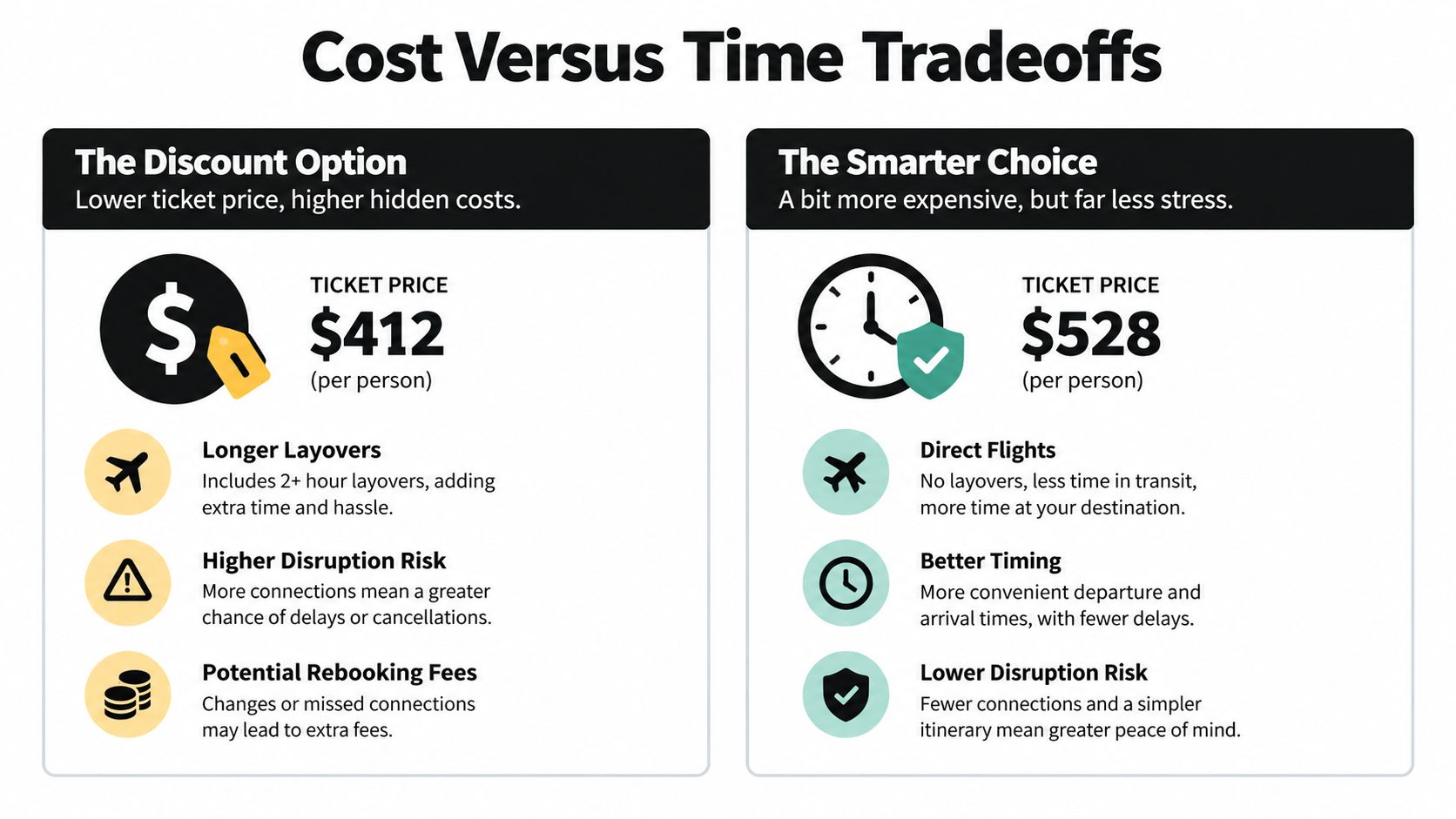
The lowest fare is not the lowest trip cost. Procurement should compare complete itineraries, not isolated tickets.
GBTA's 2025 Business Travel Index coverage projected approximately $1.57 trillion in worldwide business-travel spending for 2025, representing 6.6% year-over-year growth. At that scale, travel deserves the same scrutiny as other operating investments: what are you buying, and what business outcome does it support?
Use the comparison below as a prompt to price hidden requirements, not as proof that a direct flight always wins.
Compare the complete cost stack
Cost component | What the reviewer should examine |
|---|---|
Ticket | Fare, included services, change conditions |
Ground | Airport transfers and travel between hotel and meetings |
Lodging | Required nights and location relative to the work |
Disruption reserve | Currently priced alternatives and approval capacity |
Opportunity cost | Unbillable travel time, lost preparation, meeting consequences |
For a hypothetical domestic meeting run across two cities, compare a discounted connecting route with a better-timed direct option. Obtain current replacement-flight and transfer quotes before approval. If the connecting option requires another hotel night or sacrifices preparation time, show those costs alongside the fare difference.
Don't invent a revenue value for a missed meeting. Ask the business owner to state its consequences, and use an agreed internal hourly value when pricing work time.
Overseas travel needs a wider comparison
For a hypothetical transatlantic sales trip, compare airport-to-meeting time, arrival readiness, change flexibility, and the feasibility of alternative routing. A cheaper ticket may still be sensible when the schedule has room and the fallback is workable.
Include communication arrangements in the review. BubblyPhone's guide to cheap overseas calls at hotels is a relevant resource to consult before choosing how to make business calls abroad.
Approve the higher fare when the documented total-cost comparison supports it. Reject the upgrade when it merely reflects preference without protecting useful time or the business objective.
Why Human Escalation Beats Any App at 3 A.M.
At 3 a.m., a canceled flight can threaten a morning meeting, a hotel booking, and a ground transfer at once. Choosing a replacement that protects the meeting, coordinating those downstream changes, and securing any blocking approval requires judgment across dependencies. The advantage is accountable decision-making, with technology supporting the work.
Perk's 2025 travel-disruption survey found that 89% of global business travelers experienced disruption during the preceding year. Among affected U.S. travelers, 77% had to rebook, replacement trips cost companies an average of 27% more, and 46% missed or arrived late to meetings. The survey estimated annual U.S. mitigation costs at more than $17 billion.
The business trip plan should name a person responsible for keeping decisions and follow-ups moving when suppliers or schedules change.

Test the coverage rather than the promise
A corporate desk staffed only during business hours leaves an overnight gap. A scripted booking provider may rebook a ticket but fail to contact the meeting organizer or adjust ground arrangements. Verify the provider's actual scope. A confirmation email does not establish end-to-end coverage.
Ask candidates to show how they would manage a canceled flight, an unavailable hotel, and a changed meeting together:
- Triple-channel access: Calls, SMS, and email must reach someone authorized to act. Give all three channels equal monitoring priority.
- Shared coverage: A covering team member should inherit the itinerary, preferences, and approvals without requiring another briefing.
- Decision authority: Define which actions the team can take and which exceptions need your approval.
- Document discipline: Record confirmed changes and unresolved items in the shared plan.
Accountability matters more than geography alone
For offshore support, assess access controls, communication quality, discretion, and responsibility for errors. Location alone does not prove competence. A US-based team should also explain how it protects sensitive information and manages handoffs.
Approved Lux offers a subscription-based, US-based human Assistant team for travel coordination, scheduling, and related administration, with around-the-clock coverage. It can complement an internal travel operation or a travel-management provider with appropriate staffing.
Proactive Preference Learning should reduce repeated explanations on later trips. The operational payoff is delegated decisions, completed follow-ups, and less second-shift coordination.
A Disruption Playbook You Can Actually Execute
Write the response sheet before departure. Each scenario needs a trigger, response, fallback, owner, and named field to update.
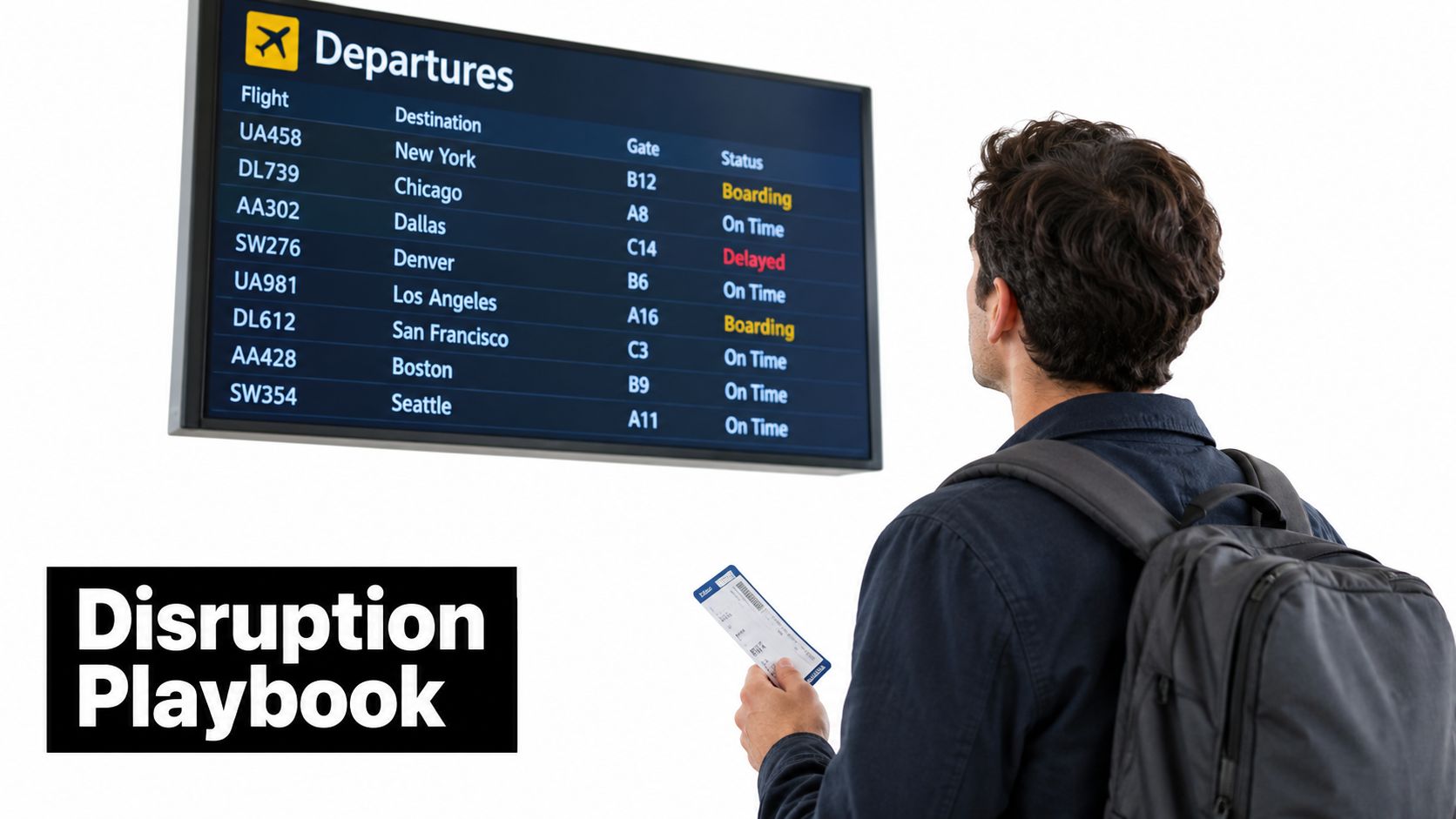
The departure board tells the traveler what changed. The playbook must tell the covering colleague what to do.
Cancellation before a time-sensitive meeting
Trigger: The canceled flight makes the required arrival infeasible. The escalation owner checks approved alternative routes against the meeting deadline, obtains any necessary spending approval, and coordinates downstream changes.
If no viable route remains, activate the agreed remote-participation or rescheduling option. Notify the meeting organizer once the revised attendance plan is credible, rather than sending speculative updates.
Log “meeting viability and revised routing”, including the decision, approval, confirmed reservation, and affected contacts. A structured travel emergency assistance plan can help keep those responsibilities explicit.
Missed connection at an unfamiliar hub
The trigger is a lost onward connection or a transfer that no longer meets the documented buffer. The covering owner assesses the next workable departure and whether the traveler needs accommodation and ground transport.
If continuing would undermine safe arrival or meeting readiness, use the approved overnight fallback. Log “connection recovery and accommodation status”, separating booked arrangements from options still awaiting confirmation.
The traveler should receive a compact action message:
- Current status: What's confirmed and what remains unresolved.
- Next action: Where to go, whom to contact, or whether to wait.
- Approval needed: The specific decision required from the traveler or business owner.
Use this video as a discussion prompt when rehearsing airport-disruption responses.
Late-night arrival beyond pickup coverage
Trigger: The revised arrival falls outside the driver's agreed availability or conflicts with hotel check-in arrangements. The ground-coordination owner reconfirms the pickup and hotel arrival, then activates the vetted transport fallback if needed.
For groups, include passenger and luggage capacity in the replacement decision. Unique Private Transportation's discussion of right-sized vehicles for executive groups is a useful planning resource to consult.
Log “arrival handoff confirmation” with the pickup location, driver contact, hotel acknowledgment, and traveler notification. These response sheets can support requests to an Approved Lux Assistant team through Lux Solo or Lux Circle, subject to the traveler's booking permissions and supplier availability.
Protecting Capacity and Measuring Whether the Plan Worked
A full calendar doesn't prove a productive trip. If the traveler finishes the final negotiation exhausted and returns to an immediate household backlog, the itinerary reviewer missed part of the cost.
SAP Concur's overview of business-travel complexity reports that 30% of surveyed travelers travel more than they'd like; it also cites GBTA findings that 39% of travel buyers saw increased linked multi-meeting or multi-destination trips and 33% saw longer trip durations.
Protect usable capacity
Set maximum meeting density with the traveler and business owner. Protect sleep windows, leave recovery space after long-haul travel, and identify meetings suitable for remote attendance.
For working parents and caregivers, document the household handoff and what changes if the return slips. Reserve a post-trip re-entry block for follow-ups, expenses, and preparation rather than treating arrival home as immediate readiness for a packed calendar.
Capacity test: Judge the itinerary by the work the traveler can perform well, not the number of appointments that fit.
Measure execution rather than booking activity
ISO 31030's executive-summary guidance includes benchmarking, metrics, communication, recording, reporting, and continual monitoring. Turn that into a compact review:
- Readiness: Itinerary completeness before departure and traveler acknowledgment of risk information.
- Resilience: Percentage of critical movements with documented fallbacks.
- Response: Time from disruption alert to traveler contact and proposed rebooking.
- Record quality: Percentage of material changes captured in the shared itinerary.
- Outcome variance: Planned versus actual arrival times, costs, and meeting attendance.
Reconcile spending through a consistent business travel expenses process, then review what caused avoidable work. Update preferences, approval rules, and supplier choices from actual experience.
A stronger business trip plan produces fewer low-value decisions and preserves more productive hours. Measure those outcomes before claiming the process worked.
Approved Lux provides a subscription-based human Assistant team for itinerary building, travel changes, scheduling, and the personal logistics surrounding a trip. Visit Approved Lux Personal Assistant to explore Lux Solo or Lux Circle, and bring your next itinerary, travel preferences, and escalation requirements to the onboarding conversation.
Updated