Virtual Assistant Responsibilities: A Practical Guide
Learn which virtual assistant responsibilities to delegate, how to hand off full task loops, and how to measure the hours you reclaim.
14 min read

The United States employed 15.795 million people in office and administrative support occupations in 2024, according to the U.S. Bureau of Labor Statistics, down about 159,000 from 15.954 million the year before. That figure should reset how you think about virtual assistant responsibilities. This isn't a boutique service category for people who can't organize a calendar. It's a labor function the size of a mid-sized country's entire workforce, and it's being redistributed rather than eliminated.
Inside that number, 234,000 people worked as executive secretaries and executive administrative assistants, and 1.758 million worked as secretaries and administrative assistants outside legal, medical and executive roles. Those jobs have never been mostly typing. They are calendar coordination, correspondence, document preparation, meeting support, information handling and operational follow-through, all of which require judgment the moment two priorities collide.
The useful way to read the shift is this. A task is a single action. A responsibility is a loop with an owner, a deadline and a definition of done. First-time delegators often hand over tasks and keep the loop, which is why they end up more tired than before.
Core Virtual Assistant Responsibilities at a Glance
Virtual assistant responsibilities fall into six recurring areas, and each one can be delegated to a different depth. The split matters more than the list. The most common failure isn't hiring badly, it's handing over a task without deciding how much of the thinking travels with it.
The 2026 Vimcal report on executive assistant work attributed 29.3% of administrative and executive assistants' time to scheduling and calendar management, 21.5% to email and communication management, and 13.5% to travel booking. Those three areas account for roughly two thirds of the working day, which is where your first hour of reclaimed time will come from.
Responsibility Area | Typical Tasks | Share of Assistant Time | Delegation Level |
|---|---|---|---|
Scheduling and calendar management | Booking, rescheduling, de-conflicting appointments, deadline reminders | 29.3% | Full loop |
Email and communication management | Inbox triage, drafting replies, chasing open threads | 21.5% | Prepare and approve sensitive threads |
Travel booking | Flights, hotels, ground transport, itinerary changes | 13.5% | Full loop with real-time changes |
Research and vendor vetting | Comparing vendors, shortlisting options, checking prices | Part of the remaining 35.7% the report doesn't break out | Prepare options, client selects |
Errands and household coordination | Gift sourcing, home-service bookings, dry cleaning | Part of the remaining 35.7% | Full loop for routine items |
Document and meeting preparation | Formatting documents, briefing packs, expense tracking | Part of the remaining 35.7% | Prepare and approve |
What Each Row Actually Covers
Scheduling means booking, moving and de-conflicting appointments, then sending deadline reminders before they fall due rather than after. Email means triaging what arrives, drafting replies for approval and chasing threads nobody has answered. Travel covers flights, hotels, ground transport and the itinerary changes that follow a cancellation.
Research is comparison work: vetting vendors, shortlisting options, checking prices against each other. Errands run from gift sourcing to dry cleaning to booking a repair. Document and meeting preparation is formatting, building briefing packs and tracking expenses.
Three Delegation Levels
Full loop means the assistant owns the outcome and reports completion. Prepare and approve means options and drafts come to you, and you make the call. Client decides covers anything with legal, medical, financial, tax, safety or relationship consequences, where the assistant supplies context and nothing more.
A quick exercise before you read further. List every task you personally handled last week and match each one to a row in that table. The largest recurring block is your first handoff, not the most annoying one.
Which Decisions Stay With You
Delegation works when the boundary is explicit: the assistant prepares, executes and reports the loop; you keep the decision where the consequence lands on you. That boundary reduces operational noise, measured by fewer unresolved choices, fewer repeated questions and fewer moments when nobody knows who owns the next step.
Workplace research supports retaining human judgment at higher-stakes points. In a 2025 Sogolytics study of AI at work, 54% of employees said AI-generated work should always receive human review, while another 21% supported audits for critical decisions only. The practical reading is simple: hand off repeatable preparation, keep approval where stakes rise.
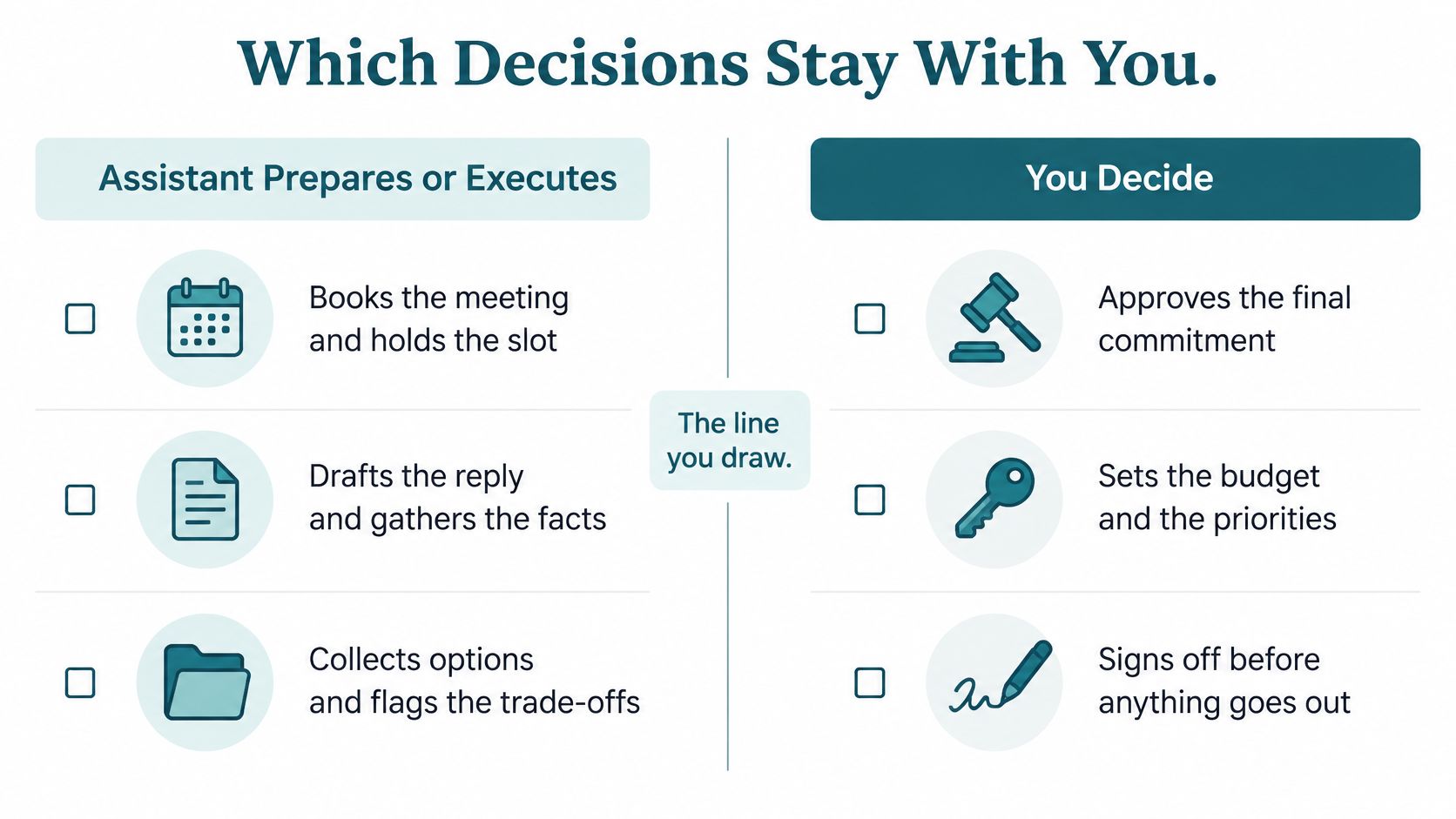
Where the Line Falls
Read the table as a working boundary rather than a rulebook. The left column is volume work that benefits from consistency and a clear owner. The right column is where accountability stays with you, because the outcome affects your money, health, legal position, safety or relationships.
Task | Assistant Prepares or Executes | You Decide |
|---|---|---|
Calendar conflicts | Proposes resolved time slots, books, reschedules and de-conflicts appointments, then sends deadline reminders before they are due | Approves any meeting moved with a client or partner |
Vendor selection | Compares, vets, shortlists and researches vendors, including sourcing deals and negotiating prices | Picks the vendor and signs the contract |
Medical or legal appointments | Finds providers, books slots and sends required documents | Decides on treatment or legal strategy |
Email replies | Drafts responses for review and works alongside your accounts | Approves sensitive or relationship-critical messages |
Spending | Tracks expenses and flags items outside policy | Approves any payment above the agreed limit |
An assistant can prepare options, compare vendors, draft communications, monitor deadlines and escalate ambiguity. What stays with you is anything with legal, medical, financial, tax, safety or sensitive relationship consequences. That division is what makes the arrangement work. A complete loop still has an owner, and the owner is sometimes the assistant, sometimes you.
The trade-off is straightforward. If you keep execution, you absorb reminder chasing and option gathering. If you hand off execution without naming the approval point, errors travel farther before anyone catches them. Good delegation sits between those failures: the assistant moves routine work forward, then stops at the exact point where judgment changes the outcome.
The Access Boundary
One practical constraint shapes the whole model. Our team never logs into your email or calendar accounts and works alongside those accounts rather than inside them. You keep the keys. The assistant works from what you forward, share or ask for, and the account stays under your control.
Practical rule: if you can't state the approval threshold, the sensitive categories and the escalation contact in three sentences, you haven't delegated. You've abdicated and hoped.
Three checks before anything leaves your desk. First, write down approval thresholds in currency and in kind, such as "any spend over a set figure comes to me." Second, list the categories that always come back: legal, medical, financial, tax, safety, family. Third, name the escalation contact and the channel for a genuine emergency. Set those answers before handing off scheduling, errands or research, because each loop needs a clear stop point.
How to Hand Off a Complete Task Loop
A booking is a transaction. The loop around it is the responsibility. Research on household cognitive labor describes that work as four linked activities: anticipating needs, identifying options, choosing among them and monitoring outcomes. Delegate only the visible transaction and you keep the harder half, which is remembering, deciding and following up.
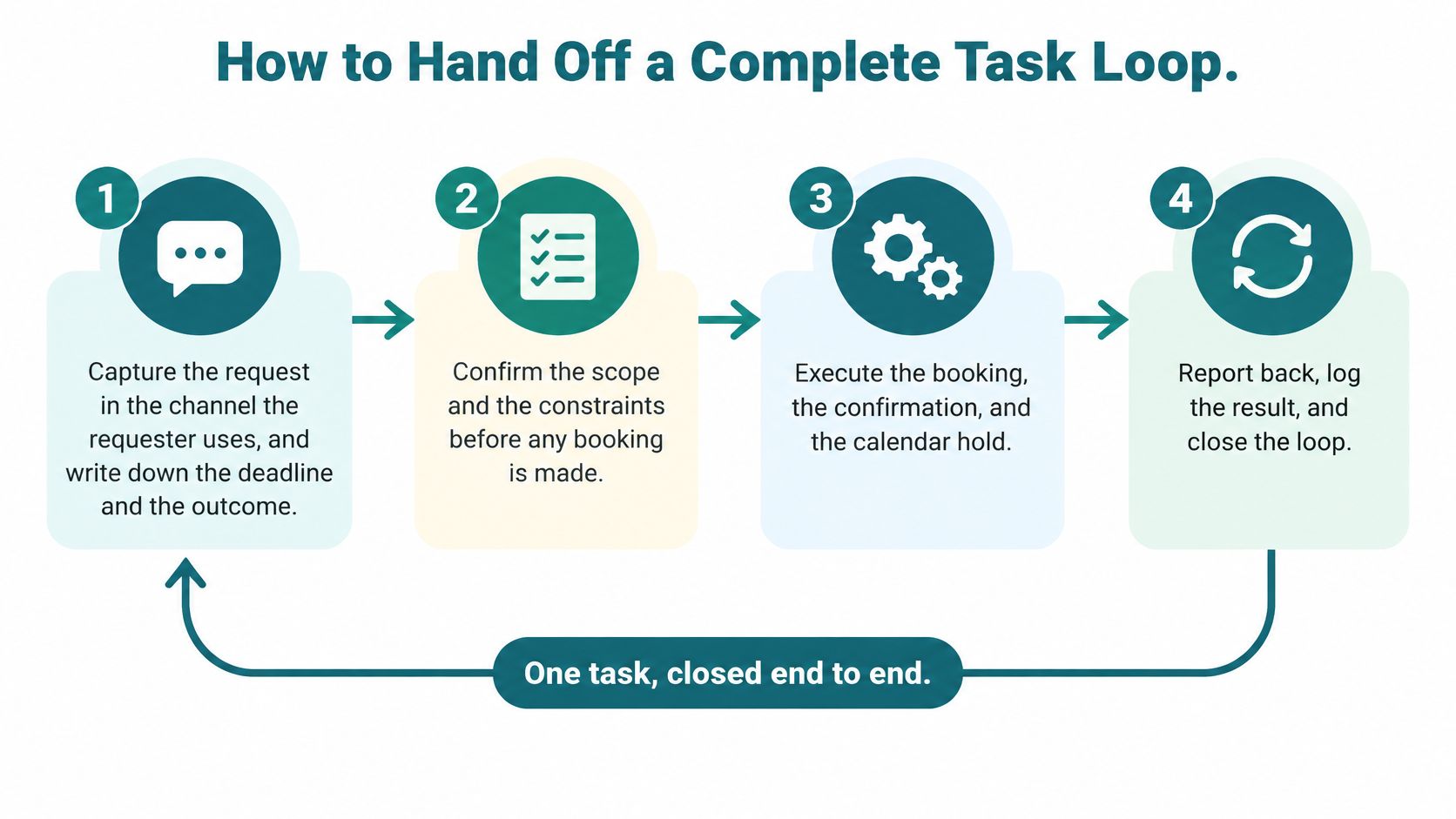
The Seven Steps
- Capture the request in the channel the requester used. If it arrived by text, log it from the text. Write down the deadline and the outcome wanted, not just the topic. A vague request produces a wrong booking, and a wrong booking costs more to fix than it saved.
- Clarify constraints in one message, not five. Budget, people involved, dates and must-have criteria belong in a single round of questions. The common slip is drip-feeding requirements over a day, which restarts the research each time.
- Check priorities against existing commitments before acting. A new meeting that collides with a school pickup or a board call is a conflict, not a booking. Surfacing it before the slot is taken is worth more than executing quickly.
- Research and compare, then shortlist no more than three options. Three is enough to expose a trade-off and few enough to decide in a minute. A list of twelve is research theater and pushes the work back to you.
- Execute within the agreed spending limit and confirm in writing. The confirmation is the proof, and it should arrive without you asking for it. Preference history earns its keep because the same seat type, room standard and meeting length get applied next time without a briefing.
- Report status and place the result on the calendar with reminders set. Skipping this step is the most common reason a finished task still feels unfinished. If the outcome isn't on the calendar with a reminder ahead of the deadline, it will be forgotten.
- Close the loop and record anything new. Confirm completion, then log the preference you learned, such as a tighter meeting length or an airline you'd rather avoid. A closed loop produces one confirmation message and no follow-up.
What a Closed Loop Looks Like
Members work with a team rather than one assigned person, so requests are covered when someone is off, and preferences and history stay with the account rather than with an individual. Whoever picks up the next request already knows how you like things done. That's the difference between re-briefing every time and compounding context.
The test of a well-run loop is simple. You read one confirmation, you didn't chase anyone, and the thing is on your calendar with a reminder you didn't set yourself.
If you want the underlying method in more depth, this guide to delegation of work covers how to sequence handoffs so each one builds on the last.
Handling Travel and Schedule Disruptions
A 6 a.m. cancellation with a 9 a.m. client meeting in Chicago is a complete loop with a named owner, not a single rebooking task. Once the disruption is reported, the assistant team compares the next viable connection against the meeting time and the drive in from the airport, changes the hotel if arrival shifts, and arranges ground transport. You still own the decision on whether the meeting moves. The team owns the sequence after that, so you are not working three vendors from a queue.
Judge the handoff by the noise it removes. A new ticket that still leaves you checking gates, hotel cutoffs and car timing has not finished the job. The loop is closed when one revised plan replaces those parallel threads.
Summer flying is where that plan earns its place. A 2025 AAA Northeast analysis of federal aviation data found that U.S. flights departing June through August made up 26% of the year's flights but 31% of all delays and 31% of all cancellations. Summer departures were on time only 72% of the time, against 78% the rest of the year. Flights leaving in the 6 a.m. hour carried about a one-in-nine chance of delay or cancellation during the period studied.
Use those figures as planning inputs, not a promise about your route. An earlier departure lowers exposure. A contingency still has to exist, because the averages say nothing about one connection.

After you report the change, run six stages: receive, compare, rebook, adjust lodging, arrange transport, confirm. Travel work here is flight and hotel research, booking and changes, plus car services, rentals and rideshare coordination. The team does not watch a flight board in real time, and it does not call your client. Coverage is what keeps the stages from stalling. The assistant team is US-based and available 24/7/365, and members get a team rather than one assigned person, so a cancellation before dawn does not wait on one person's day off.
Ground transport often has to change with the new arrival. An airport transfer and a car held through an afternoon of meetings are different bookings, and both stay inside the same loop. When the day needs the car on standby rather than a single run, hourly chauffeur hire across Britain is the kind of booking that belongs inside the loop, not outside it. On a Lux account, that same hold is handled as car service, rental or rideshare coordination in the United States.
What to Pre-Approve
Two decisions let the team move without a reply on every option. Set a rebooking budget, the amount they can spend to protect the meeting, and a contact rule, such as a delay past a stated threshold or a fare above that budget. Without both, the replacement flight is often gone by the time you answer. I would lock both before the outbound leg, not during the delay. How to structure the wider handoff is in our guide to travel and logistics coordination.
Household Coordination as Operational Work
The numbers here are hard to argue with. Research summarized by the University of Bath found that mothers in the United States handled 71% of household mental-load tasks, and performed 79% of daily jobs such as cleaning and childcare, compared with 37% for fathers. The same research cited Gallup findings that working mothers were twice as likely as fathers to consider reducing work hours or leaving employment because of parental responsibilities.
That second figure is the one that reframes the argument. Household coordination isn't an inconvenience to be absorbed. It's a measurable operational cost with a career consequence attached, and it falls unevenly.
Why the Whole Loop Matters More Than the Errand
Delegating a single booking saves minutes. Transferring the loop removes the recurring mental thread. Consider a school enrollment deadline. The deadline is identified, requirements are gathered, providers are contacted, options compared, the choice confirmed, and the arrangement placed on a shared calendar with reminders. No parent has to hold the next step in their head, and no parent has to ask whether it was done.
The same pattern covers pediatrician appointments, summer camp registration, birthday party logistics, household repairs, gift sourcing and vendor follow-ups. What changes isn't the difficulty of any one item. It's the number of open threads running in the background during a workday.
Shared Context Beats Duplicated Effort
Two partners coordinating without a shared record duplicate work constantly, comparing the same three pediatric dentists and contacting the same two repair services. When preferences, dates, contact details and pending decisions sit in one place, that duplication stops. Households on a shared account get exactly this benefit, with appointment booking and de-conflicting handled for everyone on it. Our guide to home service coordination covers how that looks across repairs, maintenance and recurring vendors.
What Stays Out of Scope
The team does not act as house sitters or in-home caregivers. It finds, vets and schedules the people who do. It also doesn't provide medical, legal, financial or tax advice, and it won't decide what treatment a family member should receive or how a contract should be structured. Those stay with you.
The sign it's working: fewer interruptions during the workday, fewer questions at 9 p.m. about who booked what, and a calendar that reflects commitments rather than intentions.
Measuring Whether Delegation Pays Off
Support has a benchmark price, which makes this a capacity decision rather than a lifestyle one. The U.S. Bureau of Labor Statistics put the median annual wage for executive secretaries and executive administrative assistants at $76,590 in May 2025, with the middle half earning between $61,390 and $94,390. At the median, base pay alone runs about $6,383 a month before employer taxes, benefits, recruiting, equipment, paid leave and the management time that goes into supervising anyone.
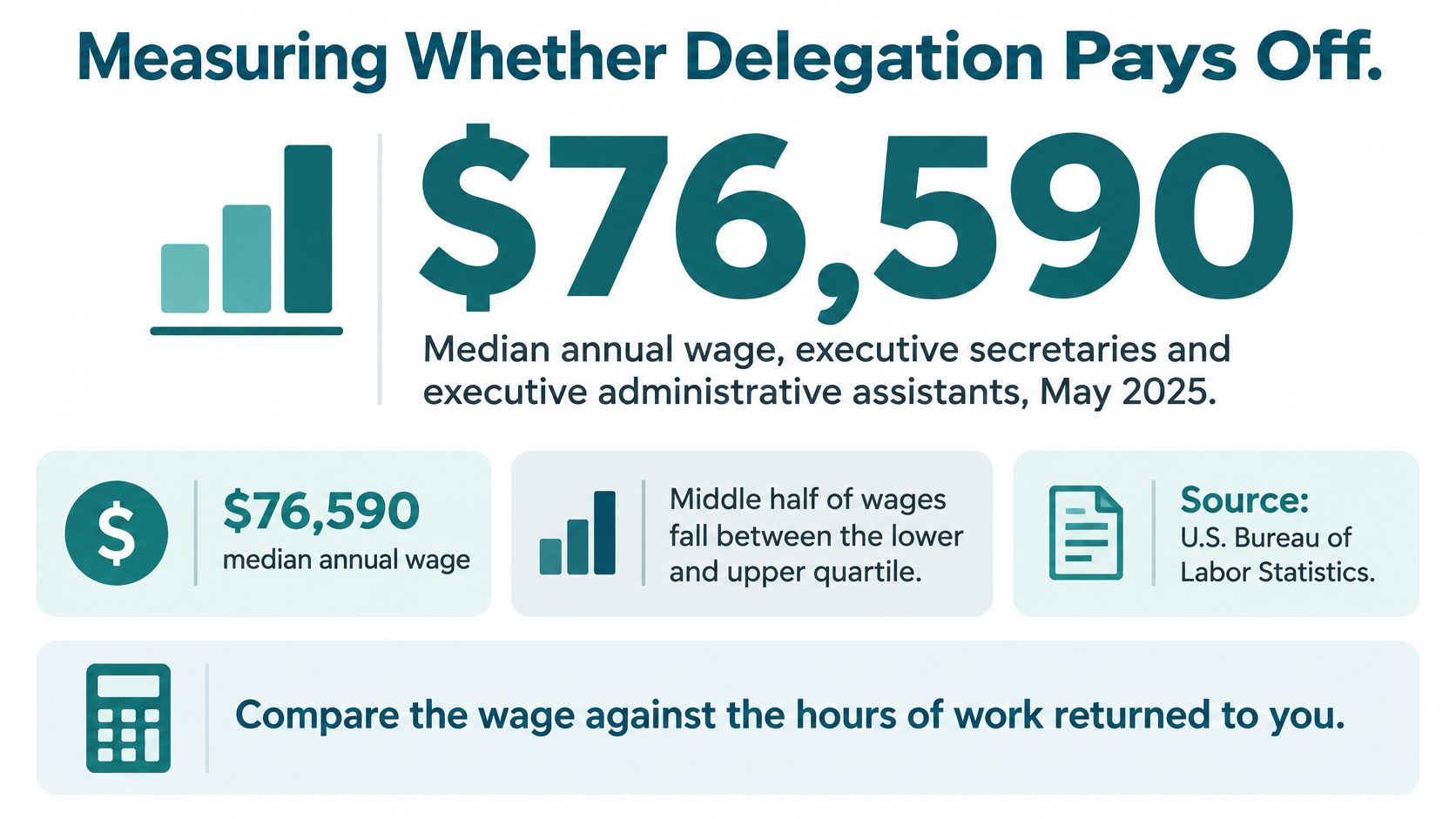
The Three-Step ROI Test
Work out your effective hourly value first. Estimate how many hours of high-value work the delegated tasks will recover each month second. Compare the recovered value against the fixed cost of whatever support you're considering third.
Run it with real numbers. Say a founder's time is worth $200 an hour and she reclaims six hours a week. That's roughly $5,200 of time recovered per month, before counting the decisions that get made on Tuesday instead of Friday. If the support costs less than that recovered value, the question stops being whether she can afford it.
Metrics That Signal It's Working
Metric | How to Measure It | Signal It Works |
|---|---|---|
Tasks closed per week | Count requests marked complete | Rising count with fewer follow-ups |
Hours reclaimed per month | Log time on delegated tasks before and after handoff | A measurable block of hours returned to priority work |
Deadlines met without intervention | Count deadlines closed without your reminder | Steady rise over the first month |
Decisions escalated to you | Count items returned for approval | Falling count as thresholds are refined |
Don't measure inputs. Message volume, response speed on trivial items and total requests logged all rise when a handoff is going badly, because you're re-explaining things you thought were settled. Measure outcomes: tasks closed, follow-ups prevented, deadlines met without your intervention.
The test measures bandwidth as well as money, and bandwidth is the harder number to put on a spreadsheet. Review the numbers monthly, because the handoff list that fit your quarter three priorities won't fit quarter four.
Set Up Your First Delegated Workflow
Three actions, in order, this week.
Write down one recurring loop and give it an owner. Pick something that repeats, such as school deadlines, travel changes or inbox triage. Note the channel it arrives through, the deadline pattern and the approval threshold that applies. One page is enough.
Choose the loop that interrupts you most often, not the one that's easiest to hand over. Brief it with deadlines, standing preferences and the specific decisions that must come back to you. The easiest task saves the least time.
Review the first month against the metrics above. Tasks closed, deadlines met without intervention, decisions escalated. If escalations aren't falling by week four, the thresholds are too vague, not the assistant.
If you want a US-based team running the loop for you, Approved Lux Personal Assistant is reachable by call, text or email around the clock across travel, scheduling, errands and research. Lux Solo at $99.99 per month covers individual access, and Lux Circle at $299.00 per month covers up to four people on one account, handling requests for anyone on the account and booking and de-conflicting appointments for the whole group. That second option is the one built for households and caregivers who need shared coordination rather than another single-user tool.
Pick one loop. Hand it off today. The list of things you're personally holding will not get shorter on its own.
The difference between delegating tasks and delegating responsibility is the difference between a to-do list that refills and a week that holds. Approved Lux Personal Assistant gives you a US-based Assistant team available 24/7/365 by phone, text or email, with preferences kept on the account so each request starts from what the team already knows. If you're ready to hand over the whole loop rather than the individual errand, visit Approved Lux Personal Assistant and choose the plan that fits how many people you're coordinating.