Timeshare Exit Options Compared: Costs, Steps and Risks
Compare timeshare exit options: developer surrender, resale, rental, donation and V.O.I.C.E. Fees, timelines and contract checks before you sign.
Travel14 min read

Nearly 10 million U.S. households own at least one timeshare product, according to ARDA's media kit. That's a substantial ownership market, but it doesn't mean every owner can find a buyer or recover their purchase price. The important question is not just how to get out. It's whether you need to end ownership, stop recurring costs, or get practical value from weeks you aren't using.
The best timeshare exit options address different problems. A completed surrender can release you from future obligations, while a rental can help with cash flow without changing who owns the interest. Start by identifying the result you need, then evaluate the paperwork and total cost required to achieve it.
Timeshare Exit Options at a Glance
Exit pathways compared on ownership and buyer needs
Pathway | What it does | Ends ownership | Needs a buyer |
|---|---|---|---|
Developer surrender or deed-back | Returns the deed through the developer's exit program | Yes, if the developer accepts and completes the release | No |
Resale through a broker or reseller | Markets the week to a buyer who takes title | Yes, once transfer records are updated | Yes |
Rental of permitted weeks | Earns rental income while the owner keeps title | No | No, a renter occupies the week |
V.O.I.C.E. deposit, exchange or listing | Moves unused weeks into exchange or rental use, up to 5 weeks per year | No | No |
Rescission during cooling-off period | Cancels the original purchase | Yes, within the applicable cancellation window | No |
Donation to a charity | Transfers title to an accepting charity | Yes, if accepted and transferred | No |
A surrender requires the developer's agreement. A resale requires someone willing to take the ownership on the offered terms. Donation also requires an accepting recipient, not merely a service that advertises charitable transfers.
Rental and exchange serve a different purpose. They put inventory to use while you retain the underlying ownership. That can be a sensible choice, particularly when your travel needs have changed but you haven't decided whether to leave permanently.
Separate ownership from financial relief
Ending ownership and ending costs aren't automatically the same event. A listing doesn't release you, and an unsuccessful sale attempt doesn't suspend maintenance fees. Even an agreed transfer needs a clear allocation of outstanding charges and a documented completion date.
Say you no longer travel during your fixed week but still take extended winter trips. Before paying someone to market the ownership, compare the cost of retaining it with alternative accommodation, including long-stay hotel rates. Compare accommodation that actually fits your needs, including kitchens, bedrooms and length of stay, rather than comparing a resort week with an unsuitable hotel room.
Practical rule: Judge an option by what it changes in your contract and budget, not by whether someone calls it an exit.
Prepare a simple ownership file containing the purchase agreement, deed or membership certificate, loan information, recent fee statements and transfer rules. Those documents determine which pathways are available.
Then name your priority: liquidity, relief from recurring fees, or better use of weeks. If you need cash, investigate realistic resale demand. If you need a clean break, prioritize a documented release. If unused inventory is the problem, assess utilization before paying to surrender something you may still use.
Verify the Contract and Spot Scams Before You Pay
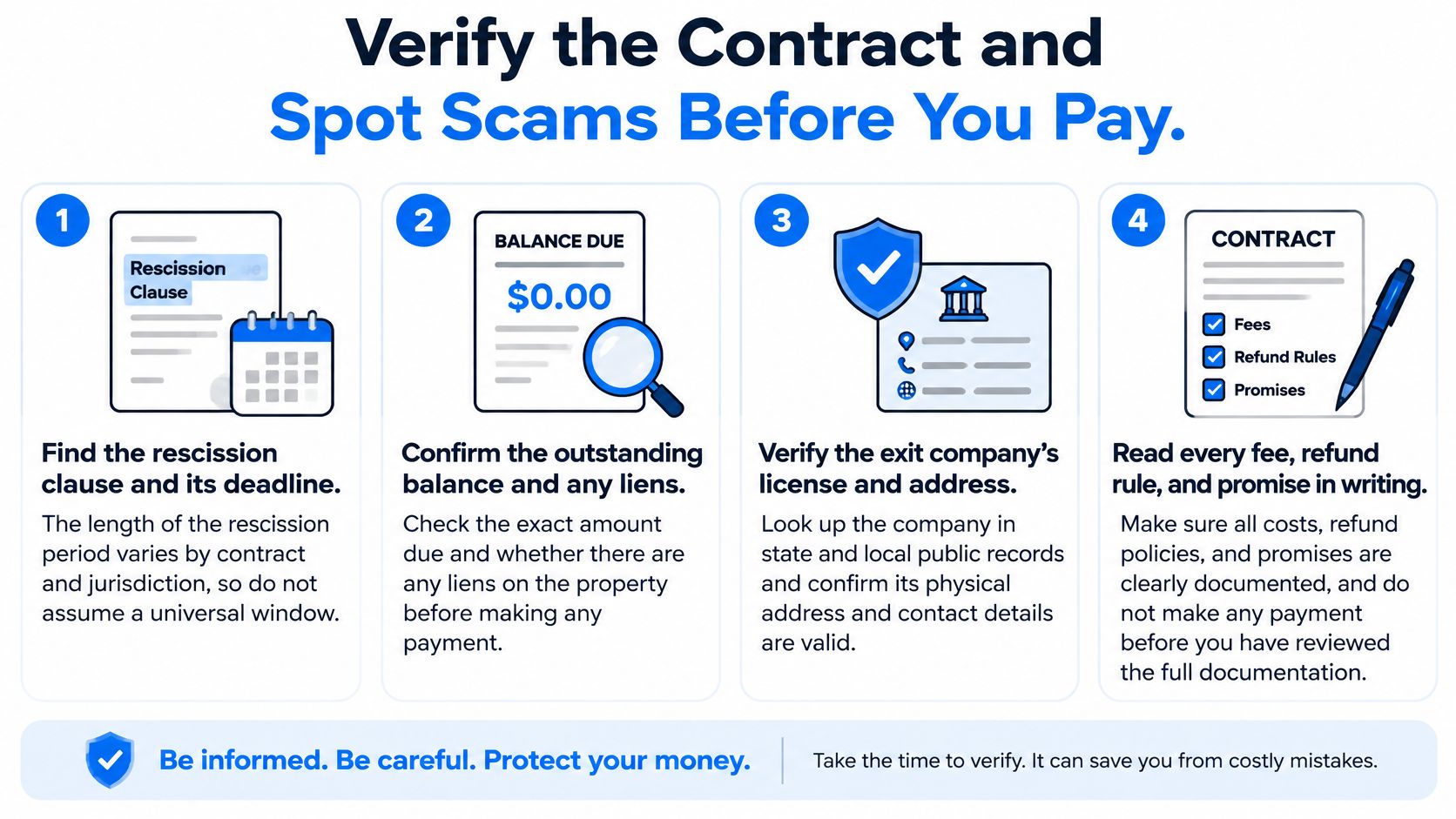
- Find the rescission clause immediately. Record the deadline, cancellation address and required delivery method. The window is set by the applicable contract and jurisdiction, not by a universal industry rule.
- Confirm the financial position. Obtain the outstanding loan balance, maintenance-fee status and any liens or transfer restrictions. An account statement and a loan payoff serve different purposes, so request both when applicable.
- Request the developer's written exit procedures. Ask whether a surrender program exists and which eligibility conditions apply. Contact the company using details from your ownership documents, not a number supplied by an unsolicited caller.
- Calculate the annual carrying cost against expected use. Include maintenance, loan payments, assessments and booking-related charges. Separate costs you owe regardless of travel from expenses incurred only when you use the week.
Treat buyer claims as claims, not evidence
In October 2019, the Federal Trade Commission mailed 8,088 refund checks totaling nearly $2.7 million, averaging $332, to consumers harmed in a timeshare resale scheme involving false claims that buyers or renters were ready. An advertised buyer and a payment request weren't proof of a transaction.
Be cautious about unsolicited calls, guaranteed cancellation, rapid-sale promises and demands for advance taxes or closing costs. Ask who receives each payment, what work it purchases and what happens if the promised transaction never closes. A money-back promise doesn't replace a verifiable counterparty or enforceable contract.
Check a broker's license with the appropriate licensing authority and an attorney's standing with the relevant bar. Check complaints with the state attorney general and consumer-protection agencies. Independently confirm any claimed resort or government affiliation.
Review the document you'll actually sign
Compare the final agreement with the sales conversation. FaxZen's contract signing guide for legal professionals is a useful supporting resource for handling signatures and execution, but signing correctly doesn't establish that the underlying exit promise is sound.
Look for the named service provider, deliverables, payment triggers, refund terms and your continuing responsibilities. If the agreement promises only advertising, don't interpret it as a commitment to transfer ownership.
Pass-or-stop test: If the provider won't put every fee and service in writing, stop before paying.
How to Request a Developer Surrender or Deed-Back
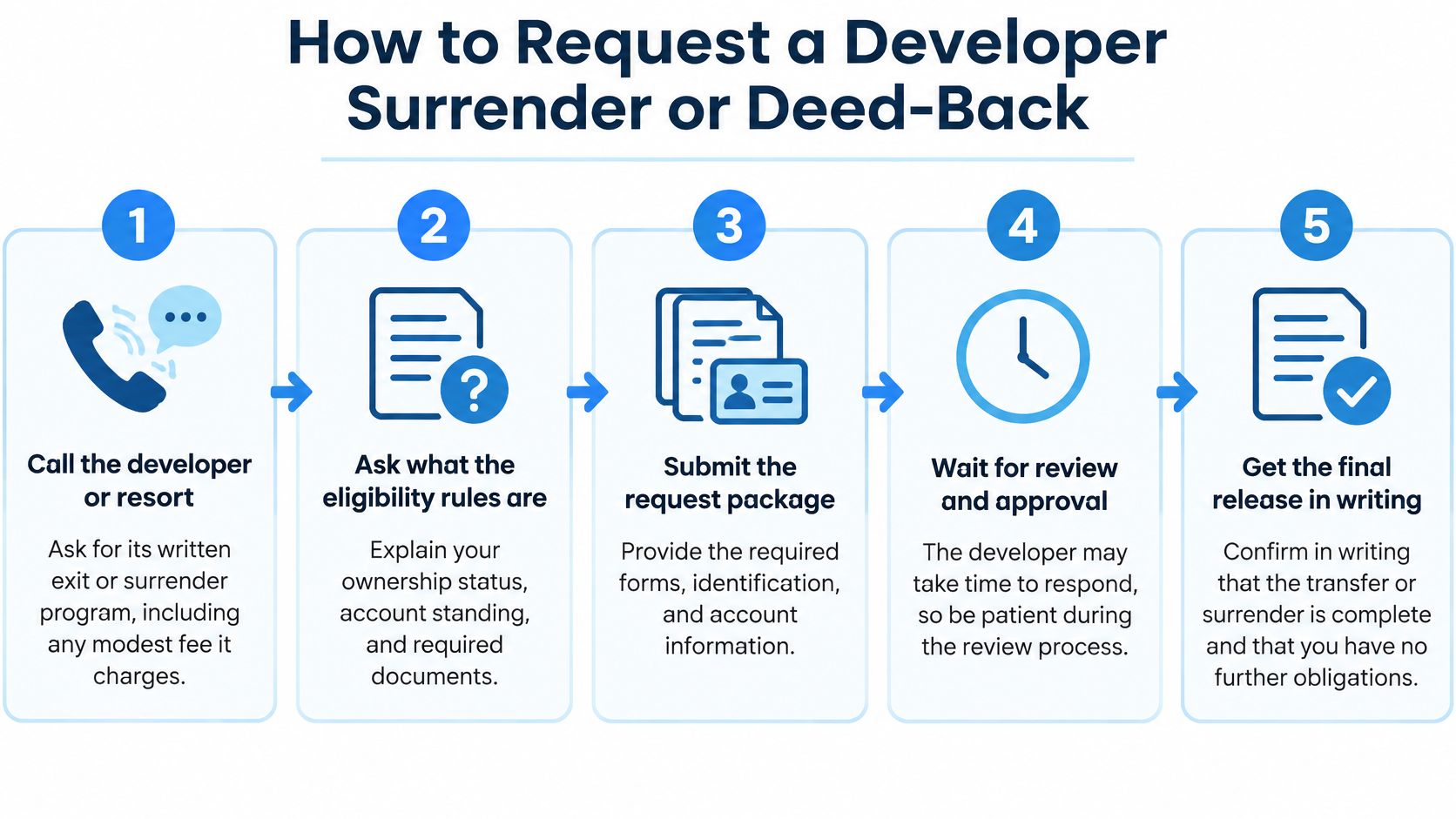
Contacting the developer directly removes an unnecessary intermediary from the first inquiry. The FTC's guidance on getting rid of a timeshare recommends this approach because some companies operate exit programs, sometimes for a modest fee.
A surrender isn't a resale. You're asking the developer to accept the interest and release specified obligations, not to find someone who will pay for it.
Submit a request that can be evaluated
- Ask for the written program. Call the developer or resort and request its current surrender or deed-back procedures, eligibility requirements and fee schedule. Ask where to submit the request and which department handles it.
- Define the proposed release. Ask whether approval ends future maintenance obligations, transfers the deed or membership, and addresses any separate financing. Require an exact liability end date rather than an assurance that the account will eventually close.
- Identify continuing charges and required documents. Request a list of assessments, transfer charges and other amounts payable before completion. Ask about tax reporting or treatment, then take any tax questions to a qualified adviser rather than relying on the representative's interpretation.
- Check whether rescission is still available. For a recent purchase, examine the cancellation provision before entering a surrender negotiation. Don't let a conversation about a discretionary program consume an existing cancellation window.
- Review the release line by line. Match the owner names, account number and ownership description to your records. If the representative promised something the document excludes, resolve that discrepancy before signing.
- Keep the complete record. Save requests, responses, submitted forms and executed documents together. Obtain confirmation that the transfer was completed, not just that your package was received.
Compare the fee with future obligations
Consider a hypothetical owner paying $1,200 annually in maintenance fees. Keeping that obligation for five years would cost $6,000, assuming the fee stays unchanged, before any developer surrender fee or other charges.
That calculation doesn't establish what a reasonable surrender fee should be. It gives the owner a relevant comparison: the documented cost of leaving against the projected cost of keeping an unwanted obligation. Comparing the fee only with the original purchase price can distract from the decision you control today.
Acceptance isn't guaranteed, and surrender shouldn't be evaluated as a route to sale proceeds. Its value is the release it provides. If a loan remains outstanding, don't assume accepting the deed also cancels that separate debt.
A submitted surrender application is a request. A completed surrender needs evidence that the developer accepted it and that your obligations ended.
If approval is conditional, list each condition and who must satisfy it. Keep paying attention to account notices while the application is pending.
The document to hold at the end is a written release letter naming the effective end date, supported by the completed deed or membership-transfer documentation where applicable.
Rescission and Donation Routes
Rescission and donation don't require a conventional buyer, but they work for entirely different reasons. Rescission exercises a cancellation right associated with the original purchase. Donation requires another organization to accept ownership and its associated responsibilities.
Act on rescission before negotiating alternatives
The FTC's timeshare consumer guide explains that cancellation rights can arise under the contract or state law and recommends certified mail with a return receipt.
- Locate the governing clause. Identify the deadline, required recipient and notice requirements. Don't assume business days, mailing dates or delivery dates are interchangeable.
- Send an unambiguous cancellation notice. Identify the purchasers and agreement, and state that you're cancelling. Follow the prescribed delivery rules rather than relying on a salesperson to relay your request.
- Preserve delivery evidence. Keep a copy of the notice, the mailing receipt and the returned delivery confirmation.
For the FTC guide's hypothetical five-day cancellation window, signing on Monday doesn't make mailing on Friday automatically safe. The notice must meet the contract's applicable delivery rules, so act promptly and verify how the deadline is measured.
Treat donation as an ownership transfer
Ask the charity in writing whether it accepts timeshare title and what documentation it requires. A charity's willingness to discuss a donation isn't acceptance.
Before proceeding:
- Confirm transfer permission. Review restrictions and identify any required resort approval.
- Allocate the costs. Document who pays existing assessments, transfer expenses and charges arising before completion.
- Review tax treatment. Ask a qualified adviser whether a deduction is available and what substantiation is needed.
- Obtain acceptance and transfer records. Don't treat a donation-service invoice as proof that the charity owns the interest.
Donation generally isn't a source of proceeds. For rescission, keep the return receipt and cancellation notice; for donation, keep the signed charity acceptance and completed transfer documents.
Resale, Rental and Donation Costs Side by Side
Fee timing and recovery expectations by exit option
Option | Upfront fees | When fees are paid | Recovery expectation |
|---|---|---|---|
Pay-only-after-sale reseller | None charged upfront | When the timeshare sells | Not guaranteed; may be little or none |
Upfront-fee reseller | Charged before any sale | Before any buyer is verified | Unverified; treat as high risk |
Developer surrender program | Modest fee where offered | Set by the developer's program | Ends specified maintenance obligations after completion; no sale proceeds |
Rental of permitted weeks | Any advertising, booking or management charges disclosed in the agreement | Under the rental agreement; ownership charges continue | Offsets carrying costs; does not end ownership |
Donation to a charity | Any required assessment, transfer or processing charges | According to the transfer agreement and applicable law | Ends ownership if accepted and transferred; usually no proceeds |
Payment timing matters more than an optimistic recovery estimate. The FTC's timeshare resale guidance advises owners not to assume they'll recover their original purchase price and recommends choosing a reseller that collects its fee after the sale, when possible.
A provider paid for advertising has delivered its contracted service when it advertises, even if no sale follows. A provider paid only after a completed sale has a different payment trigger. Read the deliverable, not just the headline price.
Build a net-cost comparison
Consider a hypothetical owner paying $1,500 annually in fees, using one week and expecting a $0 resale price. The relevant comparison is whether that week provides enough usable value to justify the carrying cost, or whether a documented surrender would better meet the owner's needs.
If the owner rents instead, calculate net income after permitted rental charges and ownership expenses. Don't count an advertised rental rate as money received, and don't assume an unbooked week will cover the annual bill.
Use a worksheet with these entries:
- Ownership costs. Maintenance, financing, assessments and taxes.
- Transaction costs. Advertising, commission, closing, transfer and processing.
- Usable inventory. Weeks you can reserve, occupy, exchange or rent.
- Expected receipts. Realistic sale proceeds or net rental income, not sales projections.
A practical guide to selling timeshare weeks can help organize the resale task, but the written fee schedule still controls your exposure.
Make every charge visible
Verify the counterparty with consumer-protection agencies and require the contract to match verbal representations. Identify whether the service merely markets the interest or coordinates its conveyance.
If the sale price is unknown and fees are payable upfront, set the option aside until the payment schedule and deliverables are documented. Don't substitute a projected recovery for a cost you'll definitely incur.
Keep Your Weeks Working With V.O.I.C.E.
V.O.I.C.E. manages unused inventory; it doesn't cancel ownership. Maintenance obligations continue while you hold the interest. That limit should be understood before treating deposits, exchanges or rental listings as financial relief.
Through our platform, owners can deposit, exchange or rent their weeks, each up to 5 weeks per year, with no exchange or listing fees. Deposits provide credits, exchanges provide another way to use inventory, and peer-to-peer listings create a rental channel. Neither a listing nor a deposit guarantees cash income or a particular reservation.
Match the inventory to your actual travel
Consider a hypothetical couple who can't use their fixed week in two of every three years. They still travel, but their family schedule no longer matches the resort calendar. Depositing eligible unused inventory can provide travel access while they decide whether to pursue surrender.
That's a legitimate operational choice, not a failed exit. The couple's problem is a mismatch between their assigned inventory and their travel dates, rather than a firm decision to stop travelling.
The choice becomes less suitable if they need immediate cash, can't carry the ongoing fees, or require a destination and date that aren't available. Confirm availability before assigning expected value to an exchange, particularly for a family trip with inflexible school or work dates.
Don't exchange a week on the assumption that your preferred replacement is guaranteed. Establish what you can book before building the rest of the trip around it.
Resolve the credit questions before depositing
Get clear answers to these questions:
- What counts as an eligible deposit? Confirm the reservation documentation, timing requirements and any restrictions affecting your week.
- How are credits issued and used? Understand the acceptance process, redemption rules and whether your intended booking can use them.
- What happens if credits remain unused? Distinguish the terms governing deposit credits from other credit categories, including Reward Credits.
Keep the deposit confirmation and resulting account record. The objective is measurable use of inventory you already control, not another promise of eventual value.
Choose Your First Move and Confirm the Exit Is Complete
Start with your situation, not the easiest-sounding offer. A provider's preferred service may not solve your particular problem.
First move by owner situation
Situation | First move | Watch for |
|---|---|---|
Unused weeks, no urgent cash need | Deposit or exchange weeks through V.O.I.C.E. | Maintenance fees continue while title is held |
Need to stop recurring fees | Request a developer surrender in writing | Release scope and exact end date |
Need cash from the week | Test a pay-after-sale reseller against a written fee schedule | Little or no recovery; no upfront fees |
Bought within the cooling-off window | Send a rescission notice by certified mail with return receipt | Deadline set by the contract and applicable law |
Outstanding loan balance | Request a payoff and balance statement first | Transfer may be blocked until the balance is settled or the lender approves arrangements |
Work in the order that protects your options
Read the contract before committing to a service. An expiring cancellation right deserves attention before a longer resale inquiry, and a loan balance deserves attention before promising an unencumbered transfer.
Next, assemble the payoff statement, maintenance account history and transfer restrictions. Send the developer a written inquiry that identifies the ownership and asks what its surrender program releases. Keep the response with your documents.
Compare the available paths using net cost, completion requirements and the result you need. If you retain title, allocate unused weeks deliberately rather than leaving them unreserved or missing deposit opportunities.
For future trips, compare timeshare alternatives against the travel you take. Separate accommodation planning from the ownership transaction so you don't accept a new commitment merely to resolve the old one.
Bookings through our service are made in the Approved Traveler member portal, which members reach by signing in from the website. That booking process is separate from any legal transfer of an existing timeshare.
Define completion with evidence
For an ownership transfer, request the recorded instrument or equivalent legal document identifying the new owner, then verify that the resort's ownership records match it. A signed listing agreement, a claimed buyer or a pending closing isn't the same result.
Florida provides a specific statutory safeguard. Under Florida Statutes section 721.17, a resale-transfer provider cannot receive compensation before delivering written evidence of completed transfer services, including the recorded instrument or equivalent ownership-transfer document, to both the consumer and the managing entity.
That evidence must include the transferee's name, address and known contact information. This is a Florida rule for the covered provider, not a universal payment rule for every service in every jurisdiction.
Florida owners also have a useful balance-verification tool. Under Florida Statutes section 721.15, the managing entity must provide the specified certificate within 30 days after a written request, identifying current amounts owed and amounts approved for payment during the next 90 days.
Use that certificate to allocate pending charges before closing. It isn't itself a release.
Close the financial record too
After completion, retain the transfer evidence, final account statement and written explanation of any remaining balance. If financing was involved, confirm its status separately rather than assuming the ownership transfer resolved it.
Seek qualified legal advice when documents conflict, ownership is disputed, multiple agreements are involved, or someone asks you to stop paying without explaining the consequences. A legal review should identify the available grounds and risks, not promise cancellation.
This week, request the developer's written exit terms and your current balance statement. Stop with any provider that refuses to document its charges or the service it will perform.
Approved Experiences Traveler offers wholesale travel access and ways to put eligible unused timeshare weeks into deposit, exchange or rental use while you evaluate your ownership options. Visit Approved Experiences Traveler to review how that infrastructure fits your travel plans, without confusing better use of inventory with cancellation of your contract.