Restaurant Reservation Services for Busy Lives
Compare restaurant reservation services by speed, fees, and follow-up so busy households know when a human team beats an app.
13 min read
It's Tuesday at 5:40 p.m. One parent is still in a meeting, you need a table for four at 7 p.m., and the request includes a high chair and a nut allergy. You don't have time to refresh booking apps, call several restaurants, and work out whether an allergy note reached the kitchen.
The useful question isn't just who can find an opening. It's who owns the follow-through: confirming the table, checking the restaurant's response to essential needs, and handling a change before it becomes a fee.
What Restaurant Reservation Services Cover
Restaurant reservation services are the working layer between a dining request and a restaurant's finite seats. They can help locate availability, make the booking, communicate constraints, and manage changes. Those are separate jobs, and not every service handles all of them.
The practical models are direct booking, platform booking, and human coordination. A broker or resale listing belongs in the comparison too, but not as an equivalent route to a dependable reservation.
Three ways a table gets booked
Model | Who does the work | Best when | Typical limit |
|---|---|---|---|
Direct phone or email | Diner or a helper contacts the restaurant | One known venue and a special request | Limited to host-stand hours |
Consumer booking platform | Diner selects a listed slot | Same-day or next-day inventory on participating venues | Only what that platform lists |
Human reservation service | A person coordinates across call, text, and email | Several constraints, backups, or a changing calendar | Fees apply and a named table is not guaranteed |
Broker or resale listing | A third party offers a held table for a fee | Rarely the right path | Integrity and no-show risk for the restaurant |
Use the table as a matching tool. If you already know the restaurant but need to discuss access or a large stroller, contact the venue directly. If your request is straightforward and a suitable slot appears on OpenTable or Resy, a platform may be enough.
Human coordination becomes useful when the request has moving parts: acceptable neighborhoods, alternative times, dietary needs, and someone whose calendar might change. The person doing that work needs permission to make decisions, not just instructions to keep searching.
Digital booking hasn't replaced direct contact
A European study covering 1,200 restaurants in Germany and France, summarized in OpenTable's explanation of how diners book, found that 43% of guests booked ahead, while 64% of advance bookings were by phone, 12% by email, and approximately 6% through third-party platforms. The useful lesson is that direct contact still belongs in the toolkit, especially when a request needs interpretation.
Choosing the room also comes before choosing the channel. For a destination meal, McLaren Vale Cellars' tips for choosing a winery restaurant provide a useful starting point for narrowing the venue before pursuing availability.
None of these models promises a seat at a named venue. A legitimate service can promise a defined process and an accountable response, not inventory the restaurant hasn't released.
How a Request Becomes a Held Table
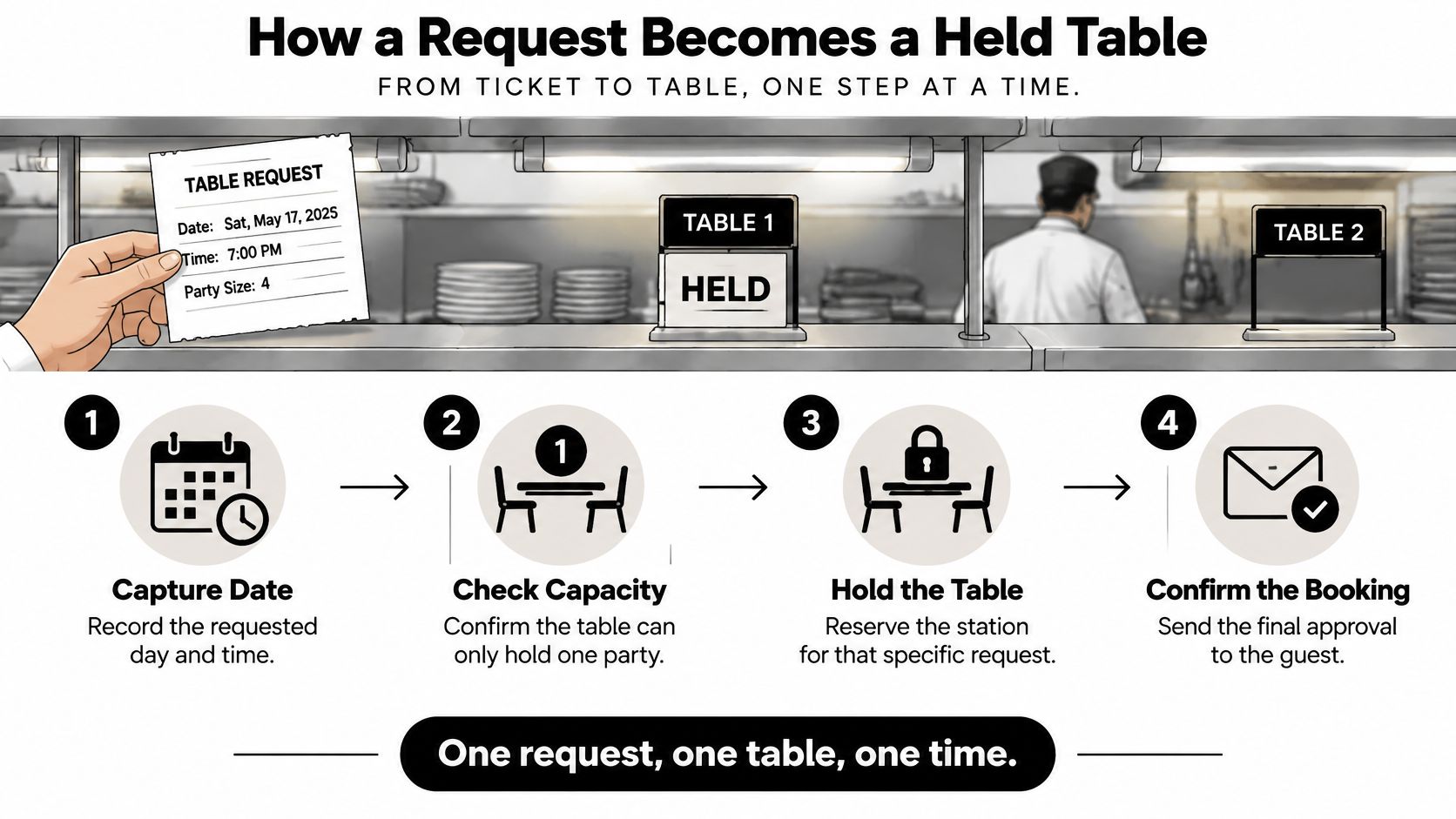
Think of a kitchen pass: the request is a ticket, and the table is a station that can take only one party at a time. An incomplete ticket sends everyone back for clarification. A complete request gives the person booking enough information to act.
Speed matters before the search even starts. Yelp's restaurant industry review reported that 59% of U.S. restaurant reservations in 2023 were made the same day or the day before. For a short-notice lunch, waiting for someone to clarify the neighborhood or spending limit can cost the useful opening.
The booking handoff
- Capture the decision boundaries. Record the date, acceptable time window, party size, neighborhood, budget, and two backup times. Separate a firm arrival requirement from a time that would merely be convenient.
- Check a legitimate channel. Start with the restaurant's own phone number or website, or a booking platform the restaurant uses. Follow the restaurant's booking link rather than assuming an unfamiliar listing is authorized.
- Book one option. Don't create overlapping holds for the same party while continuing to shop. If the preferred restaurant has no space, decide whether to join its waitlist or move to the backup.
- Record the commitment. Save the confirmation name, reference, cancellation deadline, and any card hold. Put the record somewhere the diner can retrieve without searching through someone else's inbox.
- Send preferences and needs separately. A booth preference isn't equivalent to a nut allergy or step-free access requirement. Ask the venue to acknowledge essential needs in writing when the distinction matters.
- Diary the cutoff. Assign someone to release or modify the booking through the permitted channel. A calendar reminder without a named owner still leaves the work undone.
The visual summarizes the movement from request to confirmation.
Booking software and ongoing coordination
A basic automated booking interaction can stop when the diner selects an available slot. Human coordination continues when a guest drops out, the meeting runs late, or the restaurant needs a reply. Some platforms support changes and reminders, but someone still needs to respond.
A platform can't show a room the restaurant hasn't listed. A phone line can't resolve a request after the host stand closes. Choose the route that can answer the actual question, rather than repeatedly trying the same unavailable channel.
For operators examining how guest communication connects with reservation software, Purple Engage tools for ResDiary users offer a relevant integration resource. Diners who want a practical preparation guide can use our explanation of how to book restaurant reservations.
Done means a documented outcome: a written confirmation, a waitlist place, or a clear no, with the next backup already chosen.
A request sent isn't a table held. Keep those statuses distinct in every update.
Speed Reliability and Cost Compared
Choose restaurant reservation services by the operational noise they remove, not by how impressive the service description sounds. The useful checks are time to a first answer, staffed hours, written confirmation, ownership of changes, and visible fees.
A founder arranging a client dinner this week needs an answer they can act on and a record they can forward. A dual-career parent booking Saturday needs after-work access and a clear way to reduce the party if a child gets sick. Those are different coordination problems.
What to compare before you book
Check | Direct restaurant line | Booking platform | Human coordination |
|---|---|---|---|
Speed to a first answer | Whenever the host stand picks up | Seconds if a slot is listed | Use the service's stated response window, expressed in hours |
Hours of access | Service hours only | App is on; the venue may not be | Published staffed hours; around-the-clock access must be explicit |
Written confirmation | If the host sends one | Usually an email or in-app record | Should be standard |
Change before the cutoff | You call back yourself | Self-serve if the app allows it | Someone tracks the deadline |
Fee clarity | No middleman; deposits may still apply | Shown at checkout when the platform discloses them | Check what the subscription or task fee includes |
Read the speed row carefully. An instant acknowledgment isn't necessarily an answer from the restaurant. For the founder, the useful update is whether the client dinner is confirmed, awaiting a venue reply, or moving to another option.
The access row matters to the parent finishing work after the restaurant's booking office closes. An app may accept a reservation then, but it may not resolve a question about seating. Human support can take ownership of the request outside venue hours without pretending the restaurant is also available.
Written confirmation creates a usable handoff. The person attending should receive the address, time, party size, and commitment terms without needing to reconstruct a conversation. Change ownership matters just as much: decide who will act if the guest list shifts.
Book early, then allocate follow-up
An analysis published by resOS covering 3,768,761 advance reservations at 2,417 restaurants recorded no-show rates of 1.96% for bookings made 30 or more days ahead, 2.09% for same-day bookings, and 2.67% for bookings made two to six days ahead, with dinner at 2.63% versus lunch at 1.84%. These observational figures support a prioritization rule, not a prediction for your restaurant: secure an important dinner early, then verify it closer to the date.
Long lead time doesn't eliminate changing travel plans or guest lists. A simple lunch may need fast execution; an important dinner deserves deliberate follow-up.
Separate the fee categories
Direct calls don't add an intermediary booking fee, although ordinary calling charges and venue terms can still apply. Other costs include platform or venue service fees at checkout, deposits, card holds, and subscription or task fees for human help.
A deposit paid toward the meal isn't the same as a service fee. A card guarantee isn't necessarily a charge today. Our guide to concierge service pricing provides context for evaluating assistance costs, but the decision should rest on the actual scope: what's included, what a missed cutoff costs, and whether response time is defined.
Pick a platform for a listed, simple slot; the direct line for one complex room during staffed hours; and human help when the search would otherwise consume the evening.
Deposits Cutoffs and Booking Integrity
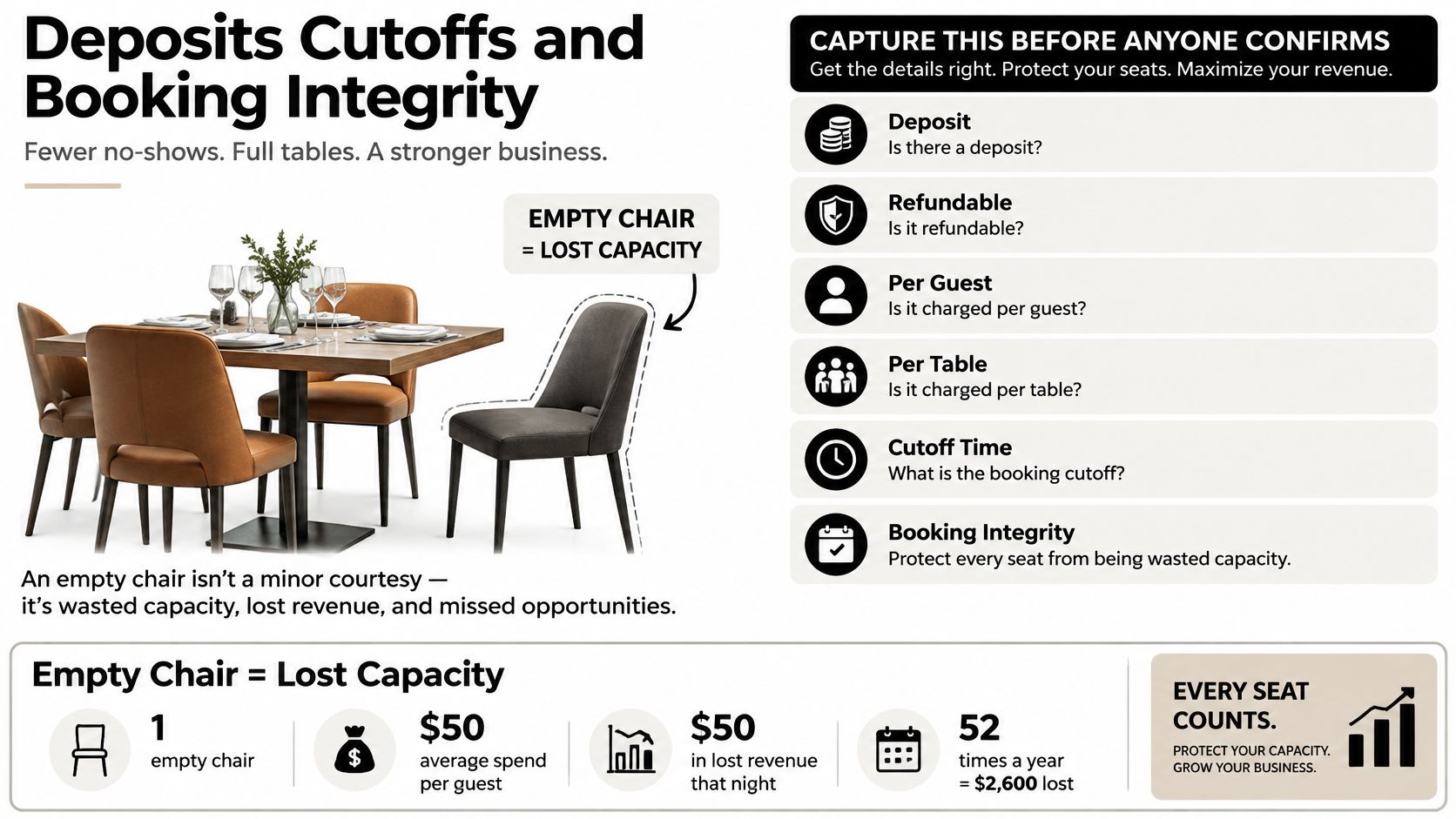
Say a four-person reservation requires a $25-per-person deposit. That creates $100 of exposure if the terms make it nonrefundable after a missed deadline, an example described in SIGEP's hospitality report citing OpenTable, which also reports 57% fewer no-shows and a 72% lower likelihood of late cancellation for reservations requiring deposits on average. Tell the requester the amount before committing, rather than burying it in an email.
These are platform averages for process design, not promised results at every restaurant. The empty chair represents capacity the restaurant may no longer be able to sell.
Cancellation and deposit benchmarks
Measure | Figure | Source |
|---|---|---|
Fewer no-shows with a required deposit | About 57% | OpenTable averages cited by SIGEP |
Less likely to end in late cancellation with a deposit | About 72% | OpenTable averages cited by SIGEP |
Diners cancelling with 24 hours' notice or less | 60% | |
Diners naming no-shows as the most common cancellation form | 19% | Barclays diner survey |
Average loss per missing diner | £89 | Barclays restaurateur estimate |
Restaurateurs taking card details and charging a fee at booking | 34% | Barclays survey |
The Barclays figures describe surveyed diners and restaurateurs, not universal cancellation behavior. They explain why the timing and permitted method of cancellation deserve attention.
Capture the terms before confirming
- Deposit: Is payment required, and is it refundable?
- Charging basis: Is the commitment per guest or per table?
- Cutoff: What exact date, time, and local time zone apply?
- Cancellation route: Must the diner use the app, call, or email?
- Approval: Who has authorized the financial commitment?
Keep that capture list alongside the booking record.
A late arrival, smaller party, and cancellation are different messages. Tell the restaurant which one applies and ask whether the existing booking can remain in place.
Treat brokers and unauthorized resale as a channel-integrity issue, not proof that every scarce table is manipulated. Use an authorized route, keep one live hold, and retain evidence when releasing it.
A study in the International Journal of Consumer Studies found that stricter cancellation barriers reduced intentions to no-show but also reduced booking intentions. Explain the rule before accepting it, and set the reminder before the penalty window, not automatically on the morning of dinner.
Reservations That Have to Survive Real Weeks
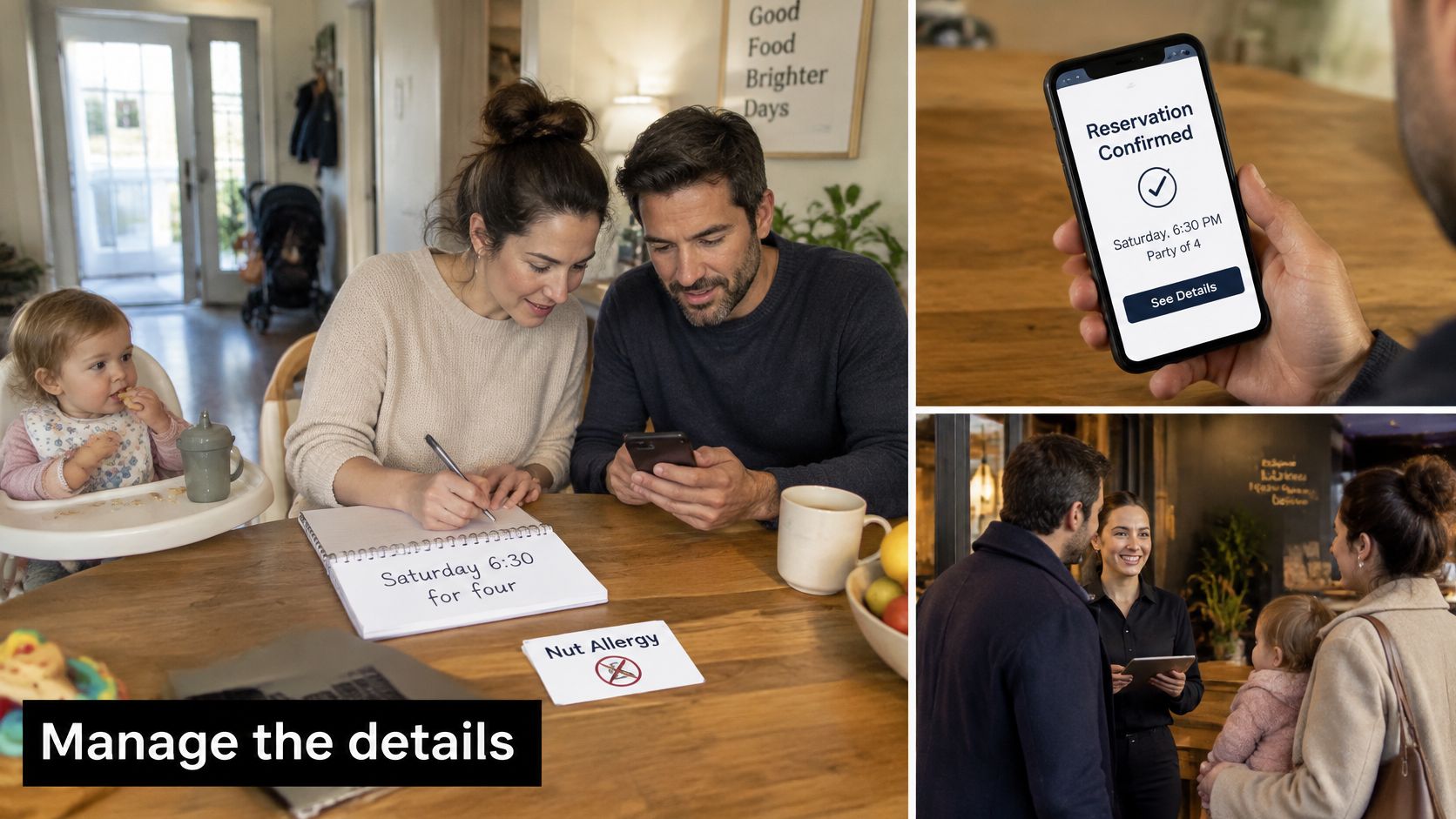
For dual-career parents, dinner can become another household task neither person has time to own. Consider a Saturday request for four at 6:30 p.m., with a high chair, step-free entry, and a nut allergy, while both parents are trying to finish work.
The family handoff needs to cover arrival and accommodation, not just availability.
A family dinner with essential needs
Give the person booking two backup times and ask the restaurant to confirm its ability to accommodate the allergy, including relevant cross-contact concerns. Lux Circle handles requests from anyone on the account and books and de-conflicts appointments for the group, so both parents don't need to contact the host separately.
A 2025 Healthwatch West Sussex poll of 166 people with nutritional or dietary requirements found that 47.9% reported lacking options when eating out, 28.8% struggled to source suitable food, and 28.2% couldn't access needed support. This is a local poll, not a global rate, but it highlights the gap between securing a table and confirming accommodation.
A reservation isn't proof that the kitchen can prepare food safely. A reservation service cannot guarantee safety or substitute for the venue's own reply; diners should reconfirm medical-risk needs with staff on arrival. High chairs, quiet seating, and restroom access are practical logistics too, though not all carry the same risk.
Write down who at the restaurant acknowledged the essential need and what they actually confirmed.
A client dinner with a moving guest list
Say a founder books a client dinner well ahead of the meeting. Capture the venue, time, party size, deposit, and cutoff at booking, then verify them again when the guest list settles.
Approved Lux makes restaurant reservations, including at high-demand venues, without guaranteeing the outcome. Record who owns the final guest-count update.
For a visual companion to the planning scenarios, the video is below.
A delayed flight and an uncertain arrival
A traveler whose flight slips needs a message that says whether they're requesting a later arrival or cancelling. Our guide to last-minute restaurant reservations helps with replacement planning when the original evening no longer works.
Keep the restaurant's reply confirming whether it will hold or release the table. Sending an update alone doesn't establish that the venue accepted it.
Where a Human Assistant Team Fits
Lux Solo costs $99.99 a month for one person. Lux Circle costs $299.00 a month for up to four people on one account. Approved Lux is a subscription Assistant team for delegated work, not an in-person household staffing service.
Both plans include travel, scheduling, errands, and research. Restaurant reservations fit within scheduling and logistics: finding a workable option, booking it, communicating details, and handling the follow-up.
Access and accountability
Our US-based Assistant team is available 24/7/365 by phone, SMS, or email. Triple-channel access means all three channels are monitored at equal priority, so you don't need to switch from text to a call merely to make the request count.
That access matters when a flight changes after the host stand closes. The team can receive the update, organize the next action, and contact the restaurant through an available legitimate route. Around-the-clock access to us doesn't make a closed restaurant answer.
The supplied visual illustrates the subscription-team structure; the current plans described here are Lux Solo and Lux Circle.
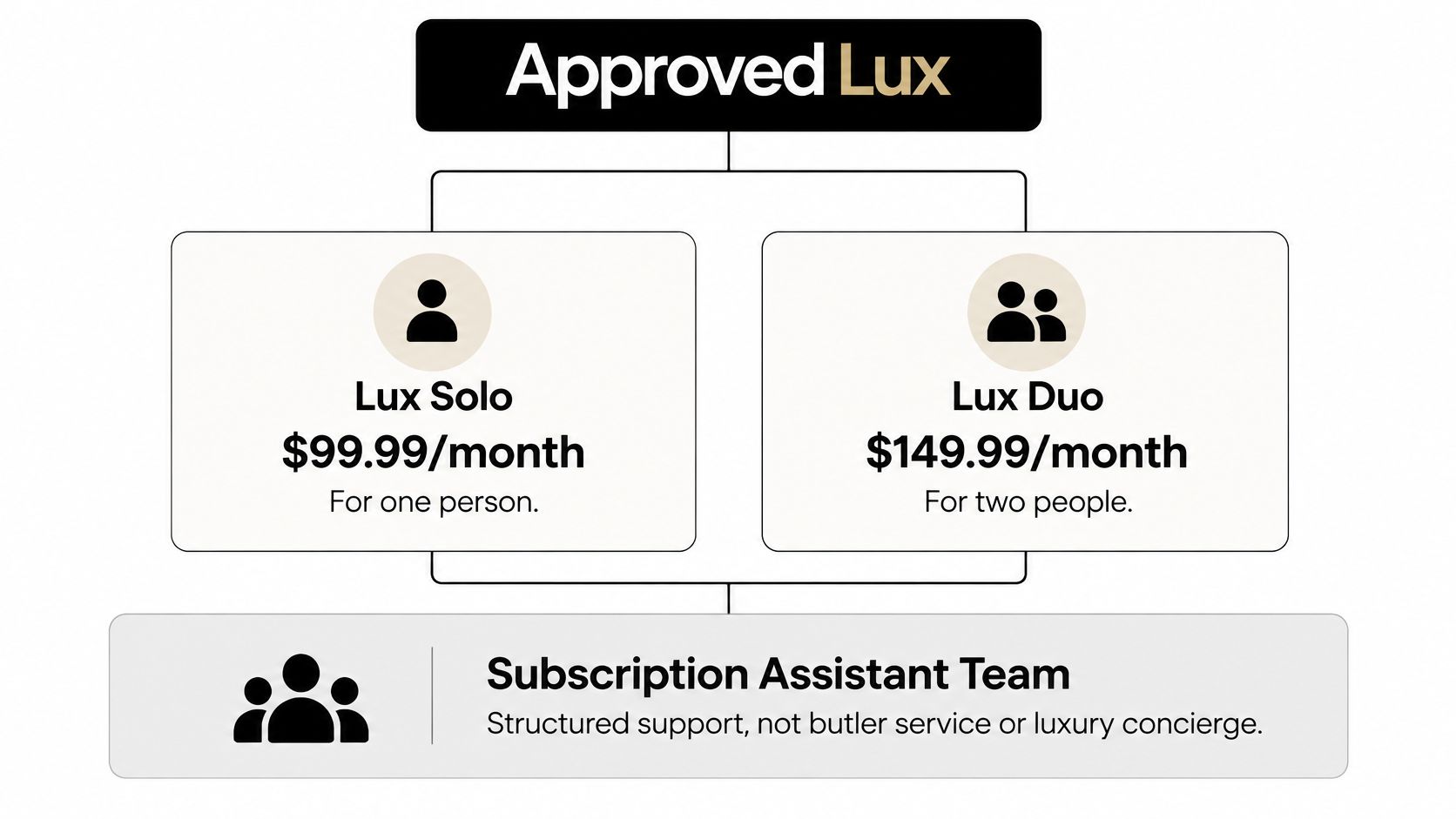
Shared context rather than a single assigned person
The service uses a managed team with shared context, not the same Assistant every time. Requests aren't unlimited, and members should understand the applicable scope rather than treating the subscription as open-ended staffing.
Proactive Preference Learning records useful routines, such as seating habits, cuisines to avoid, and typical party size. That reduces repeated explanation, while essential details still need checking for the particular meal.
For example, a parent sends a brief while finishing work. An Assistant checks an authorized channel, secures an available table if possible, records the cancellation terms, and reports the outcome. The advantage comes from delegating the decisions and follow-up together, rather than retaining the coordination work yourself.
- Remote execution: The team doesn't attend dinner or provide an in-person service.
- Professional boundaries: The team doesn't provide medical or legal advice.
- Availability limits: No named venue or specific table is guaranteed.
Members who also need travel benefits can consider Lux Traveler at $1,799.99 per year, which includes a 24/7 US-based personal assistant, the full travel marketplace, and coverage for up to 10 household members.
Judge the subscription over several weeks of real requests. Count evenings no longer spent searching, updates delegated, and cancellation cutoffs caught, not just reservations placed.
Send the Next Table Request Tonight
Use the next real dinner as the test, whether it's a client meal or Saturday with the kids. Give yourself a brief preparation window, then compare the time spent handing it off with the time you'd otherwise spend refreshing apps and exchanging messages.
If you haven't chosen an area yet, narrow that first. A local resource such as The Ten District's downtown Jenks dining favorites can help you build a relevant shortlist instead of searching without boundaries.
A brief you can paste
- Date and time window: Thursday, 6:30 to 7:15 p.m.
- Party size: Four people.
- Neighborhood and budget: Midtown, $150 total meal budget.
- Backup slots: Thursday at 8 p.m. or Friday at 6:30 p.m.
- Needs: Step-free entry and a nut allergy. Please obtain the restaurant's acknowledgment.
- Preferences: A booth, if available.
- Deposit authority: Dana may approve a deposit up to $100. Flag any commitment above that amount before booking.
These are hypothetical planning details, not a suggestion that the budget will fit every restaurant. Adjust the brief to the meal and clarify whether a deposit sits within or outside your spending limit.
Measure the work you didn't have to do
If this coordination repeats weekly, send the same format to the Approved Lux Assistant team by text, call, or email. Proactive Preference Learning can shorten later requests without making you rebuild your preferences each time.
Judge the result by hours returned and cutoffs caught, not a promised table. A clear no is still a useful outcome when someone is already acting on the backup.
Approved Lux Personal Assistant offers a US-based Assistant team to handle restaurant requests, scheduling, and the follow-up that keeps a booking usable. Visit Approved Lux Personal Assistant to compare plans, then send your next dinner request with its time window, essential needs, backups, and deposit authority.