Monthly Condo Rentals Florida: Rates, Taxes and Terms
Compare monthly condo rentals Florida rates, lease terms and tax rules, then verify building approval and total cost before you pay.
13 min read
Furnishing a two-bedroom condo in South Florida is associated with a sharply higher asking rent. In the five-county dataset covered by PBP Real Estate's South Florida rental market report, the median is $4,500 a month for a furnished unit and $2,275 for an unfurnished one, a 98% premium.
That difference is only one part of the monthly cost. Lease length affects whether state and county transient taxes apply, while condo association rules can restrict rental terms even when local rules allow them. A lower advertised rate may therefore produce a higher total for the stay.
Compare the full cost and confirm the building's rental rules before choosing a listing.
What Monthly Condo Rent Costs Across Florida
A monthly condo budget depends on which rental market the listing belongs to. In South Florida, the median asking rent across all residential leases in the five-county region is $2,763 a month. That figure covers Miami-Dade, Broward, Palm Beach, Martin and St. Lucie counties, so it is a broad benchmark, not a condo quote.
Market and unit | Rate basis | Monthly rate |
|---|---|---|
South Florida, all residential lease listings (five counties) | Median asking rent | $2,763 |
Two-bedroom condo, unfurnished | Median asking rent | $2,275 |
Two-bedroom condo, furnished | Median asking rent | $4,500 (98% premium) |
Bonita Springs furnished two-bedroom, November, December, March, April (2025-2026) | Listed monthly rate | $6,500 |
Bonita Springs furnished two-bedroom, January, February (2025-2026) | Listed monthly rate | $7,500 |
The comparison shows why a single regional median can mislead. An unfurnished two-bedroom and a furnished seasonal condo serve different needs, and the furnished unit's higher asking rent reflects a different kind of stay. Use the row that matches the property and months you need.
Why the winter units appear in the fall
Timing affects which rentals are available. In the five-county dataset, 51% of listings with stated availability dates became available between October and December. Winter inventory therefore tends to enter the market before the season, while a January search draws from what remains open.
A Bonita Springs listing illustrates how monthly rates can vary within one season. The furnished two-bedroom is listed at $6,500 for November, December, March and April of the 2025-2026 season, and $7,500 for January and February, according to the Florida Rentals listing. Six months at those rates totals $41,000 before tax, cleaning or association fees.
Budget method: Match the unit type and months to the relevant row, multiply the rate by the number of months, then add taxes and one-time charges. Compare that total, rather than the headline monthly rent.
Three Rental Formats and Where Each Fits
The formats look interchangeable in a search result and behave nothing alike in a lease. The comparison below sets out the three before the detail.
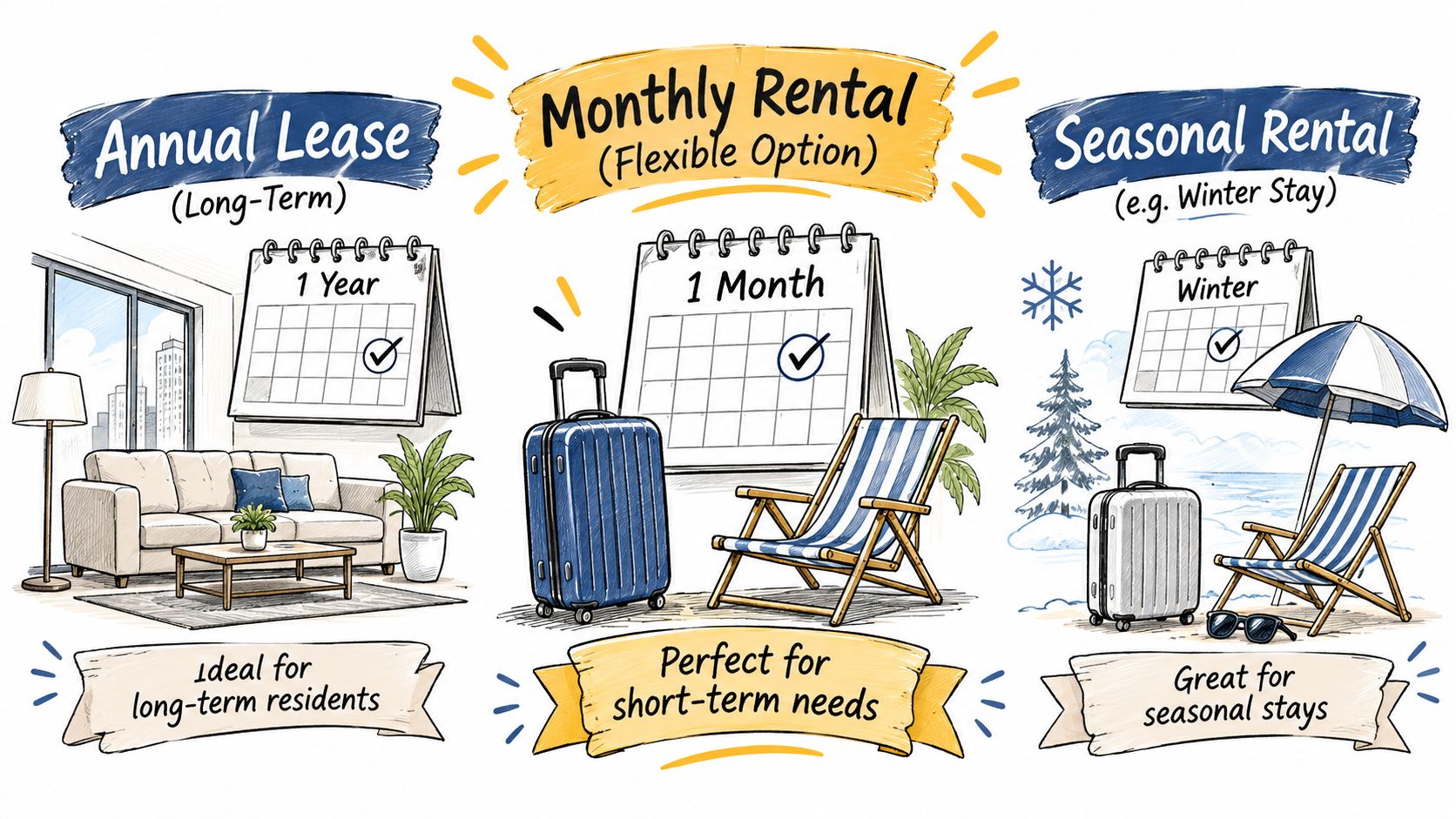
Format | Typical term | Furnishing | Best fit |
|---|---|---|---|
Conventional annual lease | 12 months | Usually unfurnished | Year-round residents who need a full year |
Furnished seasonal lease | One to several months, often November to late April | Furnished, at a premium over unfurnished units | Snowbirds and retirees spending winter in Florida |
Vacation-home weekly or monthly lease | Weeks to one month | Furnished, often with full kitchen | Families and groups needing extra bedrooms |
A conventional annual lease is a twelve-month residential contract, usually unfurnished. A furnished seasonal lease is a winter residence rented as if it were a second home for one season, and it carries the furnishing premium. A vacation-home lease is a holiday rental stretched into weeks, which is the format most beach markets sell.
Condos dominate the short-stay side. A Florida vacation-rental market summary listed 3,048 condos, 2,833 houses, 319 townhouses and 123 cottages across its tracked inventory, so condos were approximately 48% of the combined total against roughly 45% for houses, per the Find Rentals Florida market summary. Supply clusters in Gulf Coast South (1,842 listings), the Emerald Coast (2,012) and the Destin Area (512).
Coastal economics explain why a daily rate can't be multiplied into a monthly one. Two-bedroom condo benchmarks in the same summary show Panama City Beach averaging $179 a day, 43% occupancy and $39,484 in annual revenue; 30A and Santa Rosa Beach at $212, 34% occupancy and $59,472; and Destin at $214, 42% occupancy and $50,762. 30A earns the most on the highest daily rate and the lowest occupancy, which is what peak-season pricing looks like when the calendar does the work.
Matching the format to the stay
- Four winter months, furnished. A furnished seasonal lease is the fit, and the search should start in early fall while October-to-December supply is still live.
- Eight people for a reunion. One larger vacation home with enough bedrooms beats three hotel rooms, but bedroom count has to be checked against the local occupancy cap rather than against the number of sleeping surfaces advertised.
- A full year in the state. A conventional lease wins on cost and stability, and it also changes the tax treatment of the rent.
The fit test is that simple. A four-month winter stay points to the furnished seasonal row. A reunion points to a bigger vacation home. A year points to the annual contract.
How Lease Length Changes Your Tax Bill
Florida sets accommodation tax by the written lease term, not by the word monthly. State law applies a 6% tax to the total rent charged for living quarters, including condominiums, when the stay is a taxable transient accommodation, according to Florida Statutes 212.03. The same statute removes the tax where the renter signs a bona fide written agreement for continuous residence longer than 6 months, and the exemption can also apply once someone has lived at one property past six months and paid tax for the initial period.
Stay length | Tax treatment | Example |
|---|---|---|
Six months or less | Taxable transient accommodation: 6% state tax plus county surtaxes | Four-month January to April stay, paid monthly |
More than six months | Generally outside the transient-rental tax under a bona fide written continuous lease | Seven-month September to March lease in one written agreement |
Continuous residence beyond six months | Exemption can apply after tax was paid for the initial period | Renter who stayed at one property past six months |
Walk through two booking patterns. A January-through-April stay is a four-month rental, and paying once a month doesn't change that, so budget the state and local lodging taxes on it. A September-through-March arrangement runs about seven months, and the parties should put it in one continuous written lease rather than a stack of monthly confirmations, because a properly documented seven-month residential lease may qualify for the statutory exemption.
Why splitting a short stay into monthly payments fails
A payment schedule isn't a lease term. The Department of Revenue may recharacterize payment structures that obscure the actual consideration during the first six months, as the Florida Department of Revenue statute on transient rentals sets out, so three instalments on a 90-day booking don't convert it into residential occupancy.
Counties add their own layer. A four-month stay can carry both the state tax and a county transient-rental tax, which is why a 90-day condo sometimes shows three separate tax lines on a quote. Ask the owner or manager whether they collect tax, whether a local surtax applies, and whether the agreement establishes continuous residence instead of a series of shorter bookings.
A four-month stay is a four-month stay whether it's invoiced in one payment or four.
The decision rule runs one way only: fix the lease length first, then price the tax on that structure. Renters who shop rates first and read the lease last usually discover the difference after the deposit clears.
Total Monthly Cost Beyond the Advertised Rent
A $3,000 monthly rent can cost about $3,360 for a month in Brevard County before cleaning, parking or utilities. A recent local guide lists a 6% Florida sales tax, a 1% local surtax and a 5% tourist-development tax on rentals of six months or less, or roughly 12% total, in its Space Coast short-term rental guide. Confirm which taxes apply to the specific booking and whether quoted fees are included in the taxable amount.
A lower monthly rent can still produce a higher four-month total once tax and one-time fees are added. Compare the full amount due, not just the advertised rate.
Charge | Refundable | Confirm before booking |
|---|---|---|
Monthly base rent | No, consumed each month | Whether utilities and internet are included or capped |
Security deposit | Yes, under the agreement | How it is held and when it is returned |
Cleaning or administrative fee | Usually no | Whether it sits inside the taxable base |
Parking, resort or amenity charge | Usually no | Whether it is mandatory and taxed |
Association registration or move-in fee | No | Whether the building charges it to renters and who collects it |
Check the deposit terms before paying. The agreement should state who holds the deposit, what deductions are permitted, and when the balance is returned. Get those terms in writing.
Utilities, fees and the ownership trap
Confirm whether electricity, water and internet are included, capped at a stated amount, or billed separately. A utility cap can affect the total cost, so ask how overages are calculated and who pays them.
Condominium ownership costs are not automatically renter charges. If a rental quote includes a monthly fee, ask what it covers, whether it is mandatory, and who receives the payment.
The comparison test: multiply monthly rent by the number of months, then add applicable tax, one-time fees and estimated utilities. Keep refundable deposits separate from the cost total, and compare them across properties.
Request an itemized breakdown in writing. Collier County's short-term rental registration guidance describes charges that may appear in a taxable-stay quote, including rent, cleaning or administrative charges, taxes, deposits and condominium registration fees. A clear breakdown makes it easier to compare the full stay cost with the building's rental requirements.
Neighborhoods Where Snowbirds Find Monthly Condos
Market choice is a depth question before it's a price question. Two Florida markets can post similar monthly rates and give you very different odds of finding a furnished two-bedroom for the exact four months you need, because the number of live listings for your arrival month differs sharply.
Run one search with your real dates and three filters, furnished, two bedrooms, your arrival month. Count what comes back. A deep list gives you fallbacks when a building declines your term and room to negotiate on a unit that has sat empty since October. A thin list means you start earlier, widen the map, or accept a different format.
- Gated amenity communities (Naples, Sarasota). These buildings carry resort-style pools, fitness rooms and social calendars, and the monthly rate reflects access to them. Confirm whether amenity use and any club fee are inside the rent or billed after arrival.
- Beach markets with heavy short-stay supply (Panama City Beach, Destin, 30A). These are nightly-rate markets where a monthly stay competes with weekly bookings. Ask for a monthly rate directly instead of multiplying a nightly figure by 30, and expect the answer to change with the month.
- Inland value markets (Cape Coral, Fort Myers). More houses than condos, lower monthly asks, a longer drive to sand. Confirm the property type before assuming a condo, because the association rules differ entirely from a house rental.
- Barrier-island and small-town markets. Thin inventory and stricter local limits. Start the search a season ahead and keep two backup buildings.
Snowbirds in the 55 to 75 range who stay one to three months should weight listing depth in their arrival months above the headline rate. A market with options lets you trade a small rate difference for a building that will approve the term. Groups should check bedroom count against the local occupancy cap before counting beds, and anyone planning a repeat winter should ask the owner about the following season while they're still a tenant.
A regional shortlist shortens the work, and this guide to Florida snowbird communities covers the towns with established winter rental stock.
Rank each neighbourhood twice, by total stay cost and by whether the building allows your term. A market with a $600 higher monthly rent and a building that approves a 90-day lease beats a cheaper unit that falls apart at the board.
How to Verify a Condo Before You Pay
A condo rental must satisfy three separate tests: local rules, association policy and the lease terms. A listing that clears only one or two can still leave you without an approved place to stay.
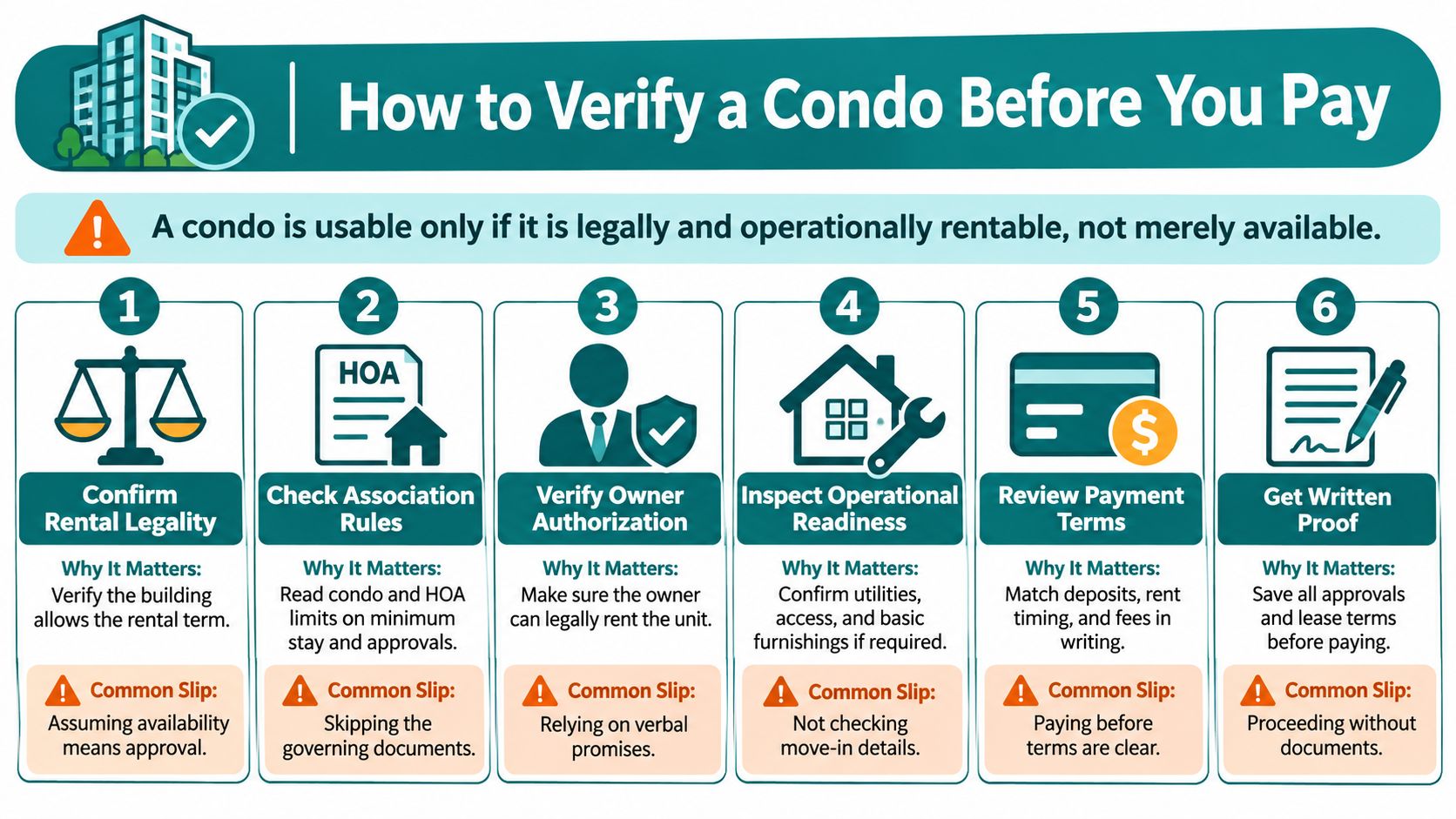
- Confirm municipal licensing and tax registration. Miami-Dade County defines a short-term vacation rental as a dwelling rented to a transient occupant for less than 30 days or one calendar month, whichever is less, and requires licensing, tax registration and compliance with local operating rules, according to Miami-Dade's short-term vacation rental rules. A city permit does not settle whether the condo association allows the rental.
- Get the association's rental policy in writing. Florida's condominium disclosure statute requires information about leasing restrictions to be provided to prospective purchasers. Rental limits are found in the declaration and governing documents, rather than state lodging law, as described in Florida Statutes 718.504. A building may allow rentals under county rules while requiring a longer minimum term, limiting annual rentals, requiring board approval or charging a registration fee.
- Check the legal occupancy limit before counting beds. Confirm the limit set by the local ordinance or building code for the unit's bedroom count. Do not assume sofa beds or air mattresses increase legal capacity.
- Match the tax receipt to the lease. Ask who collects and remits tax, then check that the receipt covers the term in your signed lease. Resolve any mismatch before arrival.
- Make written board approval a condition of booking. Approval may depend on the association's rules and board calendar. Do not pay a deposit while approval is still pending.
- Check the operational rules. Guest registration, parking permits, pet and child restrictions, amenity hours, move-in windows and elevator fees can affect whether the stay works in practice. The lease should also define maintenance duties. Review lease clauses covering pest responsibility to establish who handles a pest problem during the stay.
For a comparison with a hotel, this guide to extended-stay vacation rentals explains what a condo adds and what it costs.
Before paying, have written building approval, a lease matching your stay dates and an itemized quote. Pay the deposit only after those terms are settled.
Where to Source a Monthly Condo and How Credits Work
Book only after the stay length, the building's rules and the all-in price are settled, and use a channel that can document all three.
An owner with association approval. For a written stay longer than six months, a direct lease works when board approval is named in the contract and the tax status is tied to that single agreement. The reason is procedural: the term has to appear on the document the tax treatment rests on.
A local property manager. This is the usual route for furnished weekly or monthly vacation homes along the Gulf Coast and the Emerald Coast. Confirm minimum nights, who remits tax, and whether cleaning and parking sit inside the taxable base before you compare two quotes.
A membership inventory platform. Approved Traveler, the annual membership from Approved Experiences, puts hotels, flights, cruises, cars, vacation homes and tours under one login in the member portal, and both plans include unlimited weekly condo-style stays. There's no cap on condo-style weeks, but every week is subject to availability for your dates, and the rate depends on the property and what is open when you book. Use it to build a shortlist, not as a promise of a unit, because a building's minimum lease can still block three consecutive weeks from becoming a monthly stay. Reward Credits accrue on every booking, never expire and redeem toward future bookings, with no published dollar value, so compare properties in dollars and treat Credits as a later offset.
Pull three options that match the same months and bedroom count, then run each through the cost worksheet. The mechanics of timing and confirmation are covered in these travel booking tips, and they apply as much to a 90-day condo as to a flight. Pay when the lease, the written approval and the itemized quote agree.
Approved Experiences Traveler gives members wholesale-rate access to more than 1,000,000 hotels, 500,000 vacation homes and 700+ airlines through one membership, which is what a monthly condo search needs once your dates and building rules are settled. Both membership tiers include unlimited weekly condo-style stays, subject to availability on your dates, so a winter shortlist and the flights to reach it sit in the same member portal. Visit Approved Experiences Traveler to compare the Traveler and Lux Traveler tiers and start assembling the stay.