Extended Stay Vacation Rentals: Costs, Rules and Booking
Learn what extended stay vacation rentals are, who benefits, how costs compare with hotels, and what to verify before booking a weekly or monthly stay.
14 min read

The U.S. extended-stay hotel industry generated an estimated $19.6 billion in revenue in 2025, according to IBISWorld's industry analysis. Longer stays are not oversized vacations. They represent a unique accommodation need, where the number of nights affects what you should book, how you should compare costs, and which terms need reviewing before payment.
For extended stay vacation rentals, start with the checkout date, not the attractive nightly price. A home that works for a weekend can become awkward temporary housing when you need to cook, work, wash clothes, and resolve maintenance problems for a month.
What Extended Stay Vacation Rentals Are and How They Differ
An extended-stay vacation rental is a furnished house, condo, or apartment rented for 14 nights or longer, usually by the week or month, with a kitchen, laundry access, living space, and somewhere to work. That's a practical search definition, not a universal legal classification. A hotel is a room you pass through; an extended stay is a furnished home you borrow for a season.
In the United States, the average vacation-rental stay increased from 4.0 to 4.42 nights in 2025, while 14-to-30-night bookings were identified as the fastest-growing duration segment, according to Mordor Intelligence's U.S. vacation-rental analysis. The useful distinction isn't just longer versus shorter. It's whether the accommodation supports ordinary household routines.
Stay formats compared by length and setup
The hotel averages below come from the Extended Stay Lodging Association's industry report, which places average stays at approximately 24 nights in purpose-built extended-stay properties versus 13 nights in traditional hotels. Amenity descriptions are screening categories, not promises about individual properties.
Format | Typical stay length | Kitchen and laundry | Cleaning pattern | Pricing basis |
|---|---|---|---|---|
Traditional hotel | About 13 nights on average | Limited kitchenette provision; confirm laundry access | Daily housekeeping, subject to property policy | Nightly rate |
Extended-stay hotel | About 24 nights on average | Kitchenette; confirm whether laundry is in-room or shared | Less frequent housekeeping | Nightly rate, often with weekly or monthly rates |
Short-term vacation rental | Several nights; host sets booking limits | Full kitchen, often laundry | Turnover cleaning between guests | Nightly rate plus fees |
Extended-stay vacation rental | 14 to 30+ nights as a search category | Full kitchen, laundry, and workspace to verify | Turnover cleaning, with mid-stay service agreed separately | Weekly or monthly rate, plus utilities where charged |
Say you're planning a 28-night trip. Request one continuous booking at the applicable monthly rate, rather than assuming the total equals the displayed nightly rate multiplied by the night count. Cleaning, service charges, utility allowances, and payment schedules can be structured differently.
Ask whether the property remains yours throughout the reservation, whether any move is required, and whether scheduled cleaning involves additional payment or access.
Reading rule: If your trip runs longer than a week, choose the format whose cleaning pattern and pricing basis match how you'll actually live there.
Who Gets the Most Value From a Longer Stay
The strongest candidates aren't necessarily the travelers taking the longest holidays. They're the people who need a reliable household routine away from home. Use these profiles as planning scenarios, not demographic rules.
Match the property to the purpose
Snowbirds and retirees. Consider travelers aged 55 to 75 planning one to three months in Florida, Arizona, Mexico, Costa Rica, or Portugal. A condo-style home with a full kitchen can support that routine without requiring timeshare ownership; the important checks are comfortable daily access, seasonal heating or cooling, and proximity to groceries and healthcare.
Remote workers. A planning scenario for professionals aged 28 to 45 might involve four to eight or more weeks away each year. Their must-have is a dedicated work area, not a dining chair beside a router, and their main risk is paying a monthly rate for quality that hasn't been verified.
Multi-generational family organizers. An organizer aged 35 to 55 might be coordinating eight to ten people across several rooms. Shared living space matters, but so do bathroom access, bedtime separation, and somewhere grandparents can sit comfortably while children use the main living area.
Project-based professionals. Consider someone aged 30 to 50 assigned to a city for three to six weeks. A quiet workspace, washing machine, and walkable neighborhood make daily life easier, but a rigid departure date can become expensive if the contract changes.
A property's suitability follows the activity, not the traveler's age. A retired consultant may need stronger connectivity than a younger holidaymaker, while a family with teenagers may need more private work areas than a solo professional.
Run a simple self-test
- Count your nights. Establish the earliest arrival and latest plausible departure, including uncertainty.
- Count your people. Include visitors who may stay overnight, not just the initial traveling party.
- List the work you must do on site. Include employment, cooking, laundry, caregiving, and mobility needs.
Choose the property around the hardest requirement to replace locally. You can buy another saucepan. You can't create a quiet bedroom or step-free entrance after arrival.
Extended Stays Compared With Hotels and Short-Term Rentals
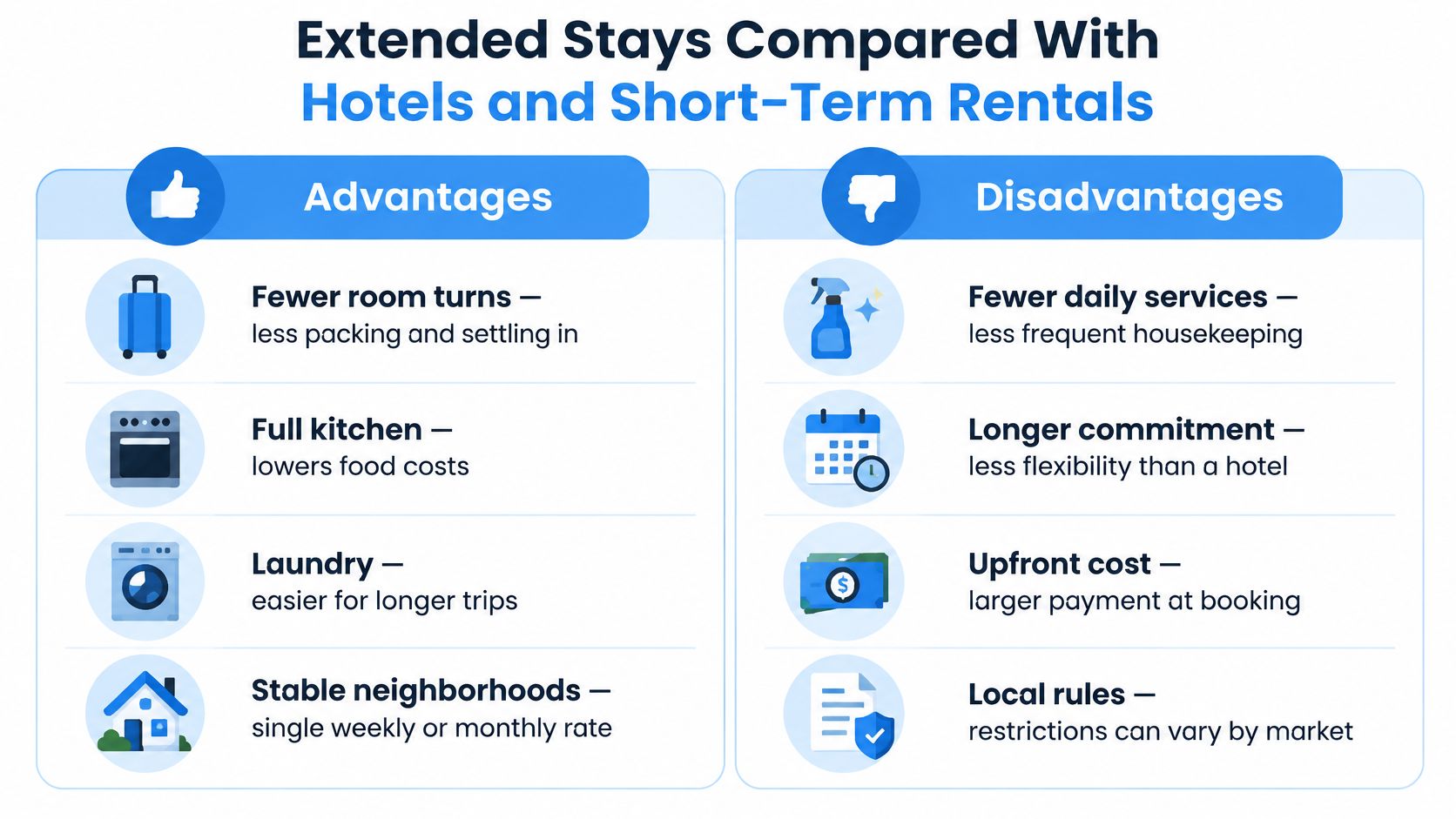
A lower nightly rate does not always mean a cheaper stay. Length changes the total: a single booking can avoid repeated turnover, while a longer reservation may bring utility charges, a deposit, or different lodging-tax treatment. The practical choice depends on both the service you want and the terms attached to your dates.
Advantages
- Fewer room turns: One continuous reservation means less packing and fewer move-in routines than several shorter bookings.
- Kitchen access: Preparing some meals can give you more control over food spending.
- Laundry access: On-site laundry can reduce the need to pack for every day.
- A settled base: Staying in one place keeps your shops, transport, and routines consistent.
Disadvantages
- More money due upfront: A longer booking may require a larger initial payment or a security deposit.
- Charges beyond the quote: Utilities, internet, or mid-stay cleaning may cost extra.
- Less daily service: You may need to manage rubbish, linen changes, and household supplies.
- Stricter exit terms: Cancellation and early-departure conditions can limit flexibility.
Compare the whole reservation
CBRE's extended-stay hotel analysis reports higher occupancy and comparable revenue per available room despite lower average daily rates than comparable limited-service hotels. Fewer room turns and less frequent housekeeping are part of that operating model. For a guest, the relevant comparison is the total cost and service over the full stay, not the operator's room-turn savings.
The worked example below is hypothetical, not market pricing. It assumes identical dates.
Cost line | Hotel example | Extended-stay rental example |
|---|---|---|
Accommodation | $180 × 28 nights = $5,040 | $3,900 monthly quote |
Cleaning | Confirm any separate charge | $350 |
Utilities | Confirm inclusion | $150 budgeted allowance |
Total before lodging tax | $5,040 | $4,400 |
Refundable security deposit | Confirm authorization | $500 held separately |
The rental's $150 utility allowance is budgeted in the example. If utilities are included up to a cap, the actual amount payable may be lower. The $500 deposit is money to have available, not a lodging expense unless deductions are made.
Check tax treatment for the exact dates and stay length. A monthly quote does not establish whether lodging tax applies. Confirm the local rule for the number of nights you will occupy the property, particularly if your dates fall near a duration threshold.
For a broader service comparison, read our hotel-versus-vacation-rental comparison. For a location-specific example, see self-catering accommodation for longer Norwich stays.
Use the total stay cost after cleaning, utilities, fees, and applicable tax to compare options. Record refundable deposits separately, since they affect the cash you need but are not necessarily a final expense.
How to Source Weekly and Monthly Inventory
Search for a continuous period of occupancy, not a collection of attractive nightly listings. A property isn't a viable option until its calendar and total price match your trip.
- Set the stay length first. Search for 14 nights or more, using a minimum-stay filter where available. Otherwise, enter the full dates so properties that can't accommodate the reservation drop out.
- Display the monthly price. Check availability for your exact arrival and departure rather than browsing a rough calendar month. A blocked weekend can make an otherwise suitable property unusable.
- Reconcile the host's quote with checkout. Compare the monthly accommodation amount with the platform's final total. Identify cleaning, service fees, utility charges, and optional extras.
- Shortlist three properties per destination. Keep the same dates, guest count, and essential requirements across the comparison. Otherwise, you're comparing different products.
- Prioritize long-stay reviews. Look for guests who describe spending four weeks or more at the property. Search their comments for noise, hot water, storage, appliance reliability, and host responsiveness.
- Request a monthly discount where appropriate. Ask whether the host offers a different rate for a continuous off-peak reservation. Don't assume the calendar automatically displays every available pricing arrangement.
Save a usable comparison file
Keep the listing description, cancellation terms, host messages, and fee schedule together. Screenshots help preserve what was displayed, but request written confirmation of any negotiated change.
Name each saved file by property and dates. That makes it easier to spot a revised quote or a term that disappeared between the first inquiry and payment.
How to Judge Sleeping, Kitchen and Household Fit
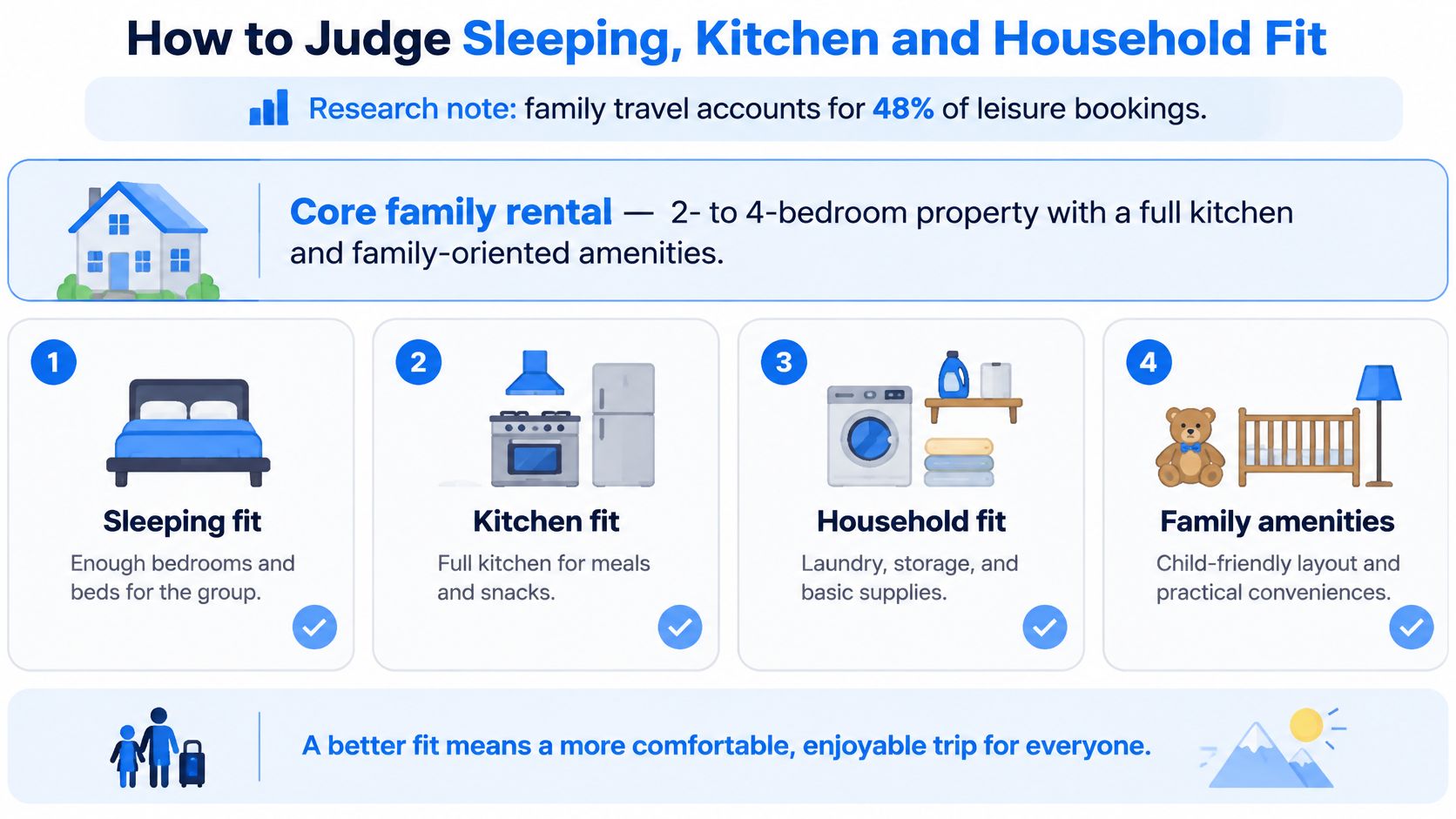
Family travel accounted for 48% of leisure bookings, while two- to four-bedroom properties with full kitchens and family-oriented amenities represented the core family-rental configuration in DataIntelo's global vacation-rental analysis. Those market estimates aren't guarantees about your destination or a particular listing.
Filter for household function before price. A large advertised occupancy tells you little about whether everyone can sleep, shower, eat, and get ready without constant negotiation.
Use this visual as a starting point, then verify the details with the host.
Check the daily bottlenecks
- Map actual beds. Write down who sleeps where, including sofa beds, bunks, and any bed accessed through another bedroom. Ask for mattress sizes and whether bedding is supplied.
- Check bathroom access. Confirm toilets, showers, and whether bathrooms are private or shared. In a hypothetical group of eight, one bathroom can dictate everyone's morning schedule.
- Inspect the kitchen inventory. Request confirmation of a full-size refrigerator, usable oven or hob, adequate cookware, and a dining table that seats the group. A kitchen photograph doesn't establish cooking capacity.
- Verify laundry arrangements. Establish whether machines are in-unit or shared, how access works, and whether drying facilities are practical. Shared machines may be unavailable when your group needs them.
- Allocate parking. Confirm a lawful space for every vehicle, including clearance, permits, and overnight restrictions.
- Specify accessibility needs. Ask about entrance steps, internal stairs, shower thresholds, and grab bars. Request photographs rather than accepting a general accessible label.
- Identify the repair contact. Establish who handles a failed refrigerator, blocked drain, or broken air conditioner, and what response the host commits to.
For a broader inventory of items to verify, use our vacation-rental amenities checklist.
Compare layouts, not bedroom totals
Say a family of eight is choosing between a two-bedroom home with sofa beds and a four-bedroom home with one bathroom. Neither is automatically better.
If the smaller home has sufficient bathrooms, comfortable permanent sleeping arrangements, and a living room that remains usable, it may create fewer daily coordination problems. If opening the sofa beds removes the only shared seating, it creates a different bottleneck.
A floor plan and a bed-by-bed sleeping map are more useful than the advertised maximum occupancy.
For a month-long stay, choose the layout that supports simultaneous activities. Privacy, bathroom access, and usable shared space matter together.
Checking Internet, Workspace and Support for Remote Work
A failed connection over several weeks can cost more than replacing an evening's entertainment. HomeToGo's 2025 travel forecast expected average stays to reach 22 days, 19% longer than the prior year, and reported that 27% of surveyed U.S. travelers planned longer, more elaborate vacations.
A Wi-Fi amenity label doesn't prove a property can support employment. Neither does a photograph of a laptop on a breakfast bar.
Verify the actual working conditions
- Request measured performance. Ask for a recent download and upload test taken at the intended desk during peak evening use. Confirm whether the connection is shared with other units.
- Check upload suitability. Compare the measured result with your employer's video-call, VPN, and file-transfer requirements. Ask about connection interruptions, not just headline speed.
- Inspect the furniture. Get a photograph showing the desk height, legroom, chair back, and working surface. A decorative console table isn't a workstation.
- Locate power. Confirm reachable sockets and whether you'll need destination-compatible adapters.
- Test separation. Establish whether the desk is outside the sleeping area and whether a door closes. For multiple workers, ask where simultaneous calls can happen.
- Confirm support coverage. Find out who responds while you're working, especially when the host lives in another time zone.
For connection options, SwiftNet Wifi's discussion of fiber versus 5G for home offices can help frame questions about fixed service and mobile backup. The property-specific test still matters more than the connection label.
Build a backup you can actually use
Prepare a phone hotspot with an appropriate data plan, verify indoor mobile reception, and identify a named nearby coworking space. Check its opening hours, call facilities, access requirements, and route from the rental.
Get the host's outage response commitment in writing. Distinguish acknowledgment from restoration: replying promptly doesn't mean an internet technician can attend promptly.
Say a consultant has six video calls a day over four weeks. A weak connection that might be tolerable during a weekend becomes a repeated interruption to paid work, and a noisy café isn't necessarily a workable substitute.
Price the fallback before booking, including coworking access, mobile data, and transport. If that cost removes the rental's apparent advantage, select a property with better verified infrastructure.
Legal, Tax and Registration Rules at 28 to 31 Nights
A monthly booking is not automatically a residential tenancy, and it isn't automatically exempt from lodging tax. The governing rule is local, even when the inventory is marketed internationally.
Avalara's review of short-term-rental regulation reports that Delaware applies a 4.5% tax to stays of 31 consecutive nights or less, and describes jurisdictions requiring registries to receive rental locations, occupancy nights, guest counts, and taxes collected. Moving checkout across a boundary can change treatment, but don't assume the next night creates an exemption without checking the applicable rule.
Keep the booking agreement and destination requirements together when reviewing the reservation.
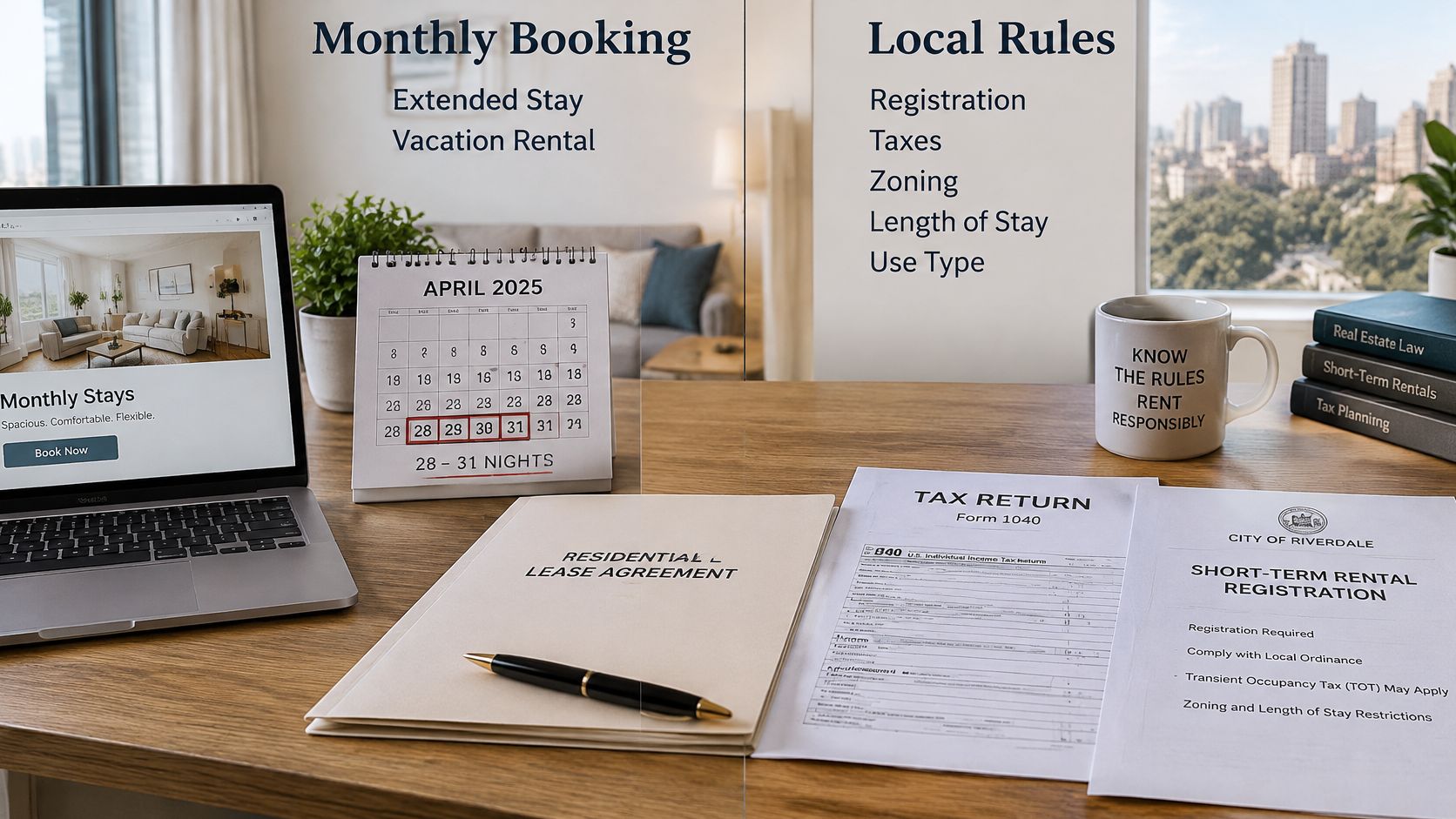
Threshold checks at 28, 30 and 31 nights
The Delaware entry below reflects the cited rule. The other entries identify verification tasks, not universal legal thresholds.
Jurisdiction | Known rule | What to confirm |
|---|---|---|
Delaware | 4.5% tax on stays of 31 consecutive nights or less | Whether your exact nights fall inside the 31-night band |
Registry jurisdictions | Hosts file rental location, occupancy nights, guest counts, and taxes collected | The host's registration or licence number |
Other destinations | Local law determines tax, registration, and tenancy classification | Tax, registration, and tenancy status at 28, 30, and 31 nights |
- Request registration details. Ask for the local licence or registration number and check it against the relevant authority's records where available.
- Confirm the actual tax calculation. Request the tax name, taxable amount, and treatment for your exact dates. A platform's monthly label isn't a legal explanation.
- Test a changed checkout. Ask for a revised written quote if extending or shortening the stay crosses a local boundary.
- Establish contractual status. Confirm the agreement, extension process, deposit handling, utility obligations, maintenance responsibilities, and any notice requirements.
For Florida planning, our monthly-rental guide can help organize destination-specific questions. Verify the relevant county, municipality, and property requirements rather than treating the state as one uniform rental market.
If a clause needs legal interpretation, consult a qualified local lawyer. LegesGPT's overview of top AI assistants for lawyers offers context on legal-document tools, but software output doesn't establish your booking's legal status.
The longest booking isn't always the simplest or most economical. One additional night can alter the legal and tax framework, so confirm the consequences before changing dates.
How to Book, Pay and Protect a Long Stay
Once the property passes the household, work, and legal checks, turn the reservation into a documented transaction. Keep every material promise attached to the booking.
This visual summarizes the booking sequence.
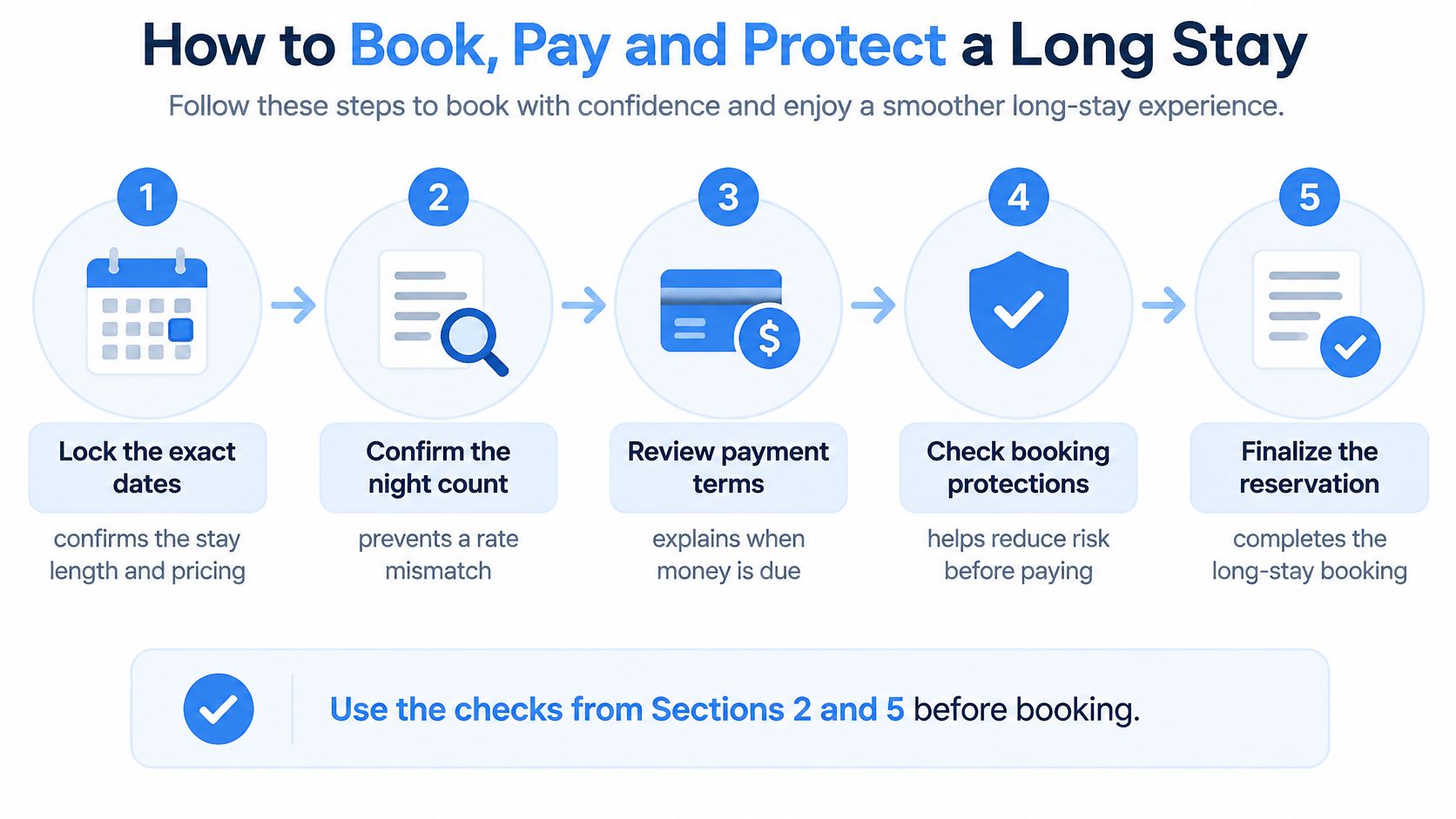
Create a complete trip file
- Lock the dates and night count. Confirm arrival and checkout in writing, using the destination's applicable threshold checks before authorizing payment.
- Request the complete fee schedule. Reconcile cleaning, utilities, deposits, and optional services with the quoted total so nothing remains an unexplained estimate.
- Keep bookings together. Use one booking account where practical for accommodation, transport, and confirmations, rather than scattering essential records across household inboxes.
- Record the payment schedule. List each instalment's due date, the deposit amount, and the refund process, distinguishing a card authorization from a collected payment.
- Save change and cancellation terms. Include early departure and extension conditions, because an informal promise of flexibility won't explain what happens to prepaid money.
- Check insurance wording. Confirm destination and duration coverage for travel medical and trip protection, then ask your insurer about accidental property damage; don't assume the host's liability policy protects your belongings or your liability.
- Document check-in condition. Take dated photographs of appliances, fixtures, furnishings, and existing damage, and send discrepancies through the booking communication channel.
- Store emergency contacts. Save the host's emergency number, maintenance contact, and promised response arrangements somewhere accessible without the property's internet.
Payment safeguard: Don't approve a revised payment request until the property, recipient, amount, and reason match your reservation records.
Timeshare owners need an additional written comparison before depositing or swapping a week. The Federal Trade Commission's timeshare guidance advises checking whether exchanges create extra booking charges or fees for different property types.
Obtain the exchange-program details and compare the full obligation, including resort charges and restrictions, rather than judging access by the destination list alone.
Confirm the Terms Before You Commit to Your Stay
Set the night count first. It determines which pricing and contractual questions you need answered, and it can affect tax and registration treatment. Before paying, make sure the written fee schedule, deposit schedule, and cancellation terms match the host's verbal explanation.
Approved Traveler consolidates weekly and monthly vacation-home inventory alongside hotels, flights, and cars under one member login, with Reward Credits earned on every booking. Both plans include unlimited weekly condo-style stays, with every week subject to availability for the member's dates; the rate shown depends on the property, dates, and what's available when booking.
Make the final decision on written terms
The 110% Best Value Guarantee pays the difference plus 10% if a lower publicly available price exists for the same booking. Read the full claim conditions in the member portal before relying on it.
Reward Credits have no dollar value shown and never expire. Keep them separate from your cash-cost comparison rather than assigning an assumed redemption value.
- Set your nights.
- Shortlist three properties using consistent dates and sourcing checks.
- Run the sleeping, work, and legal checks.
- Book when the written terms match your plan.
Approved Experiences Traveler offers consolidated access to vacation homes, weekly condo-style inventory, and the transport bookings that support a longer stay. Visit Approved Experiences Traveler to explore membership access and compare accommodation for your exact dates, then review the full reservation terms before committing.