Maui Luxury Villa Rentals: Vetting Steps for Large Groups
Vet Maui luxury villa rentals for legal permits, sleeping capacity and total cost before you pay a deposit. A practical guide for multi-room group trips.
12 min read

The usual advice for booking Maui luxury villa rentals starts with ocean views, pools, and proximity to the beach. For a large group, that's the wrong order. Start with legal guest capacity and property authorization, then compare the floor plan and full trip cost. A beautiful house that can't legally accommodate your family isn't a viable booking, regardless of how polished its listing looks.
Treat the reservation as a coordinated operation. You're assigning beds, organizing transportation, collecting money, and protecting everyone's travel plans, not just choosing somewhere attractive to sleep.
Start With Legal Sleeping Capacity
The guest cap comes before the bed count. Under Maui County Ordinance 4830, the short-term-rental-home rules limit occupancy to twice the permitted bedroom count, allow no more than six bedrooms for short-term-rental use on Maui, and permit that use in no more than two single-family dwellings or one single-family dwelling plus one accessory dwelling on a lot. Under that rule, a permitted six-bedroom property has a stated maximum of 12 guests, while a four-bedroom property has a maximum of eight.
That scope matters. Apply the rule to properties governed by this authorization, rather than assuming every accommodation marketed as a villa has the same regulatory classification. The property's actual authorization must support the booking.
Maximum legal guests by bedroom count
Bedrooms | Maximum legal guests | Typical group that fits |
|---|---|---|
2 | 4 | Two couples |
3 | 6 | Two families with young children |
4 | 8 | Three generations of a small family |
5 | 10 | Extended family reunion |
6 | 12 | Large multi-generational group with in-laws |
These are ceilings under the twice-the-bedrooms rule, not promises that every floor plan comfortably accommodates the corresponding group. The family descriptions assume the total head count stays within the stated maximum.
Calculate the minimum, then audit the rooms
For properties subject to this rule, divide group size by two and round up to find the minimum bedroom count. A hypothetical group of 10 needs at least five permitted bedrooms; a group of nine also needs five.
Advertised sleeping arrangements aren't the same as authorized occupancy. Ask how children, sofa beds, separate cottages, and accessory units are treated under the property's approval. Don't assume a detached guesthouse is included just because it appears in the photographs.
For example, a villa advertised to sleep 14 may not legally host that group if its authorization caps occupancy at 12. Extra mattresses don't expand the permit.
Practical rule: Build the rooming list from the permitted capacity, not from the listing's most generous interpretation of sleeping space.
Then assign actual travelers to actual rooms. Check bed configuration, bathroom access, stairs, and whether anyone must walk outdoors between their bedroom and the main house. Our guide to choosing a vacation rental for large groups can help organize those practical requirements.
Before paying a deposit, request the permitted bedroom count and maximum guest capacity in writing. Keep that confirmation with the rooming list so nobody adds guests based on an unverified sofa bed.
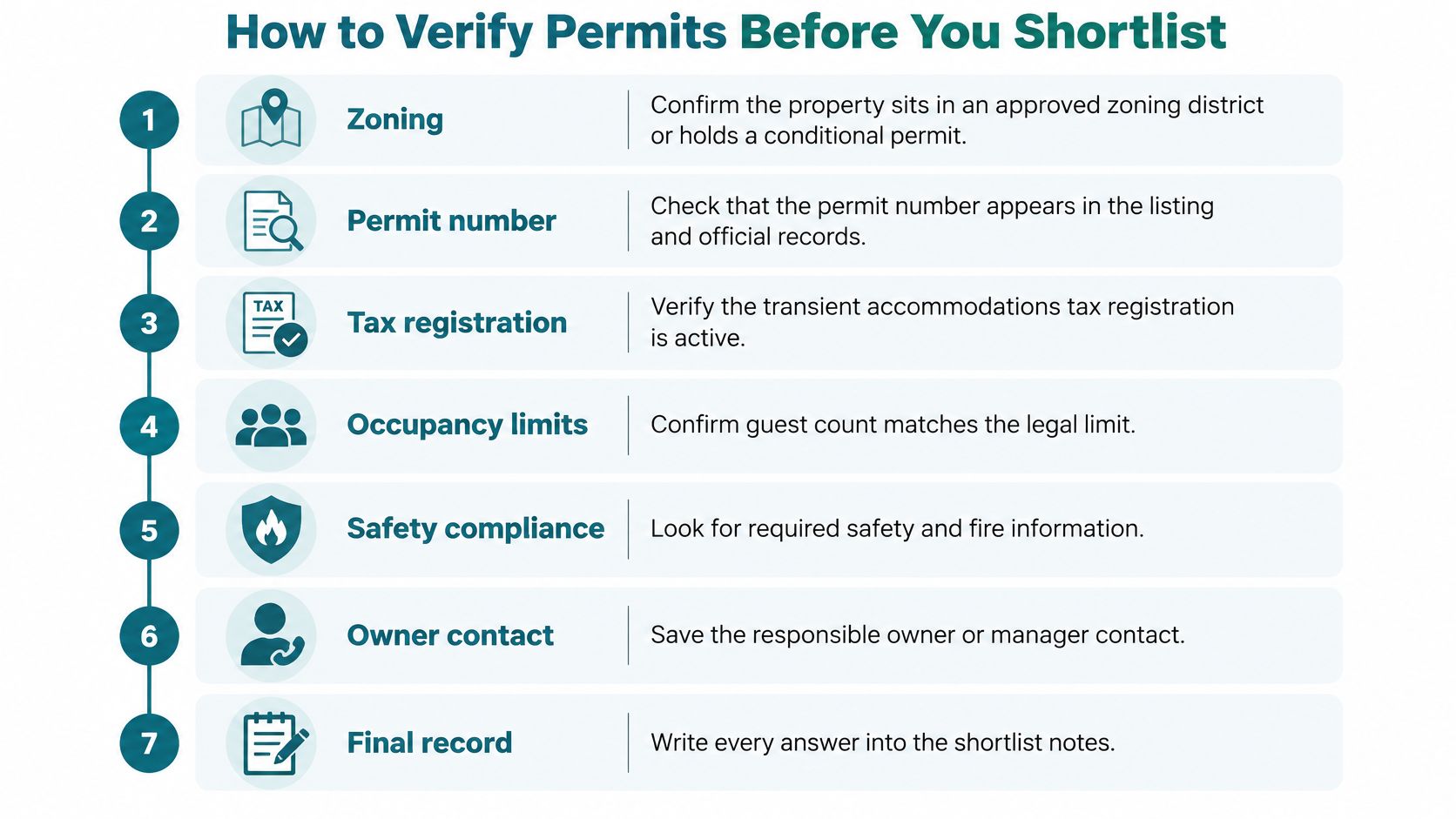
How to Verify Permits Before You Shortlist
Treat the applicable permit number, or documented permit exemption, as the first gate. A professional website, responsive host, and attractive photographs don't establish that a particular property can legally accept your reservation.
Maui County's short-term-rental guidance requires applicable permit numbers in advertising and a designated manager reachable by telephone at all times who can arrive onsite within one hour; it also identifies more than 16,000 units eligible to operate without an STRH permit in qualifying zones. An absent STRH number therefore needs an explanation, not an automatic assumption of either legality or illegality.
Record these checks in order
- Zoning. Obtain the property address and confirm the approved zoning district or conditional authorization. Match the records to the actual unit, not merely the development name.
- Permit number. Compare the listing's applicable number with official records. If the operator says no STRH permit is needed, request the property-specific basis for that exemption.
- Tax registrations. Request the operator's Hawaii General Excise Tax and Transient Accommodations Tax registrations. Maui County's transient-vacation-rental FAQ explains the zoning or conditional-permit framework and registration obligations for rentals under 180 consecutive days. Check that the registrant's identity makes sense alongside the booking paperwork.
- Contracting party. Confirm the contract names the licensed operator or broker, rather than only the platform taking payment. Ask who has authority to resolve a failed check-in or refund dispute.
- Local manager. Save the manager's direct telephone number and confirm the response arrangement. A central reservations inbox isn't a substitute for an identified onsite responder.
- Eligibility category. Record whether the property operates through qualifying zoning, an STRH permit, a bed-and-breakfast permit, or conditional authorization. Don't accept a neighboring property's approval as evidence for this home.
- Final record. Save authorization details, tax registrations, cancellation terms, occupancy limits, emergency contacts, and the dated listing. Ask for the property's safety and fire instructions before arrival.
Separate legal checks from service checks
Authorization establishes whether the property can enter your shortlist. Operational preparation establishes whether the stay is likely to work.
For the service side, CS Outsource's checklist for keeping Airbnb stays running smoothly is a useful companion when reviewing communication, turnover, and arrival preparation. It doesn't replace county verification.
If the address, operator name, and authorization don't reconcile, pause the booking. Save the unanswered question in your comparison sheet instead of letting a reassuring phone conversation substitute for documentation.
Calculate the Real Tax Cost of Longer Stays
On a $10,000 taxable rental charge, Maui's county transient-accommodations tax alone is $300, because Maui County imposes a 3% county TAT. That county component isn't the complete tax bill, and it doesn't include state taxes, GET, cleaning charges, resort fees, or other disclosed costs.
County transient tax on taxable rental bases
Taxable rental charge | County TAT at 3% | Still to add |
|---|---|---|
$10,000 | $300 | State GET and TAT, cleaning, resort fees |
$25,000 | $750 | State GET and TAT, cleaning, resort fees |
$50,000 | $1,500 | State GET and TAT, cleaning, resort fees |
The larger rows are arithmetic illustrations of the same county component, not complete quotes. Ask the operator which charges enter each taxable base rather than assuming every tax applies only to the advertised rent.
Stay length changes the classification
Hawaii treats rentals of fewer than 180 consecutive days as transient accommodations, with GET and TAT registration, reporting, and payment obligations unless an exemption applies. Long-term rentals aren't subject to TAT, while short-term rentals generally incur both GET and TAT.
A monthly booking therefore doesn't become tax-exempt merely because the listing calls it an extended stay. When comparing a one-month visit with a 180-day-or-longer arrangement, obtain separate itemized quotes rather than extending the shorter booking's nightly calculation.
Ask each operator to show:
- Rental base. The accommodation charge for your exact dates.
- Taxable charges. Which mandatory charges enter each tax calculation.
- Separate tax lines. County TAT, state TAT, and GET.
- Other fees. Cleaning, resort access, parking, and any mandatory service charges.
- Final payable total. The amount due, with refundable deposits identified separately.
Use the same worksheet for every candidate. Our extended-stay vacation rentals guide offers a useful planning framework for comparing longer bookings without losing sight of day-to-day requirements.
Weekly pricing needs a like-for-like comparison
Consider a hypothetical villa advertised at $1,000 per night with a three-night minimum, alongside a $6,300 weekly rate. The weekly accommodation charge works out to $900 per night, or $100 less than the advertised nightly rate.
That comparison holds only when both quotes use the same cleaning-fee treatment, tax lines, and included facilities. A weekly quote that omits mandatory charges isn't yet comparable.
A weekly rate can reduce the accommodation charge. It doesn't, by itself, change the booking's tax classification.
For a hypothetical three- or four-week stay, request the complete consecutive-stay quote as well as the weekly price. Check whether cleaning is charged per booking or per block, and whether housekeeping is included or optional. Compare final totals, not the most attractive rate label.
Benchmark Villa Rates Against Maui Market Data
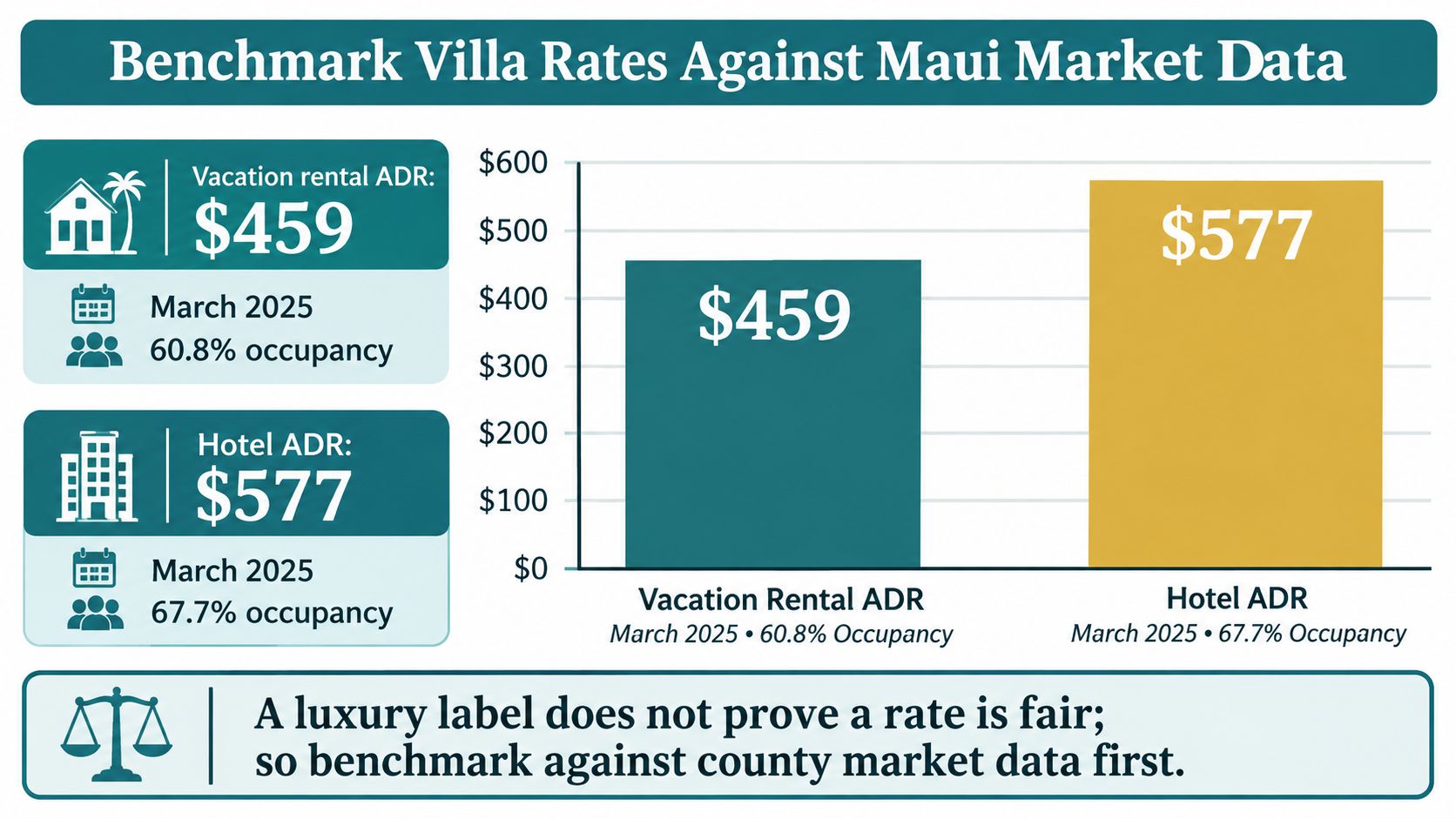
Compare a villa's all-in nightly cost with Maui County accommodation benchmarks before accepting its luxury premium. The benchmark won't tell you what a particular estate should cost, but it gives you a starting point for asking what the additional spend buys.
The March county figures place vacation-rental ADR at $459 with 60.8% occupancy, against hotel ADR of $577 with 67.7% occupancy, in the Maui County market figures. Hawaii's May 2025 vacation-rental performance report records Maui County vacation-rental ADR of $417 and 45.5% occupancy, with ADR 81.0% above 2019 and occupancy 30.4% below 2019.
Maui market benchmarks for rate checks
Benchmark | Average daily rate | Occupancy |
|---|---|---|
Maui County vacation rentals, March 2025 | $459 | 60.8% |
Maui County hotels, March 2025 | $577 | 67.7% |
Maui County vacation rentals, May 2025 | $417 | 45.5% |
These are broad accommodation averages, not bedroom-adjusted luxury-villa valuations. Don't read a premium over the county average as proof of overpricing, or lower occupancy as a guarantee that an owner will negotiate.
Normalize the quote before judging it
Use a consistent comparison sequence:
- Calculate the all-in nightly cost. Divide the complete mandatory booking total by occupied nights. Keep refundable security deposits separate from spending.
- Adjust for what the property supplies. Compare usable bedrooms, view, private pool, kitchen, resort access, cleaning, taxes, and minimum-stay restrictions.
- Calculate group economics. Divide total trip cost by guests, or by usable bedrooms when households are splitting the bill.
- Test different dates. Obtain actual shoulder-season and peak-season quotes. Don't apply one seasonal price to another travel window.
A hotel comparison needs equivalent capacity. Compare the villa with the rooms your party would book, including mandatory hotel charges, rather than treating one hotel room as a substitute for an entire residence.
Work through the apparent saving
Say a legally suitable villa costs $1,200 per night for 10 guests. Its base accommodation cost is $120 per guest per night, before taxes and other charges.
Now consider a hypothetical $700-per-night villa for six guests, with a $150 cleaning fee and a three-night minimum. The minimum booking costs $2,250 before taxes, or $125 per guest per night at full occupancy.
The lower headline rate produces the higher per-person cost in that scenario. Neither result is an all-in comparison until both quotes include the same charge categories.
Also test whether the less expensive option requires compromises your family will pay for elsewhere. A poorly positioned home can mean extra transportation, while an unsuitable kitchen can undermine the meal plan.
Write down the all-in trip total, all-in nightly cost, and cost per guest for the full stay for every shortlisted villa. Those numbers support an actual decision; the advertised nightly rate alone doesn't.
Protect Your Booking From Regulatory Change
The most luxurious villa isn't necessarily the safest booking. A professionally managed, clearly authorized residence can offer greater booking reliability than a more impressive home whose operator won't explain its legal status.
In July 2025 reporting by NBC Bay Area, Maui lawmakers advanced legislation targeting a large class of vacation rentals, with proposed transitions potentially affecting West Maui properties by 2028 and properties elsewhere in the county by 2030. Those dates describe the proposal reported at that time, not a substitute for checking the rules currently applicable to your property and travel dates.
Identify the property's actual category
An island-wide inventory count isn't proof that a particular home is permitted. Statewide vacation-rental inventory doesn't distinguish permitted from unpermitted units, and legal eligibility is determined at county level.
Request the zoning category and applicable short-term-rental authorization, along with the transient-accommodations tax registration. Have the operator identify whether the accommodation is a hotel-zoned residence, timeshare, or apartment-zoned vacation rental. Those labels aren't interchangeable.
Also ask whether association or property-level restrictions affect your stay. A marketing description such as resort residence doesn't answer whether the specific unit can accept your dates and duration.
Keep the operator's written explanation attached to the contract. If the explanation depends on pending approval or an expected rule change, don't treat that expectation as confirmed authorization.
Negotiate the disruption procedure
Cancellation language should address more than a traveler changing plans. Ask what happens if the operator loses the ability to host the reservation.
- Trigger. Does loss of rental authorization entitle you to cancel and receive a refund?
- Responsibility. Who must find a replacement, and who pays any difference?
- Comparability. Must the replacement preserve bedroom arrangements, location, accessibility, and essential facilities?
- Consent. Can you reject a materially different property rather than accept an automatic substitution?
- Timing. When must the operator notify you, and when must refunded funds be returned?
Ask for these answers in the agreement, not merely in a message saying the team will take care of you. Don't assume a lodging refund covers consequential travel expenses.
A replacement home is only comparable if your group can actually use it.
Consider a hypothetical 12-person family whose flights, childcare, activities, and accessibility arrangements depend on one villa. Splitting them between distant properties could preserve the nominal bed count while breaking the transportation plan and separating caregivers from the relatives they support.
Define those essential requirements before signing. Share them with the contracting operator so a proposed relocation can be evaluated against written requirements rather than improvised during a disruption.
Book the authorized home with clear contractual remedies over the unverified one with better photographs. You're protecting the whole itinerary, not just the accommodation payment.
Run a Pass-Fail Test Before the Deposit
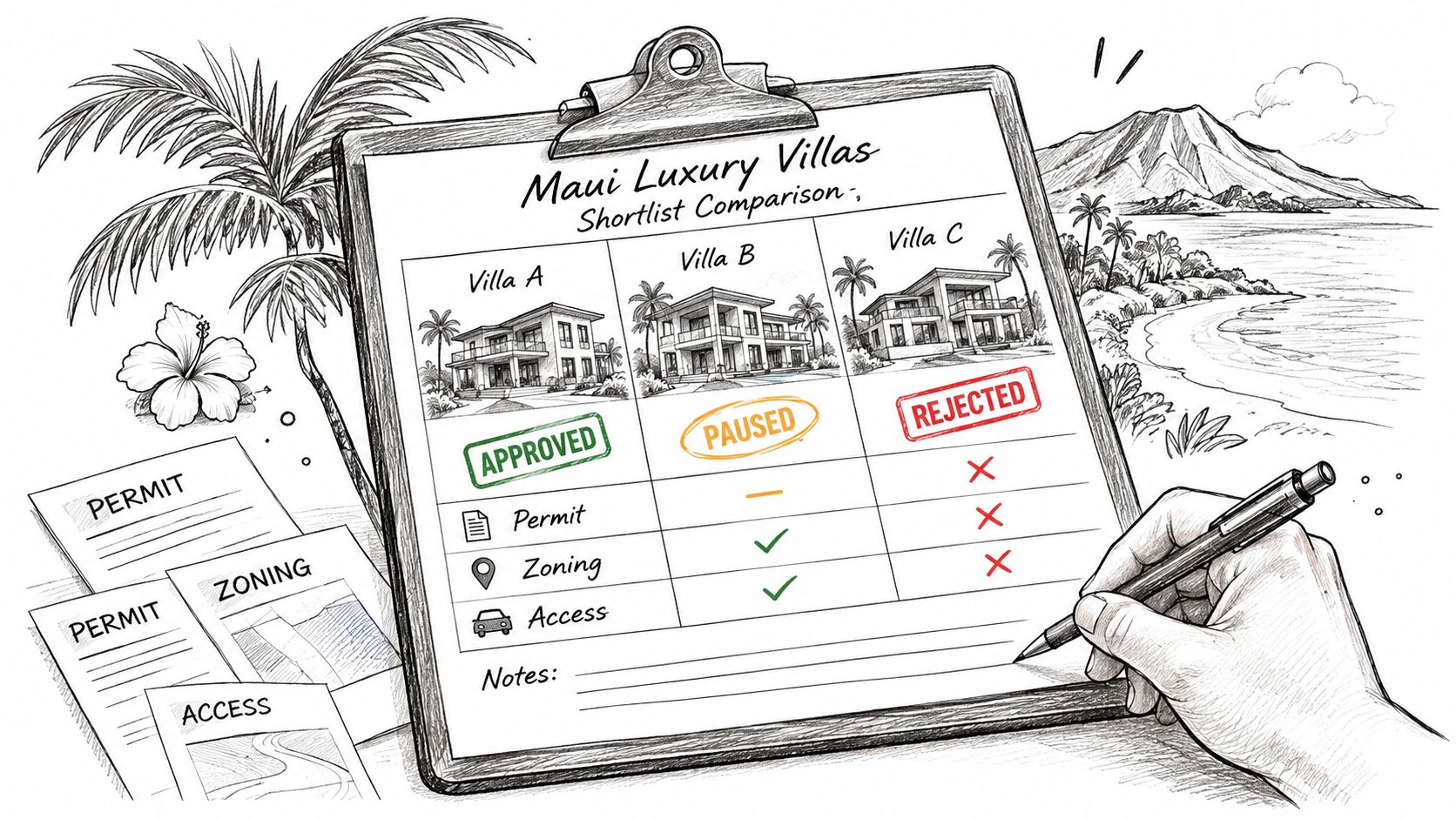
Compare your final candidates in a spreadsheet with columns for evidence, unresolved questions, and pass or fail. Don't average away a legal problem because the pool, location, or price scores well.
Use the same requirements for every property. Our luxury home rentals guide can help distinguish essential facilities from attractive extras before you make the final choice.
Apply the booking gates
- Authorization passes only with evidence. The applicable permit number or documented exemption is recorded, zoning or conditional authorization is confirmed, tax registrations are supplied, and the agreement identifies the responsible licensed operator.
- Capacity passes only for the complete party. The authorized guest maximum covers everyone, and the rooming plan works without relying on unapproved sleeping space.
- Price passes only as an itemized total. The final cost fits the group's budget after accounting for mandatory charges and the facilities needed for the trip.
For a hypothetical family of 12 booking under the bedroom-based STRH framework, a permitted six-bedroom home with an authorized guest cap is required to accommodate the party. A listing advertised for 14 fails if the operator can't document suitable legal capacity; the advertising claim itself proves nothing.
Consider another hypothetical comparison. Villa A charges $1,300 per night for seven nights, plus $300 cleaning, producing $9,400 before taxes, or about $783 per guest for 12 guests. That's a useful subtotal, but the price gate remains pending until the tax-inclusive quote arrives.
Villa B advertises a lower rate but provides neither its applicable permit number nor a documented exemption. Mark it failed on authorization, regardless of its apparent saving.
Save the decision before sending money
Keep the authorization, guest cap, signed agreement, itemized total, and payment schedule together. Confirm payment instructions through a known contact, and give the family one agreed cost-allocation sheet.
Through Approved Traveler, our members access wholesale rates on hotels, flights, cruises, cars, homes, tours, and activities, with hotels, flights, cruises, cars, tours, and homes available under one member-portal login. Our 110% Best Value Guarantee pays the difference plus 10% if a lower publicly available price exists for the same booking.
Consolidated booking infrastructure helps organize the itinerary. It doesn't replace property-specific diligence. Send the deposit only after the villa passes every gate and the supporting documents are saved.
Approved Experiences Traveler offers wholesale travel access and a single member portal for coordinating homes, flights, cars, and the rest of your family's itinerary. Visit Approved Experiences Traveler to explore membership access, then compare your Maui villa candidates using documented authorization, usable capacity, and itemized totals.