Luxury Maui Rentals: What to Book in 2026
Compare luxury Maui rentals by nightly rate, home type and legal status, then book groups around 2026 taxes and phase-out rules.
12 min read

Maui County's vacation-rental average daily rate rose 107.9% between July 2019 and July 2025, reaching $490, even as booked demand remained 42.7% below July 2019, according to the Hawaiʻi Department of Business, Economic Development and Tourism's July report. Luxury Maui rentals deserve a closer look than the nightly price suggests. For a family sharing bedrooms, meals, and transportation, the useful comparison is the complete stay, not a house photo against a hotel room.
A polished listing also isn't proof of legal operation. Before committing the group's money, separate the decisions: choose enough usable space, verify the property's authorization, calculate the gross tax, and check whether its zoning supports your travel dates.
What Luxury Maui Rentals Cost Right Now
Maui County vacation rentals averaged $464 per day with 45.3% occupancy in June 2025. Hotels averaged $558 per day and had 63.5% occupancy, according to the state's June vacation-rental performance report. In July, vacation rentals averaged $490 per day and 47.7% occupancy, while hotels averaged $558 and 66.7% occupancy. These countywide figures show that rentals had lower occupancy than hotels in both months, not that a particular luxury home will be discounted.
Maui vacation rentals versus hotels, 2025
Month and lodging | Available unit nights | Booked unit nights | Occupancy | Average daily rate |
|---|---|---|---|---|
June 2025 vacation rentals | 266,300 | 120,700 | 45.3% | $464 |
June 2025 hotels |
|
| 63.5% | $558 |
July 2025 vacation rentals | 280,700 | 133,900 | 47.7% | $490 |
July 2025 hotels |
|
| 66.7% | $558 |
The rental unit-night figures show inventory and bookings across each month. They cannot tell you whether a home with the right bedrooms, location, and legal status is available for your week.
Translate the rate into a family week
Use the June averages for a hypothetical comparison: seven rental nights at $464 come to $3,248 before taxes and cleaning. Two hotel rooms at $558 each for seven nights come to $7,812 before taxes and other charges. This is rate arithmetic, not a quote for equivalent properties. The actual total depends on the specific unit and its charges.
A rental may make financial sense when its bedrooms let your group share one property instead of booking multiple hotel rooms. A kitchen, laundry, and common area can also make a shared week more practical for relatives keeping different schedules. Those features add value only if the layout works for the people staying there.
Check the floor plan and the beds room by room. A listing's maximum occupancy is a headcount, not a guarantee that every guest gets a suitable sleeping space.
Practical rule: Compare the space your group can comfortably use, not the maximum number of people the listing says it sleeps.
Price the whole arrangement
Put the exact unit, bedrooms, beds, bathrooms, parking, cancellation deadline, and itemized total in a shared comparison sheet. For hotels, record the same kind of detail, including whether connecting rooms are confirmed or only requested. That makes the comparison more useful than lining up nightly rates alone.
Keep possible meal savings separate from lodging costs. A kitchen gives your group the option to cook, but does not ensure that anyone will use it.
Countywide occupancy also cannot confirm a property's legality or availability. Before making the rental the anchor for flights and activities, get a written quote, confirm when it expires, and read the cancellation terms. A polished listing and an attractive weekly total do not replace checking the permit, on-site rules, gross tax, and any phase-out date that could affect your trip.
Homes Condos Timeshares and Resort Rooms
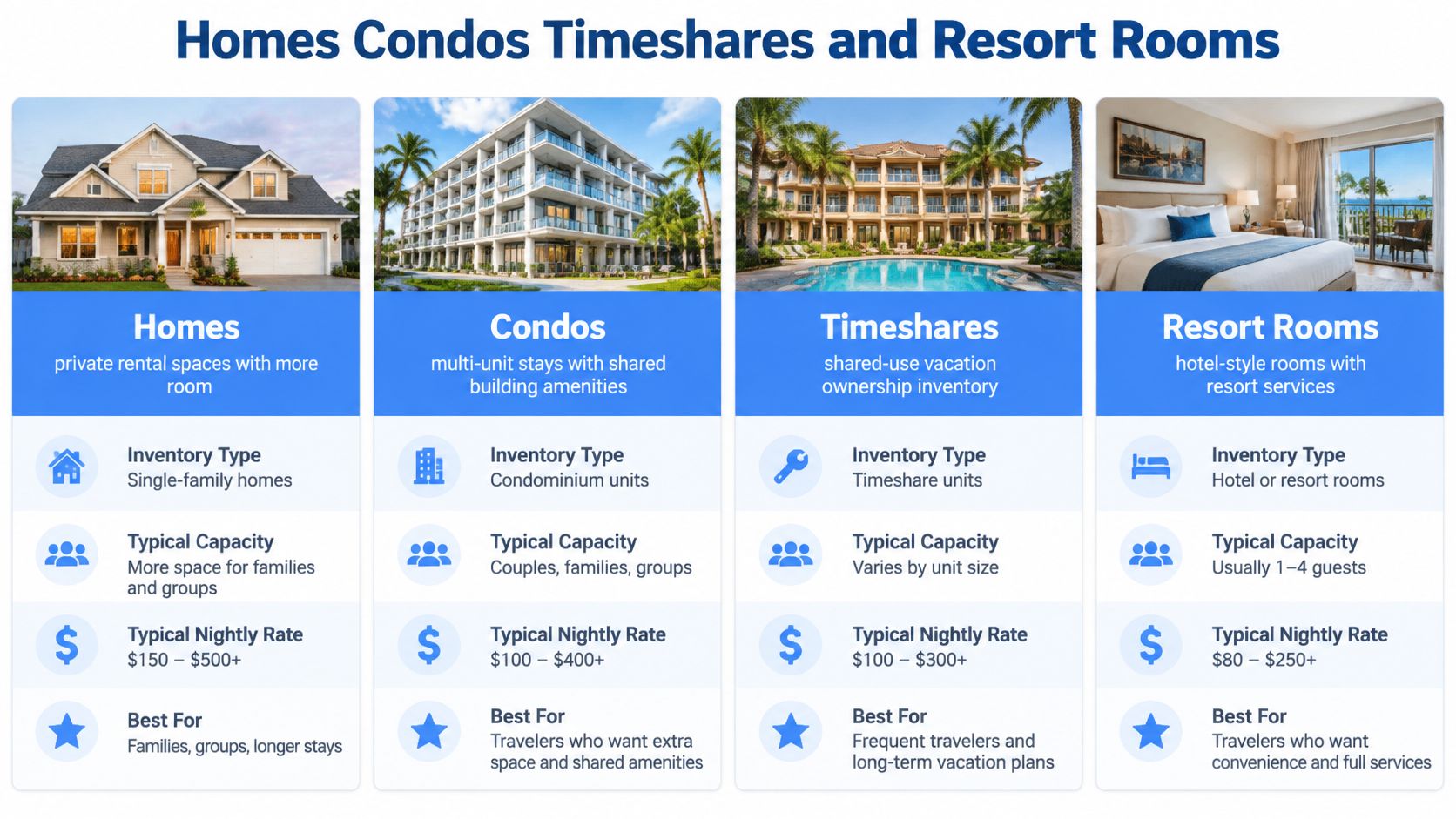
Accommodation type is the vehicle class, not the paint color. The Hawaiʻi Tourism Authority's 2025 annual visitor report reports that 54.3% of Maui visitors stayed in hotels, 23.0% in condominiums, 11.8% in timeshares, and 10.1% in rental homes.
Where Maui visitors stayed in 2025
Lodging type | Share of Maui visitors | Best fit | Watch before booking |
|---|---|---|---|
Hotel | 54.3% | Couples and short resort stays | Extra rooms multiply the weekly rate |
Condominium | 23.0% | Families who want a kitchen | Confirm beds, occupancy, and zoning |
Timeshare | 11.8% | Owners or exchanged weeks | Exchange rules differ from a nightly rental |
Rental home | 10.1% | Private multi-bedroom groups | Smaller pool, so source the exact house early |
These visitor shares describe lodging use, not a live inventory count. They're useful context, but you still need to source the particular configuration your family needs.
Put the same reunion into each category
For a hypothetical eight-person reunion, hotel rooms can keep everyone within the same resort infrastructure. The trade-off is separation: clarify who shares with whom, where breakfast happens, and whether the group has somewhere to gather without occupying a bedroom.
A condominium can combine sleeping space with a kitchen and shared building amenities. Confirm that the advertised layout belongs to the exact unit, especially when photographs show several residences or a representative room category.
A timeshare stay needs a contract-level check. Ask whose name appears on the reservation, whether a guest certificate is necessary, and which occupancy, arrival, or exchange restrictions apply.
A rental home can put the household under one roof with more private living space. It also makes the group dependent on that home's access arrangements, maintenance support, parking, and cancellation contract.
Compare daily function before finishes
A beautiful dining table isn't necessarily a remote-work setup. Ask where calls can happen with a closed door, whether the internet serves the actual residence, and whether someone working early will disturb sleepers.
For grandparents, verify the route from parking to bedroom rather than accepting “easy access” as a complete description. Steps, elevators, bathroom placement, and sleeping-floor access matter more than decorative finishes.
Our hotel versus vacation rental comparison offers another way to weigh shared space against hotel services. Lock the lodging category to the headcount, then verify the exact unit before choosing between neighborhoods.
Neighborhoods That Fit the Stay
Choose the neighborhood after the sleeping plan and before the photo shortlist. A familiar place name doesn't establish a property's zoning, authorization, or building rules.
West Maui searches commonly include Lahaina, Kaʻanapali, Kapalua, and Napili. South Maui searches commonly focus on Wailea and Kihei. Treat those names as search areas, not legal classifications, and compare the actual address against the group's daily routine.
Match the address to the routine
- Walking-oriented stays: Check the pedestrian route to dining and the beach, including entrances, road crossings, and access restrictions.
- House-centered stays: Prioritize a comfortable lanai, kitchen, gathering space, and usable parking if the family expects to spend evenings together.
- Mixed schedules: Choose an arrangement that lets early risers, working adults, and children use separate spaces without disrupting everyone else.
For a hypothetical ten-person Kihei reunion, the organizer might request five bedrooms and parking for six vehicles. Those are group requirements, not assumed features of a large house, so test them against the listing before comparing ocean views.
Ask whether each shortlisted address is in a hotel, apartment, or residential district, and whether building rules independently restrict rentals. If your itinerary includes another island, Kona Honu Divers can help you compare Big Island accommodations for divers around a different activity-based routine rather than carrying the Maui shortlist over unchanged.
How to Confirm the Rental Is Legal
Illegal transient-rental operations can face an initial $1,000 fine followed by penalties of up to $1,000 per day, and Maui generally requires an approved zoning district or county-issued conditional permit, according to Maui County's vacation-rental guidance. Those are operator penalties, but a disrupted reservation creates separate financial and logistical problems for guests.
Luxury presentation does not reduce regulatory exposure.
Use the checklist as a starting point, then obtain records tied to the property you're booking.
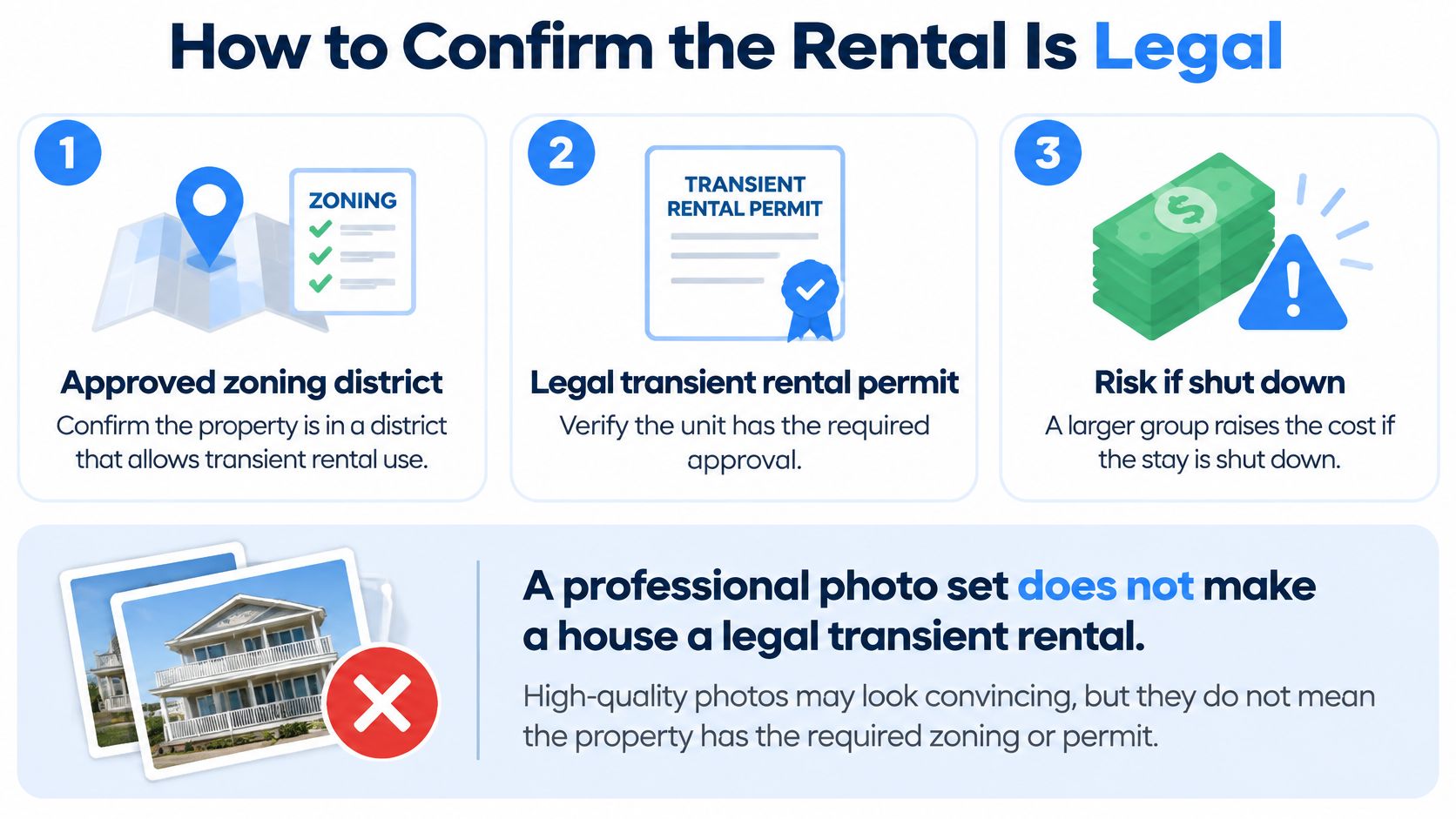
Verify authorization and operations separately
Maui County's approved short-term-rental-home materials require permitted short-term-rental-home advertisements to include the permit number, require onsite rather than street parking, and specify a manager reachable by telephone at all times who can arrive onsite within one hour. These requirements apply to that permitted-home category, so establish the property's legal basis before assuming every rental follows the same framework.
- Request the identifier. Obtain the applicable permit or registration identifier and the legal basis for transient use. A platform listing number isn't the same thing.
- Match the address and unit. Compare the advertisement, contract, and county record. For a condominium, verify the residence identifier, not merely the development name.
- Confirm permitted occupancy. Ask Maui County to confirm the authorized occupancy where applicable. Bedrooms shown in photographs don't establish the guest limit.
- Check the advertisement. For a permitted short-term-rental home, make sure the applicable permit number appears. Resolve discrepancies before paying.
- Name the responsible manager. Get the telephone contact and arrival instructions in writing. Ask who handles lockouts, plumbing failures, or loss of access after hours.
- Count actual parking spaces. Match the group's vehicle plan to the property's permitted onsite capacity. Don't build an overflow plan around street parking.
- Read the disruption clause. Find the contract language governing refunds and cancellation if authorization changes before arrival.
Save proof with the reservation
Keep the listing, permit information, manager's response, and signed contract in a shared folder. Save the version you relied on, since a live advertisement can change after booking.
Distinguish a property authorized through its district from a residential short-term-rental home operating under a permit. The question isn't whether a permit exists; it's whether the authorization covers the offered use.
For a family reunion, make authorization review part of lodging selection rather than a task left until departure. Don't purchase nonrefundable flights until the address, occupancy, and booking terms align.
Taxes That Change a Weekly Total
Start with the contract term. Hawaiʻi presumes stays of fewer than 180 consecutive days are transient accommodations, and operators must register for General Excise Tax and Transient Accommodations Tax and report gross rental receipts, according to the Hawaiʻi Department of Taxation's rental guidance.
Tax registration doesn't establish county permission to operate. It answers a tax question, not the land-use question.
Build the gross tax calculation
The Department of Taxation's Act 96 guidance identifies the former 10.25% TAT, its increase to 11.00% for gross rental proceeds received or accrued on or after January 1, 2026, and 4% GET plus a 0.5% county surcharge where applicable. On a hypothetical $10,000 gross rental, those stated rates produce $1,100 in TAT and a simplified $450 GET-and-surcharge calculation, totaling $1,550 before other charges.
Tax stack on a $10,000 Maui rental
Charge | Rate | Applied to |
|---|---|---|
Transient Accommodations Tax through 2025 | 10.25% | Gross rental proceeds |
Transient Accommodations Tax from January 1, 2026 | 11.00% | Gross proceeds received or accrued on or after that date |
General Excise Tax | 4% | Gross rental proceeds |
County surcharge where applicable | 0.5% | Gross rental proceeds |
Total at 2026 rates | 15.5% simplified combined rate | Gross rental proceeds |
This is a limited illustration of the listed tax components, not a complete statement of every charge that may appear on a Maui booking. Request an itemized quote identifying any additional applicable taxes, pass-through calculations, and taxable fees.
Using the hypothetical rental week calculated earlier, the same simplified rates add $503.44 to a $3,248 rental subtotal, producing $3,751.44 before cleaning and other charges. The point isn't to predict a property's final invoice; it's to stop treating tax as a rounding error.
Ask what the quoted total includes
Tax applies to gross proceeds rather than the owner's net profit. An owner's maintenance expenses therefore don't automatically reduce the proceeds used in the rental-tax calculation.
The accounting method also matters when rates change: cash accounting follows receipt, while accrual accounting follows when the right to receive revenue becomes fixed. Ask for a written explanation of the applicable rate rather than assuming the arrival date settles everything.
- Gross or incomplete: Does the displayed total include all applicable taxes and mandatory fees?
- Taxable items: Which cleaning, management, or other charges enter the taxable proceeds?
- Longer contract: Will a substantially extended stay change the classification or paperwork?
Our extended-stay vacation rental guide can help structure a longer-stay comparison. Don't change the contract term solely to chase a monthly rate without clarifying the resulting treatment.
Phase-Out Dates for Later Maui Trips
Two dates frame future planning for certain Maui apartment-district rentals: the county planning staff report describes scheduled phase-outs by area, with West Maui Community Plan area properties affected before those in the remaining county areas. These dates apply to specified uses, not every Maui rental. Review the planning staff report on apartment-district rentals and confirm the rules for the exact property and travel dates.
The timeline shows why an open booking calendar is not enough for a later trip.
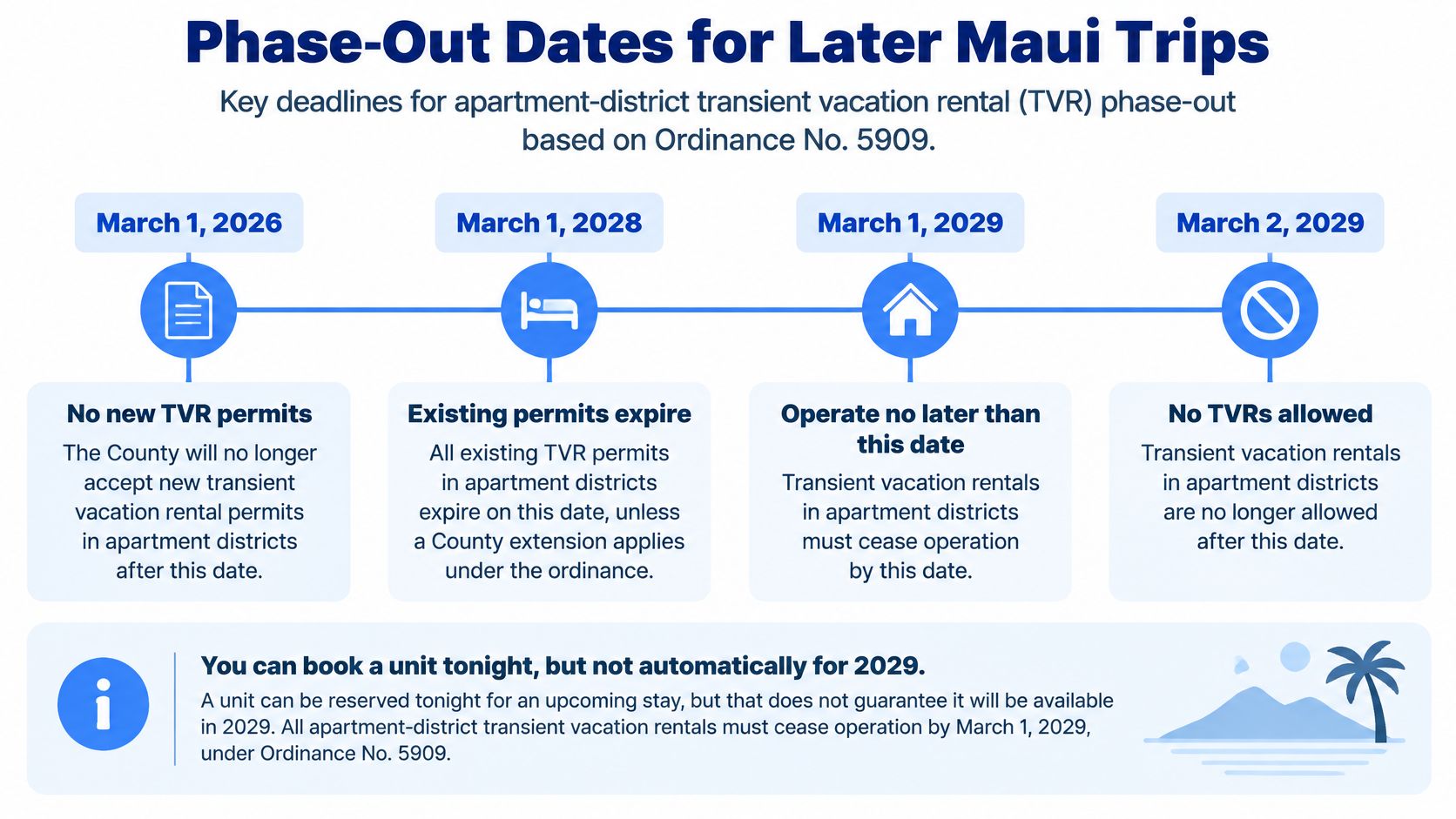
Check the property's path beyond the deadline
The report also describes a framework for certain properties to move into H-3 or H-4 hotel districts. Eligibility criteria include evidence of legal transient-vacation-rental use before September 24, 2020, and a limit on allowed units based on the amount authorized as of January 7, 2022.
A possible rezoning is not the same as completed authorization. Ask for the property's current district, the relevant approval record, and an explanation of how that record supports your reservation dates.
Present availability is not future permission.
For a later West Maui reunion, compare the property's use authorization with the planned stay. An apartment-district condominium and a hotel-district residence can look alike in a listing while having different rules for future bookings. A polished listing alone does not establish that short-term rental use is permitted.
Use the accompanying video as context, not as a substitute for the property record.
Put the future-use answer in writing
Ask whether continued operation depends on a pending change, then check what the contract promises if that change does not happen.
- Current status: What district and authorization apply to this exact unit?
- Travel-date eligibility: What record supports transient use during your stay?
- Financial protection: Who returns the deposit if the property cannot lawfully accommodate the reservation?
For a trip booked well ahead, rely on documented eligibility rather than an assurance that everything should work out. Recheck the property's status before the deposit becomes nonrefundable, and keep the written response with the contract.
Book the Week in One Login
Once the shortlist passes the property checks, manage the week as a coordinated operation. The organizer needs a shared decision record, not another message thread full of screenshots.
Use this booking sequence to keep the group's requirements attached to the reservation.
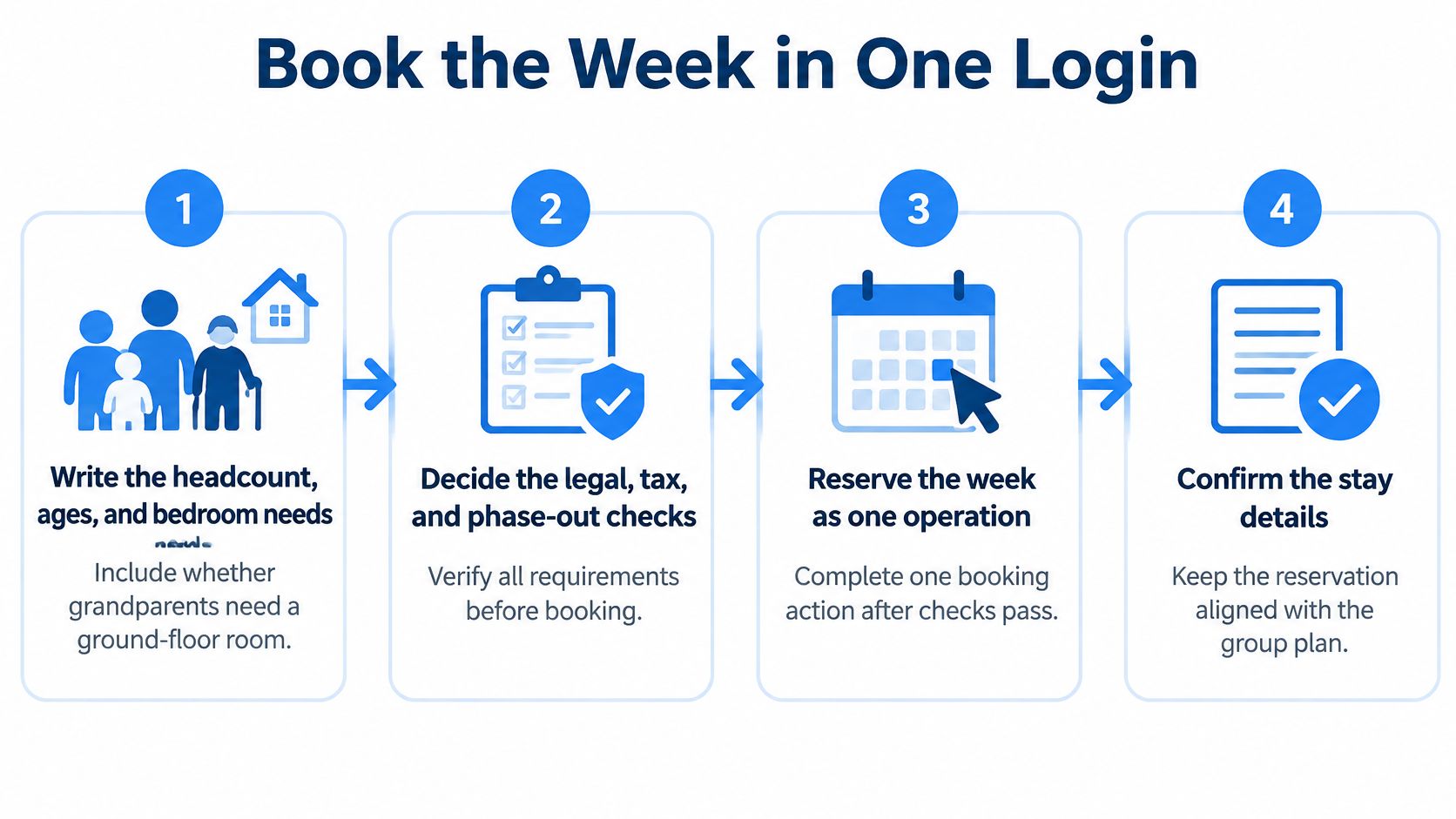
Create a reservation-ready group plan
- Write the sleeping plan. Record headcount, children's ages, bedroom assignments, and accessibility needs. Specify whether grandparents need a ground-floor bedroom and whether anyone can reasonably use a sofa bed.
- Define the stay's working needs. Confirm dates, kitchen use, laundry, and private workspace. If someone needs video calls, request details about the room and connection rather than accepting a photograph of a laptop.
- Compare complete alternatives. Put the house, condominium arrangement, and hotel configuration into the same spreadsheet with mandatory charges included.
- Coordinate commitments. Have the lodging contract, cancellation deadline, and guest limits in writing before committing the group to nonrefundable transportation.
- Agree on the split. Record each household's contribution, deposit responsibility, and what happens if someone withdraws.
- Keep a workable substitute. If the preferred residence disappears, compare another lodging category or shift dates rather than forcing the group into an undersized property.
For a hypothetical large reunion, neighboring condominiums may function better than a single cramped house. Confirm their proximity and align the cancellation decisions so the organizer doesn't retain one unit after losing the other.
Consolidate access without confusing the contracts
A travel booking platform can consolidate the search and reservation workflow, but each component still needs its own terms. A shared login doesn't make a flight refundable or replace a property's occupancy rules.
With Approved Traveler and Lux Traveler, we provide hotels, flights, cruises, cars, tours, and homes under one member-portal login. Both plans include unlimited weekly condo-style stays, subject to availability for the member's dates, cover up to 10 people, and carry the 110% Best Value Guarantee. Members earn Reward Credits on bookings; credits don't expire and have no fixed dollar value because redemption varies. Lux Traveler adds the Approved Lux 24/7 Personal Assistant, so a member can hand a problem during the trip to the assistant team.
Keep the final confirmation packet practical: exact address, arrival instructions, assigned beds, manager contact, parking plan, itemized total, and cancellation deadlines. Give every participating household access before departure, while keeping payment information private.
Approved Experiences Traveler offers wholesale travel inventory and coordinated access to homes, hotels, transportation, and activities through a member portal. Visit Approved Experiences Traveler to compare options for your Maui week, then reserve the property that fits your family's space requirements, verified authorization, and complete budget.