Luxury Hawaii Vacation Homes: Choosing and Booking Well
Compare Luxury Hawaii Vacation Homes by capacity, permits, and all-in cost, with a checklist for booking weekly stays for groups.
13 min read

In June 2025, statewide occupancy was 46.7%, down 27.0 percentage points from June 2019, yet the average daily rate was $398, 95.8% higher than in June 2019, according to the Hawaii vacation rental performance report for June 2025. That split is the core problem with luxury Hawaii vacation homes. Price signals scarcity. Occupancy often doesn't. Judge a home as an operating environment for your group, not as a showpiece, and you'll book more accurately.
Which Luxury Hawaii Home Fits Your Group
The right home depends on three things: how many people sleep under one roof, how long the stay runs, and whether anyone needs a workspace. Views come last. A beautiful house that forces adults onto sofa beds, lacks parking, or has no quiet room for calls will fail operationally within days.
Home type | Typical capacity | Best stay pattern | Best for | Check first |
|---|---|---|---|---|
Multi-bedroom estate | 8-12 guests | 1-3 weeks | Multigenerational reunions | Separate bedrooms and parking for several vehicles |
Oceanfront condo | 4-6 guests | Weekly | Snowbirds and long-stay retirees | Building rules and weekly availability |
Private-pool villa | 6-10 guests | 1-2 weeks | Celebrations and family trips | Permit status and wind exposure |
Upcountry or ridge-line home | 6-8 guests | Weekly to monthly | Remote workers | Road access and internet redundancy |
Count Bedrooms, Not the Headline Sleep Count
Read capacity by bedrooms and actual beds, not the advertised maximum. Listings often count pull-out sofas and bonus rooms as sleeping space. For ten adults, the comfortable limit is usually lower than the listed sleep count, because privacy, bathrooms, and morning routines matter more than theoretical bed space.
Say you're organizing nine people for two weeks. You generally need at least four bedrooms, a full kitchen that can handle group meals, and parking for three or more vehicles. That points to a multi-bedroom estate, not a single condo stretched beyond its design. Our guidance on fitting a large group into one vacation rental applies the same bedroom-first logic.
Contrast that with a couple plus two grandparents on a four-week snowbird stay. A weekly-stay oceanfront condo with a full kitchen, in-unit laundry, and elevator access is more practical and costs less to run than a villa built for celebrations. You're paying for livability over weeks, not event space.
Groups comparing formats sometimes look outside Hawaii first to clarify what format they need, and resources to find New Mexico retreats with lodging can help separate retreat-style gathering space from ordinary sleeping capacity before you return to island inventory.
Three-question filter: How many people need separate rooms? How many weeks will you stay? Must the home support full-time work?
Apply those questions to every listing before you look at photos. If a home can't answer all three clearly, it isn't a fit, regardless of the pool.
Why Nightly Rates Mislead Hawaii Home Budgets
A nightly rate tells you what an owner asks. It doesn't tell you how many nights sell, how competitive your dates are, or what you'll pay in total. In 2025, statewide vacation rentals supplied approximately 10.1 million available unit nights and generated about 5.0 million booked unit nights, producing average occupancy of 50.0% with an average daily rate of $528, up 6.7% from the prior year, per the Hawaii 2025 vacation rental performance summary. Half the inventory sat empty on average while the typical rate stayed above $500. That's a market where timing beats headline price.
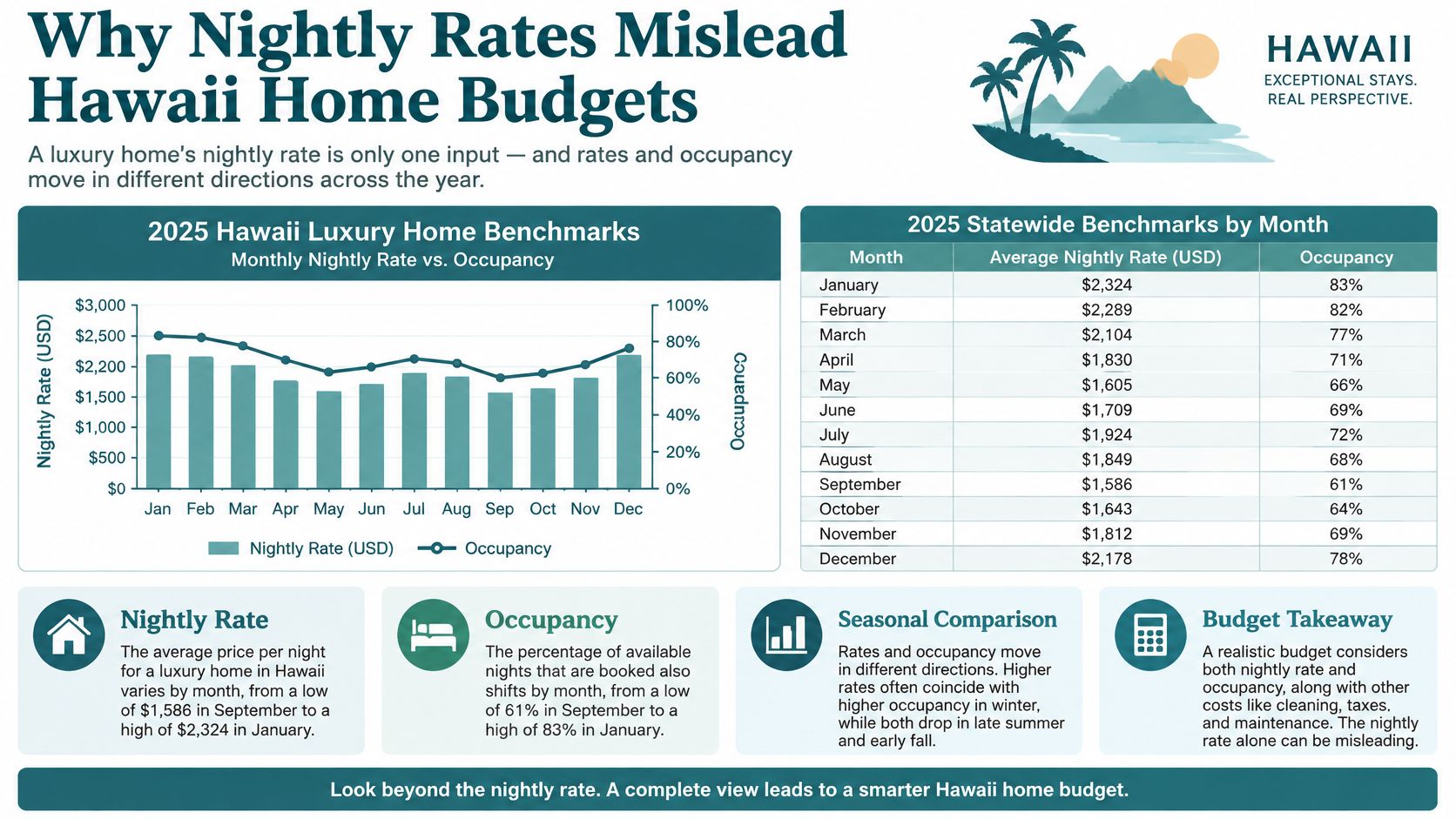
Month (2025) | Statewide occupancy | Average daily rate | What it means for budgeting |
|---|---|---|---|
January | 58.9% | $372 | Strong demand at a lower nightly rate; book early |
June | 46.7% | $398 | Soft occupancy; compare the all-in total |
July | 49.8% | $425 | Summer rates rise while half of nights stay open |
August | 47.0% | $433 | Supply exceeds demand; confirm dates in writing |
December | 52.1% | $515 | Highest rate in this sample; book the longest stays first |
How to Read the Monthly Pattern
January pairs the highest occupancy in this sample with the lowest rate. December reverses part of that picture, with lower occupancy than January but a much higher rate. If you budget from an annual average, you'll misprice both trips.
Use a worked example. A three-week stay priced at December's average costs substantially more than the same length of stay at June's average, a gap of more than $2,000 before taxes and fees in the scenario outlined for this comparison. The home didn't change. The calendar did.
- Peak months: Book early, because desirable multi-bedroom homes sell their best dates first even when statewide occupancy looks moderate.
- Soft months: Don't assume a lower rate means a better total. Compare the all-in total, since owners price flexibility, minimum stays, and fees differently.
- Long stays: Build the budget from your full length of stay and specific month, then check that total against the listing's minimum-stay rules.
A $398 rate with half of nights unbooked isn't evidence of weak pricing power. It's evidence that rate and utilization answer different questions.
For luxury Hawaii vacation homes, your question isn't whether the nightly rate looks high. It's whether that home, in that month, for that many nights, produces a total you can defend.
Check Legality and Permits Before You Pay
A polished listing doesn't prove a home may legally be rented for your entire stay. Hawaii's rules are county-specific, so authorization on one island tells you nothing about another. Honolulu requires registration for bed-and-breakfast homes and transient vacation units, with the registration requirement taking effect on October 23, 2022, according to Honolulu permitting information. That same framework distinguishes these properties from hotels, timeshare units, and units holding current nonconforming use certificates, which must be renewed annually between September 1 and October 15.
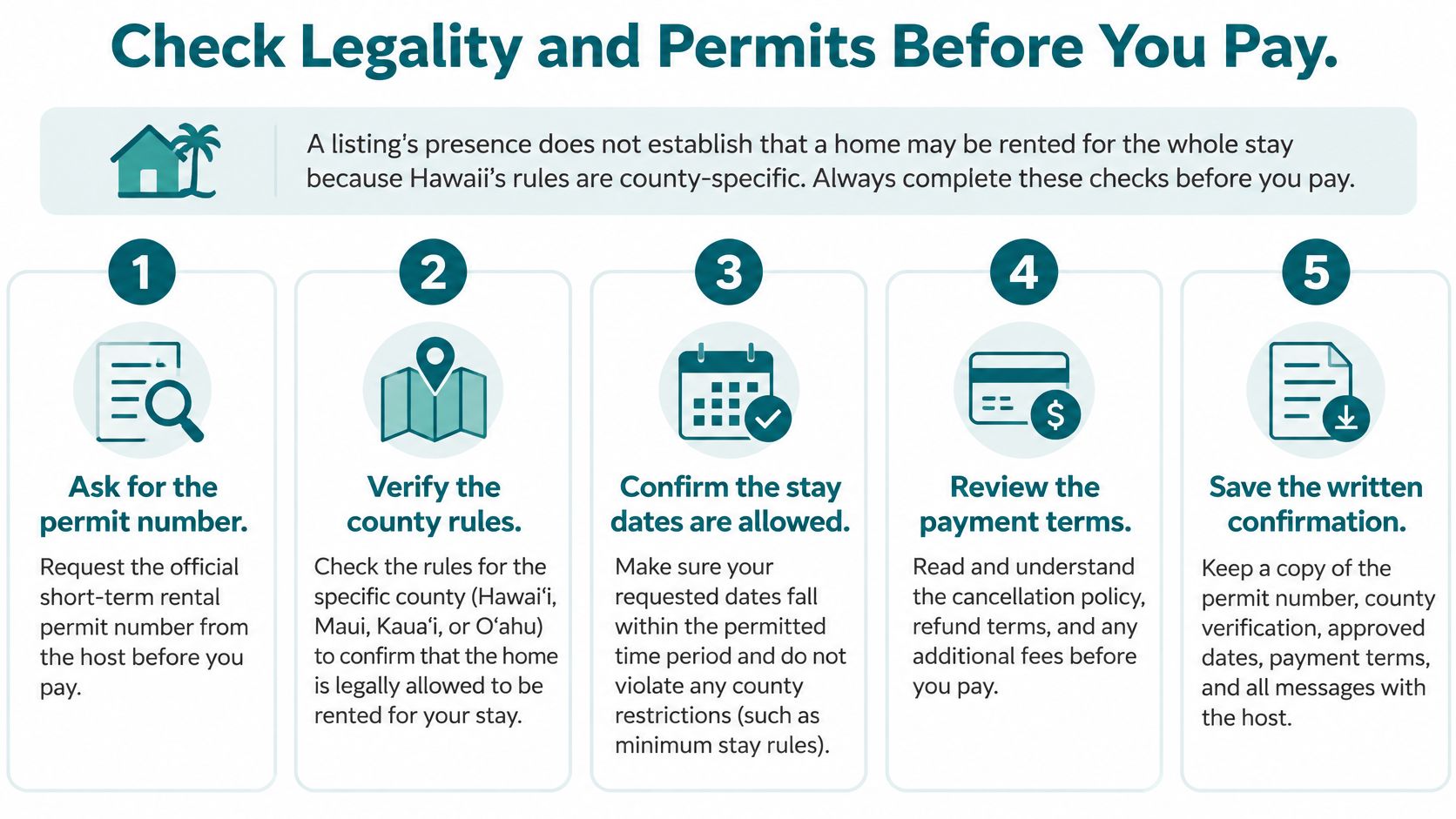
Run the Five Checks in Order
- Ask for the registration or permit number and the category it falls under. Don't accept a verbal assurance.
- Confirm the advertised rental structure matches the approved use, including your length of stay and guest count.
- Check the property type. Is it a hotel, a timeshare unit, or a nonconforming use subject to annual renewal?
- Confirm what happens if the property loses eligibility before or during your stay. Does the reservation transfer, refund, or cancel?
- Get cancellation and transfer terms in writing and keep them with your confirmation.
Say a remote worker books a month on Oahu. Before paying, that worker should request the registration or applicable certificate details and verify the monthly rental structure matches the approved use. A professionally furnished home isn't automatically authorized.
Groups face an extra layer. A home with several bedrooms, a pool, and event-style features may still face separate occupancy, zoning, or operating restrictions. If you're coordinating a reunion, ask for those limits by name. Ten people arriving to a home approved for fewer overnight guests is an operational failure, not a paperwork detail. Households that want local context on Hawaii legal resources more broadly sometimes review legal help for Kamuela accident victims when building a general island contacts list, but permit verification itself starts with the county and the owner.
For stays on Maui, Hawaii Island, or Kauai, ask the owner for the county authorization that applies to that property and confirm it covers your full stay. Save the permit details with your booking confirmation, where you can retrieve them if a platform, neighbor, or county office asks questions later.
Inspect Wind Exposure and Build Quality
Coastal views and ridge-line settings carry a structural cost that photos don't show. Hawaii's state residential code requires structural designs to account for wind loads that vary with building height and exposure, including wind effects created by local topography, under the Hawaii State Residential Code. A coastal, hillside, or ridge-line property may therefore need more demanding design assumptions than a sheltered inland site.
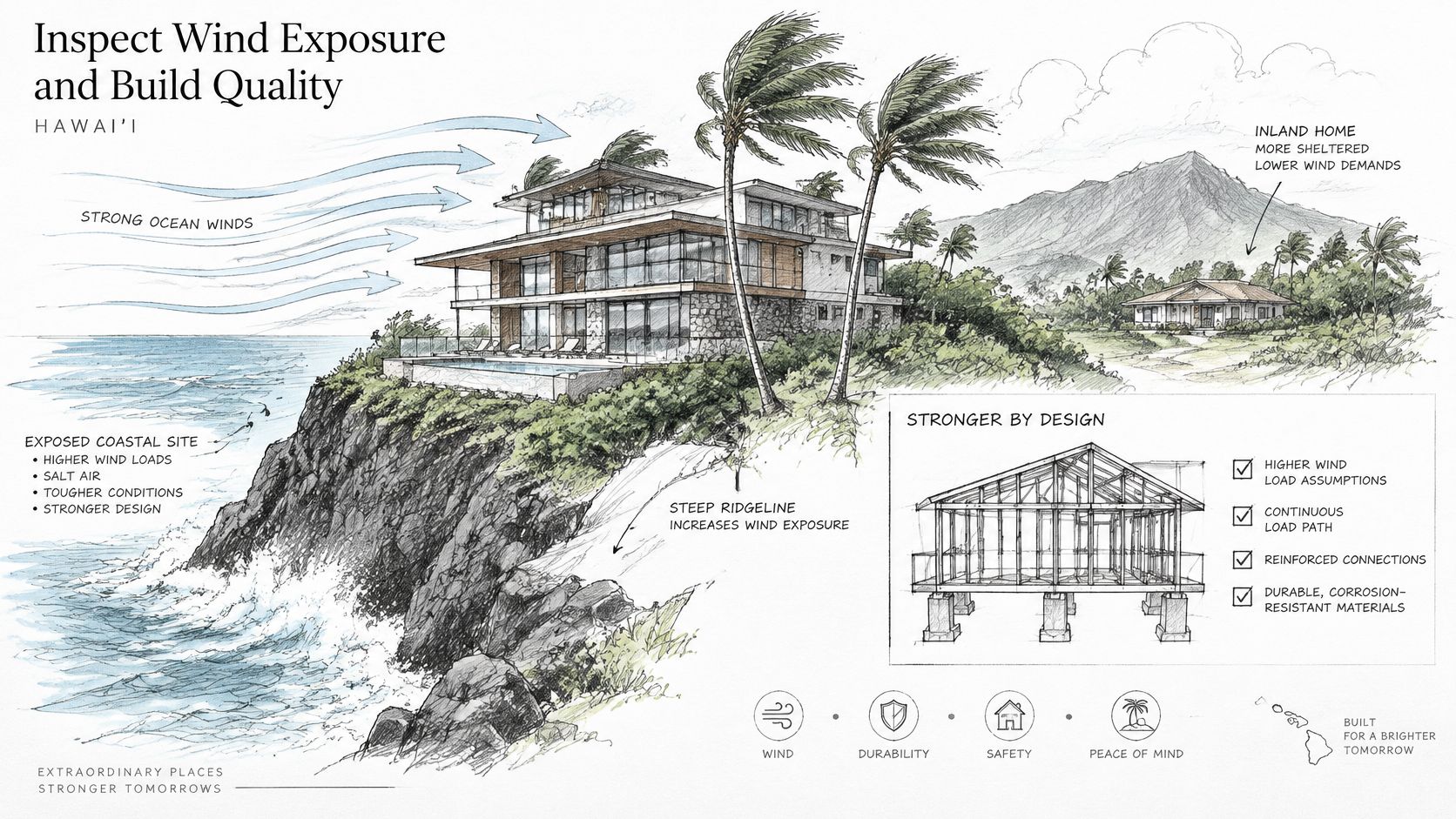
Treat the Exterior as One System
Roof coverings, exterior windows, skylights, garage doors, and exterior doors work as a wind-performance system, not as decorative choices. A failure at one opening can compromise the rest during severe weather. Large glass walls and oversized garage doors deserve particular scrutiny because they're large, exposed surfaces.
Request these documents before you treat the home as verified:
- Permitting record: Confirms the structure and major work were approved.
- Wind-design basis: Shows what loads the design assumed for that site.
- Roof attachment details: Indicates how the roof covering and structure connect.
- Impact-resistance ratings: Covers windows, doors, skylights, and garage doors.
- Maintenance history: Reveals whether seals, fasteners, and coverings have been kept current.
Say a family books a ridge-line villa with floor-to-ceiling glass for a three-week reunion. That home should show documented wind-rated openings before anyone pays. A damaged roof or failed window doesn't just create a repair bill for the owner. It can end your stay early, with no comparable home available on short notice.
A recent renovation doesn't replace these records. New stone, cabinetry, and lighting say little about structural design or roof attachment.
If the owner can't supply the permitting and wind documents, treat the property as unverified and move it to your backup list.
That's not a judgment on the home's quality. It's a judgment on your evidence. For high-value, multi-week stays, evidence is what you're buying.
Calculate the All-In Cost of a Long Stay
Start with the arithmetic owners hope you'll skip. On a $10,000 taxable rental, a 10% transient accommodations tax would add $1,000 before other taxes, cleaning charges, resort fees, or management fees, under the Hawaii transient accommodations tax statute. The advertised weekly rate is rarely your checkout amount.
Cost line | How it is calculated | Example on a $10,000 taxable rental |
|---|---|---|
Base rental rate | Nightly or weekly rate times nights | $10,000 |
Transient accommodations tax | Statutory rate on taxable rent; confirm the rate in force for the stay dates | $1,000 at 10% |
Cleaning charge | Flat fee per stay; check the listing terms | Add the quoted flat fee |
Management or resort fee | Per stay or per night; check the listing terms | Add the quoted fee for your nights |
Estimated all-in total | Base rate plus tax plus confirmed fees | $11,000 plus confirmed fees |
Confirm Which Tax Rate Governs Your Dates
The statute lists a 9.25% rate through December 31, 2025, and a 10% rate beginning January 1, 2026, while a separate legislative measure described an 11% rate beginning January 1, 2026, in the same statutory source linked above in the opening example context. Don't copy a rate from a listing written last year. Confirm the rate in force for your stay dates and the accommodation's classification, and ask which taxes the quote already includes.
Weigh Fixed Fees Against Stay Length
Fixed fees punish short stays. A flat cleaning charge spread across four nights adds a larger share to your nightly cost than the same charge spread across a month. Management or resort fees charged per night do the opposite, steadily compounding on extended stays. You can't compare two luxury Hawaii vacation homes until both fee structures sit on the same total.
Say you're comparing two estates for a family stay. One shows a lower nightly rate but adds per-night management fees. The other shows a higher rate with a single cleaning charge. Over several weeks, the second home can cost less overall. Our guidance on structuring an extended-stay vacation rental budget uses the same total-first comparison.
- Request a written all-in quote for your exact dates and guest count.
- Itemize every line the owner expects to charge, including charges collected at the property.
- Compare properties on that total, not on the nightly rate.
Budget rule: If a quote won't show tax, cleaning, and management fees as separate lines, it isn't a quote. It's an estimate.
Save the itemized quote with your confirmation. If checkout math changes later, you'll have the original numbers to reference.
Build a Backup Plan If a Home Falls Through
Even a verified home can lose eligibility, get cancelled by the owner, or prove unavailable on arrival. A couple can improvise with a hotel room. A group of eight to ten travelers can't. Your backup plan isn't pessimism. It's capacity protection.
Build the Backup Before You Pay
- Identify two or three backup homes with equal bedroom count before you pay for the first choice.
- Confirm cancellation terms and transfer rights for each property, including deadlines and penalties.
- Record taxes, cleaning charges, and check-in rules for every backup, so switching doesn't restart your budget work.
- Hold flights and cars until lodging is confirmed for the full stay, or book travel you can change without heavy penalties.
Say a reunion of nine books a four-bedroom home. A sound plan names two backups in advance, one with four bedrooms in the same district and one with five bedrooms a short drive away. Each backup has transfer terms written into its confirmation, parking checked, and a kitchen that can still handle group meals. If the first home falls through, the organizer executes a switch instead of starting a search under pressure.
Match Capacity, Not Just Price
A cheaper backup that sleeps fewer people in separate rooms will split your group across units. That breaks the shared kitchen plan, the workspace arrangement, and the daily coordination that made a single home attractive. Grandparents end up in one building, kids in another, and every meal becomes a logistics exercise.
- Bedroom count first: The backup must hold the same sleeping arrangement.
- Shared spaces second: Kitchen, dining, and living areas must still serve the full group.
- Location third: A short drive is acceptable if capacity and shared space hold.
- Price last: Compare all-in totals only among homes that pass the first three tests.
Write the backup list into your trip plan before you send travel dates to the group. Once ten people book flights around a single unconfirmed home, your negotiating position disappears and your replacement options narrow to whatever remains.
Access Wholesale Rates and Apply Reward Credits
A member rate is only useful if you can prove it's lower than the public price for the same home, same dates, and same guests. That proof takes about fifteen minutes of structured comparison. Skip it, and you're trusting a label.
Verify the Rate Before You Book
- Price the same home on the same dates through the public listing and the member portal, using the all-in total for both.
- Ask what kind of rate you're seeing. Is it a wholesale rate or a reduced public rate, and are taxes and fees included?
- Ask where Reward Credits apply. Do they reduce the nightly rate only, or also taxes, cleaning, and management fees? Get the answer in writing.
- Confirm the 110% Best Value Guarantee terms. Which comparable homes count, which price gets compared, and how do you file a claim if a lower price appears after booking? Approved Traveler and Lux Traveler are backed by a 110% Best Value Guarantee, so record its conditions before you rely on it.
- Record everything in your trip plan: public total, member total, credit amount, and guarantee terms.
Say a family compares a $10,000 estate for two weeks as a hypothetical. The useful comparison is member all-in total versus public all-in total, not two advertised nightly rates. Note also whether Reward Credits reduce the total at checkout or apply only after the stay, because that timing changes how much cash the group needs upfront.
A snowbird booking a four-week condo should repeat these questions for the full stay, since weekly pricing can differ from a nightly quote multiplied out. Our collected travel booking tips for comparing member and public prices reinforce the same like-for-like discipline.
Finish with a simple confirmation. Both prices cover the same dates, same number of guests, and same bedroom count. If any of those differ, you don't have a comparison yet.
Book Through One Login Once the Checks Pass
Once a home passes your capacity, legality, wind, and cost checks, consolidate the booking. Hotels, flights, cruises, cars, tours and homes are all available under one login in our member portal, so your permit numbers, all-in quote, and backup terms sit with one confirmation instead of scattered across separate checkouts.

Before you commit, recheck availability for your exact dates. A home that passed every check can still be full on the day you book, and there's no cap on condo-style weeks, but every week is subject to availability for your dates. Confirm the 110% Best Value Guarantee terms in writing, including coverage and how a claim is raised. Save permit details, cancellation terms, and transfer rights with the confirmation, set a reminder for the cancellation deadline, and verify every traveler's name matches the reservation for the full stay length.
Approved Experiences Traveler gives households wholesale-rate access to vacation homes, hotels, flights, cars, cruises, tours, and activities through one membership, with Reward Credits earned on bookings and a 110% Best Value Guarantee behind member prices. If you're coordinating a multigenerational Hawaii stay and want that inventory consolidated under one login instead of fragmented across platforms, visit Approved Experiences Traveler to review membership options and start your comparison.