How to Plan a Month Long Trip Week by Week
Learn how to plan a month long trip with weekly bases, a 30-day budget, visa checks, and health timing before you book.
16 min read

A month away isn't four vacations in a row. It's temporary living, with laundry, food, work, school, medication, and rest days that have to function in a place that isn't home. If you're learning how to plan a month long trip, stop building a sightseeing list first. Build weekly bases, price the full operating month, and check stay limits before any nonrefundable payment makes the plan hard to undo.
The Week by Week Lock List
Eurostat tourism statistics on characteristics of tourism trips reports that EU residents averaged 3.9 nights on domestic trips and 7.8 nights on foreign trips. A 30-night itinerary is roughly 4 times the average foreign trip and close to 8 times the average domestic one. That gap changes the work. A long stay fails on ordinary things: laundry access, a kitchen that can't handle breakfast, weak connectivity, a transfer day that wipes out a grandparent. Plan the month as phases you can run, with slack between them.
The same data shows rented accommodation takes the majority of nights on foreign trips, a much higher share than on domestic travel. For a month, rental terms matter more than lobby photos. Read cancellation deadlines, cleaning charges, occupancy limits, utility rules, and neighborhood access before you judge the nightly rate. A room can look spacious and still be unusable if there's nowhere to store medication, dry clothes, or take a work call.
What to lock before a 30-night trip
Planning window | Lock this | Leave flexible |
|---|---|---|
8 to 12 weeks out | Traveler list, passports, purpose, mobility, legal stay count, route blocks | Day tours and restaurants |
About 6 weeks out | Travel-health visit and vaccine or medication timing for every country | Optional activities |
4 to 6 weeks out | International or intercity transport and one base per 7 to 14 nights | Local transit passes |
2 to 4 weeks out | Insurance through the return date, entry documents, rail or car | Daily timetable |
Final week | Medications, immunization copies, offline policy contacts | Any new nonrefundable booking |
Walk the rows left to right. At 8 to 12 weeks out, name who's going, check every passport, define the purpose, and write mobility limits in plain terms: stairs, walking distance, a ground-floor bedroom. Count legal stay days then, before any deposit. Leave restaurants blank. They don't decide whether the month is lawful or livable.
At about 6 weeks out, book the travel-health visit for the full route, including side trips and transit countries. At 4 to 6 weeks out, reserve international or intercity transport and one primary base per 7-to-14-night block. Hold off on local transit passes, since a base change can make the wrong pass worthless.
The final two checkpoints
At 2 to 4 weeks out, confirm insurance runs through the return date, then lock local rail or a car only where the route needs it. In the final week, pack medications and records in carry-on bags, save insurer contacts offline, and stop adding nonrefundable bookings. Anything booked this late is usually calming nerves, and it commits money to a plan you can no longer test.
Before you search: on every row, write a destination, a lodging type, and a working weekly cost estimate before you open a single listing. An empty row is a decision still unmade.
For example, a family organizer might write "Lisbon, weekly condo, fixed transport plus weekly living cap" for week one, before choosing a property. That single line forces the right questions. Does the unit sleep everyone legally, can grandparents manage the building, and does the neighborhood have groceries nearby? If any answer is no, the row stays open and the search changes target.
Weekly Bases Versus Hotels and Cruise Legs
Judge lodging by living setup, not star rating. A property that works for two nights can become expensive and tiring when every meal, wash load, and work session has to happen outside the room for a month.
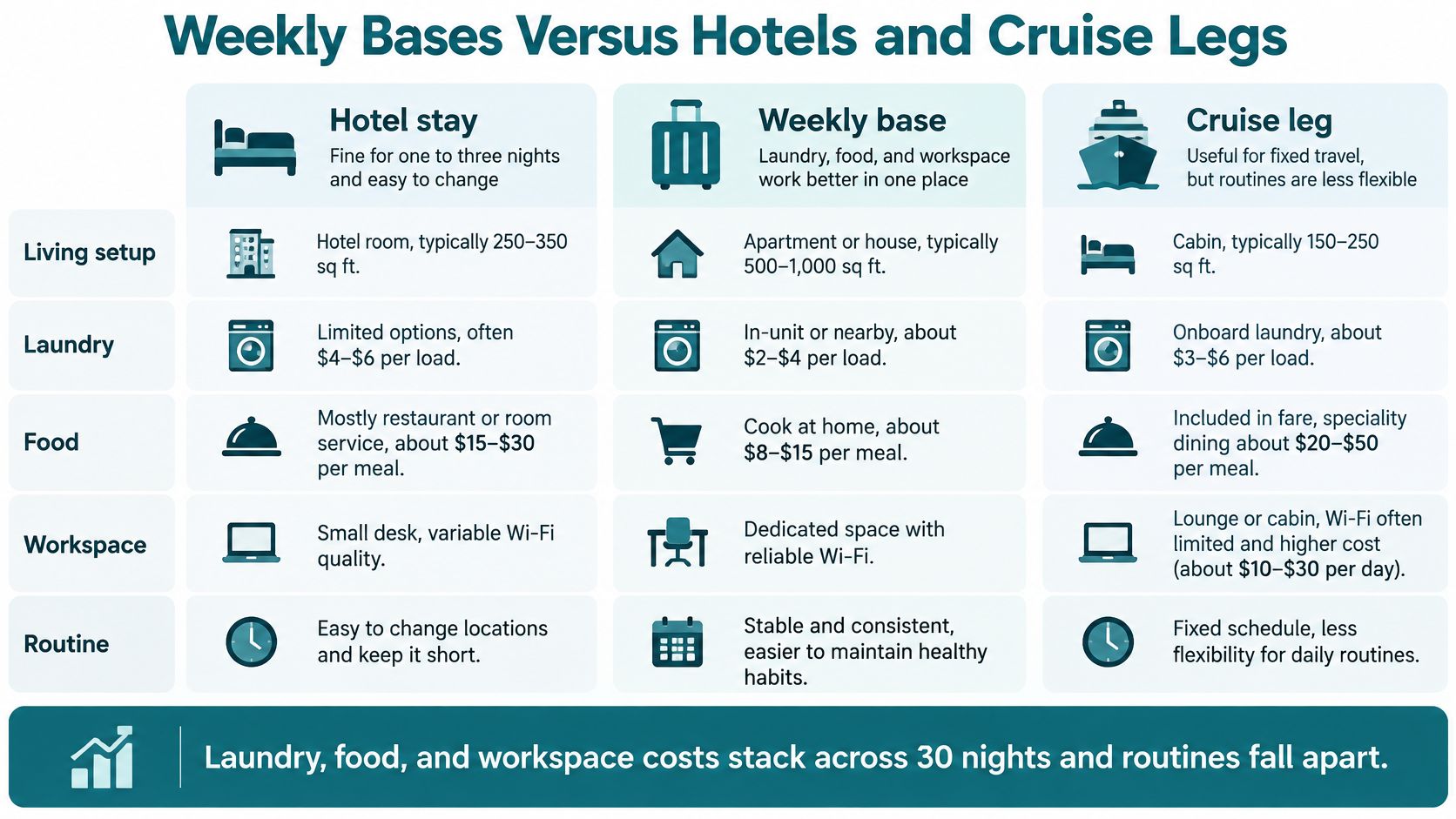
Where to sleep for a week or a month
Stay type | Best length | Living setup | Cost behavior | Watch-outs |
|---|---|---|---|---|
Hotel | 1 to 3 nights | Limited kitchen and paid laundry | Nightly rate compounds over 30 nights | Weak for food, work, and family routines |
Weekly condo or vacation home | 7 to 14 nights | Kitchen, laundry, storage, workspace | One cleaning fee per stay plus taxes | Occupancy cap, cancellation rules, neighborhood access |
Monthly vacation home | 28 to 30 nights | Full temporary home | Often lower operating cost if you do not move | Utilities and less ability to exit early |
Cruise segment | Fixed sailing dates | Cabin and meals bundled | Transport and lodging priced together | Not a land base and does not reset stay clocks |
A hotel is useful for arrival nights, short city stops, and places where plans may change quickly. Its weakness is repetition. Paid laundry, restaurant meals, minibar drinks, and working from a bed don't stay minor across 30 nights, and children or retirees lose the routines that keep energy steady.
A weekly condo or vacation home fits most month-long routes when it has a usable kitchen, laundry, storage, and reliable connectivity. You're trading daily housekeeping for control over food and space, usually with one cleaning fee per stay. Check whether the occupancy cap counts children, whether extra guests trigger fees, and whether the street feels practical after dark for groceries and transit.
A monthly vacation home makes sense when the group will stay put for 28 to 30 nights. It can lower operating friction because you unpack once, cook normally, and learn one neighborhood. The tradeoff is commitment, including possible utility charges and less ability to leave early if the area, noise, or medical access is wrong.
Two ways to use the table
Say snowbirds compare a 14-night condo in Florida or the Algarve with four hotel hops. The hotels may win on nightly promotions, but the condo usually wins once they count one cleaning fee instead of several, grocery breakfasts, laundry in the unit, and no lost transfer days. It also gives them a repeatable morning routine, which matters more by week two than a new lobby does.
Say a remote worker finds a low-priced room with no desk and unstable Wi-Fi. That room fails the week even if the bed is excellent. If you're comparing places built for longer working stays, find long-term stays for remote work and score the actual workspace, not the listing headline. Our guide to extended stay vacation rentals for longer trips is also useful when you're weighing a weekly base against a hotel block.
A cruise leg can bundle transport, cabin, and meals on fixed dates, but treat it as a moving segment. It isn't a home base for laundry, schoolwork, or a work routine, and sailing between countries doesn't create a new visa allowance. Before choosing any row, score each candidate on kitchen, laundry, workspace, cancellation deadline, occupancy, and total fees. Pick the base that supports the week you'll live.
How to Build the Route in Five Moves
Start with the lock list filled in, then connect blocks without filling every day. A route that only works when every train, body, and booking behaves isn't finished yet.
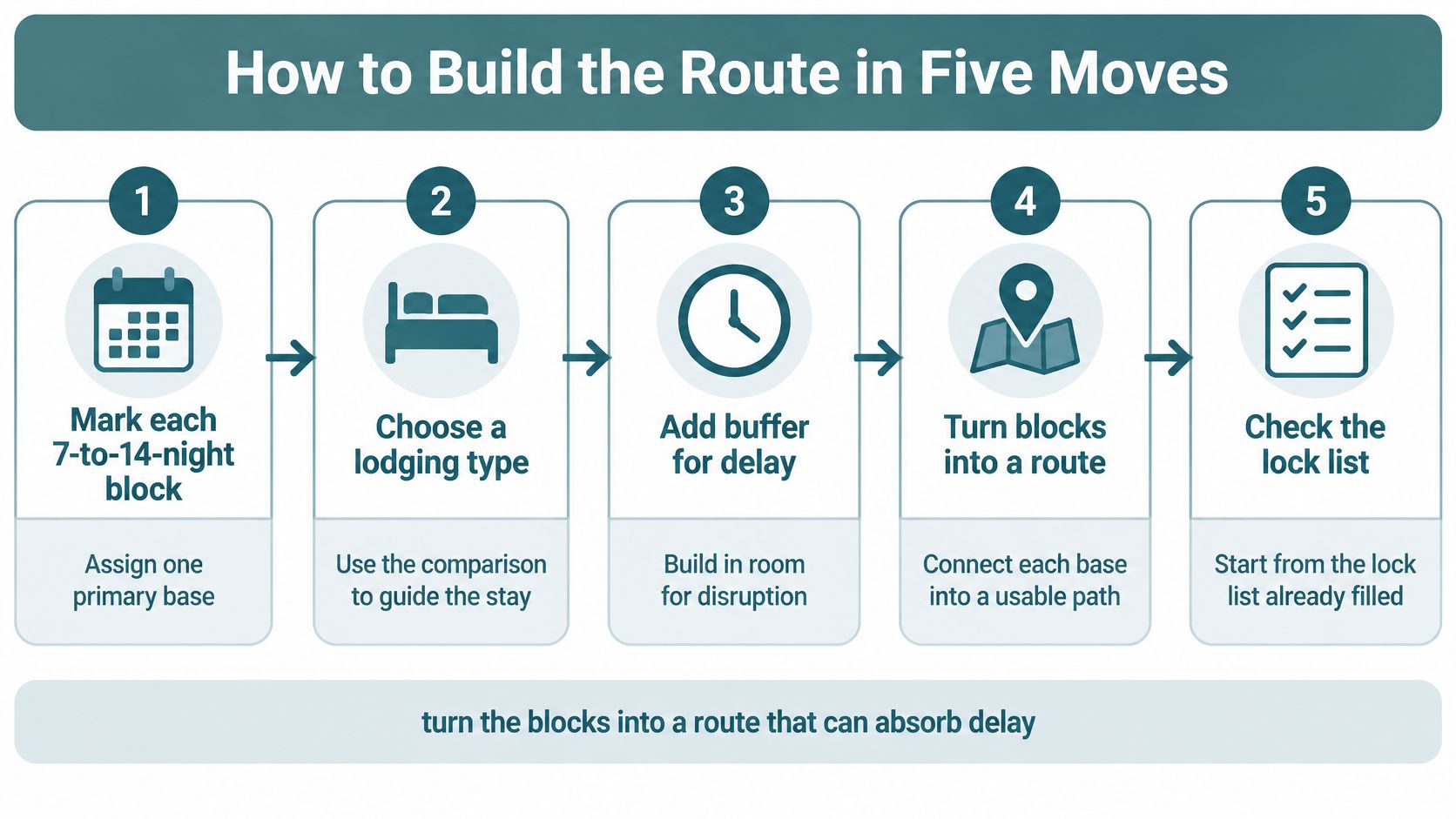
The five moves
- Mark each block: Give every 7-to-14-night block one primary base, a lodging type, and the transport mode in and out. Write the purpose beside it, such as family time, remote work, medical recovery, or sightseeing, because purpose controls pace.
- Reserve only fixed items: Book the international flight, intercity legs, bases, permits, and activities with real deadlines. Use an open-jaw or multi-city ticket when the month doesn't return to the arrival city, and schedule no more than one major intercity transfer on a demanding travel day.
- Protect empty capacity: Keep fixed commitments below roughly 70 to 80 percent of available days, and hold 10 to 15 percent of the calendar as recovery or disruption capacity. Empty days aren't wasted days on a month-long route.
- Write the fallback first: Name alternate lodging, a second transport mode, and where each traveler would get care before paying deposits. Put cancellation deadlines on the same calendar as flights so a change doesn't become a surprise fee.
- Check fitness for effort: Treat remote hikes, high-altitude days, long drives, and multi-country transfers as separate risk modules. Don't stack them against arrival days or against a traveler who needs a slower start.
Immediately after those moves, run three stress tests. First, insert a 24-hour transport disruption and see which booking breaks. Second, raise variable expenses by 20 percent and check whether the weekly cap still holds. Third, make one traveler unavailable for 48 hours and confirm the group can rest, split up, or move a transfer without rebooking everything. Research on automated itinerary planning in a study of automated travel itinerary generation reported 70% user satisfaction with generated itineraries and 82% satisfaction with automated preference learning, which supports writing pace, budget, interests, accessibility, and transit tolerance into the plan before you optimize it.
That caution matters because travel-health research on risk scores and health events found that 19.3% of assessed travelers had a high or very high risk score, those travelers planned longer trips on average at 19 days versus 16 days, and the high-risk group had a 27% higher incidence of health events, with an incidence-rate ratio of 1.27. You don't need to label anyone high risk to use the lesson. Longer exposure plus more transfers gives small problems more chances to interrupt paid plans.
A route with room to absorb delay
Say a six-person household wants Portugal without exhausting grandparents. Use 10 nights in Lisbon, then two buffer days built into the end of that block, then 14 nights in the Algarve, with the remaining nights held for arrival recovery or a short final stop near departure. That structure gives the group one city base with transit and medical access, one slower coastal base with a kitchen, and no fifth city competing for energy.
If your route has several bases, our breakdown of multi-destination vacation packages and route structure can help you compare bundled legs with separately booked blocks. I would still keep the fallback written outside any package. A bundled confirmation doesn't tell you who stays behind with a sick child or which train replaces a canceled flight.
A schedule with no empty day isn't efficient. It's fragile.
A 30-Day Operating Budget
Don't budget a month from a nightly rate. Separate money into fixed costs, variable costs, and reserve, because each behaves differently once you're living away from home.
U.S. Bureau of Labor Statistics consumer expenditure data for 2022 show that in 2019, lodging represented 29.5% of travel spending while transportation represented 34.4%, and in 2022, lodging represented 31.3%. The BLS also reports that average household travel expenditure rose 27% in 2022 compared with 2019. Those figures are a baseline, not your quote, and they explain why pre-2022 prices make a weak budget.
30-day cost categories
Category | Baseline or rule | When it hits | Planning move |
|---|---|---|---|
International and intercity transport | 34.4 percent of 2019 US travel spending | Upfront | Book only after the route blocks are fixed |
Lodging | 29.5 percent in 2019 and 31.3 percent in 2022 | Across all 30 nights | Compare one long base with several short stays including fees |
Daily living | Groceries, transit, laundry, dining, admissions | Every week | Set a weekly cap |
Contingency | Retest variable costs at plus 20 percent | Any week | Reserve for care, weather, or an extra night |
Price baseline | Household travel spend up 27 percent in 2022 versus 2019 | Before you total the trip | Do not reuse pre-2022 prices as the budget |
Fixed costs hit first, including international or intercity transport, insurance, visas, deposits, and major activities. Once paid, they limit how much freedom you have to change bases. Don't lock them until stay limits, passport validity, and cancellation terms are acceptable.
Variable costs repeat every week, including groceries, local transit, dining, laundry, and admissions. Give them a weekly cap by household, then track spending against that category rather than against one leftover trip total. A single total hides the moment dining starts eating the reserve.
Compare the operating month
Build two totals the reader can copy. Option A is one 28-night home, with rent, taxes, utilities, one cleaning fee, groceries, local transit, and no inter-property transfer. Option B is four weekly stays, with four sets of taxes and service fees, four cleaning charges, transport between properties, more restaurant meals during move days, and the value of lost time. The lower nightly rate often loses after those lines are added.
If you're traveling at the leanest end, European travel advice for budget backpackers shows how tightly daily choices have to be controlled, but families and retirees still need a reserve. Don't copy a backpacker total into a household month with medication, work obligations, or limited mobility. Use our travel budget planning framework to turn the categories into a weekly tracker before you pay deposits.
Test the variable column at plus 20 percent. If the plan only works at exact prices, cut a move or a paid activity before departure. Keep the reserve for a medical visit, replacement ticket, weather change, or unplanned extra night, and review actual spending every week while you can still adjust groceries, dining, or admissions.
For a filled example in planning units, put international transport and two bases in fixed costs, set one weekly amount for groceries and transit, set a separate weekly amount for dining and admissions, and write a reserve line before the first nonrefundable payment. That's the moment how to plan a month long trip becomes a budget you can operate, not a guess you defend later.
Stay Limits Health Lead Times and Cover
Treat legal stay, work permission, health timing, and insurance as gates. If a gate fails, the correct move is to change dates or route before housing deposits make the error expensive.
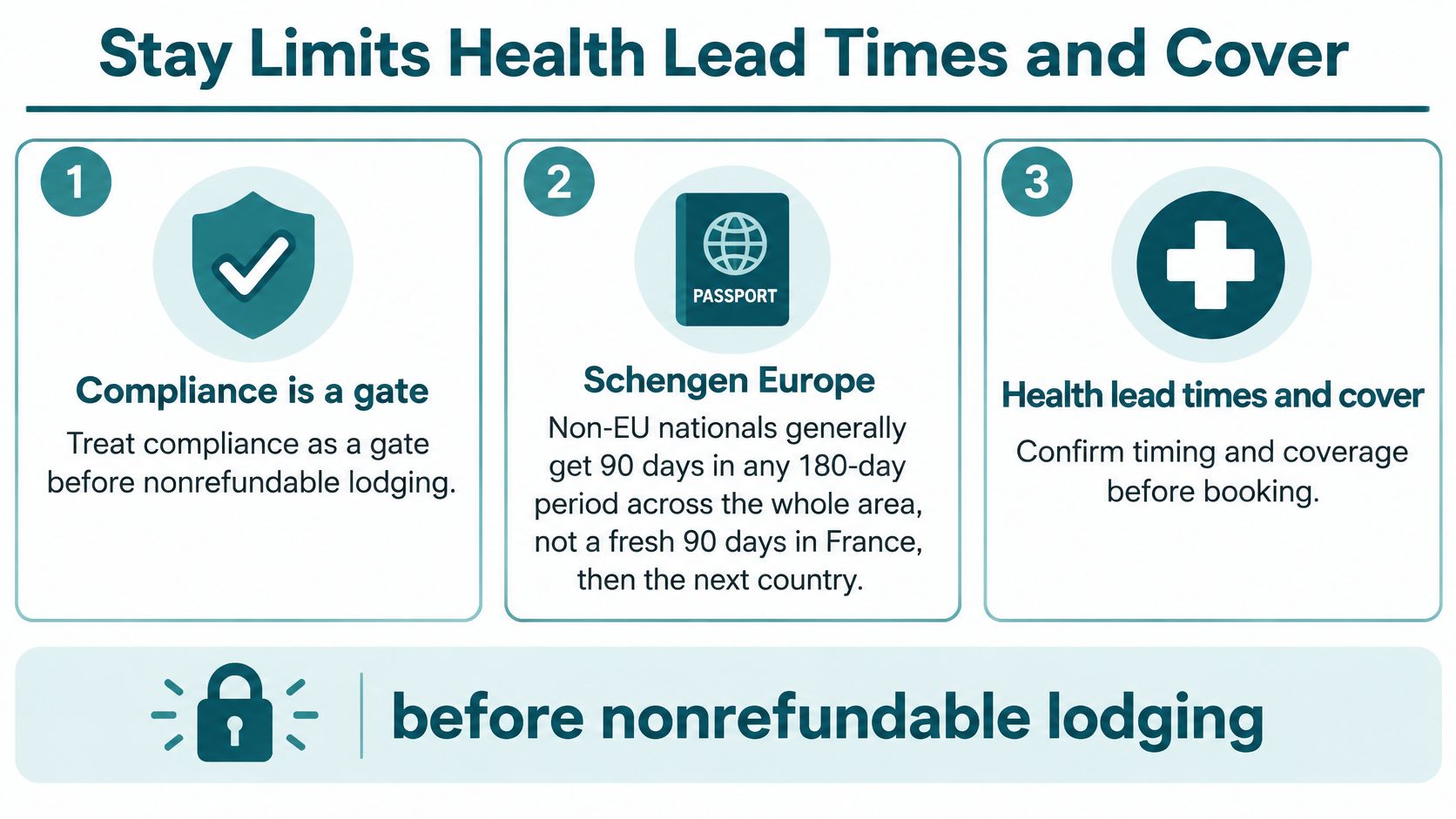
Gates before a nonrefundable month
Check | Rule | Timing |
|---|---|---|
Schengen short stay | 90 days in any 180-day period across the whole area, not a fresh 90 in each country | Before nonrefundable lodging |
Prior Schengen days | List every entry and exit; a 30-day trip fits only if earlier days still leave room | Same checkpoint |
Stay beyond 90 days | Use that country's national long-stay process | Before housing deposits |
Remote work | Tourist entry is not work permission; about 66 percent of nomad visas last one year and 76.6 percent allow extension or renewal | Before booking a month of housing |
Travel-health visit | Clinician reviews the full route, not only the first city | 4 to 6 weeks before departure |
Injectable typhoid | At least 2 weeks before travel | With the visit |
Yellow fever | At least 10 days before arrival where proof is required | Before that segment |
Japanese encephalitis | Often two doses 28 days apart; some adults 18 to 65 may take dose two from day 7 | Schedule both doses |
Pre-exposure rabies | Two doses 7 days apart | Before departure |
Insurance | Names every country including transits and runs through the return; Medicare and Medicaid generally do not pay abroad | Before any coverage gap |
For Europe, European Commission guidance on Schengen visa policy states that non-EU nationals generally may visit Schengen countries for up to 90 days within any 180-day period, calculated across the entire area. France, Italy, and Spain don't each grant a fresh 90 days. List every entry and exit, count prior days in the preceding 180 days, and confirm passport nationality, passport validity, and whether the main destination requires the application. A 30-day trip fits only if earlier travel still leaves room, and stays beyond 90 days need the destination country's national long-stay process.
Remote work needs a separate check. The Global Digital Nomad Report 2025 reports that approximately 66% of digital-nomad visa programs last one year and 76.6% of countries offering those visas allow extensions or renewals. Tourist entry isn't permission to work, so confirm the correct permission, employer approval, and tax or data-security constraints before booking a month of housing. A cruise or border hop doesn't create a new stay allowance.
Health timing can decide whether departure dates work. CDC travel vaccine guidance recommends an appointment at least 4 to 6 weeks before travel, states that injectable typhoid vaccine should be given at least 2 weeks before travel, and notes yellow-fever vaccination may need to occur at least 10 days before arrival where proof is required. Build a matrix with country, dates, vaccine or medication, start date, documents, and provider confirmation for every segment.
Dose spacing matters too. CDC guidance on recommended adult vaccines describes Japanese encephalitis vaccination as normally two doses 28 days apart, although eligible adults aged 18 to 65 may receive the second dose as early as 7 days after the first, and pre-exposure rabies vaccination as two doses 7 days apart. Schedule both doses, carry medicines in original labeled containers, and keep prescriptions and immunization records in carry-on bags.
Insurance must match the route on paper. U.S. Department of State guidance on insurance for international travel notes that Medicare and Medicaid generally do not pay for medical care outside the United States and advises confirming coverage for emergency treatment and medical transportation. Check every country including transits, exact coverage dates, pre-existing conditions, activities, evacuation, and whether the insurer pays providers directly or reimburses you. Save the policy number, assistance phone, limits, disclosures, and prescription list offline, and in a multi-generational group check each passport, medication, and mobility limit separately.
Fixes When a Long Stay Breaks
Most long-stay repairs are boring, and that is why they work. The useful fix is usually fewer moves, clearer money rules, or a base change at the next clean deadline rather than a new destination.
Field fixes that protect the month
- Too many cities: Drop the extra base and lengthen the stay with a kitchen, laundry, and reliable transit. Do not solve fatigue with a night train and another check-in.
- Fee shock after booking: List the cleaning, utilities, service charges, and transfers you skipped, then cut variable dining or admissions before touching the reserve. The reserve is for disruption, not for a budget you undercounted.
- One person ill for two days: Use the empty day already on the calendar, move that person off the transfer if needed, and let the rest of the group do a low-effort local day. Keep the rebooking decision until symptoms and options are clearer.
- Work failure: Test the desk, chair, outlets, and connection with a real work session on day one. If the base cannot support a workday, change at the next cancellation deadline instead of enduring three more weeks and paying with missed work.
Connectivity failures deserve the same direct treatment as a broken boiler. First prove whether the housing Wi-Fi or the mobile line is at fault: run a work call on the property connection, then repeat it on tethered data. If a prepaid travel data plan ends early and maps, banking, or work tools go dark, use support for travel data ending prematurely to work through the plan issue while you tether or shift work to a nearby fixed connection. Replace the SIM or data plan before you replace housing; move only when the property connection fails on ordinary weekdays.
Group friction usually starts with shared money. Split shared lodging and transport from personal spending in writing before arrival, even for close family. Decide who pays for groceries, who keeps receipts, and how optional tours are approved, so eight or ten people are not renegotiating dinner every night. For a large household, one shared ledger beats a pocket full of screenshots.
If a policy ends before the return date, extend cover before the gap begins. The last days are still travel days, with the same roads, weather, and medical exposure as the first days. Point every fix back to the fallback lodging, second transport mode, and care location already written in the route. If those names are not written, fill them in today while you are calm.
The repair is usually fewer moves and a written reserve, not a new destination.
Book the Month From One Login
Once the weeks, bases, budget, and stay rules are written, stop scattering confirmations across separate sites. Consolidation helps because you can see flights, bases, cars, and activities against the same calendar and cancellation deadlines.
Approved Traveler is travel infrastructure for that job, with wholesale-tier rates on hotels, flights, cruises and cars, plus vacation homes that can suit 7-to-14-night bases, under one member-portal login. Approved Traveler starts at $899.99 per year for the Traveler plan. Both plans include unlimited weekly condo-style stays, subject to availability for the member's dates, which is useful when a weekly base beats a chain of hotel nights.
Members earn Reward Credits on bookings. They don't expire and can be applied to later bookings, specified fees, renewal, or eGift cards, so treat them as an infrastructure variable after price and terms are acceptable, not as a reason to book the wrong base. If a member finds a lower publicly available price, the 110% Best Value Guarantee refunds 110 percent of the difference.
Timeshare owners can deposit, exchange, or rent weeks through V.O.I.C.E., up to 5 weeks per year, with no exchange or listing fee. That can turn an unused week into part of a longer route instead of leaving it stranded.
Your next step is practical. Sign in, load the fixed flights and four weekly bases first, check occupancy and cancellation terms line by line, and apply Reward Credits only after those terms work. Keep the cash reserve outside the platform so a medical visit, replacement ticket, or extra night is still payable if plans break.
Build your four weekly bases, fixed transport, and fallback options in one operational view with Approved Experiences Traveler, where wholesale-tier inventory, Reward Credits, and the 110% Best Value Guarantee support a manageable month. Visit today, load your route blocks first, and book only after stay limits, insurance dates, and cancellation terms line up.