Hawaii Luxury Vacation Rentals: A 2026 Island Guide
Compare Hawaii luxury vacation rentals by island, check permits and taxes, and consolidate multi-property bookings with Reward Credits in 2026.
14 min read

Hawaii's vacation-rental market can charge premium rates without filling its available inventory. In August 2025, statewide rentals had 47.0% occupancy and a $433 average daily rate, while occupancy was 27.3 percentage points below August 2019. That contrast, reported in the Hawaii Tourism Authority's August 2025 vacation-rental report, is a useful reminder: choosing a luxury home is not just about its view or nightly price. You need to verify that the property can legally host your group, confirm the all-in cost, and make sure its location, capacity, and booking terms work for your dates.
Where Luxury Vacation Rentals Sit on Each Island
Permit rules decide which luxury homes can take your dates. Island areas set the shortlist, county permission decides what books.
Island | Strongest luxury areas | Dominant property type | Best-fit traveler | Permit and rule risk |
|---|---|---|---|---|
Maui | Wailea, Kapalua, Kaanapali, Kihei | Oceanfront villas and estate homes | Multigenerational groups of 8–10 | High: permit number must be displayed, a manager must be reachable at all times, and on-site response is required within one hour for licensed Short-Term Rental Home operations |
Big Island (Kohala Coast) | Waikoloa, Kohala Coast | Family villas and resort-adjacent homes | Families and long-stay guests | Check the county status and permit requirements for the specific property |
Oahu | Honolulu, Kailua | Condos, beach houses, and city-edge homes | Short leisure stays and urban trips | Check the county status and permit requirements for the specific property |
Kauai | Poipu, Princeville | Private estates and beachfront homes | Couples and small multigenerational groups | Check the county status and permit requirements for the specific property |
Those areas are useful starting points. They do not guarantee available or legally usable inventory. The statewide vacation rental count covers a large pool of units, but it does not separate permitted from unpermitted homes and it does not show how unevenly the luxury subset spreads by island. For the Big Island, use this guide to Kohala Coast resort areas to orient your search, then compare individual homes by access, layout, and operating status: https://www.approvedexperiences.com/blog/map-of-kohala-coast
Use Maui to understand the permit question
Maui shows why "villa" is not a legal category. The county identifies a large pool of units eligible to operate as short-term rentals without a short-term-rental permit in specified zoning districts. Other properties may need a Short-Term Rental Home, Bed and Breakfast, or Conditional Permit. For licensed Short-Term Rental Home operations, the county requires advertising to include the applicable permit number, onsite parking, and a manager reachable by telephone at all times who can arrive onsite within one hour when called. These requirements are detailed in the Maui County short-term-rental materials.
Maui also caps the size of a Short-Term Rental Home operation. Bedroom and dwelling limits apply, so a group of 10 may need two linked homes, or a hotel block, instead of one permitted villa. Confirm how the property permit covers its bedrooms and advertised guest capacity before paying.
Use Maui October pricing as a budget anchor, not as a quote for your dates. Set a total accommodation budget before comparing islands, and include taxes, fees, and any cost of booking a second home. Shortlist two islands first. Then compare homes within those areas for legal capacity, total cost, and fit for your trip dates.
What 2025 Market Data Means for Your Booking
Statewide vacation rentals in August supplied 908,400 unit-nights and filled 427,200, which left occupancy at 47.0% with a $433 average daily rate (ADR). That ADR sat 38.6% above August 2019, while demand sat 37.3% lower and occupancy sat 27.3 percentage points lower. High price with wide-open inventory is the pattern to plan around.
Period | Supply (unit-nights) | Demand (unit-nights) | Occupancy | ADR |
|---|---|---|---|---|
January 2025, statewide | 742,000 | 437,100 | 58.9% | $372 |
May 2025, statewide | 896,400 | 418,100 | 46.6% | $358 |
August 2025, statewide | 908,400 | 427,200 | 47.0% | $433 |
October 2025, Maui | 282,600 | 119,800 | 42.4% | $505 |
Statewide figures for May 2025, with supply at 896,400 unit-nights, demand at 418,100 and ADR at $358, are reported in the May 2025 Hawaii vacation rental performance report. Maui's October figures come from the October 2025 Hawaii vacation rental performance report.
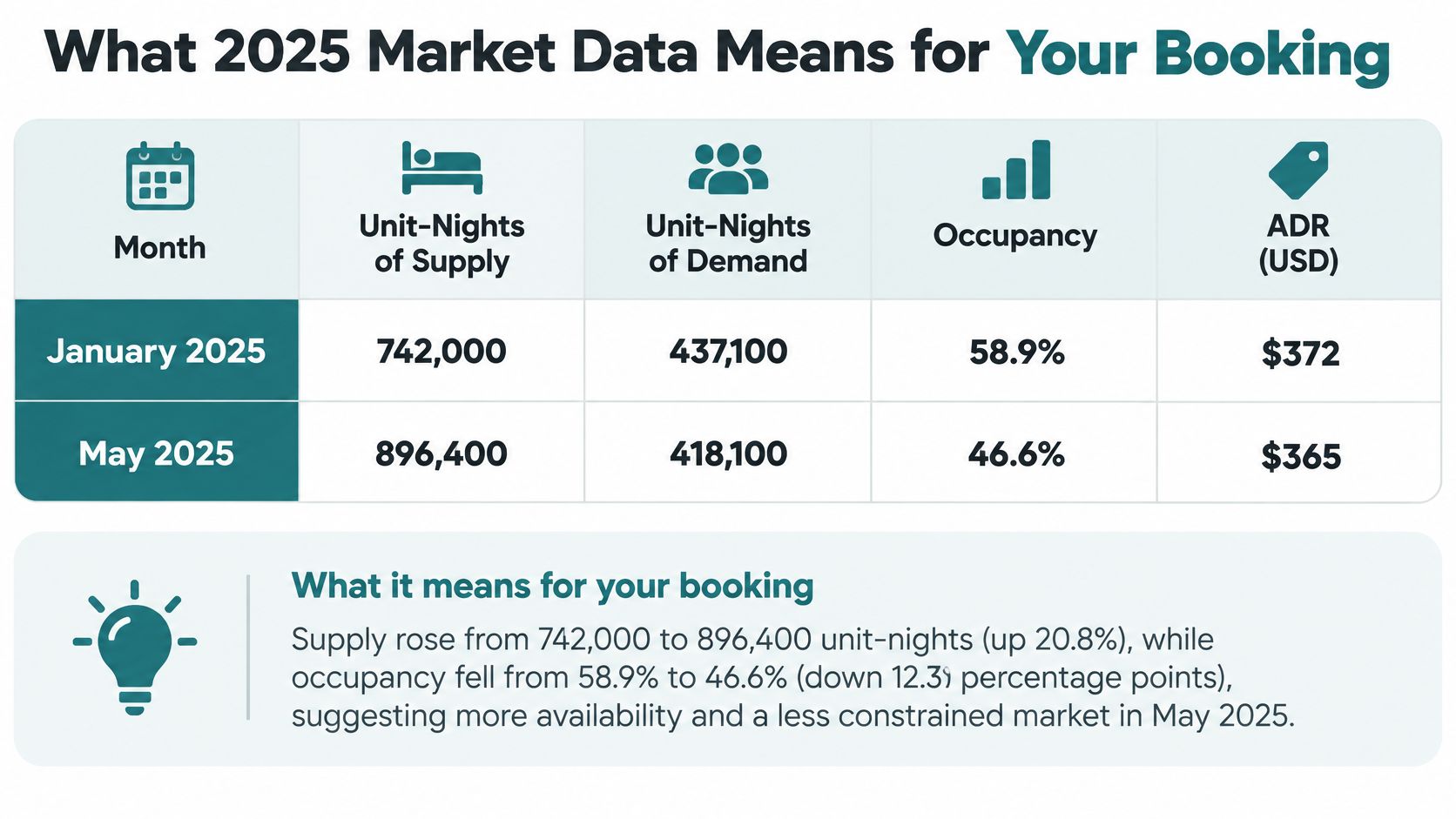
Read occupancy alongside price
Supply counts available unit-nights. Demand counts occupied unit-nights. Occupancy shows the share used. ADR shows the average price of the nights that sold.
Treat those four together as an availability check. In May, statewide supply reached 896,400 unit-nights while only 418,100 sold, for 46.6% occupancy. In October, Maui listed 282,600 available unit-nights, filled 119,800, and posted 42.4% occupancy alongside a $505 ADR. A luxury quote can look firm while much of the island inventory goes unsold.
I recommend using the table as a budget anchor, then verifying your exact stay. Statewide or island averages do not confirm that a five-bedroom home in your location is open for your dates, at your minimum stay, or under current operating rules. Ask which specific homes with your bedroom count remain open for those dates before you compare one listing price against another.
Booking rule: Compare occupancy beside ADR, then ask for open inventory matching your dates and group size before comparing rates.
Matching a Rental to Your Family, Snowbird or Long-Stay Needs
Start with the need that would make a property unusable if it weren't met. The table turns common traveler profiles into checks you can make before paying.
Traveler profile | Non-negotiable | Property type that fits | Check before booking |
|---|---|---|---|
Multigenerational family, 8–10 people | Bedroom count and parking | Multi-bedroom villa or linked homes | Confirm bedrooms match the permit and parking is onsite |
Snowbird, 1–3 months | Kitchen, laundry, weekly rate | Condo-style weekly stay | Confirm availability for your dates and check the stay against the 180-day line |
Remote worker, 4–8+ weeks | Reliable internet and a desk | Condo or home with workspace | Ask for the stated internet speed and confirm the building is quiet enough for work |
High-net-worth household | Time saved and operator support | Estate or luxury home | Get operator response times and on-call support in writing |
Frequent leisure traveler, 3+ trips | Flexible inventory | Mix of hotels and homes | Compare total cost with hotel alternatives |
Match capacity to how the group travels
For a reunion of nine, begin with at least four bedrooms and parking for several cars as a planning scenario, then verify that the permitted bedroom count and guest capacity fit the home. A listing's sleeping capacity may include sofa beds or shared rooms that don't suit grandparents, young children, or adults who need privacy. Ask for a bedroom-by-bedroom layout and confirm how many vehicles can park onsite.
A group of 10 should compare one villa with a set of connected hotel rooms, not assume the house wins because it offers shared space. The villa may make meals and family gatherings easier; a hotel may be the better fit when daily housekeeping, on-site dining, or flexible room assignments matter more. The right choice depends on how your group values service against shared space.
Plan long stays around daily use
A snowbird staying three months needs more than a weekly rate on a listing page. Check that the kitchen has the equipment you'll use for everyday cooking, that laundry is convenient, and that the home is available for the full period. The applicable tax treatment also depends on stay length, so confirm it in writing before comparing the quote.
For a remote worker, request the internet speed stated by the host and identify where a desk can be set up. A beautiful living room isn't a workspace if it's shared all day with the rest of the household. For households that prioritize time, get a clear description of who handles questions and how support works during the stay.
Shortlist rule: Write your must-haves first. Eliminate any home that fails one, then compare the remaining options on total cost and operating fit.
Total Cost of a Luxury Home Versus Hotel Rooms
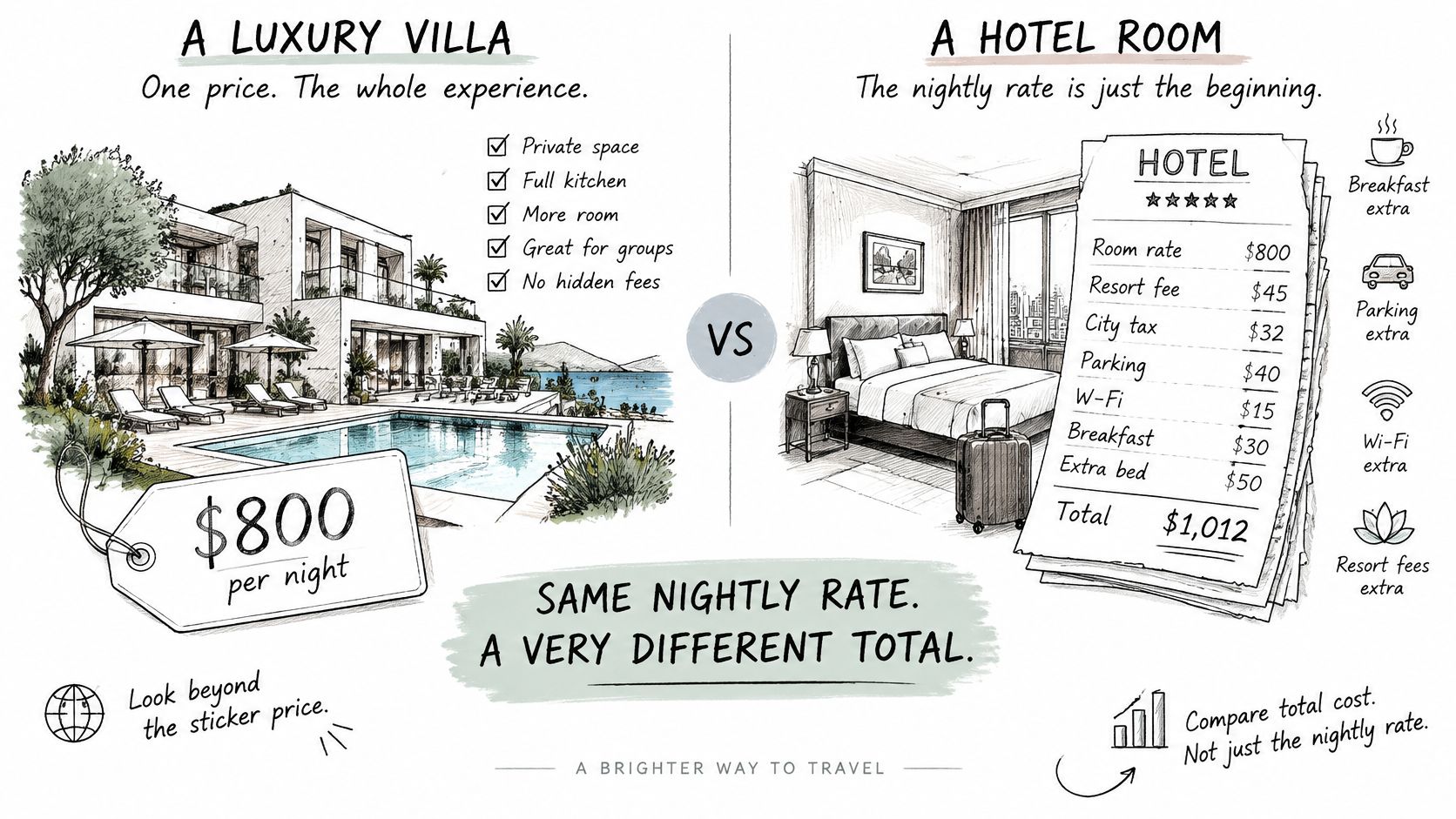
A family of eight pricing three hotel rooms for six nights against one five-bedroom villa needs a tax-inclusive total for each side. Request written quotes for identical dates and guest count, with state and county taxes, cleaning charges, service fees, and parking shown separately. A lower nightly rate stops meaning much once those lines are added.
Build the comparison on five inputs. Multiply each nightly rate by the same number of nights. Add the full tax and fee stack from the quote. Credit only the meals you will realistically cook and the laundry loads you will run onsite. Count gathering space and vehicles, plus how the group moves between activities. Price coordination too, meaning separate reservations, check-ins, room assignments, and payment records.
Know when a hotel is the better fit
A hotel often wins on short stays, daily housekeeping, on-site dining, accessible services, or assignments that may change at arrival. A fixed villa cleaning charge takes up a larger share of a two or three night total. A home pulls ahead when the group uses the kitchen, laundry, and shared living areas every day.
Families still eat out from villas. That habit, plus a high cleaning or service charge, can erase the kitchen saving. I recommend comparing the hotel total for all three rooms with the villa total, never one hotel room against the whole house.
For a broader comparison of the practical differences, see this guide to hotel versus vacation-rental planning. Apply the same check to size. A well matched property used as intended can justify a higher total, while an oversized home charges you for bedrooms, pool capacity, and parking you never use.
Formula: Total cost = nightly rate × nights + taxes + fees + coordination time minus the value of included kitchen and space.
Tax Math That Changes Your Real Nightly Cost
Tax component | Rate | Amount on $10,000 |
|---|---|---|
State Transient Accommodations Tax | 11.00% from January 1, 2026, up from 10.25% | $1,100 |
Hawaii County Transient Accommodations Tax | 3% | $300 |
General Excise Tax | 4% plus a 0.5% county surcharge, 4.5% combined | $450 at 4.5% of $10,000 |
For receipts received or accrued on or after January 1, 2026, Hawaii's state Transient Accommodations Tax (TAT) rate rises from 10.25% to 11.00%. Hawaii County separately describes a 3% county TAT on taxable gross rental proceeds; General Excise Tax (GET) is generally 4% plus a 0.5% county surcharge. The Hawaii County TAT guidance explains its county tax and the applicable calculation context.
On a $10,000 taxable Hawaii County rental invoice, the state TAT amounts to $1,100, and the county TAT to $300, before GET and other disclosed charges. The $450 GET figure in the table is a simple 4.5% calculation on $10,000; the exact tax base and collection method depend on the transaction structure. TAT applies to gross rental proceeds, so cleaning, management, or platform costs don't automatically reduce the taxable amount.
Compare the full quote, not the headline
County rules aren't interchangeable. Hawaii County's county TAT example is not a statewide rule for Maui, Oahu, or Kauai. Ask which county applies, how the operator calculates each tax, and whether the quote includes taxes or adds them at checkout.
The effective date also matters: the rate regime depends on when receipts are received or accrued, not only on the day you make the reservation. A booking placed late in 2025 and paid in 2026 may need a different tax treatment depending on the transaction. Request an itemized quote, compare all options on a tax-inclusive basis, and keep the quote and payment record.
Avoid comparing a $450-per-night villa with a $480 hotel rate until you know whether either figure includes taxes and fees. The advertised nightly rate is not the amount your household will pay.
How a 180-Day Line Changes Your Stay
A vacation home, condominium, apartment, beach house, or similar lodging rented for fewer than 180 consecutive days is a transient accommodation under Hawaii's tax classification. That status affects operator registration, income reporting, tax returns, and how you should read the quote. The Hawaii Department of Taxation's tax facts on transient accommodations explain the threshold and the associated GET and TAT responsibilities.
Operators must register for GET and TAT licenses, report rental income, and file periodic and annual returns when the rental qualifies under the rules. TAT is assessed on gross rental proceeds, so cleaning, management, and platform expenses don't generally shrink the taxable base. Before booking, confirm the property's tax-registration status and whether taxes are included or added at checkout.
Apply the threshold to the dates you'll actually stay
A snowbird planning a 90-day condo stay falls within the transient-accommodation definition. Read the quote on a tax-inclusive basis and confirm the applicable state, county, and GET treatment. For receipts received or accrued from January 1, 2026, the state TAT rate is 11.00%, as detailed in the Hawaii County tax guidance. Don't assume a weekly price is available for your dates, or that it includes taxes.
A stay of 180 consecutive days or more falls outside this transient definition, so the tax treatment and agreement terms may differ. For example, a retiree planning four months split across two condos should get each unit's dates and terms confirmed in writing. Splitting a single stay into pieces to try to avoid the threshold isn't a sound planning tactic; confirm the arrangement with the operator and understand the agreement before paying.
Keep the stay length, tax-registration confirmation, and tax treatment with the booking record. For longer-stay planning, compare the full duration and terms using this guide to extended-stay vacation rentals.
Permit and Operator Checks Before You Pay
Hawaii's statewide vacation rental inventory reached 18,211 units in 2025, up 3.9% year over year, according to the 2025 visitor plant inventory report on statewide lodging supply. That count measures supply. It does not separate permitted from unpermitted properties, and legality is set at the county level. A polished listing does not prove a home can legally host your group on your dates, so verify the permit and the operator before you pay.
Use this checklist before paying:
- Match the permit number: Ask the operator for the advertised permit number and check that it matches the county record.
- Identify the jurisdiction: Confirm the county where the property is located, not just the island name used in the listing.
- Confirm tax registration: Ask whether the operator has the required TAT and GET registrations and request an itemized tax explanation.
- Verify bedroom count: Compare the number of bedrooms in the listing with the permitted operation.
- Confirm onsite parking: Ask how many vehicles can park onsite and whether the arrangement is part of the property's operating requirements.
- Get manager response details: For Maui licensed Short-Term Rental Home operations, confirm a manager is reachable by phone at all times and can arrive onsite within one hour when called.
- Understand cancellation and rule-change exposure: Ask what happens if a permit or local rule affects the stay after you've paid or booked flights.
- Identify backup inventory: Find a comparable property for the same dates before relying on a single reservation for a large group.
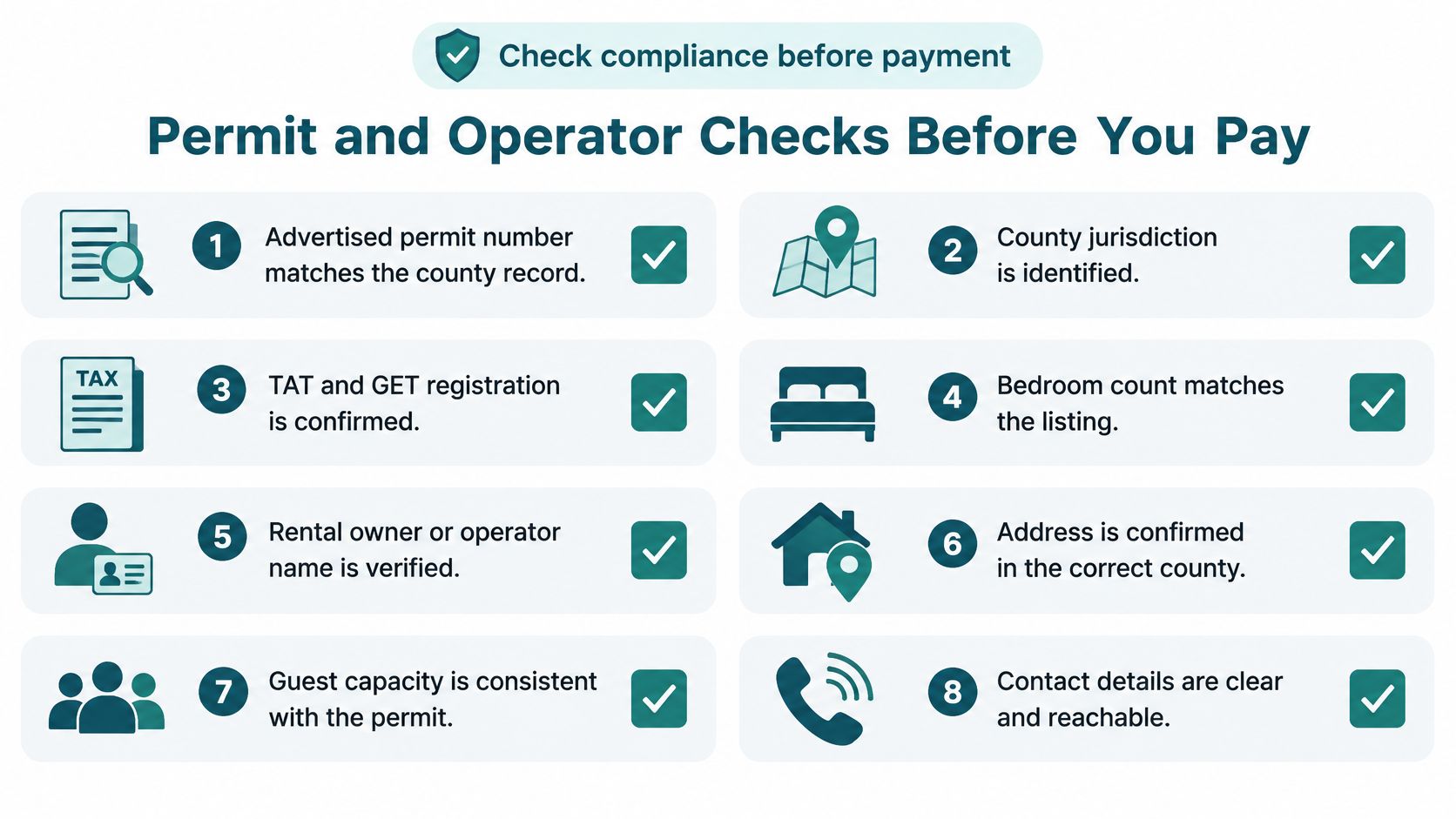
The owner name, address, guest capacity, and contact checks in the infographic complement the core permit review. Verify who is responsible for the home, confirm the actual property address and guest arrangement, and keep working contact details on file. The operator or manager should provide documentation. Do not assume a booking channel has independently verified compliance.
Plan for changes, not just the initial confirmation
Maui's short-term rental rules include specific operational requirements for licensed homes. Local short-term rental rules can change, so ask the operator what happens if a rule changes after your group has purchased flights. Read the cancellation terms before committing, including refund timing, rebooking rights, and who pays price differences.
A 10-person group whose villa reservation falls through three weeks before arrival needs more than any available room. A useful backup must have a similar bedroom count, accept the group, and be open for the same dates. I recommend you drop any home that fails one of these checks. Do not build a multi-property trip around it.
Consolidate Your Next Multi-Property Trip Under One Login
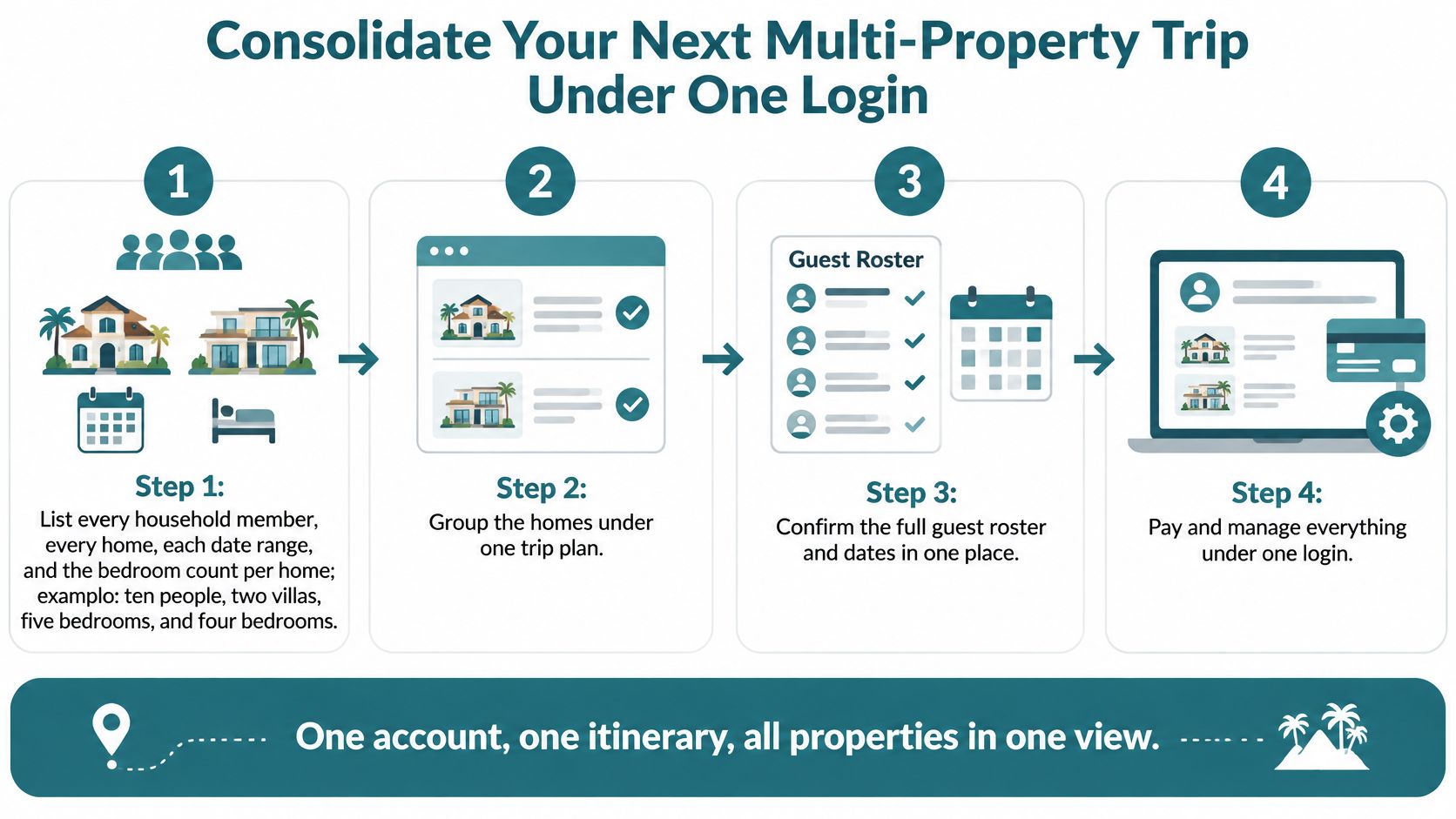
A 10-person trip across two villas fails on paperwork before it fails on views. One home has five bedrooms and a clear permit file, the other has four bedrooms and a tax quote that does not match the listing. Flights get booked around both. That is the inventory verification problem.
- List the people, homes, dates, and bedrooms. Record 10 travelers, two villas, five bedrooms in one and four in the other, with exact date ranges for each property. Short sentences help. No shared headcount works until each bed is assigned.
- Run each home through the checks. Confirm permit status, tax treatment, and how the 180-day rule applies to your dates. Drop a property that fails. Do not build flights and activities around a home still in question.
- Compare total costs on the same basis. Use tax-inclusive quotes plus cleaning, resort, and service fees for every property. Compare the combined villa total against three hotel rooms on the same nights, with the same tax basis, not a nightly rate stripped of fees.
- Put the trip in one booking account. In the Approved Experiences member portal, hotels, flights, cruises, cars, tours and homes are available under one login. Shared dates and charges in one itinerary make mismatches visible faster. Central access does not replace the permit and cancellation review for each home.
- Use the available wholesale-tier access. Members get wholesale rates on homes and hotels from the first reservation, plus flights, cruises, cars, tours and activities. Verify itinerary, bedding, and cancellation terms match before you compare rates across properties.
- Review the guarantee terms. Approved Traveler and Lux Traveler include the 110% Best Value Guarantee when a lower publicly available price exists for the same booking. I recommend checking that the dates, room or home type, and terms are identical before counting on coverage.
- Track Reward Credits accurately. Members earn Reward Credits on bookings. They never expire and redeem toward future bookings, but they carry no fixed dollar value. Leave them out of the villa versus hotel math for this trip.
Both plans cover up to 10 people, which fits a household organizer holding permits, tax-inclusive quotes, payment receipts, and cancellation terms in one trip file. File the actual documents, not screenshots of the listing.
Approved Experiences Traveler brings homes, hotels, flights, cars, tours and activities together under one login, giving Hawaii trip organizers a way to consolidate the inventory and bookings they are coordinating. Visit Approved Experiences Traveler to review the travel membership and compare how its booking access fits your next multi-property trip.