First Time Cruise Guide: Pricing, Cabins and Embarkation
First time cruise guide for newcomers: compare all-in cruise pricing, itineraries, cabin types, embarkation steps and health checks before you book.
16 min read
68% of international travelers said they were considering taking their first cruise in 2025, according to CLIA's 2025 State of the Cruise Industry Report. Interest at that scale changes what a first booking is. It stops being a leap of faith and becomes a comparison exercise with a lot of inventory behind it.
Here's where first-timers get caught. A cruise is sold as a fare, but you're buying a system. The line sets the cost structure, the ship sets the crowd math, the itinerary sets your flights home, the cabin sets how you sleep at sea, and the daily charges arrive whether or not you planned for them.
That's why this First Time Cruise Guide works in sequence rather than in categories. Choose the line, ship and route first. Then price the whole trip, then clear the health checks, then rehearse embarkation day. Do it in that order and nothing arrives as a surprise.
Cruise Lines, Ship Types and Itineraries Explained
A first cruise isn't one purchase. It's three decisions stacked in a fixed order, and the order carries more weight than any brand name you've already heard.
The shortlist problem is real. CLIA forecast 37.7 million ocean-going passengers and 310 ocean-going vessels for 2025, a projection that describes a fleet wide enough to make a catalog useless as a starting point, as Travel Weekly's coverage of the 2025 CLIA report lays out. You need a filter, not a list.
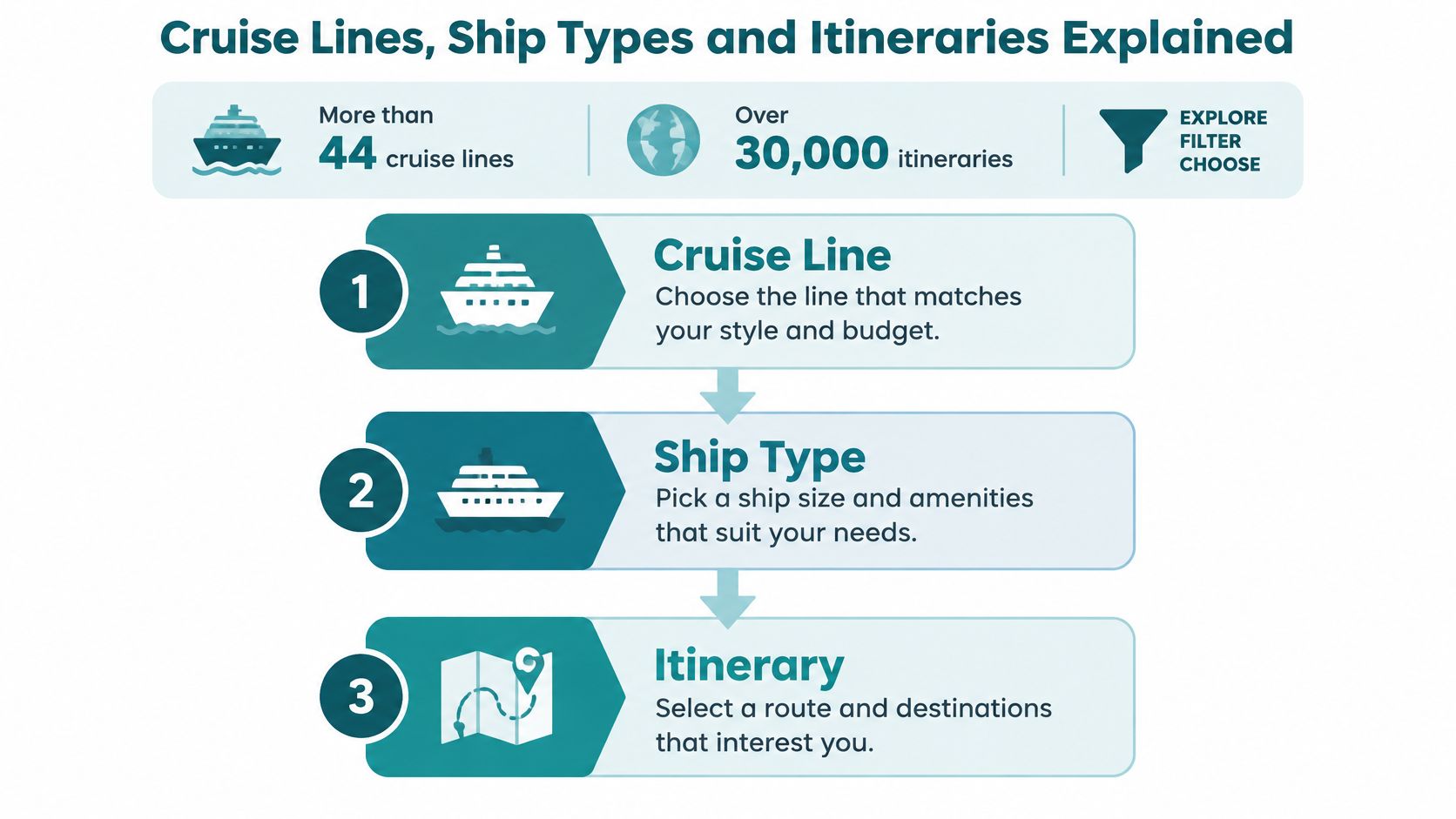
Line first, because the line writes the invoice
Cruise lines differ on atmosphere, dining style, family programming and, most consequentially, what sits inside the fare. One line bundles drinks, wifi and specialty coffee into a higher headline number. Another publishes a lower fare and charges for each of those separately, which means the two are not comparable until you've priced your actual habits. The line is the default cost structure. Pick it before you fall in love with a route.
Ship size changes the crowd math
Large ships give you six restaurants, a theatre, an entertainment zone and something open at midnight. They also give you more people in the same terminal at the same hour and longer queues at the gangway on port days. Smaller ships have fewer venues and quieter decks, and they clear a port faster. If your group includes anyone who finds crowds draining, ship size is a comfort variable, not a prestige one.
The itinerary decides your flights and your days off
Take two seven-night trips that cost roughly the same.
- A Caribbean round trip from a Florida port. One flight in, one flight home from the same airport, three or four sea days breaking up the week, and no ground transport puzzle.
- A one-way Mediterranean sailing that starts in Barcelona and ends in Rome. Now you need an open-jaw flight pair, a pre-cruise hotel night because an overnight flight and same-day boarding is a bad trade, and a transfer from the second city's port to its airport.
The second trip is a better holiday and a harder project. That's the trade-off, and it belongs in the shortlist stage, not after you've paid a deposit.
Before you compare prices, fix three things: your departure region, your trip length and your tolerance for sea days. Then shortlist two lines and two itineraries and read how cruise line itineraries differ side by side. Two of each is enough to expose the pricing difference. Ten is paralysis.
Choosing a Cabin That Suits Your Comfort
Cabin selection is three decisions wearing one coat: how much you'll pay, how much daylight you get, and how the ship's movement treats you at night.
Cabin type | Best for | Trade-off | Location note |
|---|---|---|---|
Interior | Budget-focused travelers who spend most days ashore | No window or natural light | Choose a central lower deck to reduce motion |
Oceanview | Travelers who want daylight without balcony pricing | Window may be partly obstructed or small | Check the deck plan for lifeboat overlap |
Balcony | Couples and travelers who want private outdoor space | Higher fare, and some balconies face strong sun | Midship lower-deck balconies move less than bow or stern |
Suite | Families and travelers who want extra space and priority services | Highest fare and additional ship-wide fees | Often midship with extra space; check the deck plan |
Motion is the variable nobody prices in
The CDC reports that motion sickness can affect up to 25% of cruise travelers, even on modern ships fitted with stabilizers, according to CDC guidance on cruise ship travel. The mechanism is sensory conflict: your inner ear, your eyes and the rest of your body send disagreeing signals while the vessel moves.
That has a direct cabin consequence. A cabin near the ship's midpoint on a lower passenger deck moves less than one at the bow, the stern or the top deck. If you've been seasick on smaller boats, book to that rule rather than to the view.
Practical rule: Pick the ship's midpoint and a lower deck first, then choose the cabin grade you can afford within that zone. A midship lower-deck balcony beats a higher bow balcony at the same fare.
The CDC also advises travelers prone to motion sickness to discuss preventive medication with a healthcare professional before departure, because some common medicines, including certain antidepressants, painkillers and birth-control pills, can worsen symptoms. That conversation is cheaper than a day in a cabin.
Two real cabin decisions
Say a retired couple wants a balcony. They'll see a bow balcony and a midship balcony at close to the same price. The midship one is the better buy, because it's the difference between watching the horizon and watching the horizon while bracing.
Now say a family of four needs two cabins. Compare two connecting or adjoining rooms against one suite. Two rooms usually deliver a second bathroom and separate sleep schedules for less than a suite, while a suite gives you space and priority services plus higher ship-wide fees. Price both, then decide which problem you're solving: space or bathrooms.
Reading the deck plan before you commit
- Find the midpoint: locate the ship's centre on the plan, then count cabins forward or aft to see how far off-centre your cabin sits.
- Check for lifeboat overlap: low-deck oceanview windows often sit behind or beside a lifeboat, and the plan marks obstructed views if you look closely.
- Watch the sun side: a balcony facing the afternoon sun turns into a hot box, and the direction depends on your route, not the ship.
- Check what's above and below: a cabin under the pool deck, the theatre or the galley gets noise at odd hours.
Settle cabin location before you book dining times or excursions. Where you sleep shapes how much time you spend in the room and how well you handle the sea days.
Build Your All-In Cruise Budget Before You Book
The fare is one line on a longer invoice, and the rest of the invoice is where first trips go wrong.
This isn't a niche problem. CLIA reported that 31% of people who cruised during the two years covered by its 2025 research were new to cruising, up from 27% in 2023 and 24% in 2019, with 34.6 million people cruising in 2024, per the CLIA State of the Cruise Industry Report 2025. That's a large population learning the invoice structure for the first time.
Cost item | Usually included? | How it is charged | Planning note |
|---|---|---|---|
Cruise fare | Yes, base price only | Per cabin, with per-person rates shown | Compare inclusions, not just the headline fare |
Gratuities | Often added automatically | Per person per day, varies by cruise line | Confirm whether they are pre-set on your booking |
Port taxes and fees | Usually added to the fare | Per person, shown during booking | Check that the final total includes them |
Drink packages | No | Per person per day or per package | Compare with your actual daily drink count and read the exclusions |
Internet | No | Per device or per package | Check whether a package covers all your devices |
Shore excursions | No | Per booking, per person | Book popular ports early and check group sizes |
Flights and transfers to port | No | Booked separately | Allow a buffer between arrival and check-in time |
The family example, costed in categories
Four people, seven nights. There's the fare, then a drink package for the two adults who'll use it, then daily gratuities multiplied by four travelers and seven nights, then two excursions per person in two ports, then flights and a night-before hotel.
Stack those and the extras land in the same range as the fare. That's the sentence nobody reads on the booking page.
Complaints cluster in exactly these places. Passenger gripes consistently name drink packages, onboard essentials, gratuities, service fees and port taxes as pain points, and one 2025 survey reported by Cruise Fever found 84% of respondents still intended to cruise again. Dissatisfaction doesn't kill demand. It kills expectations. And package labels don't guarantee universal inclusion: the same reporting described passengers finding exclusions buried inside beverage and activity packages.
The lowest advertised fare is often the worse operational choice, especially for a multigenerational group where drinks, dining, connectivity, excursions and gratuities multiply across travelers.
Five steps to a number you can compare
- List every traveler in the group, including the child who shares a cabin and the grandparent who'll want a spa appointment.
- Mark what the fare includes. Write it down: main dining room, buffet, theatre shows, kids club, gym.
- Add the automatic charges. Gratuities and port taxes, per person, before you look at anything optional.
- Price optional items against your real habits. Count the drinks you have, the devices you connect, the ports you tour.
- Add travel to the port. Flights, transfers, a pre-cruise night, airport parking, and travel insurance.
You now have an all-in figure per person. Divide it by nights and you can compare two sailings, which is the point. If the total looks high, work through ways to save money on cruises before you cut the trip itself.
Medication, Health and Port Planning Checks
A cruise removes transport decisions. It leaves destination health risk intact. You still need country-specific advice for the embarkation port and every shore stop, and that advice can differ from one port to the next.
Government travel guidance is explicit on the medical question. Cruise travelers should consult a doctor about whether the trip and its destinations are medically safe for them, and prescriptions should travel in original labeled containers in carry-on luggage rather than checked baggage, per the US State Department's cruise ship safety guidance. Health monitoring continues once you sail. The CDC's Vessel Sanitation Program tracks gastrointestinal illness aboard ships and publishes outbreak information, so a vessel's record is something you can review before you commit money to it.
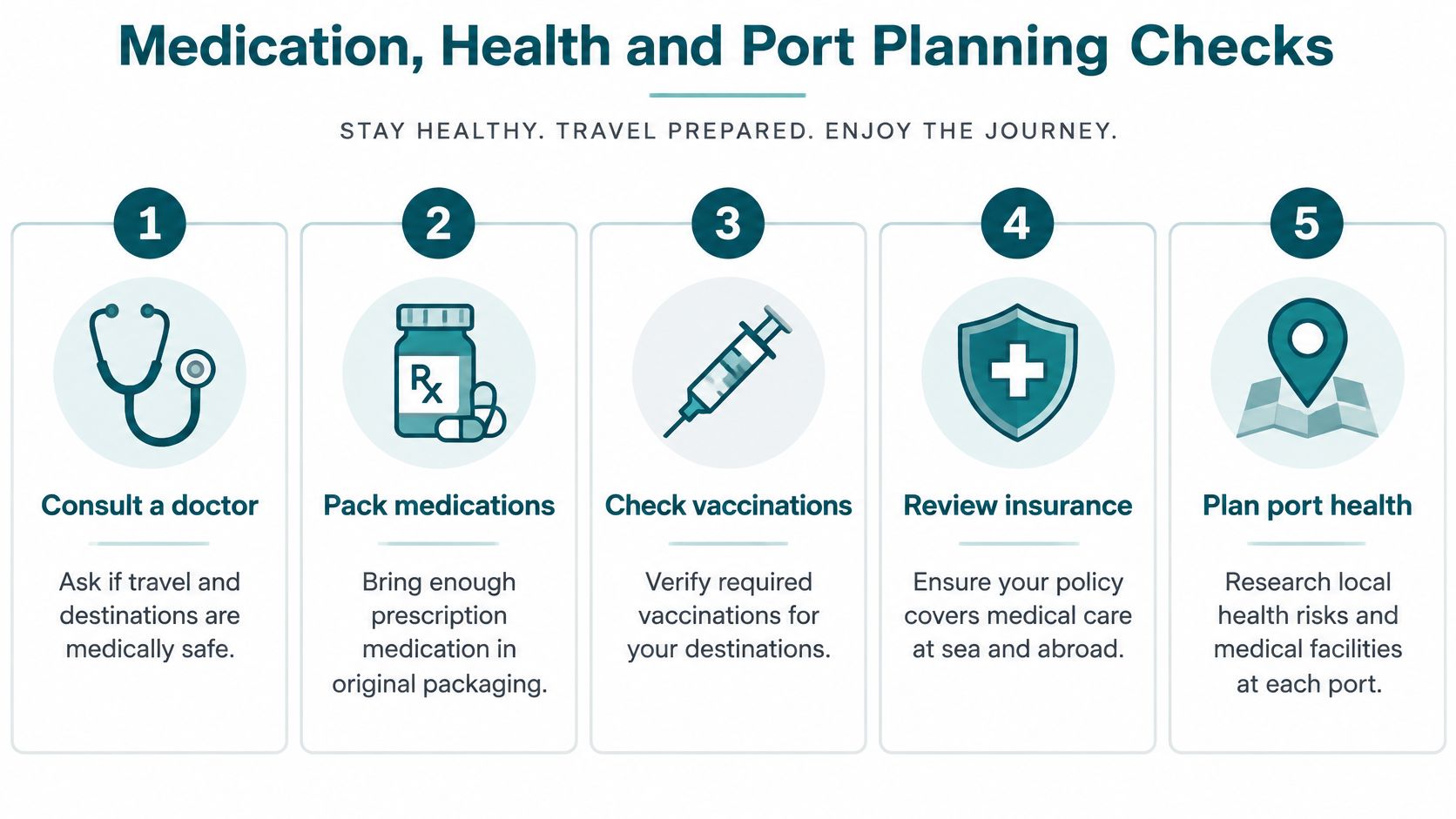
The pre-departure checklist
- Medical review: cover chronic conditions, current prescriptions and motion-sickness susceptibility with your doctor, not a forum. If you have never been seasick, treat that as unknown risk and raise it at the same appointment.
- Medication continuity: time zone changes and long port days can shift your dosing schedule, so pack for the full trip plus extra days in case of delays.
- Insurance and evacuation: confirm the policy covers medical care at sea and abroad, and ask what evacuation from a port call costs. This is one of the hidden numbers in your all-in budget, and it only surfaces when something goes wrong.
- Accessibility verification: confirm cabin type, tender access and terminal assistance with the cruise line in writing at booking, not at the pier.
- Contingency planning: decide in advance what you'll do if a port is missed or disembarkation runs late.
The snowbird couple with a heart condition
A couple in their seventies, one with a heart condition, books a fourteen-night winter sailing. They carry a fourteen-day supply in original bottles, split so half sits in a carry-on and half in a companion's bag. They list the ports with hospitals or clinics near the berth. They ask their insurer whether an evacuation from a port call is covered, and they get the answer in writing before final payment.
That is the standard. Convenience is what the ship provides. Preparedness is what you provide.
The same logic applies once symptoms appear on board. Vomiting or diarrhea isn't automatically seasickness, and reporting it early to the ship's medical centre allows assessment and a sanitation response that protects the people in the next cabin. Waiting it out in your cabin only lengthens the exposure for everyone.
Booking Routes and Reward Credits for Repeat Cruisers
Once you've cruised once, the question changes from "which line" to "how many lines, and through whom". Three routes cover almost every booking.
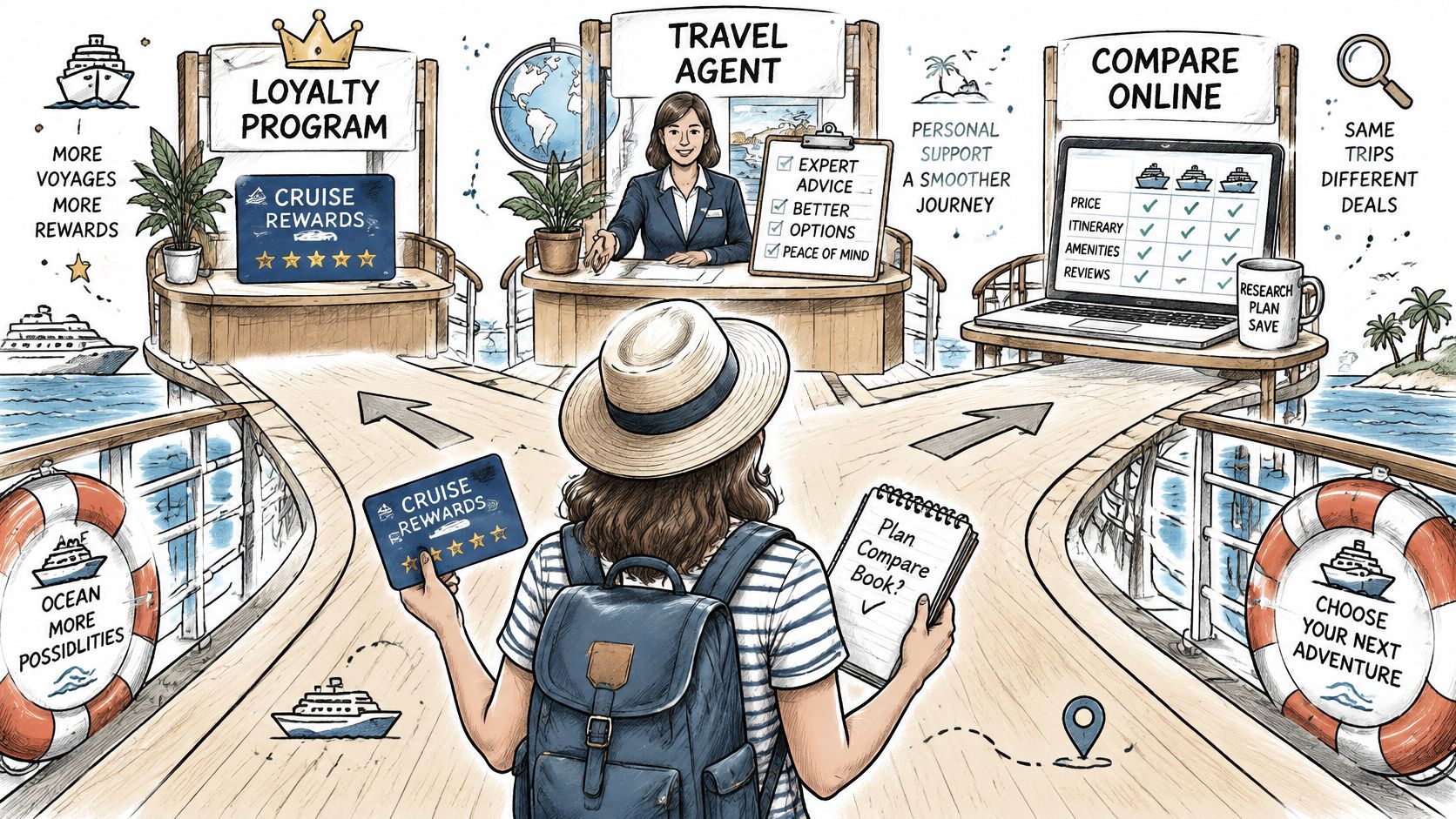
Booking route | Loyalty earnings | What to compare | Best fit |
|---|---|---|---|
Cruise line direct | The line's own loyalty program | Fares and offers from that line only | Travelers committed to one cruise line |
Travel advisor | Depends on the advisor and the line | Advisor service, line access and itinerary help | Travelers who want personal help with complex itineraries |
Approved Experiences Traveler portal | Reward Credits on every booking, which never expire | Wholesale-tier rates, credit balance and line coverage | Repeat cruisers who compare several lines or also book hotels and flights |
What loyalty actually buys you
Booking direct with one line builds status that pays out in onboard perks and repeat-sailing offers. The cost is blind spots. You stop seeing the routes the line doesn't sail and the fares it doesn't match. For a traveler who takes one cruise a year on the same brand because the kids love the ship, that trade is fine. For someone sailing three lines a year, it's a tax on curiosity.
A travel advisor earns their place on multi-port itineraries, family logistics and anywhere you'd otherwise spend a weekend on the phone. Their value varies with the advisor and with the line, so ask what they know about the specific ships on your shortlist.
One login, one balance
Approved Traveler members book at the wholesale tier from their first reservation, backed by the 110% Best Value Guarantee, with Reward Credits on every booking. Credits never expire and redeem toward future bookings, but they carry no fixed dollar value because redemption rates vary, so track them as a balance rather than as cash.
The structural advantage shows up in volume. Hotels, flights, cruises, cars, tours and homes sit under one login in the member portal, which members reach by signing in from the website. Take a traveler who sails two different lines and adds a hotel stay in the same year. Three bookings, one login, one credit balance, instead of three separate loyalty accounts and a spreadsheet.
Before you choose a route, answer one question: how many cruises and how many lines will you book in the next 12 months? One cruise on one ship doesn't need infrastructure. Three bookings across two lines does.
Dining Structure and Onboard Routines
Dining is a cost and comfort decision most first-timers make by accident, usually by accepting whatever time appears on the booking and discovering on day two that it collides with bedtime.
Two structures cover nearly every ship. Fixed dining assigns you the same table and the same time each evening. Flexible dining lets you book or walk in when it suits, which is what you want when an excursion runs late.
Main dining rooms are typically included in the fare, and buffets and casual cafes cover quick meals. Specialty restaurants charge a per-person surcharge, so they belong in your budget as optional purchases rather than as a surprise on the final statement.
Which one fits your group
Fixed dining suits families who want predictable meal times and the same staff each night, because the waiter learns who has the allergy and who needs the kids fed fast. Flexible dining suits groups with irregular schedules, late port days or teenagers who surface at nine.
The 6 pm test: if anyone in your party is under five or over seventy-five, a fixed early seating usually beats flexibility. Neither of them wants to eat at 9 pm after a sea day.
Picture a family of four with two young children. They pick a fixed 6 pm table. Dinner matches bedtime, the children eat before the meltdown, and nobody spends a port day refreshing an app for a table reservation. Same ship, same fare, entirely different week.
Formal evenings need one planned outfit each, and most lines accept a smart-casual option if a suit or gown isn't happening. Pack for the dress code you'll follow, not the one on the website's gallery.
Decide the structure at booking. Changing it later usually depends on what's left, and on a full sailing, nothing is.
Embarkation Day, Documents and Muster Drill
Embarkation is a sequence with one mandatory checkpoint. Under SOLAS Regulation III/19, as amended by the IMO, newly embarked passengers must complete the muster process before departure or, at the latest, immediately after departure, as the IMO's briefing on the amended SOLAS requirements explains. The timing exists for a reason: you learn your muster station while the ship is still in port, not during an emergency at sea.
A muster drill works like a school fire drill. The route gets practised on a calm day so an alarm never has to teach it. Treat it as the last piece of the system you built: every document check and walk-through protects the days you already paid for.
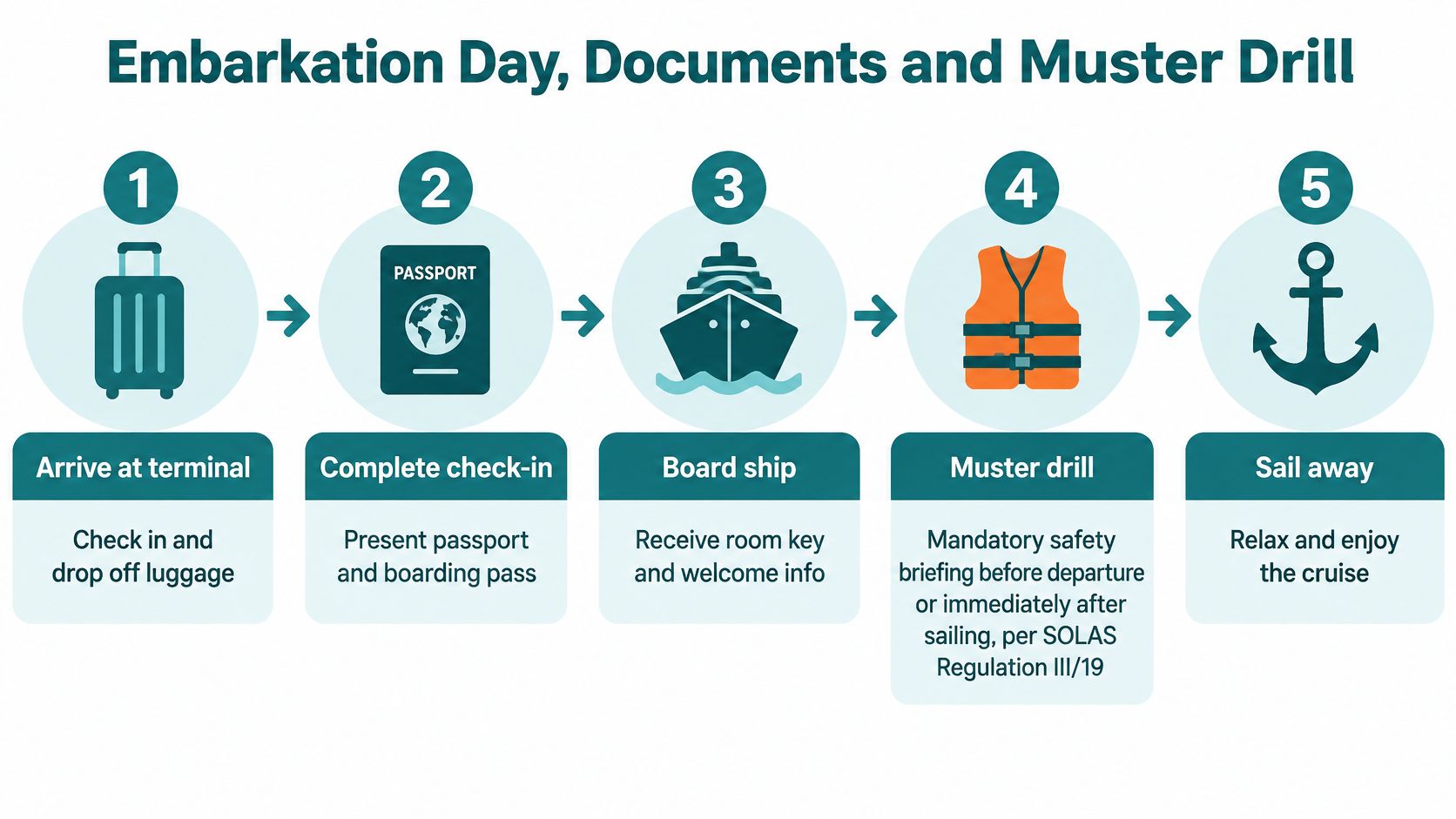
The six steps, in the order you'll act on them
- Pack one carry-on with passports, booking confirmation and all medication. Reason: checked bags may not reach your cabin for hours, and medication you can't reach isn't packed. Common slip: putting the pill box in the suitcase "for safety".
- Confirm your check-in window and terminal before leaving home. Big ports run several terminals handling ships that sail at similar times, and arriving at the wrong one costs an hour you don't have.
- Board, then locate your cabin and your muster station. You don't need to unpack first; walk the route once while corridors are empty.
- Complete the muster process before departure, or immediately after at the latest. Reason: instructions are only useful if you can execute them without hunting for a corridor or a phone signal. Common slip: assuming it can wait until evening plans begin.
- Agree a family meeting point. Crowds, lifts and alarms separate groups, and a fixed spot on a named deck beats a phone call that may not connect.
- Set up your onboard account and confirm dinner times. Both are far easier on day one than at 8 pm on day two when everyone else has the same idea.
The family of four, on the day
Each adult takes one child to the assigned station the first time they walk it. Someone photographs the station sign on the cabin door. If connectivity drops or a phone dies, the photo and the meeting point still work. Four minutes of walking removes the worst part of an emergency.
If your itinerary includes a first-timer boat trip in a West Coast port, Tiki Time Bay Tours cruise advice on what to do and what to avoid is a useful cross-check for small-vessel habits before you step onto a ship carrying thousands.
For the terminal mechanics, this walkthrough of the cruise ship boarding process, step by step covers documents, queues and timing.
You're done when four things are confirmed before the ship leaves the berth: documents in hand, cabin found, muster station walked, meeting point agreed.
Confirm Your Cruise Plan Before You Book
The plan is built. What remains is the check that stops you paying twice for the same thing.
Start with the arithmetic. Compare your final booking total against the all-in figure per person you built from the cost table. If gratuities, port taxes or excursions are missing from the total, the total is wrong, and the missing line will find you on board.
Then confirm three settings in writing: the gratuity setting on the booking, the cancellation schedule with its dates, and the final payment date. Save the confirmation email somewhere you'll find it, because those terms are what you'll rely on if plans change.
Approved Traveler and Lux Traveler bookings are backed by the 110% Best Value Guarantee. Read its terms before you pay: the window in which a lower publicly available price must be found, and how the refund is calculated (110% of the difference). Then recheck your fare a day or two after booking, which is when price moves are easiest to catch.
A first-time family of four confirms the all-in total, saves the confirmation with the cancellation dates attached, and sets a reminder a week before the cancellation deadline. Three minutes of admin, and the deposit stays refundable while they finish the health checks.
Which leaves one decision for this week. Choose the itinerary and the cabin, then name the single open item still blocking payment: a medical review, an insurance question, an accessibility confirmation with the line, or a flight that needs an extra day. Answer that one, and the booking is a decision rather than a gamble.
A first cruise gets easier the moment you stop treating the fare as the price. Approved Experiences Traveler consolidates wholesale-tier rates across hotels, flights, cruises, cars, tours and homes under one login, so the line, cabin and route you shortlist can be priced against the flights and pre-cruise night that surround them. Reward Credits are earned on every booking and never expire, and members start at the wholesale tier from their very first reservation, backed by the 110% Best Value Guarantee. Visit Approved Experiences Traveler to see how the inventory fits the trip you're planning, then build the all-in budget before you book.