Cruise to Ensenada: What to Expect and How to Plan
Plan a cruise to Ensenada with itinerary options, port transfers, crowd timing, shore excursion tips and a pre-sail checklist for a smooth port day.
18 min read
You're staring at a three- or four-night Southern California sailing, calendar open in one tab and shore excursions in another. The brochure makes a cruise to Ensenada look effortless: step off the ship, visit La Bufadora, tour a Valle de Guadalupe vineyard, grab street tacos downtown, and stroll back to the pier before sailaway. In reality, trying to pack all of that into one port call is the fastest way to spend half your afternoon watching highway brake lights and checking your watch.
An Ensenada port day works best when you treat it as a timed logistics problem rather than a sightseeing checklist. Every shore option carries a distinct travel radius and late-return risk, and the ship's all-aboard time sits at the center of every decision you make. When you plan backward from that hard deadline and factor in real berth limits and port traffic, you know within minutes whether a wine-country tour makes sense or whether staying near the waterfront is the smarter call.
That shift in planning takes the stress out of a short Pacific getaway. Instead of guessing how far you can roam, you match your itinerary's actual hours ashore to the exact radius you can cover with a safe return margin.
Ensenada Cruise Options at a Glance
Most travelers reach Ensenada on a single daytime port call baked into a two- to seven-night sailing out of Southern California. Because the port sits so close to major homeports, the itinerary decision rarely comes down to ship amenities alone. What separates a relaxed port day from a rushed one is how many usable hours ashore the ship's published schedule gives you.
Itinerary type | Typical length | Common departure port | What the Ensenada call looks like |
|---|---|---|---|
Short Southern California round trip | 3-4 nights | Long Beach, Los Angeles or San Diego | Full daytime call in Ensenada |
Weekend getaway with one port | 2-3 nights | San Diego | Short sea day plus Ensenada |
Longer Pacific loop with several Mexican ports | 5-7 nights | Southern California | Ensenada as one of several stops |
Look closely at the trade-off across those three structures. A two- or three-night weekend sailing lets you drive to the terminal after work on Friday and return Monday morning without burning extra vacation days, while a four-night round trip usually pairs a full daytime Ensenada stop with an unhurried sea day. Longer five- to seven-night Pacific loops fold Ensenada into a broader Mexican Riviera lineup, where you might already be pacing your energy across multiple port days.
Why the Overnight Run Works So Well
Ensenada functions as a high-frequency foreign port of entry because ships don't need a multi-day ocean crossing to reach it. According to the Port of San Diego cruise operations overview, Ensenada lies roughly 64 nautical miles from San Diego, while other nautical references put the route near 80 nautical miles depending on the departure terminal and routing path. That short coastal hop lets a vessel depart Southern California in the evening, cruise overnight, and tie up in Mexico for a full morning arrival.
For cruise lines, that geometry solves both passenger experience and route-design rules on three- and four-night Pacific sailings without sacrificing onboard sea time. For you, proximity doesn't automatically equal extra hours in town. Immigration clearance, berth congestion, and whether your vessel docks at a pier or runs tender boats all chip away at the published window.
A Three-Step Test for Any Sailing
Before you put down a deposit on any sailing, run the itinerary through a quick operational screen:
- Pull the published port times and subtract a 90-minute cushion. Say you're comparing a four-night round trip with a posted 08:00 arrival and a 17:00 all-aboard. Subtracting an example 90 minutes for morning disembarkation and a conservative pre-boarding buffer leaves about seven usable hours ashore, which tells you right away what kind of excursion fits.
- Confirm pier docking versus tendering. A docked ship lets you walk straight down a gangway at your own pace. A tendered call requires waiting for boat transfers in both directions, which tightens every timed reservation in town.
- Match sailing length to your real calendar and travel budget. A three-night weekend departure works well if you live within driving distance of Long Beach or San Diego, while travelers flying in usually get stronger value from a four- to seven-night sailing that spreads flight and hotel effort across more days.
Timing Your Port Day Around Crowds
Most port guides treat Ensenada as a sleepy coastal town where you can wander off the pier, grab a cab on the curb, and breeze into any restaurant you like. That assumption breaks down fast on a busy multi-ship morning. Passenger traffic has climbed sharply enough that who else is docked beside your vessel now determines how far from the terminal you should plan to go.
Period | Cruise arrivals | Passengers | Planning implication |
|---|---|---|---|
2022 (Baja California planning data) | 332 | 528,397 disembarking | Recovery baseline; moderate queues |
2023 | 320 | 1,006,890 | Peak year; expect multi-ship days and full shuttles |
2024 (official port study) | 272 | 949,321 (approx. 3,490 per call) | Still near one million; heavy midday demand on shared-berth days |
Jan-Apr 2026 vs same period 2025 | Not published in local reporting | Approx. 500,000, up 28.6% | Fastest growth; single mega-ship berth at main terminal |
2026 full year | Not published in local reporting | Crossed one million (reported) | No confirmed timeline for capacity expansion |
The trajectory in that table explains why old forum advice feels outdated. State planning figures cited by Travel And Tour World show 332 cruise arrivals and 528,397 disembarking passengers in 2022, establishing the post-pandemic baseline as Ensenada rose to Mexico's third-busiest cruise port by passenger arrivals in the 2023-2024 period. Official statistics published in the Baja California Secretariat of Tourism December 2024 bulletin then recorded 1,006,890 passengers across 320 arrivals in 2023 and 949,321 passengers across 272 arrivals in 2024, a 5.72% dip in passengers and 15% drop in arrivals that still averaged roughly 3,490 passengers per ship call.
Traffic surged again right after that. Reporting from Baja Daily News notes that Ensenada received roughly 500,000 cruise passengers from January through April 2026, a 28.6% increase over the same four-month window in 2025, while the main terminal's single passenger berth can accommodate only one mega-ship at a time. The same outlet references reporting that the port crossed one million passengers in 2026 with no confirmed construction timeline announced for capacity expansion.
What Multi-Ship Days Actually Slow Down
When thousands of guests step ashore inside the same 90-minute window, bottlenecks ripple straight through local infrastructure. Shuttle queues lengthen at the pier, licensed taxis outside the gate disappear quickly, downtown avenues back up around midday, and walk-in tables at popular seafood spots fill before noon. Outlying attractions absorb that surge last, creating long lines right when you need to head back.
Use four criteria to calibrate your schedule against the port calendar:
- Check the port schedule before booking. Compare your ship's arrival window against every other cruise ship calling on the same date.
- Shrink your radius on shared days. If two or more large ships are in port together, keep timed meals, tastings, and walking tours within easy reach of the terminal.
- Flag long drives as high-risk. Treat independent road trips to La Bufadora or Valle de Guadalupe as directly exposed to highway slowdowns and late returns whenever passenger volume spikes.
- Hold a 60-minute boarding buffer. I set a hard target of being back on board at least 60 minutes before the published all-aboard time, never cutting it down to the final shuttle run.
Say a couple wants a 12:30 lunch reservation on a two-ship Saturday. Rather than booking a trendy restaurant across town that depends on finding a return taxi during peak afternoon traffic, they pick a café near downtown Calle Primera that they can reach on foot in either direction.
Crowd radius rule: The busier the Ensenada port schedule, the smaller the travel radius you should plan from the pier.
Getting From the Ship to Downtown Ensenada
You don't need a private driver or an excursion bus just to reach central Ensenada. According to terminal logistics published by Ensenada Cruiseport, you have two direct ways into town: take the official port shuttle, which takes approximately five minutes to reach Plaza Cívica de la Patria (locally known as Tres Cabezas) near the entrance to downtown Calle Primera, or walk along the flat harbor boardwalk in roughly 12 to 15 minutes.
Here is a quick visual comparison of the two direct port-to-town options.
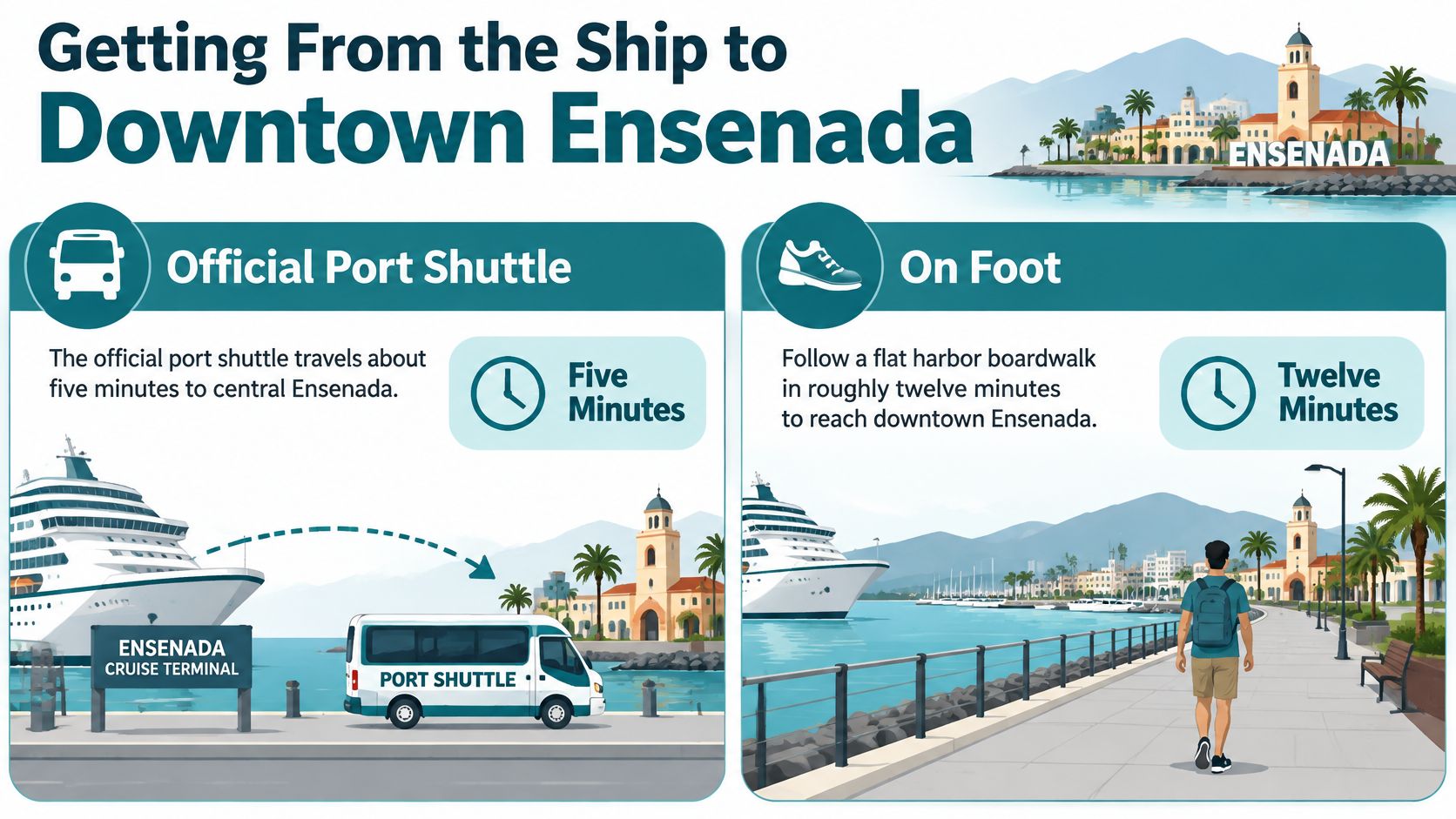
Choosing between those two options comes down to mobility, weather, and how tight your first reservation is. If you're traveling with small kids, older relatives, or anyone conserving stamina, the five-minute shuttle cuts out unnecessary walking in the sun. If the weather is mild and everyone in your group moves comfortably on flat pavement, the waterfront boardwalk walk removes shuttle-line friction entirely.
One detail catches first-time visitors off guard: Plaza Cívica is a drop-off hub, not the front door of your restaurant or tour operator. You still need to add the final walk along Calle Primera or surrounding side streets to reach your actual meeting point.
Five Steps From Cabin to Calle Primera
Follow this sequence on port morning so a short transfer doesn't turn into a frantic sprint:
- Verify the morning's port setup before leaving the ship. Berth assignments and active harbor operations can change where shuttles load and how pedestrians exit the secure terminal zone, so check the ship's morning port sheet and pier signage first.
- Pick your transfer mode by time and mobility. Board the official shuttle when minutes are tight or someone in your party has limited stamina; take the boardwalk walk when you want zero wait times and steady ocean views.
- Price in the disembarkation queue. Your transfer clock starts when you line up inside the ship's stairwell, not when the shuttle doors close. Early-bird disembarkation waves frequently bunch up right after gangway clearance.
- Map the last stretch from Plaza Cívica. Pin your restaurant, shop, or tour guide's exact corner on Calle Primera before losing ship Wi-Fi, and add that walking time to your arrival estimate.
- Mirror the timeline for the return leg. Treat your all-aboard time as immovable, then reverse the exact same walk, shuttle wait, and terminal security check on the way back.
Consider a family with a 10:00 walking-tour meeting point midway down Calle Primera. They leave their cabin early enough to absorb the morning gangway line, the five-minute shuttle ride, and the stroll from Tres Cabezas, targeting an arrival in central town with an hour to spare before their guide starts checking names.
For a real-time look at the pier layout and waterfront walk into town, watch this port walkthrough before you sail.
Shore Excursions Worth Booking and Their Trade-offs
Once you know how quickly you can reach town, the next step is ranking what's worth your limited hours. Every excursion in Ensenada trades novelty and scenery against road distance and return risk. The map below illustrates how close the waterfront and central Calle Primera sit to the cruise pier compared to outlying drives.
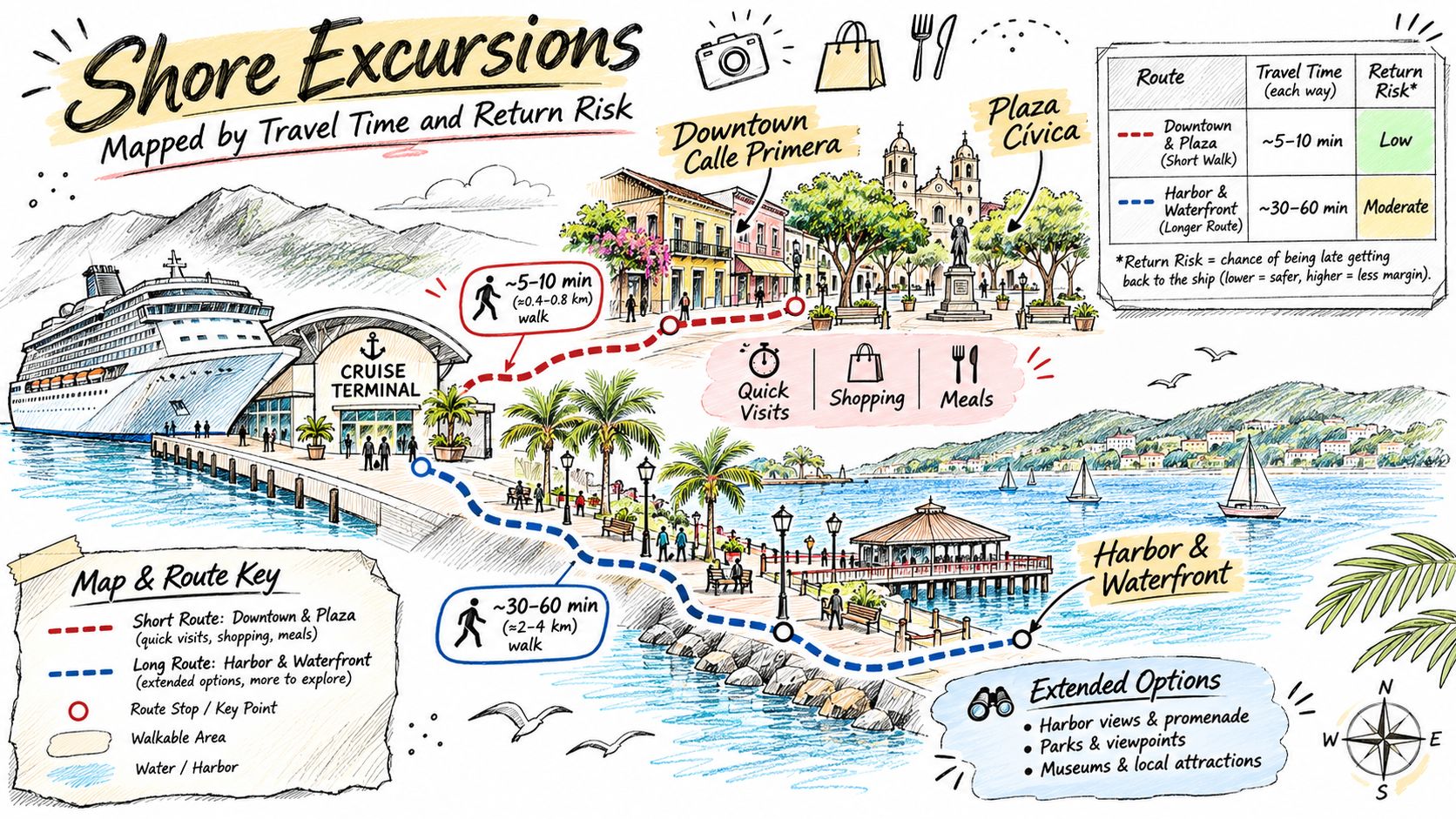
Comparing your choices side by side makes the risk gradient unmistakable.
Shore option | Travel from terminal | Return risk | Best fit |
|---|---|---|---|
Terminal and waterfront boardwalk | 0-15 min on foot | Lowest | Short calls, mobility-limited groups, families with children |
Downtown Calle Primera and Plaza Cívica | 5 min shuttle or 12-15 min walk | Low | Shopping, meals, tacos, sub-4-hour calls |
La Bufadora | Longer road trip; traffic and access challenges | High | Book the earliest return slot; allow extra time for uneven access |
Valle de Guadalupe wine country | Longest travel; full-day tour | Highest | Only when the ship allows a late all-aboard |
Ship-booked excursion with guaranteed return | Pier pickup to full-valley bus | Managed by the line | Travelers unwilling to absorb a missed-ship risk |
Matching Each Stop to Your Schedule
Each tier solves a different kind of port day, and mixing up the wrong tier with a tight schedule is where travelers run into trouble.
- Harbor and waterfront promenade: Flat, close to the gangway, and completely insulated from highway traffic. You can browse marina views, grab a cold drink, and keep the ship in sight the entire time.
- Downtown Calle Primera and local taco stands: Ideal for unstructured half-day visits, local fish tacos, bakeries, and souvenir stops. Because you can walk back to the pier if shuttle lines spike, your return risk stays low even on crowded afternoons.
- La Bufadora marine geyser: Ensenada's signature coastal blowhole sits well south of downtown along a winding road that backs up easily when tour buses converge. If you go independently, book the earliest morning departure you can find and budget extra time for the steep, crowded vendor corridor leading to the lookout.
- Valle de Guadalupe wine country: Baja's celebrated wine region delivers unforgettable tastings and farm-to-table kitchens, yet it demands the longest drive of any standard excursion. Only commit to a full-day valley circuit when your ship offers a late afternoon or early evening all-aboard, or when you reserve through a ship-sponsored tour that holds the vessel if traffic stalls.
Any itinerary that leaves the port perimeter needs enough slack to absorb a fender-bender, roadwork, or slow restaurant service. Take a group of three friends who want local wine without gambling on a missed ship: instead of booking a six-hour full-valley itinerary, they select a shorter morning tasting tour scheduled to return to the pier by early afternoon, leaving plenty of room for a quick taco stop near town afterward. Before locking in a deposit, check a clear framework on how to book shore excursions so you decide consciously when ship-line return protection is worth paying for over an independent operator.
Does the activity finish at least an hour before all-aboard even if the drive takes twice as long as planned? If the answer is no, step down to the next-closest tier on the table.
Accessibility and Mobility on a Port Day
Many cruise reviews describe Ensenada as broadly wheelchair-friendly because the cruise terminal itself is flat. That shortcut sets travelers up for a rough afternoon. Mobility conditions change dramatically the moment you step past the port gates onto city sidewalks or board an independent tour van.
Segment-by-Segment Mobility Breakdown
Planning accurately means breaking your port day into five distinct physical segments rather than treating Ensenada as a single uniform surface:
- Ship to terminal. Pier infrastructure directly shapes how long disembarkation takes and how far you have to wheel or walk. According to ASIPONA Puerto Ensenada cruise terminal data, the terminal handles vessels up to 3,200 passengers with throughput productivity of approximately 2,300 passengers per arrival across two gangways and a projected annual capacity of 800,000 passengers. Berth assignment also varies across the harbor: the Port of Ensenada customer FAQ lists two public docks (API 1 at 220 linear meters and API 2 at 150 linear meters with a 13.05-meter official draft), while Ensenada Cruiseport Village separately lists Pier 1 at 163 meters and Pier 2 at 185 meters, each with a 10-meter official draft. A ship docked at a farther berth adds meaningful distance before you even clear the terminal exit, and gangway slope shifts with the tide.
- Terminal to waterfront. As detailed in the Cruising in the Wake Ensenada port guide, the terminal, pier, and adjacent waterfront boardwalk are step-free and wheelchair-accessible. Manual wheelchairs, power chairs, walkers, and strollers all handle this stretch smoothly.
- Downtown streets. Once you move off the modern harbor promenade into older downtown blocks, pavement becomes unpredictable. You'll encounter cobblestones, high curbs without consistent curb cuts, narrow shop thresholds, and occasional stairs that require route adjustments or a companion's help.
- Excursion transport. Cruise-line accessibility policies note that most standard excursion motor coaches can stow collapsible wheelchairs underneath, whereas non-ambulatory guests who cannot climb bus steps often need independent accessible transportation arranged well ahead of sailing.
- The attraction itself. Flat downtown plazas and ground-floor restaurants are manageable with minor route tweaks, whereas coastal stops like La Bufadora involve sloped paths, crowded walkways, and uneven ground that can turn an outing exhausting for guests using walkers or dealing with limited stamina.
Different mobility aids face different friction points. A parent pushing a stroller can pop over a missing curb ramp in seconds, while a traveler in a heavy power wheelchair needs a verified accessible route and a lift-equipped vehicle. Guests with limited stamina may walk comfortably on flat ground yet struggle if a tour requires standing in direct sun between stops.
What to Confirm Before Booking
Before committing to any shore plan for a mixed-mobility group, verify six specifics in writing with your cruise line or tour provider:
- Vehicle lift availability: Confirm whether the transport has a working hydraulic ramp or lift rather than assuming a tour bus accommodates seated boarding.
- Folding-wheelchair storage: Ask whether a collapsible chair or rollator fits inside the luggage bay alongside other guests' gear.
- Total walking distance and surface type: Get exact distances on pavement versus cobblestones, gravel, or stairs.
- Accessible restroom stops: Verify ground-level, wide-door restrooms along the route, not just at the cruise terminal.
- Terrain and shade at the destination: Check for steep grades, long standing periods, or exposed walkways.
- Cruise-line assistance deadlines: Most lines require special-needs forms weeks before embarkation to reserve accessible tender help or wheelchair pier assistance.
Say a multi-generational family sails together with a grandparent in a wheelchair and two young kids. Instead of forcing everyone onto a bumpy highway trip to a hillside lookout, they stick to the flat waterfront boardwalk and a pre-checked ground-floor seafood lunch near Plaza Cívica. If you're coordinating across age groups, practical guidance on traveling with elderly parents helps you build pacing buffers that keep the day enjoyable for everyone.
Accessibility reality check: A smooth, step-free cruise terminal never guarantees an accessible shore excursion. The highest-risk transition is almost always moving from the controlled port zone onto uneven public streets and independently operated vehicles.
Documents, Checks and Locking In Your Port Day
Before you book your cabin, confirm your passport or accepted travel documents against current entry rules for your exact citizenship. Even a quick weekend round trip from Southern California crosses an international border into Mexico, and showing up at embarkation with the wrong ID ends the trip at the check-in counter.
The graphic below highlights the three core pillars to lock down before departure day.
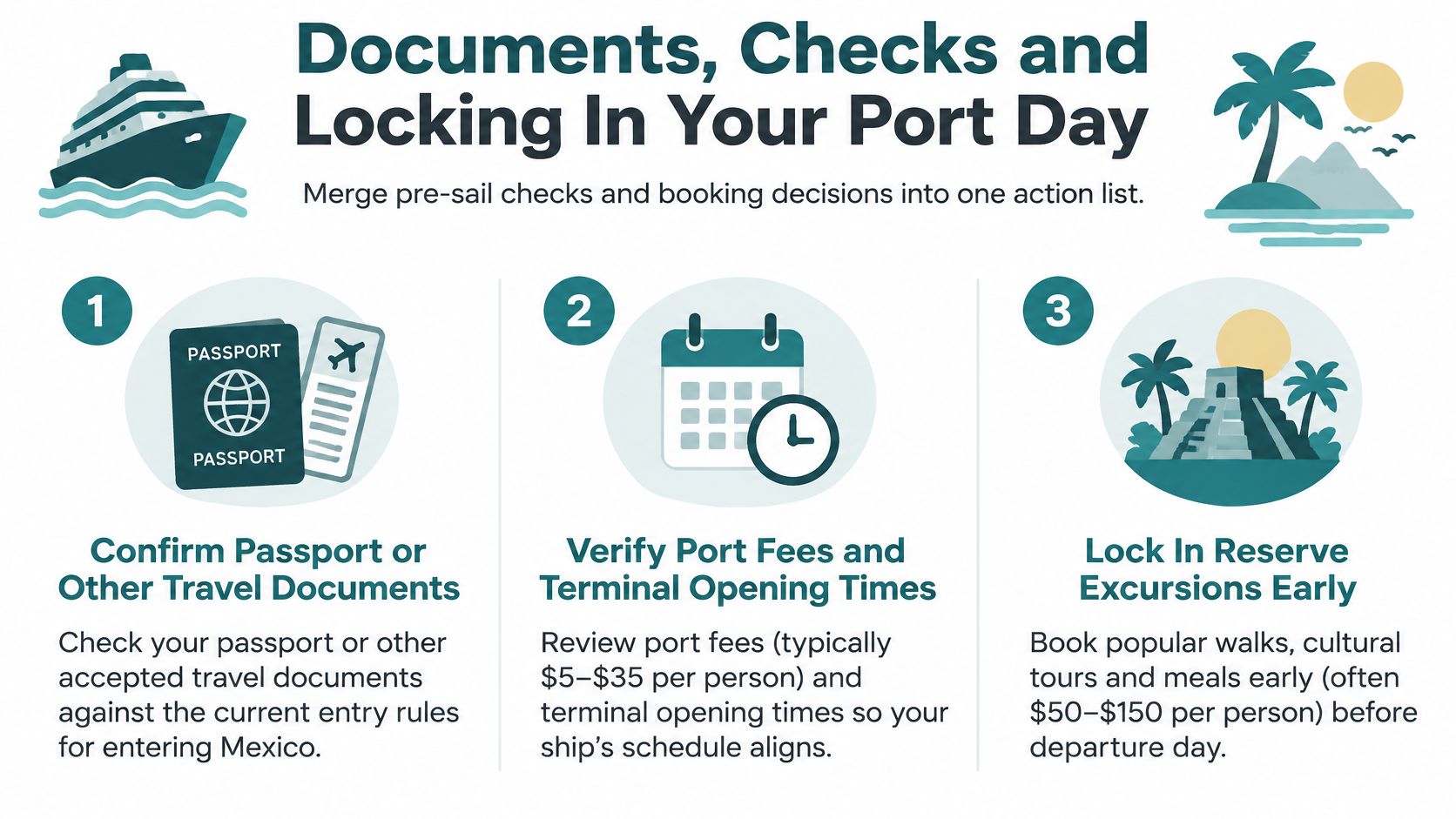
Once your documents are confirmed, merge your pre-sail prep and your port-day booking decisions into one clean sequence so nothing slips through the cracks.
Eight Pre-Sail and Port-Day Actions
- Verify citizenship and entry rules with your cruise line. Check whether a valid passport book is required for your nationality, whether a passport card or closed-loop documentation applies, and whether any Mexican visa or tourist-card fee is bundled into port charges.
- Record the published Ensenada schedule. Write down your ship's arrival time, expected pier or berth, and official all-aboard time from your cruise documents rather than relying on the generic marketing page.
- Prioritize the one or two plans that need the biggest cushion. If you want a wine-country excursion or a timed lunch table, lock those anchor items first so the rest of your day fits around them.
- Set your personal return cutoff before booking anything else. Put your self-imposed back-on-board target in writing and reject any independent tour that cuts inside that margin.
- Check pier transport on port morning. Confirm shuttle loading zones, ticket desks, and pedestrian exit routes inside the terminal before stepping outside the gate.
- Verify mobility and assistance deadlines. Submit accessibility requests to your cruise line early and confirm vehicle, restroom, and terrain details with every tour vendor.
- Prep cash, cards, and mobile data. Carry small Mexican peso bills for street tacos, tips, and local booths alongside a card with no foreign transaction fees, and check whether your cell plan includes Mexico data roaming before you sail.
- Pack for sun, harbor wind, and cobblestones. Closed-toe shoes with solid grip beat flimsy sandals on uneven downtown blocks, and saving your ship's local port-agent phone number on paper keeps you covered if your phone battery dies.
A simple habit prevents nearly every port-day mistake: say a couple writes the ship's all-aboard time, their personal return deadline, and their tour meeting address on one index card and keeps that card in the same pocket as their ship keycard. You can run your final packing and paperwork against a complete cruise planning checklist the week before sailing so port morning stays calm.
If you're coordinating pre- or post-cruise nights in San Diego or Long Beach alongside your sailing, Approved Traveler consolidates wholesale rates on hotels, flights, cruises, cars, homes, tours, and activities under one login so you can compare cruise options and shore-side stays in the same place instead of bouncing between separate accounts.
Booking sequence: Pick the sailing that gives you the port window you want, then lock in your personal return deadline before you reserve a single excursion or restaurant table.
How Many Hours Ashore You Actually Get
The number that governs your day isn't the nine-hour block printed on your itinerary. It's your usable hours ashore, calculated by subtracting morning gangway clearance, your pre-boarding return buffer, and round-trip transit from the ship's published window.
Passenger behavior confirms how tight that real window feels on the ground. According to Seatrade Cruise, reporting on the 2023-2024 period found that 73% of cruise passengers explored Ensenada, with an average stay of five hours. Most independent cruisers naturally treat the stop as a focused half-day outing rather than trying to stretch every minute to the gangway pull.
Two Port-Day Math Scenarios
Running two hypothetical schedules shows how quickly a published itinerary compresses once real-world logistics kick in:
- Scenario 1 (08:00 to 17:00 port call, light port traffic): Suppose your ship clears local authorities smoothly and you walk off the gangway at 08:30. Setting a 16:00 back-on-board deadline and factoring in short pier-to-town transit each way leaves roughly 6.5 usable hours for downtown shopping, waterfront walks, and lunch. If you spend extra road time heading out to La Bufadora and back, your actual on-site sightseeing window trims down closer to 5.5 hours.
- Scenario 2 (10:00 to 18:00 port call, multi-ship day): Now model a later arrival when another big vessel shares the harbor. If morning disembarkation and pier shuttle lines eat an extra 30 minutes on top of your return cushion and transit, you end up with roughly 5 usable hours in town. That's comfortable for Calle Primera, local fish tacos, and a relaxed café stop, yet too compressed for an independent drive into Valle de Guadalupe.
Treat whatever figure you calculate as a ceiling, never a guarantee. Tender boat transfers, slower immigration clearance, or berth congestion can each shave another 20 to 30 minutes off a well-planned schedule, so leaving an extra cushion on the table is what keeps your cruise to Ensenada relaxed from gangway down to sailaway.
When you're ready to compare Southern California sailings alongside pre- and post-cruise stays, Approved Traveler gives members consolidated wholesale-rate access across 44+ cruise lines with 30,000+ itineraries, 1,000,000+ hotels, 700+ airlines, and 150,000+ activities in one platform, backed by Reward Credits on every booking and our 110% Best Value Guarantee. Whether you're coordinating a quick weekend Ensenada call or a multi-generational family sailing for up to 10 household members, explore the membership infrastructure at Approved Experiences Traveler.