What Is the Second Shift and How to Reduce It
What is the second shift? Learn the unpaid home and coordination work behind it, the data on who carries it, and practical ways to reduce it.
12 min read
A household can look well equipped and still leave one person responsible for keeping everything on track. A cleaner may handle the floors, and a shared calendar may display appointments, yet someone still has to notice what needs doing, assign it, and follow up.
Adults worldwide spent about 2.9 hours a day on unpaid care and domestic work in 2023, according to UN Women's technical brief, with women averaging about 4.3 hours and men roughly 1.6. Sociologist Arlie Russell Hochschild popularized the term the second shift in her 1989 book, describing how employed couples could divide paid work more evenly than housework and family management.
Those figures count time, but the hours alone do not show who owns the work. A chore is one task; ownership also means noticing it, deciding how to handle it, coordinating help, and checking that it is done. When those steps sit with one person, the household's work can remain uneven even when some chores are shared or outsourced. To measure the second shift at home, track both the tasks and who carries responsibility for each one.
What the Second Shift Means in Plain Terms
When does work end if dinner still needs planning, a permission slip needs signing, and camp registration opens during a work meeting? Household responsibilities rarely fit neatly after paid work. They spill into the day, then continue once it ends.
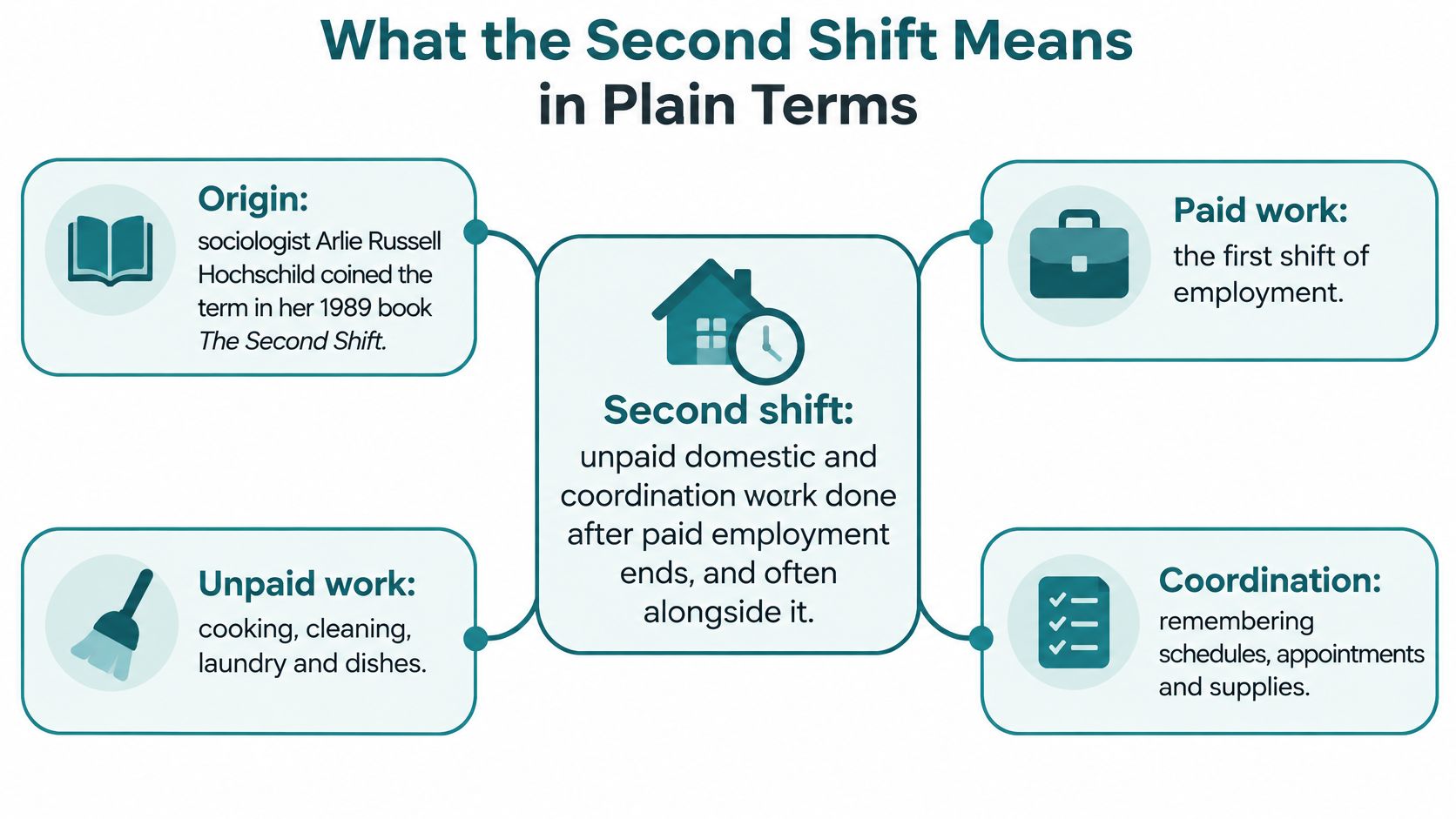
Sociologist Arlie Russell Hochschild popularized the term in her 1989 book The Second Shift. Her work described how employed heterosexual couples often shared paid work more equally than housework and family management. The gap is part of a broader pattern: UN Women's technical brief on forecasting time spent in unpaid care and domestic work examines unpaid care as a global issue.
The second shift is the unpaid work of running a household alongside paid employment. It includes visible tasks, such as cooking and laundry, and the responsibility for ensuring those tasks happen. That responsibility can begin before the workday ends and continue after the last chore is done.
The word “shift” can make the work sound like a tidy block of hours. In reality, it often behaves more like a shared job with no clear closing time. The key question is not only how many tasks each person completes, but who notices, plans, and follows through.
Household work can include:
- Visible chores: cooking, cleaning, laundry, dishes, and shopping.
- Childcare: hands-on care and supervision.
- Household administration: bills, insurance, school paperwork, and medical records.
- Appointment coordination: booking, rescheduling, confirming, and informing others.
- Mental anticipation: noticing that shoes no longer fit or remembering an upcoming birthday or deposit deadline.
In 2023, adults worldwide spent slightly more than 12% of the day on unpaid care and domestic work. Women spent roughly 2.7 more hours per day on this work than men, according to the linked UN Women analysis. These figures show that the second shift can be measured in time, while the responsibility for keeping household tasks moving may be harder to see.
To make the idea practical, look back at yesterday. Write down the household work you did after paid work, then mark which tasks you also had to remember, plan, or follow up on. Those marks show who owns the coordination, not just who completed the chore.
Visible Chores and Invisible Coordination
Household work splits into layers, and each layer costs the person coordinating it something different. Sorting them makes the invisible part visible.
Type of work | Household example | What it costs the coordinator |
|---|---|---|
Visible execution | Cooking, cleaning, driving to practice | Time spent on the task itself |
Coordination | Booking a pediatrician visit, tracking a school form deadline | Attention held on the task until it closes |
Monitoring | Checking whether a camp deposit cleared | Repeated check-ins that rarely appear in a time diary |
Mental anticipation | Remembering that a birthday party is next week | Background load that never shows up as a task |
One form, five hidden steps
Take a single school enrollment form. Somebody has to notice the deadline exists. Somebody has to find the portal login, pull the immunization record, fill in the emergency contacts, submit it, confirm the receipt, and then remember two weeks later that the confirmation email never arrived. The visible task is ten minutes of typing. The coordination is a month of low-level background attention.
That gap is why a household chores list for adults never quite matches the lived experience of running a home. A list captures execution and stops at the last checkbox, while the work keeps going after it.
Supervision you never log
A large share of the second shift sits underneath other activities. U.S. adults living with at least one child under age 13 spent an average of 5.1 hours per day providing secondary childcare in 2023, meaning they were responsible for a child while doing something else, per the Bureau of Labor Statistics. Answering email while a child does homework counts. So does cooking while a toddler plays at your feet, even though no childcare block appears on the calendar.
The mix concentrates rather than simplifying. In 2024, adults whose youngest child was under 6 spent an average of 2.57 hours caring for or helping household members and 2.15 hours on household activities, alongside 0.59 hours buying goods and services, according to Bureau of Labor Statistics time-use data on households with young children. Appointments, supplies, and transportation each look short. Together they form a standing operational job.
Run one ordinary weekday through a four-line audit:
- List every task you finished: the lunch, the form, the refill, the ride.
- List every supervision window: the hours you were responsible for someone while doing something else.
- Count the interruptions: each one is a context switch even when the task itself was tiny.
- Name who closed each loop: not who did the visible step, but who confirmed it was done.
A household doesn't shrink the second shift by outsourcing one chore. It shrinks it by removing the loops that keep reopening.
The Numbers Behind the Second Shift
Time-use surveys turn the second shift into something you can budget against rather than argue about. Here are the figures worth keeping in view.
Measure | Figure | Year and source |
|---|---|---|
Adults worldwide on unpaid care and domestic work | About 2.9 hours per day, slightly over 12% of the day | 2023, UN Women |
Women versus men, unpaid care worldwide | About 4.3 hours versus about 1.6 hours per day | 2023, UN Women |
U.S. people doing household activities on an average day | 80.4% of people, about 2.01 hours | 2024, Bureau of Labor Statistics |
Women versus men, housework among those who do it | 0.88 hours versus 0.36 hours per day | 2024, Bureau of Labor Statistics |
Adults with a child under 13, secondary childcare | 5.1 hours per day | 2023, Bureau of Labor Statistics |
Mothers versus fathers, household mental-load tasks | 71% versus 45% | 2024 study, British Psychological Society summary |
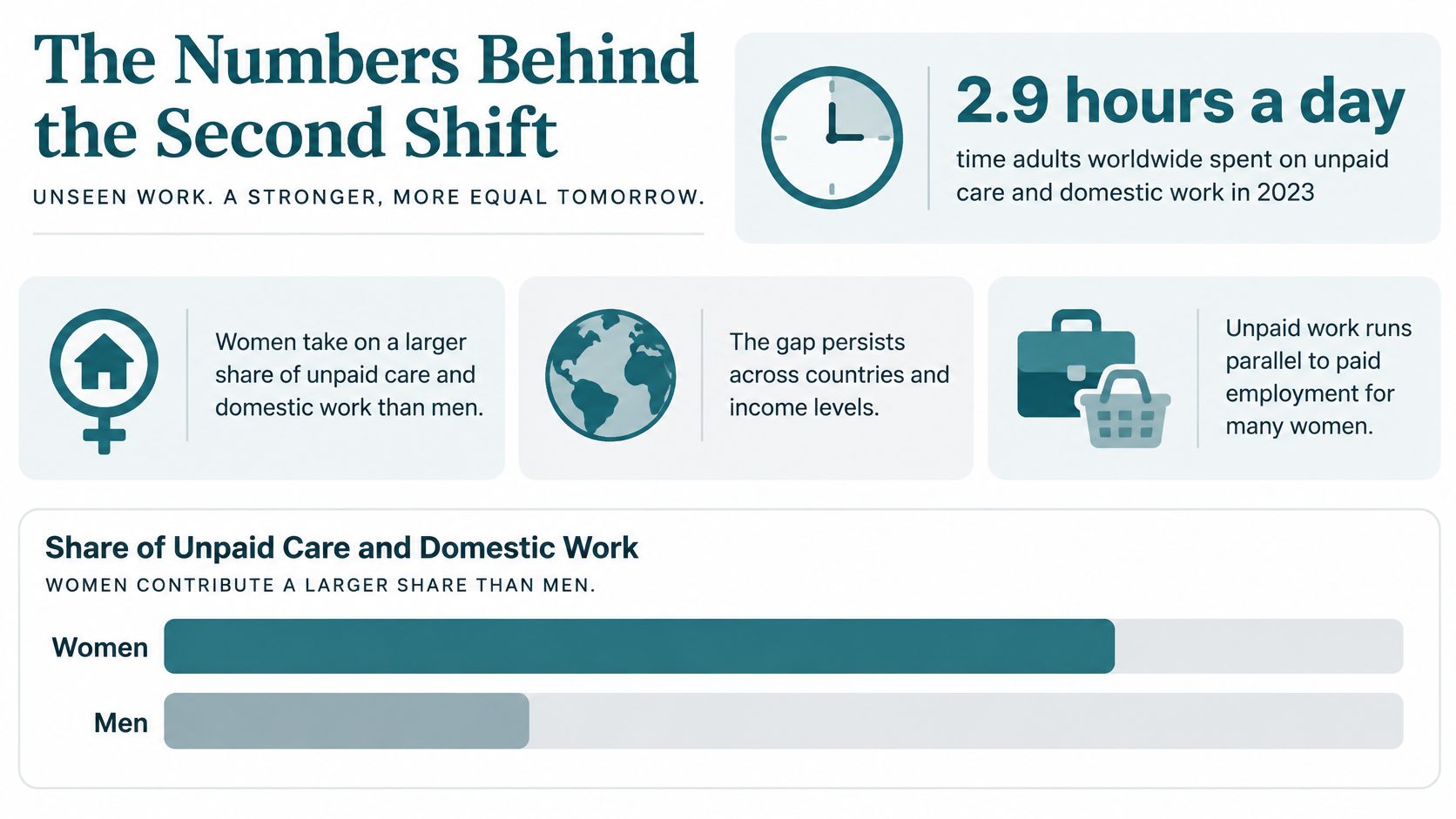
Zoom from those global averages into one country and the pattern repeats in narrower categories. In the United States in 2024, 80.4% of people engaged in household activities on an average day and spent about 2.01 hours doing them, according to the Bureau of Labor Statistics American Time Use Survey. The split inside those hours is the part worth reading twice: among people who did housework, women averaged 0.88 hours a day against 0.36 hours for men, and for food preparation and cleanup the figures were 0.86 hours against 0.46.
Why the diary undercounts the shift
A time diary logs what a person is doing at any given moment, and coordination doesn't behave that way. Planning happens in three-second bursts, in the shower, in the elevator, in the gap between two meetings. Nobody reports "I held the camp deadline in my head for eleven days."
A time diary can capture the fifteen minutes you spent booking the appointment. It can't capture the four days you spent remembering to book it.
So treat the published averages as a floor, not a ceiling. The housework gap alone comes to 0.52 hours a day. Across five weekdays that's about 2.6 hours, and that number covers one category measured only among people who did the work at all.
Do the arithmetic for your own household before you decide anything. Take the daily gap you can defend, multiply it by the days it happens, and treat the result as the budget for your first real delegation attempt. If the number looks small, you're probably measuring execution and leaving coordination out.
Mental Load and the Split Between Partners
It's 10:40 on a Tuesday morning. A pediatrician reminder pings during a budget review, the camp registration window closes at midnight, and the gift for Saturday's party hasn't been ordered. None of those items takes more than fifteen minutes. Each one has to be held in working memory until it closes.
That holding is the mental load, and it has nothing to show for it. Combine the cognitive work of noticing and planning with the physical work of executing and the emotional work of tracking how everyone is doing, and you get a job that runs in parallel with the paid one.
Who ends up running the system
Whoever carries the model of what must happen, when it must happen, and who's responsible becomes the household's default operating system. Every question routes through them, including the questions they'd rather not field.
In a 2024 study of 3,000 U.S. parents with children aged 18 or younger, mothers handled 71% of household mental-load tasks compared with 45% handled by fathers, according to the British Psychological Society's summary of the research.
Equal paid hours don't correct it. Among different-sex couples where both parents work full time, 52% say the mother performs more parenting tasks, 10% say the father does more, and 39% say the tasks are shared equally, Pew Research reports. The work-family boundary blurs along the same line: 81% of mothers say they handle parenting tasks while at work at least sometimes, including 38% who do so extremely or very often, against 17% of fathers.
Four signs you're the default operator
- You're the contact of record: the school, the pediatrician, the dentist, the camp, and the handyman all have your number saved.
- You notice the supply running out: toilet paper, inhalers, the specific snack, the shoes that now pinch.
- You're the escalation point: when plans change, the call comes to you first, even if someone else executes the fix.
- You hold the timeline: you know the deadline exists before anyone else in the house thinks to ask about it.
A test that actually works: ask your partner to name the date of the next dentist appointment without checking a phone. Whoever can answer owns that workflow, regardless of who physically drives to the visit.
Most "help" falls short. A partner who completes a task on request still leaves the coordinator holding the request, the deadline, the reminder, and the verification. The version that reduces the load takes ownership of the whole workflow: it initiates, it confirms, it closes, and it reports back when the loop is shut. Read more about how the mental load in relationships actually gets redistributed rather than just split.
For dual-career households, the measurable target isn't a cleaner house. It's fewer decisions reaching the primary coordinator and fewer open loops parked in their head at 10:40 on a Tuesday.
Five Steps to Hand Off the Second Shift
Handing off coordination is a project, not a conversation, and it works better in a fixed order. The sequence below moves a workflow from one person's head into a system that runs without them.
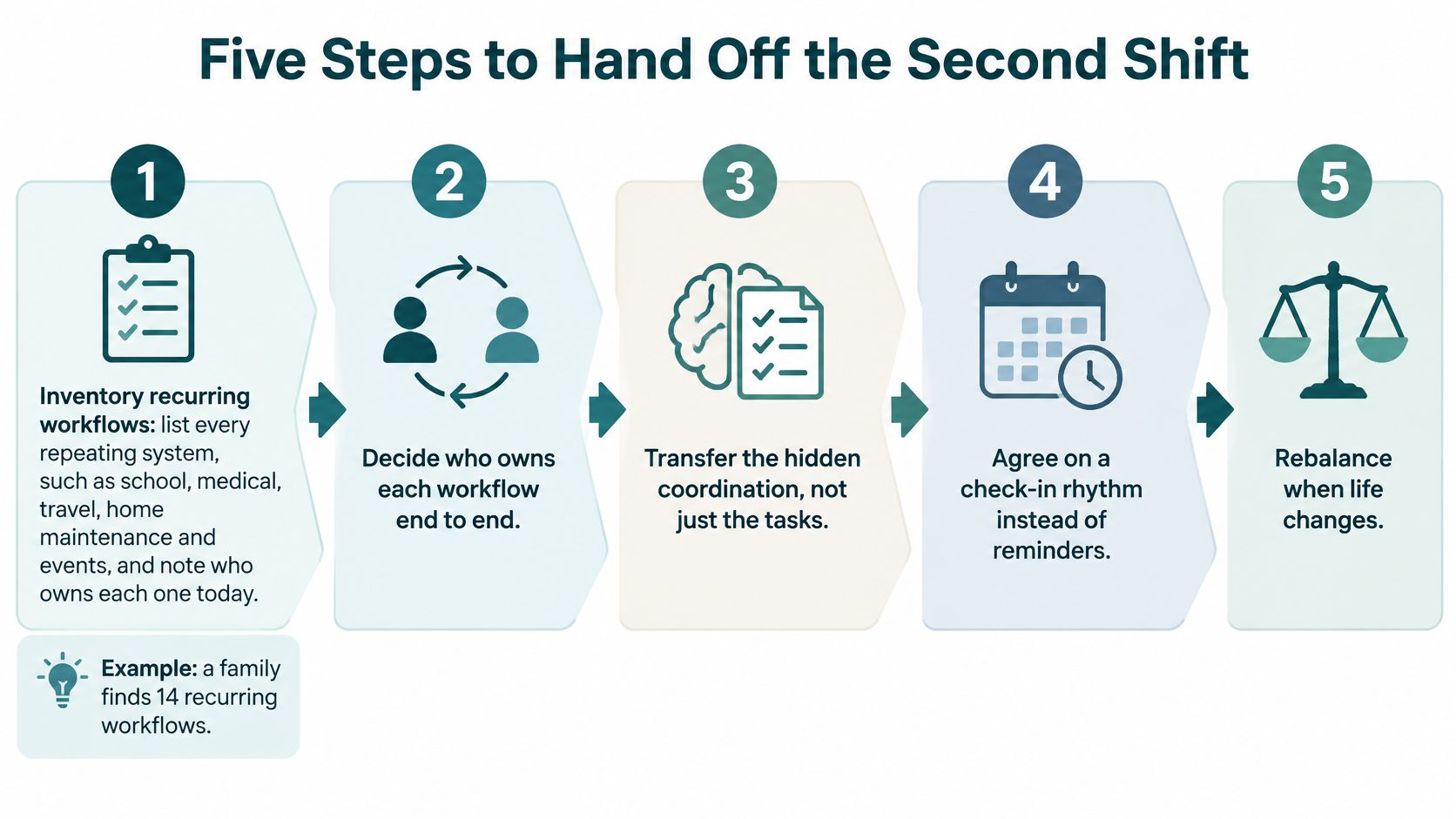
- Inventory the recurring workflows. Sit down with a list and write every system that repeats: school, medical, camps, activities, travel, home maintenance, vehicles, gifts, social calendar, elder care, pets, finances, groceries, seasonal clothing. Note who owns each one today. Say a dual-career household lists 14 workflows and finds nine owned by one parent. That's the baseline, and it's usually the first time anyone has seen the pattern in writing.
- Assign ownership end to end, not single tasks. A workflow has a first deadline and a closed follow-up, and one person should hold both ends. School enrollment means noticing the window, gathering documents, submitting, confirming receipt, and checking back. Giving someone the form to fill out transfers a step. Giving them the workflow transfers the loop.
- Mark the decisions that stay with you. Values-based choices remain in the household: which school, how to handle a conflict with a teacher, whether to change a pediatrician. Routine logistics move out. The line matters because it prevents the handoff from feeling like abdication, and it gives the person receiving ownership a clear mandate for everything else.
- Write the standing preferences once. Record the preferred vendors, budget ceilings, timing windows, and communication channel for each workflow. Answer questions like:
- Which pediatric practice, and is a same-day appointment acceptable?
- What's the ceiling on a birthday gift before someone checks in?
- Should the camp confirmation go by text or email, and to whom?
- Which weeks are fixed for travel?
Without written preferences, every request restarts from zero and the coordinator gets pulled back in to answer the same questions.
- Track reclaimed time. Log hours per week on each workflow before and after, and count open loops closed rather than tasks completed. A week that ends with three fewer follow-ups parked in your head is a result, even if the house looks identical.
For single-parent and solo households, the owner is you, and the inventory does the same work. It shows which workflows to simplify, batch, or pay to remove. If a partner resists the exercise, treat the list as a conversation starter rather than a verdict on the relationship. The subject is capacity, not blame.
Here's the short version of the method in practice.
Pick the single most painful workflow and run it as a one-week trial. Compare hours spent and interruptions absorbed at day seven. If the loop closes without you touching it, you've found a model worth repeating on the next one.
Deciding Whether to Outsource Recurring Coordination
Use a blunt test. If recurring coordination is owned by one person, its hours can be measured, and the same person is also the escalation point for everything else, an outside operating layer is worth pricing. If the work is already shared and the loops close on their own, you don't have a problem to buy your way out of.
Approved Lux Personal Assistant is one option in that category. It's a monthly subscription with a US-based Assistant team available 24/7/365 and reachable by call, text, or email, with all three channels monitored at equal priority. Lux Solo costs $99.99 per month for one person. Lux Circle costs $299.00 per month and covers up to 4 people on one account, which fits a dual-career household with children.
Know the boundary before you buy. The Assistant team doesn't act as house sitters or in-home caregivers, but it finds, vets, and schedules the people who do. Proactive Preference Learning means the service compounds over time as the team learns a household's routines, so the tenth request takes less explanation than the first.
The execution-versus-coordination distinction also shapes how you buy the chore layer. A recurring cleaner removes visible work, and providers such as cleaning services sydney show what a scheduled service contract looks like in practice. That's a good buy for execution. It doesn't touch the deadline tracking, and it won't close a single loop. If you're weighing models for the coordination side instead, this breakdown of concierge home service subscriptions covers what those arrangements typically include.
Next step: list your top five recurring workflows, mark the one that generates the most interruptions, and choose a plan based on how many people the account has to cover.
If your inventory ends with more open loops than you can close in a working week, Approved Lux Personal Assistant is built for exactly that gap: a US-based Assistant team reachable by call, text, or email at any hour, handling the scheduling, vendor coordination, and follow-up that keeps landing back on your desk. Start by naming your five most interruption-heavy workflows, then pick the plan that matches how many people the account needs to cover, whether that's Lux Solo for one person or Lux Circle for a household of up to four. Visit Approved Lux Personal Assistant to see the plans and get your first workflows handed off.