Vendor Vetting Process: A Step-by-Step Guide for 2026
Learn the vendor vetting process step by step: risk tiers, evidence checks, weighted scorecards and re-checks, with real examples for travel and home vendors.
14 min read
Longer vetting checklists don't make hiring safer. They push busy people to bypass the checks altogether. In a 2019 Dow Jones Risk & Compliance study of 250 UK procurement professionals, 50% of respondents said the time needed to vet suppliers caused organizations to cut corners just to move faster, and roughly one-third of new supplier onboarding completed over the prior 12 months was likely executed incorrectly. Even worse, 41% believed senior-level relationships influenced how thoroughly a vendor got vetted.
That same breakdown happens inside households and growing companies every week. You rush to book a contractor or travel operator on a friend's referral, skip proof of insurance, and hand over keys or itineraries before verifying anything. Then the cost arrives months later. According to IBM's 2025 Cost of a Data Breach research conducted by the Ponemon Institute across 600 organizations breached between March 2024 and February 2025, third-party vendor and supply-chain compromises carried a 267-day detection-and-containment timeline, and 29% of organizations facing an AI-related security incident traced it to a third-party software-as-a-service vendor.
A reliable vendor vetting process solves both halves of the problem. Instead of forcing a neighborhood florist and an in-home contractor through the same paperwork, you scale scrutiny to the consequences of failure, and you treat periodic re-checks and clean offboarding as part of vetting rather than optional extras.
Classify Each Vendor by Risk Tier and Stop Rule
Most vetting failures start with a single mistake: applying one universal checklist to every vendor you hire. When a dinner reservation and a key-holding home contractor sit inside the same workflow, you either waste hours collecting useless paperwork on low-stakes errands or grow impatient and rubber-stamp someone who can harm your household or business.
Research bears out how easily poorly scoped reviews stall operations. The 2026 KPMG Global Third-Party Risk Management Survey report notes that critical vendors are often onboarded within 30 days, while high- and moderate-risk relationships take even longer, with the biggest delays driven by risk-management reviews, information-security checks, background checks, and system access decisions. More diligence doesn't automatically create better protection. Heavy checks on minor jobs delay urgent work, encourage mindless box-ticking, and burn the exact hours the process is supposed to save.
Separating qualification from comparison keeps the process sharp. As the Qualityze supplier onboarding guide recommends, initial qualification should confirm baseline requirements like licensing, insurance, and compliance first, and only then should you compare response times, references, and pricing. A polished sales call or low quote should never cover up a missing license.
Four Risk Tiers Based on Consequence
Classify every vendor by the damage a failure would cause, not by how prestigious or expensive the service looks. You can assign a tier in one quick pass by writing down four facts: the service being bought, the data or physical access the vendor touches, what breaks if they fail, and whether you could replace them within a week.
Risk tier | Example vendors | Access given | Minimum evidence |
|---|---|---|---|
Critical | Home-service company with keys, payroll processor, data-hosting provider | Money, personal data, physical access to the home | Full evidence pack: ownership, license, insurance, privacy terms, continuity plan |
High | Travel operator, event planner with a guest list | Addresses, itineraries, calendars, but no keys or payments | Verified identity, insurance certificate, two verified references, privacy terms |
Medium | Florist, dry cleaner, recurring errand provider | Reversible, supervised work with limited personal details | Business registration, license where the trade requires one, one verified reference, written price |
Low | One-off restaurant booking or gift order | No personal data beyond the order itself | Business identity, recent review check, price confirmed in writing |
Resist the temptation to tag every vendor as High just to feel cautious. Inflating tiers creates an immediate backlog, forces you to skim evidence, and buries the two or three providers who hold keys, financial credentials, or private family schedules.
Practical rule: Rate a vendor by worst-case consequence, not invoice size. A $150 locksmith holding a spare house key carries far more exposure than an expensive floral order delivered to a supervised lobby.
Five Consequence Questions and Your Stop Rule
When a vendor sits near the boundary between two tiers, test them against five concrete questions: Do they touch money or sensitive personal data? Is physical safety involved? Does poor work create legal or regulatory exposure? Would a sudden cancellation disrupt daily operations? How fast can you reverse the choice if they underperform?
Compare a childcare provider against a plumber hired for one fixed pipe repair. Both enter your home, yet their risk profiles diverge sharply. A childcare provider requires criminal background checks, verified references, and safety credentials because they work unsupervised with your family. At Approved Lux, our team doesn't act as house sitters or in-home caregivers, but we find, vet, and schedule qualified people who do, applying those strict safety checks upfront. A plumber fixing a single leak while you're home needs an active trade license, valid liability insurance, and recent customer references, not a data-privacy audit or business-continuity plan.
Every tier also needs a clear stop rule: stop investigating the moment the next check can't change your decision. If a contractor's general liability policy expired three months ago and they can't produce a renewal, calling a second reference wastes fifteen minutes on a vendor you've already disqualified.
Quick Verification, Approvals, and Rejection Triggers
Before you start gathering documents, split vetting work into three operational buckets so nothing gets stuck in limbo:
- Verify quickly on your own or via delegation: Public state license registries, active insurance certificates with policy expiry dates, recent multi-platform review trends, and written price confirmations.
- Require explicit owner approval: Sharing house keys or alarm codes, sending deposits above your set dollar threshold, or approving any exception to a standard requirement.
- Reject or replace immediately: Any failed baseline requirement, refusal to provide requested proof, or two missed commitments during a single engagement.
Before you vet a single new supplier, open a simple spreadsheet and tag every vendor you currently use with one tier from the table above.
How to Run the Vetting Steps in Order
Order matters as much as thoroughness. Collecting the right documents does little good if you email your home address, travel dates, or gate code while you're still waiting for them to arrive.
That slip is remarkably common. According to Secureframe's third-party risk statistics, only 36% of surveyed organizations evaluate all vendors before sharing sensitive information. Once private details leave your inbox, you can't pull them back if a vendor fails a basic check two days later.
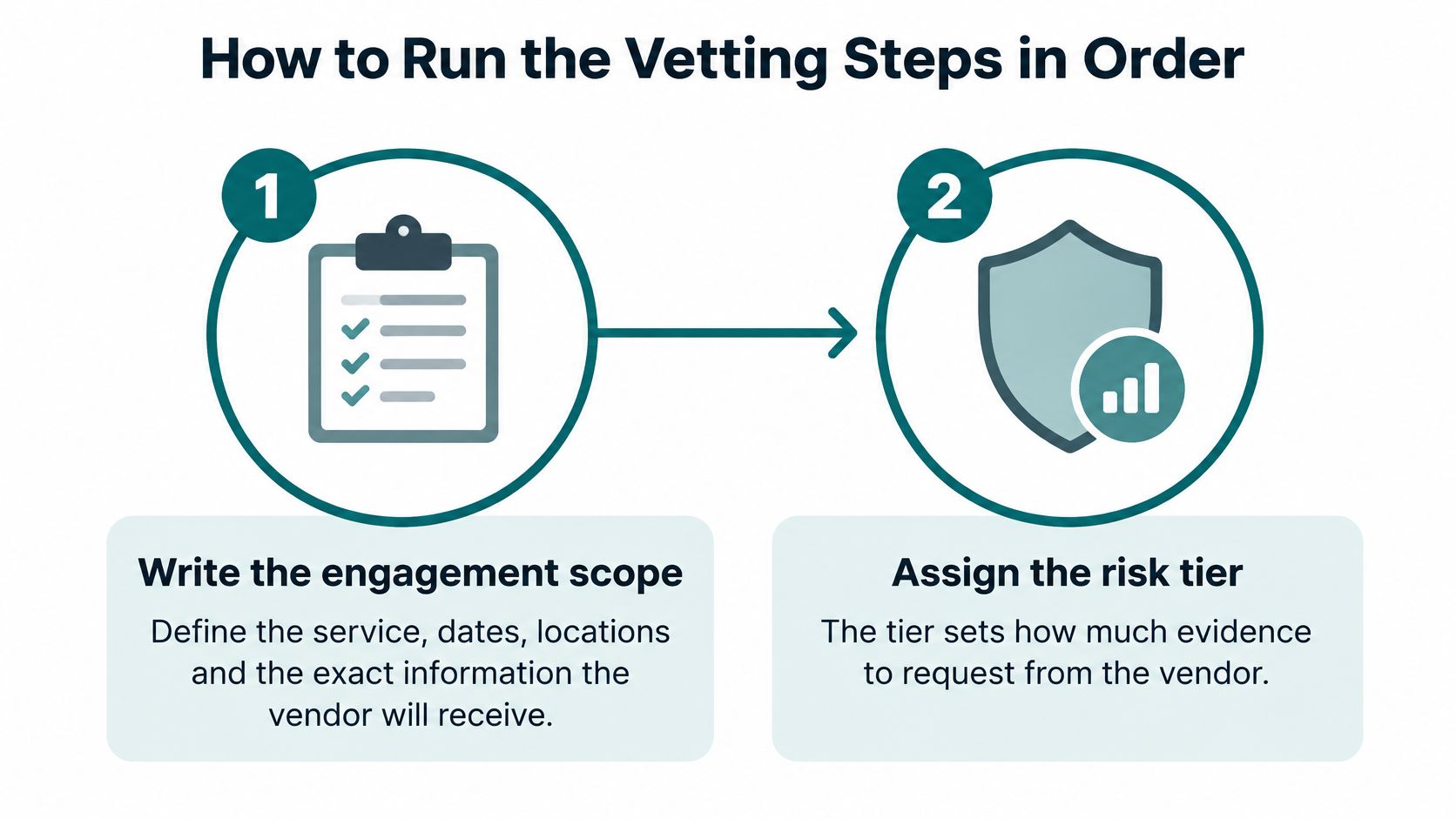
The diagram below shows how the sequence starts before any outreach or data sharing takes place.
Seven Steps in Strict Sequence
Follow these seven steps in order for every Medium, High, and Critical hire, skipping no gate before moving forward. The depth of each step scales with the tier, so a Medium vendor never absorbs the time a Critical one deserves, and a Critical one never slips through on a Medium's lighter standard.
- Write the engagement scope. List the exact service, target dates, locations, and every piece of personal or business information the vendor will need to do the job. Keeping scope tight upfront stops accidental oversharing later.
- Assign the risk tier. Match that scope to the tier table so you know exactly which documents to ask for before contacting the vendor. You avoid asking a dry cleaner for a continuity plan or forgetting privacy terms for a travel planner.
- Request the proportionate evidence pack. Ask for the vendor's legal business name, ownership details, business registration, trade license where required, certificate of insurance with its expiration date, and written privacy or confidentiality agreements when personal details are involved. Send one consolidated request so the vendor responds in a single pass.
- Verify identity independently. Look up the business registration on the state registry yourself rather than trusting a PDF letterhead, and confirm insurance coverage by calling the insurer's main public number, never a phone number printed on the vendor's quote. For High and Critical hires with home or executive access, pairing registry checks with OSINT sources for HR screening from Digital Footprint Check helps surface public litigation, alias mismatches, or adverse media that self-reported forms leave out.
- Call independently sourced references at the tier's depth. Medium hires get one verified reference, High and Critical hires get two. Skip the hand-picked testimonials on a website and find past clients through local groups or verified directories, then ask three direct questions. Did the team show up on time, did the final invoice match the original quote, and how did they handle something that went wrong?
- Apply explicit pass or fail gates. Confirm five conditions before approval: verified identity and ownership, independently confirmed references, documented proof rather than verbal assurances, an assigned owner and deadline for any open medium risk, and data access restricted to the bare minimum. At Approved Lux, every request is handled by a US-based person on our team, which keeps those pass/fail checks consistent instead of letting details drop between anonymous ticket queues.
- Log the decision in one line. Record the vendor name, approval outcome, primary reason, approver's name, and next re-check date in your central file so you aren't relying on memory six months later. That re-check date matters more than anticipated, because an insurance certificate that passes today can lapse next quarter, and step 7 is what turns vetting from a one-time event into a standing control.
The single mistake that breaks vetting most often is sending an address, calendar invite, or door code right after step 3 to "save time" while references and insurance are still pending.
Hold all access details until step 6 clears completely. If a vendor pushes you to share keys or payment credentials before returning basic paperwork, treat the urgency itself as a warning sign.
For a quick walkthrough of how structured due diligence prevents costly vendor surprises in practice, watch the overview below.
Scoring Vendors with a Weighted Scorecard
Once two or three vendors pass baseline qualification, gut instinct becomes a terrible tie-breaker. The slickest salesperson or the cheapest estimate usually wins, even when their cancellation policy is rigid or their backup coverage is nonexistent.
A weighted scorecard replaces hunch-based picking with a simple, repeatable calculation. Start by assigning fixed weights to five criteria so every candidate gets judged on the same terms.
Criterion | Weight | What to verify |
|---|---|---|
Security and privacy | 30% | Access controls, data handling terms, subcontractor disclosure |
Reliability and continuity | 25% | On-time record, backup plan, business-continuity evidence |
Service quality | 20% | Verified references, review trends, responsiveness to questions |
Financial and legal | 15% | Ownership, license, insurance certificate, sanctions and adverse-media screen |
Commercial fit | 10% | Written price, cancellation terms, value against the defined scope |
How to Calculate Scores and Apply Decision Bands
Drawing on the Oxalys supplier-assessment workflow, score each criterion on a 1-to-5 scale, divide each rating by 5, multiply by that row's weight, and add all five results for a clean total out of 100. For example, a 4 out of 5 on Reliability and continuity (25% weight) earns 20 points.
Tie the final number to four preset decision bands so nobody argues over borderline candidates:
- Above 85: Approved for immediate engagement.
- 70 to 84: Approved with a written improvement plan addressing specific weak rows.
- 50 to 69: Conditional approval only if named safeguards or restrictions are met first.
- Below 50: Rejected without further negotiation.
You can tilt those weights to fit the job's risk profile. Keep Security and privacy at 30% or higher for Critical and High vendors touching personal schedules, home access, or financial records, and shift weight toward Commercial fit and Service quality for Medium or Low purchases where data exposure is minimal.
Knockout Criteria and Side-by-Side Comparison
Weighted averages come with one hard guardrail: knockout criteria override the total score every time. Missing required liability insurance, failing a sanctions or adverse-media check, or refusing a critical security requirement triggers automatic rejection, no matter how high the other four rows climb.
Say you're comparing two residential cleaning services. Vendor A holds spotless five-star reviews, answers texts in five minutes, and quotes 20% less than competitors, scoring 88 overall, yet they can't produce an active general liability certificate. Vendor B quotes slightly more and scores 82, with verified insurance, background-checked staff, and clear breakage terms. Vendor A gets rejected on the spot because a great price never offsets uninsured property damage.
Putting two or three finalists side by side on identical scorecard rows also builds trust and accountability in vendor relationships from day one. When a partner or family member asks why you picked a higher-priced contractor, you point to the exact rows that earned the win. Build a one-page template with these five rows and three knockout checks before your next vendor call.
Monitoring and Re-Checking Vendors After You Hire
Approving a vendor feels like the finish line, yet most operational failures begin months after onboarding. Insurance lapses, a reliable lead technician quits, ownership changes hands, or a company starts handing your job off to unvetted subcontractors.
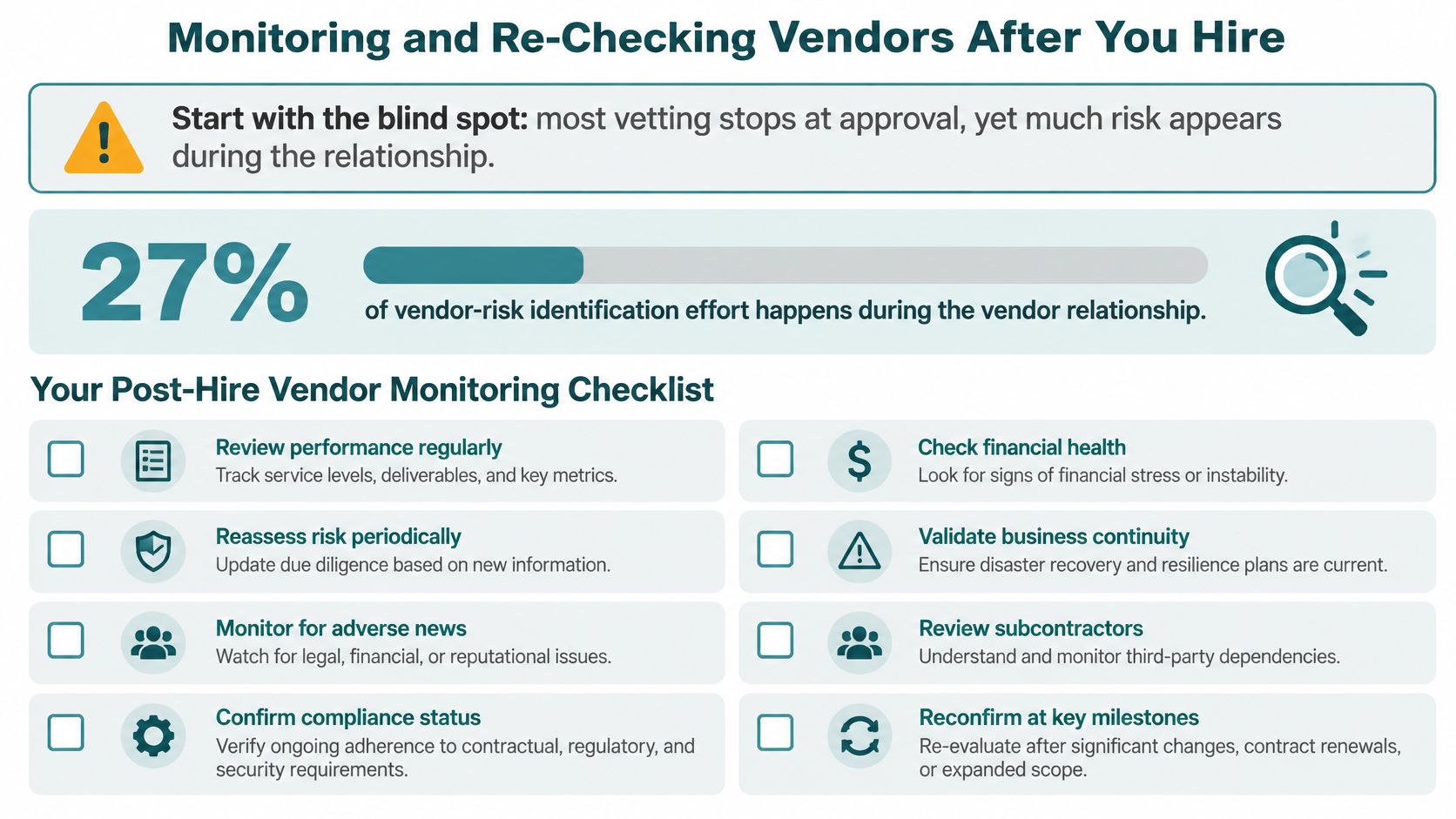
Benchmark numbers show how wide that blind spot really is. According to a third-party risk management statistics benchmark, 27% of vendor-risk identification effort occurs during the ongoing relationship rather than at initial onboarding, and 83% of legal and compliance leaders reported identifying vendor risks only after due diligence was already finished. Worse, gaps often survive from day one. The 2026 KPMG Global Third-Party Risk Management Survey reports that 60% of organizations wait four months or longer for vendor responses during assessments, and only 16% complete 90% to 100% of required remediation before onboarding.
The checklist below highlights why ongoing oversight belongs inside the vetting lifecycle rather than in a forgotten folder.
Re-Check Cadence and Event Triggers
You don't need constant surveillance to stay protected. Match review frequency to the risk tier so high-consequence relationships get scheduled calendar checks while minor vendors only trigger attention when something changes.
Risk tier | Full re-check | Light review |
|---|---|---|
Critical | Every 12 months and after any incident | Quarterly check of SLA performance, complaints and insurance expiry |
High | Every 12 months | Semiannual review of complaints, missed commitments and insurance |
Medium | Every 24 months or after any trigger | Annual check of review trends and license status |
Low | Only when a problem occurs | Price and outcome check at each use |
Between scheduled reviews, specific event-based triggers should force an immediate re-check regardless of calendar dates:
- Credential and corporate shifts: Insurance policy expiration, change in business ownership, a new subcontractor touching your work, or any legal or regulatory action.
- Performance slippage: Repeated missed deadlines, unexplained price hikes outside your written terms, a sudden dip in customer reviews, or any safety incident.
- Scope creep: Any request for broader data access, new system logins, or expanded physical entry to your property.
Good monitoring optimizes for decision usefulness, not paperwork volume. One calendar alert thirty days before an insurance policy expires prevents more headaches than a forty-question annual survey nobody reads.
Keeping clean historical records makes those checks painless. At Approved Lux, member preferences and vendor history stay stored directly with the account, so whichever US-based Assistant picks up a request already knows how you like work handled and what standards a vendor agreed to meet.
Offboarding and Five Metrics Worth Tracking
Ending a vendor relationship is where sensitive access lingers longest. The same benchmark shows only 47% of organizations track risks at termination, just 38% remediate them, and 39% do nothing at all.
Run a seven-point exit checklist whenever you drop a High or Critical vendor: revoke logins, gate codes, and physical keys; confirm return or deletion of personal data; cancel recurring billing or auto-renewals; transfer service records or warranty files; reconcile open jobs; validate the final invoice against quoted rates; and get written closure confirmation from the vendor.
To separate vendors who merely look credible during hiring from those who steadily cut operational noise, track five simple metrics alongside your vendor management best practices: incident rate per vendor, SLA breach rate, remediation aging (how long open issues sit unresolved), percentage of evidence refreshed on time, and time from risk discovery to closure.
Build Your First Vetted Vendor File This Week
Don't try to overhaul every service provider you've ever hired in one sitting. Pick the three recurring vendors you rely on most right now, specifically the ones touching your home, travel logistics, or weekly calendar.
Open a single document or spreadsheet and write one row per vendor using six fields:
- Vendor name (legal business name and primary contact).
- Risk tier (Critical, High, Medium, or Low).
- Evidence already on file (license number, active insurance certificate, signed scope).
- Evidence still missing (for instance, unverified references or missing privacy terms).
- Next re-check date (set to the earliest credential expiry date or annual mark).
- Approver (the exact person authorized to renew, expand access, or replace them).
Here is what one finished line looks like in practice: Northstar Home Maintenance | Critical | Active license verified, COI on file expiring in four months | Two independent references pending | Re-check set for insurance expiry date | Household owner. Filling out three rows like that takes twenty minutes and immediately exposes which critical relationships are running on assumption instead of proof.
Decide Who Runs the Next Vetting Task
Once those three lines are written, make a deliberate choice about who executes the follow-up. You can run license lookups, insurer verification calls, reference interviews, and expiry tracking yourself, or you can delegate that groundwork while keeping final approval authority in your own hands.
A dedicated Assistant team can research and shortlist candidates, read and synthesize customer reviews, negotiate pricing, and keep re-check dates current without adding payroll overhead. Keep scope boundaries clear when delegating: our team at Approved Lux doesn't provide legal, medical, tax, or financial advice, though we research and shortlist licensed professionals who do. Getting that workflow off the ground doesn't require weeks of setup either, since Lux Solo includes a dedicated onboarding intake designed to capture your preferences and access standards before the first request goes out.
Set a firm deadline for Friday: hold a completed one-line record for your top three recurring vendors, flag any missing insurance or reference proof, and assign the next vetting step deliberately instead of letting it slide by default.
If you'd rather keep final approval on every vendor while handing off the research, review synthesis, price negotiation, and re-check reminders, Approved Lux Personal Assistant gives you 24/7 access to a US-based human Assistant team via phone call, SMS text, or email. We run the legwork to find, vet, and schedule reliable household, travel, and business providers while keeping your preferences and vendor records organized in one place, so you reclaim hours every week and cut operational noise for good.