Travel Itinerary and Budget Template: A Step-by-Step Guide
Learn how to build a travel itinerary and budget template with real examples, buffer rules, contingency math and a plan for handling mid-trip changes.
11 min read

About 1.4 billion international overnight tourists traveled in 2024, up 11% from 2023 and back to roughly 99% of pre-pandemic levels, according to UN Tourism. At that scale, a reservation list isn't enough preparation. You need to know what you've committed, what you'll probably spend, and what you'll do if a connection or booking falls apart.
A useful travel itinerary and budget template answers those questions before you're standing at an airport counter. Build it as a decision tool, not just a trip total.
What a Working Travel Template Tracks
A working template has three linked tabs: Itinerary, Budget, and Disruption Log. Give each movement or reservation a unique booking ID, then use that ID wherever its cost or recovery plan appears. You shouldn't have to guess which hotel charge belongs to which overnight stay.
Start with the itinerary because costs need a date, destination, and traveler. Add the budget next, then attach recovery instructions to the transport legs and reservations that could affect the rest of the trip.
Tab | What belongs there | Connection to the other tabs |
|---|---|---|
Itinerary | Movements, appointments, lodging, meal breaks | Booking ID and budget category |
Budget | Estimates, commitments, payments, forecast | Booking ID and travel date |
Disruption Log | Alternatives, decision owner, extra-spend authority | Affected booking ID |
Separate fixed costs from variable costs. A booked fare may establish your transport commitment, while meals and local travel continue changing with your choices. Fixed doesn't mean risk-free: changing a prepaid booking can still create another expense.
Make destination, currency, and travel dates required fields. A lodging estimate without its currency isn't ready for a spending decision, and a transport estimate without a date isn't ready for booking.
First action: Open a blank Google Sheets or Excel workbook, create the named tabs, and enter the trip dates, travelers, and reporting currency in a header block.
Use consistent traveler names throughout. A shared booking should identify everyone covered so you don't accidentally budget the same room again for another traveler.
Set Up the Budget Columns and Category Lines
Category lines for a $4,000 international trip
Category | Planned (USD) | Priority when over budget |
|---|---|---|
Airfare | 1,200 | Protect first |
Lodging | 1,000 | Protect first |
Food | 600 | Flex lever (discretionary dining) |
Local transportation | 350 | Trim second |
Activities | 200 | Flex lever |
Insurance | 150 | Protect first |
Visa or entry | 100 | Protect first |
Communications | 100 | Trim second |
Taxes and exchange-rate variance | 300 | Hold as a category line |
Total | 4,000 | Keep forecast within the approved ceiling |
This illustrative allocation follows the expense categories in the University of Colorado's travel-budget guidance, which includes transport, accommodation, food, entry costs, insurance, communications, taxes, and exchange rates. It isn't a destination quote or a recommended spending ratio.
Build columns that don't double-count
Set your maximum trip budget first, then distribute it among the category lines. Beside each line, add:
- Planned cost: Your initial allocation.
- Committed cost: The full amount you're obligated to pay once booked, including any unpaid balance.
- Actual cost: The expense incurred, reconciled against receipts.
- Variance: Latest forecast minus planned cost. Positive means over plan.
- Remaining balance: Show both uncommitted funds and forecast headroom at the trip level.
Don't add committed and actual costs together when they describe the same purchase. Instead, build a forecast using actual costs for completed items, committed amounts for outstanding bookings, and estimates for unbooked items.
Add supporting fields for currency, exchange rate, taxes, service or resort fees, baggage, transfers, and cancellation exposure. Mark whether each charge is already included in the booking total. Our travel budget planning guide can help you organize the spending decisions before booking.
Set priorities, not rigid percentages
A tourism expenditure study of 20,574 international visitors found accommodation and shopping relatively inelastic, while food, transportation, and other expenses were more price-sensitive. That describes spending behavior, not an instruction to protect shopping.
Protect essential airfare, lodging, insurance, and entry requirements first. Use optional activities, shopping, and discretionary dining to balance your own forecast. If a guided experience is a priority, use Northern Spain Travel to compare private tour costs in Europe, then record the quote's inclusions rather than comparing headline prices alone.
After booking the example airfare, move its allocation into committed cost and recalculate immediately. Uncommitted money isn't spare money if the rest of the trip still needs funding.
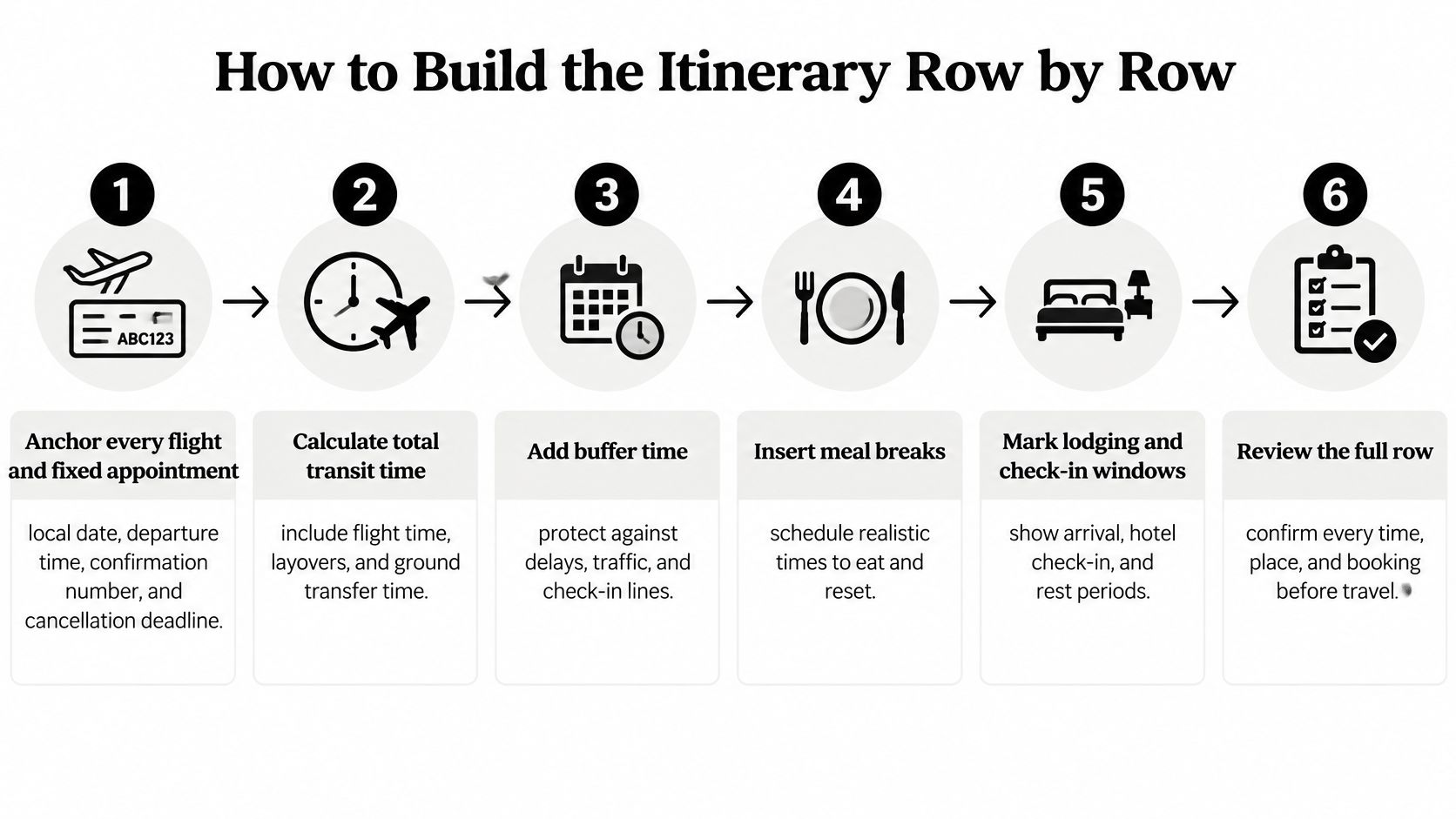
How to Build the Itinerary Row by Row
- Anchor flights and fixed appointments. Enter the local date, departure or start time, confirmation number, and cancellation deadline. These commitments establish what everything else must fit around.
- Calculate door-to-door time. Include check-in, security, walking, baggage collection, and ground transfers, not just time aboard the aircraft or train.
- Insert realistic buffers. Meet the documented connection or ground-transfer requirement, and leave a recovery block after overnight travel. Don't substitute optimism for the operator's requirements.
- Group nearby activities. Put geographically close visits together, with meal breaks and lodging check-in windows included. Crossing town is a movement that needs its own row.
- Run a daily feasibility check. Check overlaps, opening hours, time-zone changes, luggage storage, and access restrictions.
- Flag overloaded days. As an editorial review rule, highlight days with more than two major timed commitments, plus any transfer below its documented minimum. A flag means review, not automatic cancellation.
Use this visual checklist while entering the schedule.
Give every movement its own row
Use these fields: date, start, end, location, transport mode, transfer duration, buffer, traveler, dependency, confirmation number, and cancellation deadline. Put the exact station, terminal, or street address in the location cell rather than only the city.
Diary-style travel records capture places, transport modes, and timing, an approach discussed in the Bureau of Transportation Statistics journal's travel-survey methodology. Apply that same specificity before departure: each row should describe something a traveler can follow.
A dependency tells you what must happen first. Hotel check-in may depend on train arrival and a station transfer; dinner may depend on checking in and leaving luggage. For activity combinations, use our travel itinerary ideas as starting points, then check the movements yourself.
Test a travel day
Say your hypothetical Lisbon-to-Porto schedule allows about three hours aboard a train, a 45-minute arrival buffer, and dinner at 7:30 pm. Those are scenario assumptions, not a published timetable.
Once you add the station-to-hotel journey, check-in, and time to change, you move dinner to 8:30 pm. Verify the actual train and restaurant availability before booking.
Zero-buffer connections, distant back-to-back reservations, and missing recovery time are the mistakes to catch. Test the finished itinerary: can you explain each row's timing and location without opening another tab?
Use the video alongside your completed draft for another planning review.
Add Contingency and Hidden-Cost Lines
Contingency reserve by planned trip cost
Planned trip cost | 10% reserve | 15% reserve | Working budget range |
|---|---|---|---|
$1,500 | $150 | $225 | $1,650 to $1,725 |
$3,000 | $300 | $450 | $3,300 to $3,450 |
$4,000 | $400 | $600 | $4,400 to $4,600 |
$6,000 | $600 | $900 | $6,600 to $6,900 |
These illustrative amounts apply Minster Bank's cited recommendation to reserve an additional 10% to 15% of total trip cost. The calculation is contingency = estimated cost × 0.10 or 0.15; on a planned $3,000 trip, that creates a $300 to $450 reserve and a $3,300 to $3,450 working budget.
If your absolute spending ceiling can't accommodate that reserve, reduce the base itinerary. Don't label money as contingency when you've already allocated it to something else.
Record the payable price
Build explicit lines for mandatory fees, taxes, resort or destination charges, baggage, seat selection, airport transfers, and payment fees. Also record dynamic-price exposure and the conditions attached to a quote.
Hidden or unexpected fees were the top booking frustration for 61% of travelers in Fullstory's travel and hospitality survey. Your template should make those charges visible before checkout, not after you've mentally committed to a purchase.
For each major booking, distinguish:
- Known total: The verified payable amount, with included charges identified.
- Potential add-ons: Unselected or conditional charges that might apply.
- Worst-case total: A defined adverse scenario, including relevant change or cancellation exposure.
A worst-case total isn't an unlimited disaster estimate. State the scenario, such as replacing a missed separately ticketed flight, and record when you verified the price and terms.
Separate cash flow from risk
Add fields for deposit due, balance due date, refund deadline, and refundable amount. A booking can be committed now without requiring full payment today.
A cheaper booking isn't automatically the safer financial choice. Compare what you'd lose or need to replace if the plan changes.
Separate tickets and nonrefundable reservations can shift more recovery responsibility onto you. A refundable alternative may justify its higher initial price when it protects an important appointment or uncertain travel date.
Keep contingency separate from the taxes and exchange-rate category. Known taxes belong in the forecast; the reserve covers uncertainty beyond what you've already allowed. Shopping and entertainment shouldn't consume it either.
Finish with a decision range: committed cost, probable cost, and disruption reserve. Probable cost is your forecast, not an extra amount to add on top of commitments.
Write a Disruption Playbook for Each Leg
In Perk's business-travel disruption survey, 56% of business travelers experienced a delay longer than an hour in the prior 12 months, 36% experienced cancellations, and 26% missed connections. A confirmation number doesn't tell any of those travelers who should act or how much they may authorize.
Build the recovery instructions while you're calm, have internet access, and can compare alternatives. Record the decision owner, not just a customer-service number.
A disruption row should support the kind of live coordination shown below.

Build a usable fallback
Consider a hypothetical 75-minute connection in Denver, with a possible backup nonstop about 90 minutes later. These are planning assumptions, not verified schedules or a claim that the connection is sufficient.
Playbook field | What to enter for the scenario |
|---|---|
Connection requirement | Documented minimum, terminals, and your additional buffer |
Backup route | Verified nonstop departure, destination, availability, and price-check time |
Rebooking channel | Airline app, followed by the booking agent or airline support if needed |
Hotel fallback | Airport-area property with current availability and cancellation terms |
Ground alternative | Rideshare pickup location and an acceptable alternative |
Action deadline | Time by which rebooking must preserve the next essential commitment |
Decision owner | Named traveler or Assistant, with an approval contact |
Label each affected booking flexible, changeable for a fee, or effectively locked, after checking its terms. Record any fare difference separately from a change fee so nobody mistakes permission to change for permission to spend freely.
Set authorized extra spend per disruption. For example, you might hypothetically authorize $250 for same-day rebooking, with your approval required above that amount; this is your chosen limit, not a recommended industry threshold.
Specify whether that authority covers transport alone or includes lodging and meals. Our travel emergency assistance guide can help you distinguish logistical recovery from situations requiring emergency services.
Put a value on uncommitted time
A packed prepaid schedule leaves fewer affordable recovery choices. Compare the cancellation exposure of the next activity, the expense of preserving it, and whether rescheduling would still achieve the trip's purpose.
For a festival-centered Kyoto day, for example, use Jasumo to find Jidai Matsuri parade viewing spots, then verify current event arrangements before locking in nearby transport and dining. A specific viewing location belongs in the itinerary because it affects the day's movements.
Leave time uncommitted when protecting the whole trip matters more than filling another slot.
In the disruption log, record the delay, missed commitment, replacement expense, and outcome. Business travelers should also record lost work time so the eventual review captures more than receipts.
Fill in a playbook row for your next transport leg now. If the backup depends on availability you haven't checked, mark it unverified, not ready.
Decide When to Hand Off Changes to Your Assistant
Keep predictable work in the template. Escalate changes that require a live decision across connected bookings. Updating receipts, checking a deadline, and comparing prices are manageable spreadsheet tasks. A midnight cancellation, a missed connection, or a same-day hotel replacement calls for someone who can coordinate actions while you keep moving.
A high-demand restaurant request in an unfamiliar city can also justify delegation, especially when you need alternatives that fit the location and schedule. The useful handoff isn't just a request to fix dinner. It states the constraints and the decision you need.
Send a decision-ready handoff
Give your Assistant enough context to act without a chain of clarification messages:
- Travelers and references: Names as booked, confirmation numbers, and affected itinerary rows.
- Timing: Original and proposed times, cancellation deadlines, and the decision deadline with its time zone.
- Spending authority: Overall budget ceiling, extra-spend cap, and who approves an exception.
- Nonnegotiables: The meeting, arrival deadline, accessibility requirement, or traveler arrangement that can't move.
- Flexible elements: Acceptable alternative airports, lodging areas, transport modes, or dining times.
- Communication preference: Where to send options and whether you want a recommendation or action within preauthorized limits.
Avoid sending passwords or payment credentials in an ordinary itinerary message. Share the booking details needed for the task and follow the agreed access process for anything sensitive.
Choose the channel that fits the moment
At Approved Lux, Triple-channel access means we monitor phone calls, text messages, and email at equal priority. Call when talking through a moving situation is easiest, text when you're in transit, or email when the handoff needs supporting documents. Our US-based Assistant team provides human judgment, while Proactive Preference Learning helps us apply your established preferences over time.
On Lux Traveler, you can hand a mid-trip problem straight to our Assistant team. Lux Solo and Lux Circle both include travel, scheduling, errands, and research; a 7-day Lux Solo trial costs $9.99, after which the plan becomes $99.99 per month.
Choose the starting point that removes today's friction: build the template if you need clarity first, or start the trial if you've already got planning and follow-ups waiting for an owner.
Approved Lux Personal Assistant offers full itinerary building with backup options, booking changes, and human support for travel coordination. Visit Approved Lux Personal Assistant to start the Lux Solo trial, and bring your trip dates, spending ceiling, and fixed commitments so our Assistant team can help turn them into an actionable plan.