Tips for Frequent Business Travelers: 8 Ways to Save Hours
Tips for Frequent Business Travelers that reclaim hours: 8 practical strategies for disruptions, packing, ground transport, and expenses in 2026.
13 min read
You land at 9:50 p.m. The connection is already gone, the hotel hold dies at midnight, and the client breakfast is still sitting on a calendar set to home time. You spend the next hour rebuilding a trip you finished yesterday.
That night is repeatable friction, not a one-off disaster. Rebooking, a car, a room change, a note to the client, and a receipt you will chase next week all steal the same hours. The Global Business Travel Association's 2024 Business Travel Index put global business-travel spending at $1.48 trillion, above the 2019 record of $1.43 trillion, and projected spending past $2 trillion by 2028. At that volume, a late text is an operating condition.
These tips for frequent business travelers are eight levers across the trip, not a packing sermon. Before you leave, you cut the checkpoint and lock a profile. When a flight breaks, you run a playbook. On the ground, the car and the dinner are already chosen. After you get home, the report and the next brief are already closed. Cabin choice is a separate call, including when business class beats coach. The payoff below is decisions you stop making, measured in hours you get back.
1. Enroll in Trusted Traveler Programs to Cut Airport Time
Say you fly about 60 times a year. If each departure costs you an extra 20 to 30 minutes in a standard security line, you are giving up a full workweek to a queue. TSA PreCheck and CBP Global Entry don't change what you pack. They change which lane you stand in, because you were vetted once.
A consultant coming back from a European client week clears U.S. customs at a Global Entry kiosk instead of a standard arrivals line. That is the return leg, where fatigue is highest and a missed car is most expensive. Enrollment is a one-time setup. Renewal, the interview slot, and the number on the booking are the part people drop.

Approved Lux keeps the membership number on the shared profile and tracks the renewal date so check-in isn't the moment you discover it lapsed.
What to lock in before the next ticket
- Fee first: Check whether a card or airline program already reimburses the application before you pay it yourself.
- Known Traveler Number: Enter it in the airline profile and confirm it prints on the boarding pass, not only in the app.
- Ninety-day reminder: Set it before expiration and have the Assistant team book any interview.
- Shared profile: Add the number once so every booking carries it.
Practical rule: If the number isn't on the boarding pass, you don't have the lane.
Hours back: roughly 20 to 30 minutes per departure, which is many hours a year once you are past two flights a month, plus one less decision at every checkpoint.
2. Build a Midnight Disruption Playbook for Flight Changes
A management consultant's connection dies at 11:40 p.m. The text hits at the gate. Corporate travel is closed. The useful move isn't “search any flight.” It's a pre-ranked recovery: morning nonstop, approved airline, hotel if the first bank is gone, expense code already set. The Assistant team rebooks and sends the confirmation before the traveler reaches the hotel.
Booking.com for Business, citing U.S. Bureau of Transportation Statistics, reports that only 78.53% of domestic U.S. flights arrived on time between December 2023 and December 2024, and 1.29% were canceled. On a multi-airport month, that is a schedule you plan for. Triple-channel access means you call, text, or email from the jet bridge, and all three reach a US-based Assistant team. A sales lead can take the cancellation by phone in a client meeting and get the revised itinerary by email within the hour. For the wider failure modes, use this travel emergency assistance checklist, and treat irregular nights the way an Optimal Native guide to shift rotations treats a broken shift: decide the fallback before you are tired.
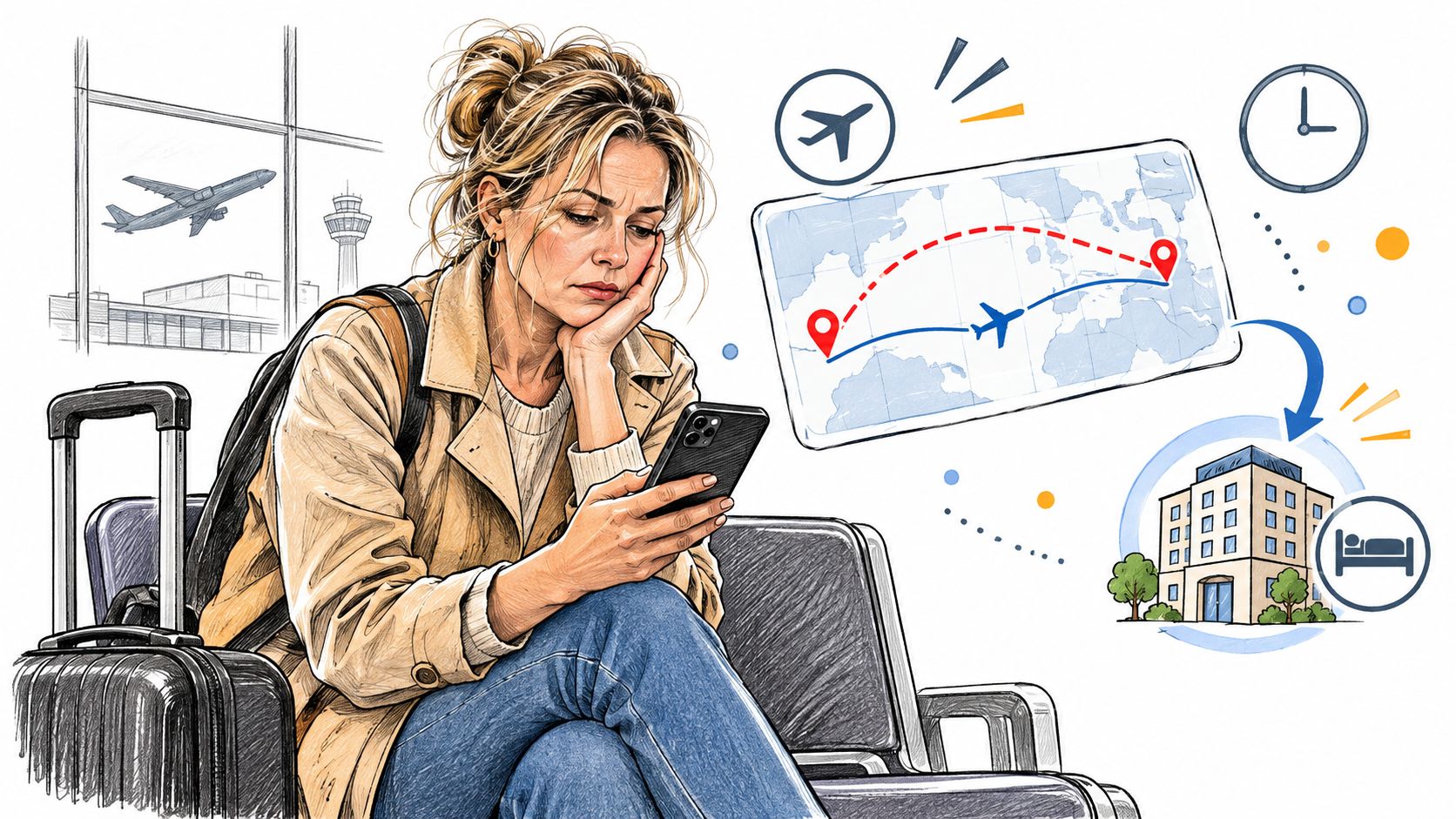
Write down three airports you will use on each regular route and rank them. Store loyalty numbers and alliance preferences so the new ticket stays inside your status. Note whether you will take a later departure or a higher fare. Confirm the disruption expense code so receipts don't wait for Monday.
Hours back: the one to two hours you would spend rebuilding a trip after midnight, and the client meeting you don't miss because the decision tree already existed.
3. Maintain a Single Travel Profile for Airlines, Hotels, and Ground Transport
Most “travel problems” are data problems. The passport spells the name one way, the card another, and the boarding pass gets rejected. A loyalty number lives in a notes app. Seat and room preferences get retyped every trip.
A single profile holds the legal name as printed, every loyalty number, cabin and seat choice, room rules, and ground-transport defaults. Proactive Preference Learning means the Assistant team updates those defaults as a pattern shows up, so month six doesn't start with the same aisle-seat request.
The GBTA Foundation found that roughly one-third of business travelers in Germany, France, and the United Kingdom said their organizations did not provide an assistance hotline, and about half agreed that booking outside company channels could affect safety because the company could not locate them. A profile that feeds the company record is a safety control, not a convenience file.
Keep the file boring and current
- Passport check: Match the profile to the passport before the first trip of the year.
- Every number: Record loyalty IDs you rarely use. Partner benefits often depend on them.
- Non-negotiables apart: Quiet room, accessible transport, and early checkout sit in their own line, not inside “nice to have.”
- Quarterly pass: Review after any alliance or hotel-brand change.
A name mismatch is cheaper to fix in January than at a kiosk.
Hours back: the re-entry you skip on every booking, and the rejected pass you don't spend an hour fixing at the counter.
4. Adopt a Carry-On-Only Packing System for Frequent Trips
Checked bags fail at the worst moment: a gate change to an earlier flight, and you are still waiting on a carousel. A carry-on-only system removes that wait, the lost-bag chase, and most baggage fees. It only works if packing is a kit, not a fresh decision.
A consultant on three-day client rotations uses one list and finishes in about 15 minutes. Clothing changes. The kit does not. Modular cubes, a capsule that works in three client settings, and a standing pouch of travel-size items stay in the bag between trips. The Assistant team keeps the list, reorders what runs out, and flags a dinner that needs a jacket or a badge you would otherwise remember at 11 p.m.
This walkthrough is worth ten minutes before you rebuild the kit:
The kit, not the closet
- Standing pouch: Toiletries and chargers stay packed. Only clothes move.
- One capsule: Build it for three or more client settings so you aren't choosing outfits per city.
- Restock on a cadence: Have consumables reordered before the bottle is empty.
- Dress code at booking: Weather and formality get checked when the trip is held, not the night before.
If you can't grab the bag and leave, the system isn't finished.
Hours back: about 45 minutes of packing you don't repeat, plus the connection you still make because nothing is in the hold.
5. Pre-Arrange Ground Transport with Time Zone and Buffer Logic
The flight can be fine and the trip still breaks at the curb. A rideshare that never pins your terminal, a driver booked to the scheduled arrival, or a rental line that eats 40 minutes will burn the only slack you had.
Say you land at 9:50 p.m. The driver is already booked with a 30-minute buffer after scheduled arrival, and the pickup moves when the inbound slips. Share the flight number so the car tracks wheels-down, not the timetable. For a week that crosses three time zones, book against local arrival, not the home calendar. A consultant who stacks cities learns this the hard way when a “9 a.m. pickup” was 9 a.m. at home.
A 2024 Blacklane survey of 3,006 adults who traveled for business at least once a year in the United Kingdom, the United States, and the United Arab Emirates found that 86% of respondents who had a stressful journey lost at least one productive hour after arrival, and 67% said that lost time hurt productivity on the trip. The curb is where that hour usually goes. Approved Lux keeps flights, hotels, and cars on one itinerary, so a delay updates the ride with the flight. See how ground transportation services stay tied to the inbound.
- Flight number on the car: Pickup follows arrival.
- Airport-specific buffer: Set it from how that terminal behaves, not a generic 15 minutes.
- Named backup: One alternate for each route you fly often.
- Meeting point in writing: Terminal and curb, inside the itinerary.
Hours back: the 30 to 40 minutes you don't spend hunting a car, and the meeting that still has a buffer when the inbound is late.
6. Plan Client Dinners and Meals in Unfamiliar Cities Ahead of Time
A client dinner in a city you don't know is three jobs: find a room that isn't loud, match diets, and hold a table that lines up with the meeting end. Doing that from the hotel at 6 p.m. is how you walk in late and distracted.
Build the meal plan when the meeting is scheduled. Send dietary limits and the neighborhood. Ask for three options, not one. Reservation availability can't be guaranteed at any named venue, so the shortlist is the product. A sales executive on a three-day Chicago visit gets three venues per dinner, one hold, and two backups. A consultant hosting a team dinner in Austin has seating and diets collected before arrival, so nobody is texting the group that afternoon.
Confirm the table against the actual end of the meeting, including the ride between buildings. Note whether that client wants a quiet room for a hard conversation or a livelier spot for a relationship dinner. Those are different restaurants, and swapping them the same day is how good will gets awkward.
I would rather decline a perfect room than walk a client into a shouty one. Noise is a meeting choice.
Hours back: the evening you don't spend on maps and holds, and one decision at dinner instead of six.
7. Consolidate Travel Expense Tracking and Receipt Capture
The trip ends, and the admin starts. Receipts sit in five inboxes. A taxi never generated a PDF. A client dinner is on the card with no names, so finance sends it back. That loop is often longer than the delay that caused it.
Capture during the trip, not after. Forward card receipts and rideshare confirmations into the trip folder the day they happen. Write the business purpose and the attendees while you are still at the table. A sales lead who logs the dinner with names the same night doesn't get the follow-up from finance. A consultant off a four-city week can file a complete report the morning after landing because every line already has a category.
The GBTA U.S. economic study estimated 487.8 million U.S. business trips in its 2024 data, with $538.5 billion in business-travel spending. At that volume, “I'll sort receipts Sunday” is how reports slip. Approved Lux treats expense tracking as professional support: the Assistant team sorts receipts, flags gaps, and formats the report to the policy you already handed over. That is operations only. It is not tax or accounting advice. Match the file to your business travel expenses rules before the first trip, and send it with time against the deadline.
Hours back: the two to four hours of reconciliation you don't do on Sunday, and a resubmit you never open.
8. Run a Single Itinerary with Time Zone-Aware Calendars and Pre-Trip Briefs
Flight in one inbox. Hotel in another. A London call that displays as New York. Client context in a doc you can't find on the taxi wifi. Fragmented trips fail in small, expensive ways.
One itinerary should show every leg, hotel, car, and meeting in local time. On travel days, set the calendar's primary zone to the destination so invitations don't lie. A consultant with London and New York on the same week sees each appointment in local time and doesn't dial an hour early. Review the file the evening before each departure. Add one named contact per meeting so a slip has a person, not a distribution list.

GBTA reports that about half of business travelers in each surveyed country said their company required pre-trip approval for domestic travel, and two-thirds said approval was required for international travel. Put that step at the start. An overseas invite discovered the day before is an authorization problem, not a booking problem. After approval, changes have to land in the same record.
The pre-trip brief is the other half. A sales executive walking into a quarterly review gets one page: recent client questions and three open follow-ups, not only the meeting title. That is chief-of-staff work, which is why Approved Lux sits as an operational layer rather than a booking site.
Hours back: the missed call, the wrong-zone dial-in, and the 20 minutes of searching you don't do before you speak.
How the eight travel strategies compare on benefit, best use, and trade-offs
Item | Primary Benefit | Best For | Main Trade-Off |
|---|---|---|---|
Enroll in Trusted Traveler Programs to Cut Airport Time | Speeds up security screening and border processing | Frequent flyers who want to reduce airport waiting time | Requires an application, eligibility review, and sometimes an interview; benefits vary by airport |
Build a Midnight Disruption Playbook for Flight Changes | Enables faster, prepared rebooking during disruptions | Travelers who may face late-night cancellations or schedule changes | Options depend on airline inventory, fare rules, and an up-to-date playbook |
Maintain a Single Travel Profile for Airlines, Hotels, and Ground Transport | Reduces booking errors and repeated data entry | Travelers who regularly use multiple airlines, hotels, and transport providers | Profile details need regular updates, and preferences may not sync across providers |
Adopt a Carry-On-Only Packing System for Frequent Trips | Avoids baggage claim delays and makes packing more consistent | Frequent travelers taking short trips or needing schedule flexibility | Carry-on limits can constrain longer trips, and overhead space is not guaranteed |
Pre-Arrange Ground Transport with Time Zone and Buffer Logic | Makes airport pickups more predictable and synchronized with flights | Travelers with tight schedules, late arrivals, or multi-time-zone itineraries | Traffic, weather, availability, and cancellation terms can affect plans |
Plan Client Dinners and Meals in Unfamiliar Cities Ahead of Time | Saves research time and simplifies meal coordination | Travelers hosting client or team meals in unfamiliar cities | Popular venues may be unavailable, and plans require a confirmed schedule |
Consolidate Travel Expense Tracking and Receipt Capture | Simplifies receipt collection and post-trip reporting | Frequent business travelers with time-consuming expense reports | Employer policies vary, and some expenses require traveler-supplied details |
Run a Single Itinerary with Time Zone-Aware Calendars and Pre-Trip Briefs | Keeps trip details and meeting context organized in one place | Travelers managing complex, multi-city schedules and meetings | Depends on current shared information and compatible calendar integrations |
Turn Eight Habits Into One Operational Layer
None of these levers is clever on its own. Together they are a routine you run once and then stop re-deciding. Enroll and store the numbers. Keep one profile. Pack from a kit. Pre-clear the car and the table. Capture the receipt while the ink is fresh. Read one itinerary in local time the night before you go.
Disruption is the test. Perk's reporting on travel disruption found that 89% of business travelers were affected by disruption in 2025, with each disruption adding as much as six hours, while 66% reported higher stress. A separate GBTA-featured survey found weather-related events affected 42% of UK business travelers, twice the 2023 level, and estimated UK businesses spend more than £1.6 billion a year mitigating disruption. Only 14% of travel buyers were using AI in their programs in late 2024, which is why I still want a person on the exception, not a chatbot queue.
That person should be reachable when the desk is dark. Approved Lux is a US-based Assistant team you can call, text, or email at any hour of the year, with all three channels monitored at equal priority. You get a team, not one assigned person, so a request is still covered when someone is off. A mid-trip break can go straight to that team, and the itinerary is rebuilt with backups instead of a single brittle plan.
If you also want travel benefits, don't bolt a separate membership onto Lux Circle. Lux Traveler at $1,799.99 per year is the bundle: assistant access, the travel marketplace, and household coverage, which is the cleaner buy than stacking plans. Onboarding is a real intake, not a form you abandon, and the team's judgment compounds as your routes and preferences repeat.
This week, audit two things only. Open the travel profile and fix the passport spelling, loyalty numbers, and known-traveler ID. Then write the disruption playbook for your three regular routes: airports, fare tolerance, hotel fallback, and the expense code. Everything else in this list hangs off those two pages.
Approved Lux Personal Assistant is the operational layer for the hours these tips for frequent business travelers keep giving back: flights, hotels, cars, reservations, and the midnight rebuild, handled by a US-based Assistant team on call, text, or email. If your road time is still leaking into rebooking and receipt chases, start with the profile and the playbook, then put the rest on the team at Approved Lux Personal Assistant.