Setting Objectives at Work: How to Write Measurable Goals
A practical guide to setting objectives at work: write measurable targets, align them with priorities, and adjust them when workload changes.
9 min read

You opened the quarter with a tidy list of goals and a calendar that was already full. Setting objectives at work still feels like stacking more tasks onto a day that cannot hold them. I treat every new objective as a capacity decision. It has to name the result, the number, and the work that gets paused. Success is goals hit and hours returned to the work that moves the business.
Why Vague Objectives Stall Work
A team lead says, "Let's improve client follow-up this quarter." Everyone nods. Two weeks later the inbox looks the same, because nobody can say what done looks like.

That gap is what a usable objective closes. A major review by Edwin Locke and Gary Latham.pdf) reported meta-analytic effect sizes for goal difficulty of 0.52 to 0.82, and studies by Latham and colleagues found that employees who helped set their goals established higher targets and achieved better performance than employees who merely received goals from supervisors. In one trucking study, drivers' goals produced $250,000 in savings over 9 months. A later study with unionized drivers generated $2.7 million in savings over 18 weeks after workers were assigned a goal to increase their daily trips to a mill.
Practical rule: An objective is a result, a number, a credible level of difficulty, and a named person who owns it.
The next sections walk through type, wording, six steps, alignment, workload changes, and a first objective you can confirm this week. A hard goal only pays off when the person has the capability, resources, and information to pursue it. Without those, the number is a wish.
Matching the Objective Type to the Work
A renewal target fails for different reasons than a first forecasting model. Match the objective to whether the person can already do the task, then name the work that will pause while they do it.
Objective type | Use when | Example objective | Evidence of progress |
|---|---|---|---|
Performance | The task is familiar and output can be counted | Close 20 renewals in the quarter | Cycle-time reduction or renewals closed against the target of 20 |
Learning | The person has not yet mastered the task | Build two forecasting models without help by June | Demonstrated competence reviewed by a senior analyst |
Behavioural | The outcome matters but is hard to quantify | Give written feedback to each direct report every two weeks | Stakeholder feedback and fewer escalations |
A 2025 review of goal setting states that performance goals fit straightforward, well-mastered tasks, learning goals fit tasks people have not yet mastered, and behavioural goals fit outcomes that are difficult to quantify, such as developing others or acting ethically. Use that as the sorting test before you write the number.
Participation is not the fix
A self-drafted target still needs a type, an owner, and a cost. Pair the draft with manager feedback and a short walkthrough of the three types, and make the paused work explicit: which recurring report waits, which inboxes get batched, which meeting drops. Success is goals hit plus hours returned to renewals, forecasting quality, or the work that most needs that person.
If the person cannot yet do the task reliably, set a learning goal first and a performance goal later. Counting output before the skill exists records the struggle and hides the capacity decision.
Writing Objectives With Outcome, Metric and Deadline
SMART means specific, measurable, achievable, relevant, and time-bound. Treat it as a checklist for repeatable work, not a law for every job. A 2024 study comparing SMART goals, "do your best" goals, and open goals found no meaningful difference in creative performance among the conditions.
Component | Question it answers | Weak version | Strong version |
|---|---|---|---|
Outcome | What changes when this is done? | Improve client follow-up | Every client follow-up answered within one business day |
Metric | How will we count it? | Better response times | Share of follow-ups answered within one business day |
Threshold and deadline | What number, by when? | Soon, and as much as possible | Fewer than five unresolved follow-ups at the end of each Friday for eight weeks |
Owner and review | Who is accountable, and when do we check? | The team | One named account lead, checked in a weekly 15-minute review |
For admin coordination, write the full sentence. Reduce unresolved travel and scheduling follow-ups to fewer than five at the end of each Friday for the next eight weeks. It names a threshold, a review cadence, and a time horizon. Track those dates in a shared deadline tracking sheet so Friday is a check, not a surprise.
Creative work breaks if you force a quota onto it. "Produce a breakthrough campaign concept" should become milestones. Research completed, concepts reviewed, and a stakeholder decision date. Frameworks for closing the intention-execution gap help when the words are clear but the weekly work still drifts.
If someone other than the author cannot check the objective on a given date and reach the same yes or no, rewrite it.
How to Set a Work Objective in Six Steps
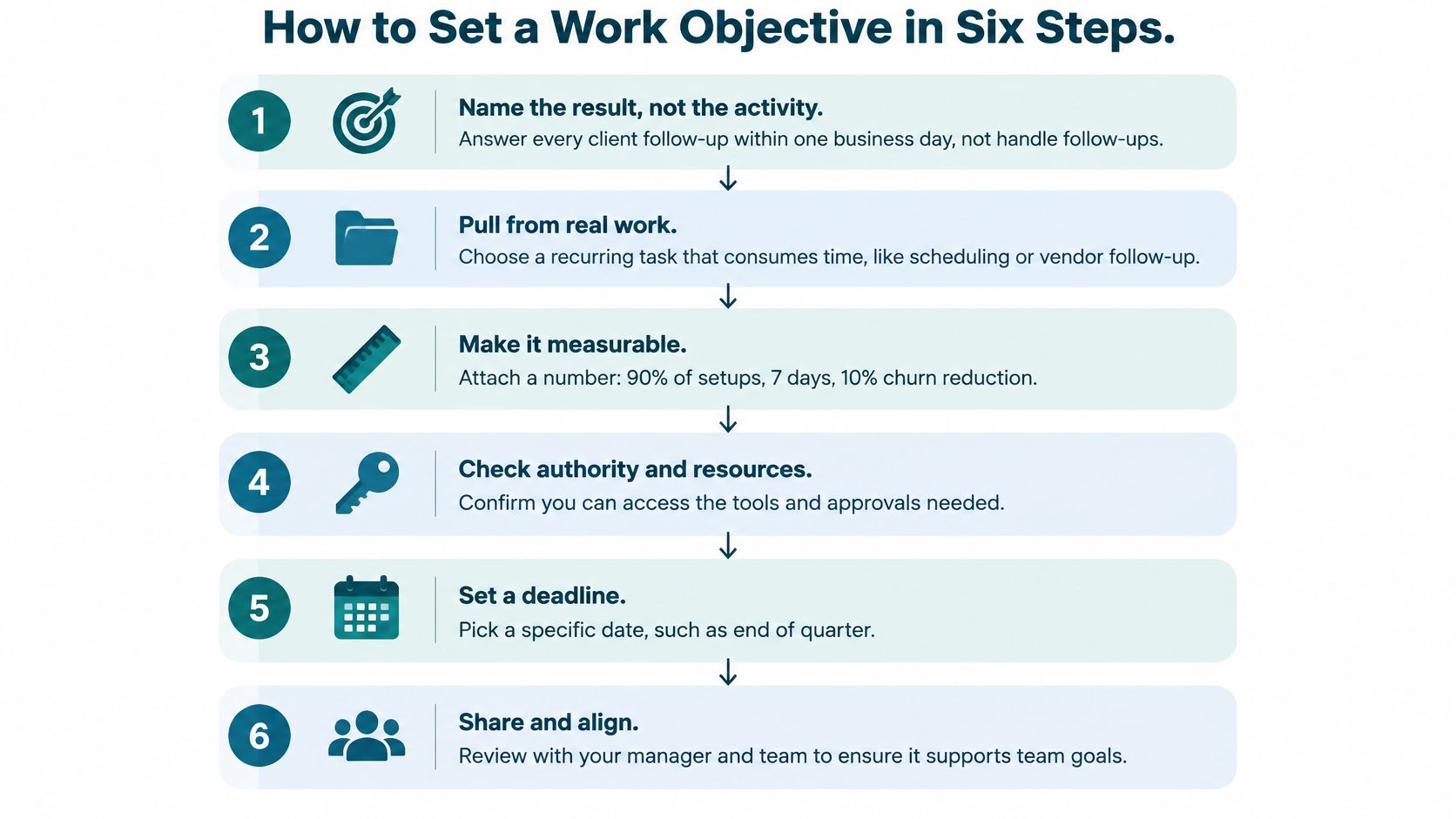
Use one client-follow-up example all the way through. Skip a step and the sentence looks finished while the week stays the same.
Build the sentence
- Name the result, not the activity. "Answer every client follow-up within one business day" beats "handle follow-ups." An activity can be finished without changing the client's wait.
- Pull a baseline. Check two weeks of sent mail first. Say 61% of follow-ups are answered within a day today. If you have no history, log the task for one week in a simple spreadsheet and use that count.
- Set a credible difficulty. Stretch past the baseline without inventing a miracle. 85% within eight weeks is a stretch this team can staff. 100% by Friday is a setup for a miss.
Protect the hours
- Confirm capacity. List the hours and the tools, such as the shared inbox and a saved reply in Gmail or Outlook. Name one competing task to pause before you add this objective. I would start with the status meeting that does not change a client outcome.
- Agree ownership and a review date. The person doing the work proposes the number. The manager confirms it. Both book a weekly check-in on the calendar, not in a chat thread.
- Write the finished sentence and test it. Result, metric, target, deadline, owner. Ask whether a colleague could tell on Friday whether it was met.
A healthy version in a shared doc reads like this. "Jordan answers 85% of client follow-ups within one business day by the end of week eight, reviewed every Friday at 4 p.m., while the Tuesday status meeting stays paused."
The common slip is skipping step 4. The target is then missed for a reason the person could have raised on day one.
A short walkthrough of turning a fuzzy aim into a checkable result is worth ten minutes before you lock the sentence.
Aligning Objectives With Team and Company Priorities
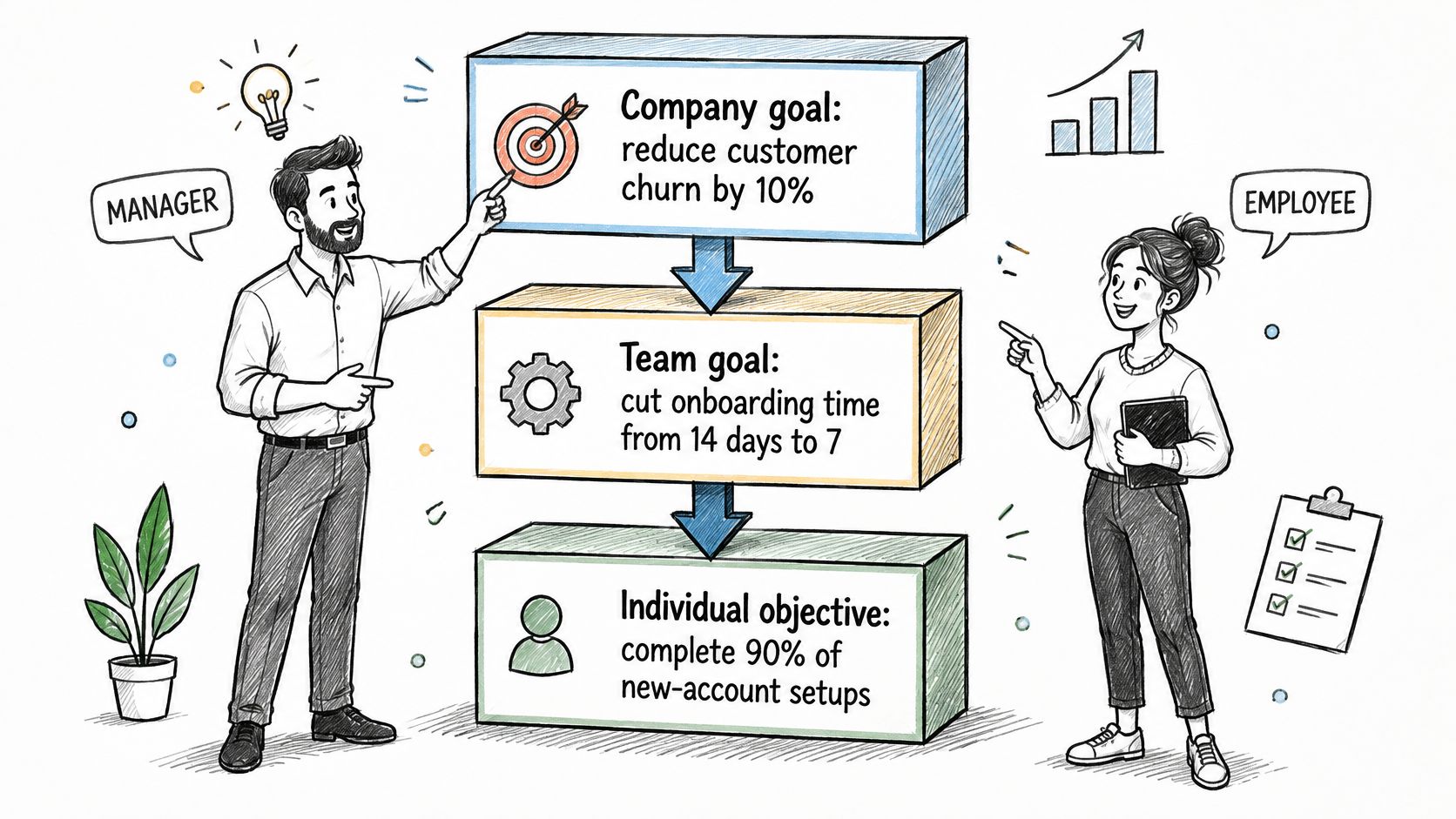
Write the chain in three lines before anyone opens a template.
- Company: reduce customer churn by 10% this year.
- Team: cut onboarding time from 14 days to 7.
- Individual: complete 90% of new-account setups within 48 hours.
Each link has to earn the next one. Faster setups only matter if slow onboarding is why customers leave. The personal target only matters if it is the lever the team controls.
Gallup reported in 2024 that only 47% of employees strongly agreed they knew what was expected of them at work, down from 56% immediately before the pandemic and 61% in 2015, and that 56% formally reviewed performance goals with their manager once a year or less. Earlier Gallup research found that only 13% strongly agreed their manager helped them set performance goals, while just 12% strongly agreed their manager helped them set work priorities. In a Gallup study of 8,287 employed U.S. adults in 2013, employees who said their manager helped them set performance goals were 17 times more likely to be engaged than disengaged.
The one-sentence test
Ask the manager to name, in one sentence, which company priority this objective serves. If nobody can, it is probably busywork. Put that sentence at the top of the objective so team accountability has a shared reference, not a private guess.
A monthly alignment check takes fifteen minutes. Read the three lines, drop anything that no longer serves the company line, and confirm the owner still has the tools.
Adjusting Objectives When Workload Shifts
A new objective lands midweek and the calendar is already full. If nothing comes off the list, the goal is a promise that breaks by Friday. Heavy workloads leave no room for new goals unless something else is taken off first.
So before you add one, run three checks. Is there spare capacity this week? Which current objective carries the highest business consequence? What will you pause the day the new priority arrives?
Trigger | What to change | Who decides | How to record |
|---|---|---|---|
Capacity overload | Pause the lowest-consequence objective | Employee proposes, manager approves | Log the paused item and date |
Priority shift | Re-rank objectives and reset targets | Manager with the business owner | Note the old and new priority |
Unrealistic target | Lower the target or extend the deadline | Employee and manager together | Keep the original target and the reason |
Sudden new request | Swap in the new objective and name what it displaces | Manager | Record the trade-off the same day |
A worked example keeps this honest. A team lead is asked to deliver a vendor comparison by month end. Her lowest-consequence objective is a documentation update, so she proposes pausing it for two weeks. The manager approves, the paused item and date go in the log, and the revised target is scored against the original with the reason written beside it.
Questions managers dodge
Which objective gets deprioritised? Pick the one with the smallest effect on the company line; how irritating it feels is not the criterion. Who has authority to change it? The manager, after the owner proposes the pause. How is success recorded when the original target no longer fits? Keep the first number, write the reason, and score the revised target. Do not pretend the quarter never changed.
Tie every reset to your continuous improvement cycles so each pause is a logged decision anyone can trace. Then score the adjustment on two measures: goals hit, and hours returned to high-value work once low-value obligations come off the list.
Confirm Your First Objective This Week
Pick one recurring outcome that eats time without moving the work forward. Scheduling, vendor follow-up, or family logistics are the usual suspects. A compiled review of executive time-use research, citing Harvard Business Review estimates, puts administrative tasks at 10% to 20% of executive working time, with calendar coordination alone at about 4 to 8 hours per week, more than 200 hours a year. A realistic first target is to reclaim four hours a week.
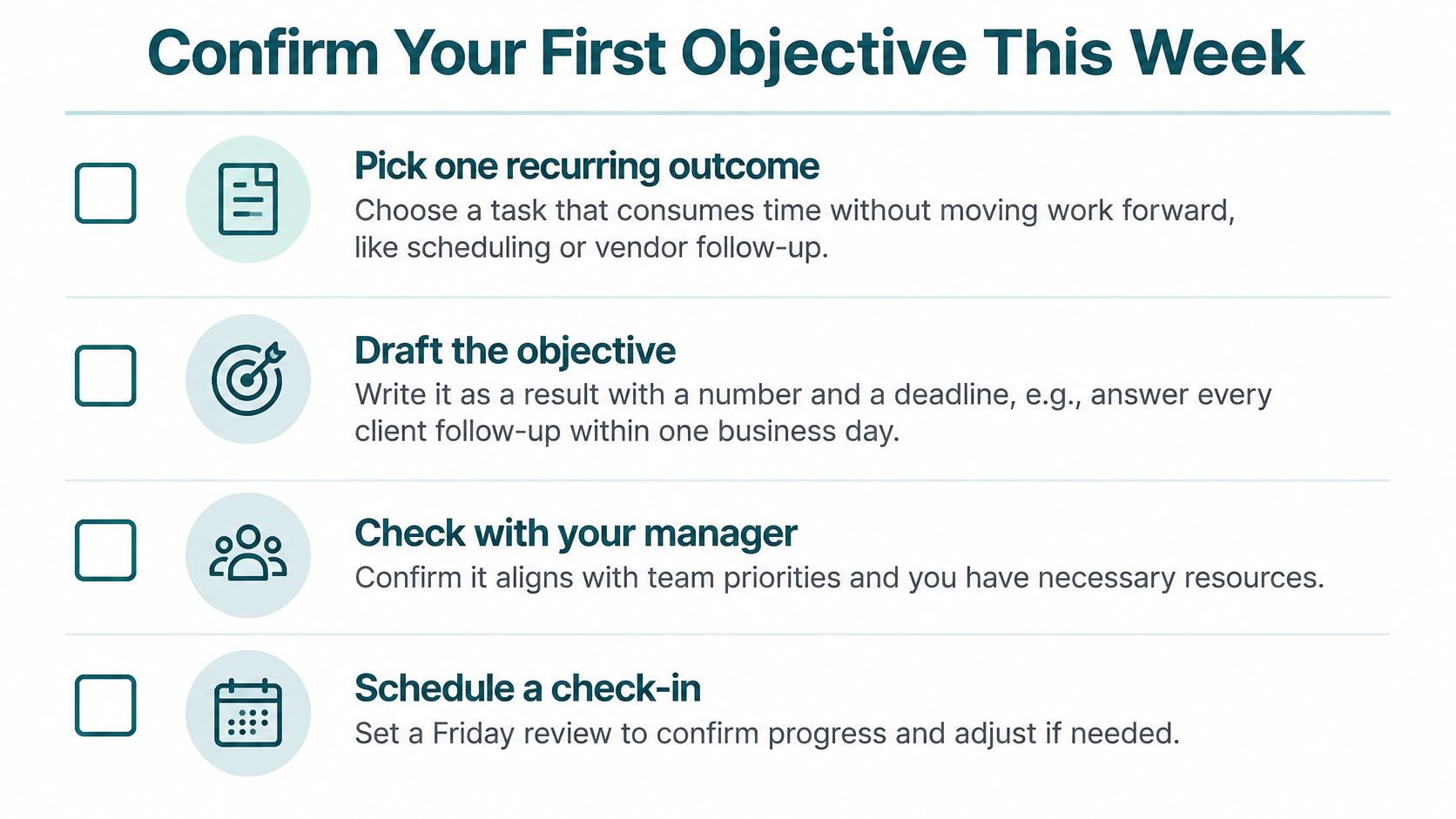
Write it with the six steps, using two weeks of calendar data or a one-week log. Ask your manager or co-owner to confirm the target and name the one task you will pause. Book the first review date before you leave the conversation.
Decide what leaves your hands. Scheduling, confirmations, itinerary assembly, and reminders can go to a teammate or an Assistant team. Final prioritisation stays with you. Both Lux plans include a step-by-step onboarding intake, which is the same habit. Capture how you like the work done before the first handoff.
Copy this into your planning doc.
- Outcome named: the result, not the activity.
- Baseline recorded: two weeks of data or a one-week log.
- Paused task logged: one named item, with a date.
- Review booked: a calendar hold, not a promise.
- Delegation decided: what moves, and what you still decide.
Send one sentence. "I propose to reclaim four hours a week of scheduling work by pausing the Tuesday status meeting, with a review on Friday at 4 p.m."
Approved Lux Personal Assistant is a 24/7 Assistant team you reach by phone, text, or email, built to take scheduling, travel changes, vendor follow-up, and inbox noise off a full week. That is the same capacity decision as a good objective. Name the hours you want back, keep final calls with you, and let the repeatable work move. Visit Approved Lux Personal Assistant and start with the onboarding intake on Lux Solo or Lux Circle.