Rentals on Kiawah Island: Types, Rules and Total Costs
Rentals on Kiawah Island compared by type, with property rules, beach and pet limits, and the full tax-inclusive budget before you book.
12 min read

Kiawah Island short-term rentals averaged 226 booked nights per year during August 2023 through July 2026, according to Airbtics data cited by Kiawah Island Getaways. That's a substantial amount of visitor use, but it doesn't tell you whether a particular home will work for your family. Bedroom count, authorized beach access, overnight parking and the final lodging bill matter more than a busy booking calendar.
The practical way to compare rentals on Kiawah Island is to treat each property as a separate operating agreement. Choose the right accommodation type, verify what your group can use, and compare complete quotes before anyone pays a deposit.
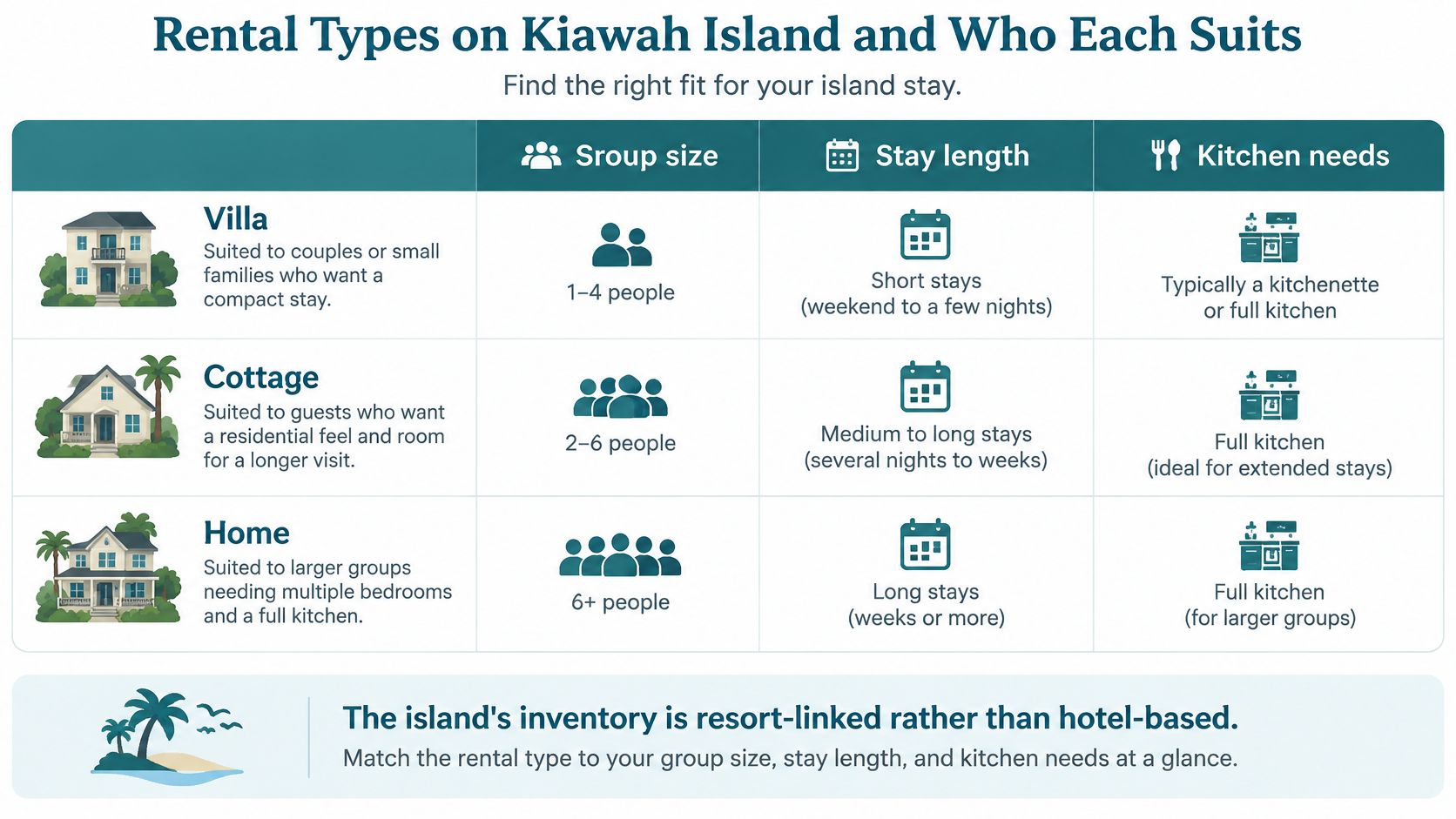
Rental Types on Kiawah Island and Who Each Suits
Kiawah Island rental types by group and stay
Rental type | Typical group fit | Kitchen and workspace | Best stay length |
|---|---|---|---|
Vacation home | Multi-generational groups of 8-10 across several bedrooms | Full kitchen and shared living space; verify a separate work area | Weekly or longer |
Villa | Couples and mid-sized families | Full kitchen; confirm desk or dining-table workspace | Weekly or longer |
Condo | Snowbirds and couples, 2-4 guests | Kitchen suited to longer stays; check seating and work surfaces | Weekly or monthly |
Cottage | Small families on shorter trips | Confirm a full kitchen, dining seating and a usable work surface | Nightly to weekly, where permitted |
These are planning fits, not occupancy permissions. A rental's approved capacity, equipment list and minimum-stay policy take priority over its category name.
Kiawah's accommodation mix reflects its development as a planned resort rather than a conventional town with a hotel district. A historical account in the Observer describes the Kuwait Investment Company's acquisition in 1974 and the opening of the Kiawah Island Inn and Marsh Point golf course in 1976, alongside the start of residential sales. That resort-linked residential foundation helps explain the prominence of villas, condos, cottages and private homes.
Match the layout to the trip
A vacation home makes sense when shared meals and time together are the priority. The trade-off is that a large bedroom count doesn't automatically provide enough dining chairs, bathrooms or quiet space for everyone's routine.
Villas can give couples and families a full kitchen without the footprint of a detached home. Condos deserve particular attention for extended stays, when laundry, food storage and a comfortable place to sit become more important than decorative finishes. Cottages offer a residential feel, but don't assume the label guarantees a yard, a full kitchen or permission for a short visit.
For example, a three-generation family of nine might compare one five-bedroom home with two condos that collectively have sufficient authorized capacity. The home keeps cooking and conversation together. Separate condos provide more privacy and separate kitchens, but the organizer must check where everyone can gather without exceeding any property's rules.
For a broader accommodation decision, compare the practical differences between a hotel and a vacation rental. If you're organizing a structured Airbnb search, RealtyAPI.io's resource to filter Airbnb listings by property type can help separate categories, though it doesn't replace listing-level verification.
Finish with three questions: How many guests are traveling? How many nights? Does everyone need one shared space or separate units?
Property Rules to Check Before You Pay
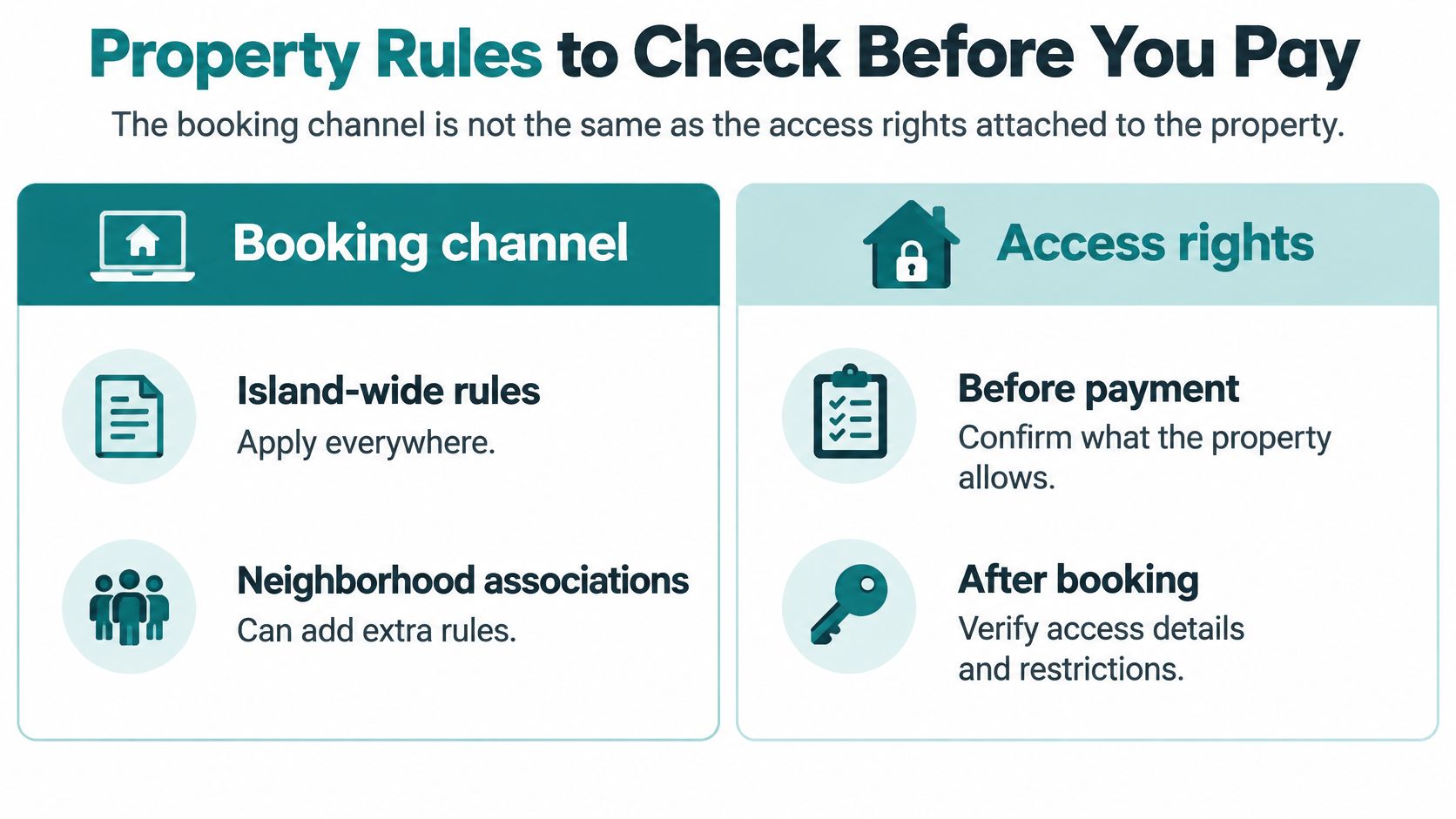
Neighborhood rules can change whether a property is eligible for your trip at all. Individual associations may impose minimum stays, owner-occupancy requirements or restrictions on rentals shorter than 30 days, while Kiawah has one public beach access point at Beachwalker Park, according to Kiawah Island Getaways' beach-access guide. Most other access points serve owners, resort guests or authorized rental guests.
The booking channel is not the same as the access rights attached to the property. A reservation confirmation establishes a booking; it doesn't establish identical beach, pool, parking or resort-service access across every listing.
Get these answers in writing
- Confirm the exact community and its minimum-stay rule. Ask for the community name, not just the island address. A listing that appears available for your dates still needs to comply with the rules governing that property.
- Confirm maximum occupancy against your guest list. Count everyone traveling and ask how children and infants are treated. Don't use bedroom count or available sofa beds as permission to add guests.
- Confirm the overnight vehicle allowance. Give the manager your actual arrival plan, including separately traveling households. Ask where each permitted vehicle must park and whether any proposed overflow arrangement is authorized.
- Confirm the beach-access route for your group. Request the designated boardwalk or access point and any necessary credentials. A map pin near the ocean doesn't show whether the route is practical with a stroller, mobility aid or beach wagon.
- Confirm resort-benefit eligibility in writing. Name the facilities or services your family expects to use. A general reference to resort proximity isn't an answer about eligibility, reservations or additional charges.
- Confirm whether you're booking the entire home or a private room. Clarify exclusive use of kitchens, living areas and outdoor spaces. Photographs alone don't establish which spaces are included.
Before payment: Save the answers with the property address and your travel dates, not just in a general conversation about available rentals.
Consider a hypothetical ten-person group arriving in four cars. The house may accommodate the guests but not their vehicles, and discovering that at the gate leaves the organizer trying to solve a parking problem after everyone has traveled.
Written confirmation lets the group consolidate vehicles, select another property or revise the trip before committing money. It also gives every household the same instructions, rather than leaving one person to interpret a listing description.
Pet, Beach and Tide Rules by Season
Beach use can change by season, while a rental's pet policy is set by the specific unit. Check both against your dates before you book.
The Kiawah Island Golf Resort's pet and beach guidance says pets are prohibited in most homes and villas, except specially designated units. Its seasonal guidance requires leashes on the beach from March 1 through October 15 and allows restricted daytime off-leash use outside critical habitat areas from October 16 through February 28. Confirm that the rental accepts your dog, then check the permitted beach hours and habitat boundaries.
September and November require different plans
A family arriving in late September should expect to keep its dog leashed on the beach. A quieter stretch of sand doesn't change the seasonal rule. Check whether the property's pet permission covers your animal and any conditions that apply.
An early-November visit may allow off-leash use during designated hours. Keep a leash available, follow the habitat boundaries and control the dog around other beach users and wildlife.
Ask the property manager whether beach equipment may be stored outside and where wet towels or clothing should go. Storage limits can affect what you bring, especially when the rental has little room for sandy gear.
Pack for the property's storage arrangements, not just for the beach.
Use tide timing to reduce carrying
West Beach is often wider and easier to walk at low tide. That can make a beach outing more manageable for guests with mobility limitations, young children or chairs and other equipment to carry.
Check a current tide table alongside the beach-access route. Low tide doesn't establish that a boardwalk is step-free, and a wider beach may still mean a longer walk across sand to the water.
Keep the packing list purposeful:
- Leash: Bring one even if your dates may allow off-leash use.
- Equipment storage bag: Use it to contain sandy items before moving them to the property's approved storage area.
- Tide table: Mark likely outing times for the week, then reassess weather and conditions each day.
Budget Your Stay Including the 13% Tax
Start with the 13% combined accommodation tax, not the advertised nightly rate. Multiply the taxable accommodation subtotal by the tax rate, then account for every disclosed fee and any tax applicable to that fee.
The Town of Kiawah Island's accommodation-tax packet lists a combined 13% burden comprising 5% state sales tax, 1% state local-option sales tax, 1% county transportation tax, 1% education tax, 2% state accommodation tax, 2% county accommodation tax and 1% local accommodation tax. The table below applies that published rate to hypothetical taxable subtotals; these aren't quoted rental prices.
Tax-inclusive lodging budget at four subtotals
Taxable subtotal | 13% combined tax | Total before extra fees |
|---|---|---|
$1,500 | $195 | $1,695 |
$3,000 | $390 | $3,390 |
$5,000 | $650 | $5,650 |
$10,000 | $1,300 | $11,300 |
The distinction between taxable subtotal and base rent matters. Don't assume every fee sits outside the tax calculation merely because it appears on a separate checkout line.
South Carolina Department of Revenue accommodations guidance treats most stays shorter than 90 consecutive days as transient accommodations and bases taxation on gross rental charges, making the classification of mandatory cleaning, booking and other charges important. For a longer stay, request a duration-specific calculation rather than assuming the ordinary vacation-stay treatment applies unchanged.
Read the quote as a complete invoice
Ask for separate lines showing base accommodation charges, the taxable subtotal, taxes, cleaning, management, resort charges and other mandatory fees. Identify any refundable deposit separately so you can distinguish the trip's cost from money temporarily held.
The owner is responsible for collecting and remitting applicable accommodation taxes, although an authorized agent may perform that work. The Town doesn't directly collect those taxes or establish the owner's remittance accounts.
Booking through HomeAway or VRBO doesn't remove the owner's filing responsibility. For a guest, the useful response isn't to audit the owner's accounts; it's to obtain an itemized quote that makes the amount payable understandable.
Comparison rule: Put complete totals beside complete totals. A lower nightly rate isn't a saving if the final bill is higher.
When comparing separate units with a shared home, include all property-level charges. Don't compare the combined base rent of the condos with the fully loaded price of the house.
Seasonality and Rate Trends That Shape Your Timing
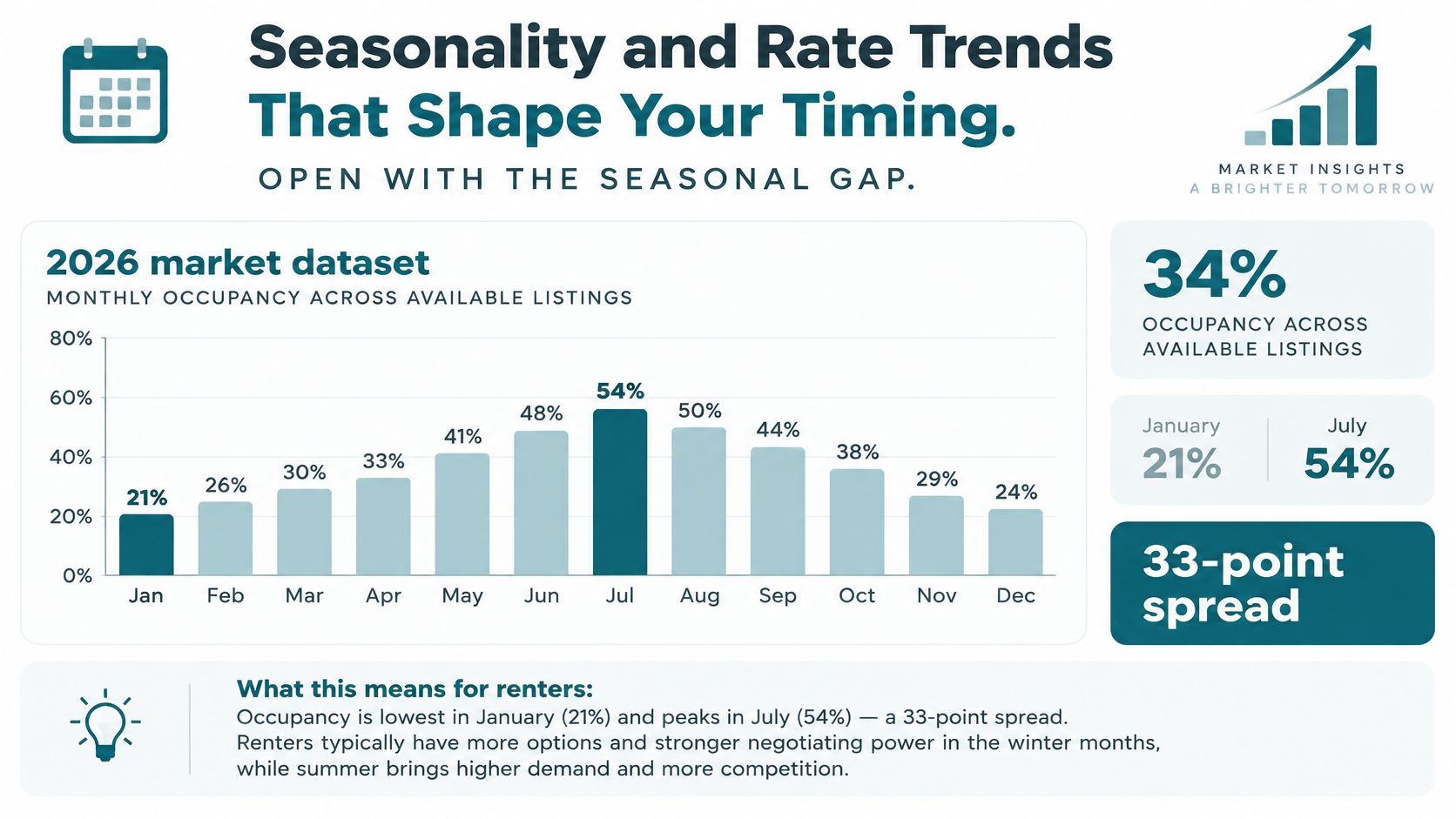
January and July require different booking strategies. An AirROI market dataset for Kiawah Island reports approximately 34% occupancy across available listings in 2026, ranging from 21% in January to 54% in July, a 33-percentage-point spread.
That gap supports an operational distinction: summer travelers should prioritize securing a suitable property, while winter travelers can test more date combinations. It doesn't mean every January owner will negotiate or every July home will be unavailable.
Lower occupancy doesn't guarantee lower rates
The annual figures reported in Kiawah Island's Legends Magazine show occupancy peaking at 77.7% with a $447 average daily rate in 2021, followed by 66.1% occupancy and a $485 average daily rate in 2022, approximately 33% above the 2019 rate. The full historical series makes the distinction clear.
Kiawah Island occupancy and average daily rate, 2018-2022
Year | Occupancy | Average daily rate |
|---|---|---|
2018 | 52.8% | $395 |
2019 | 53.9% | $366 |
2020 | 66.9% | $377 |
2021 | 77.7% | $447 |
2022 | 66.1% | $485 |
These are historical market measures, not current quotes for a particular villa or home. Nor should the annual series be treated as directly interchangeable with the separate available-listing dataset.
For the booker, the lesson is straightforward: occupancy measures use; average daily rate measures pricing. Owners can accept fewer occupied nights while charging more for the nights they sell.
Test flexibility before compromising the property
If your family can move its travel dates, compare shoulder-season weeks before giving up a suitable bedroom arrangement or manageable beach route. A practical shoulder-season travel strategy starts with the activities and services you need, then checks whether they fit the alternative dates.
For example, compare the same family trip across different available weeks using identical occupancy and amenity requirements. Keep the property standard consistent so the comparison shows the effect of timing rather than a change in accommodation quality.
Use two rules:
- Flexible dates: Compare whole-stay totals across rental types and adjacent weeks.
- Fixed peak dates: Secure a compliant property early rather than relying on market-wide occupancy to predict last-minute choice.
Watch shoulder-season availability, but don't assume an empty calendar means an owner will waive minimum stays or property restrictions.
How to Consolidate a Large Group or Long Stay
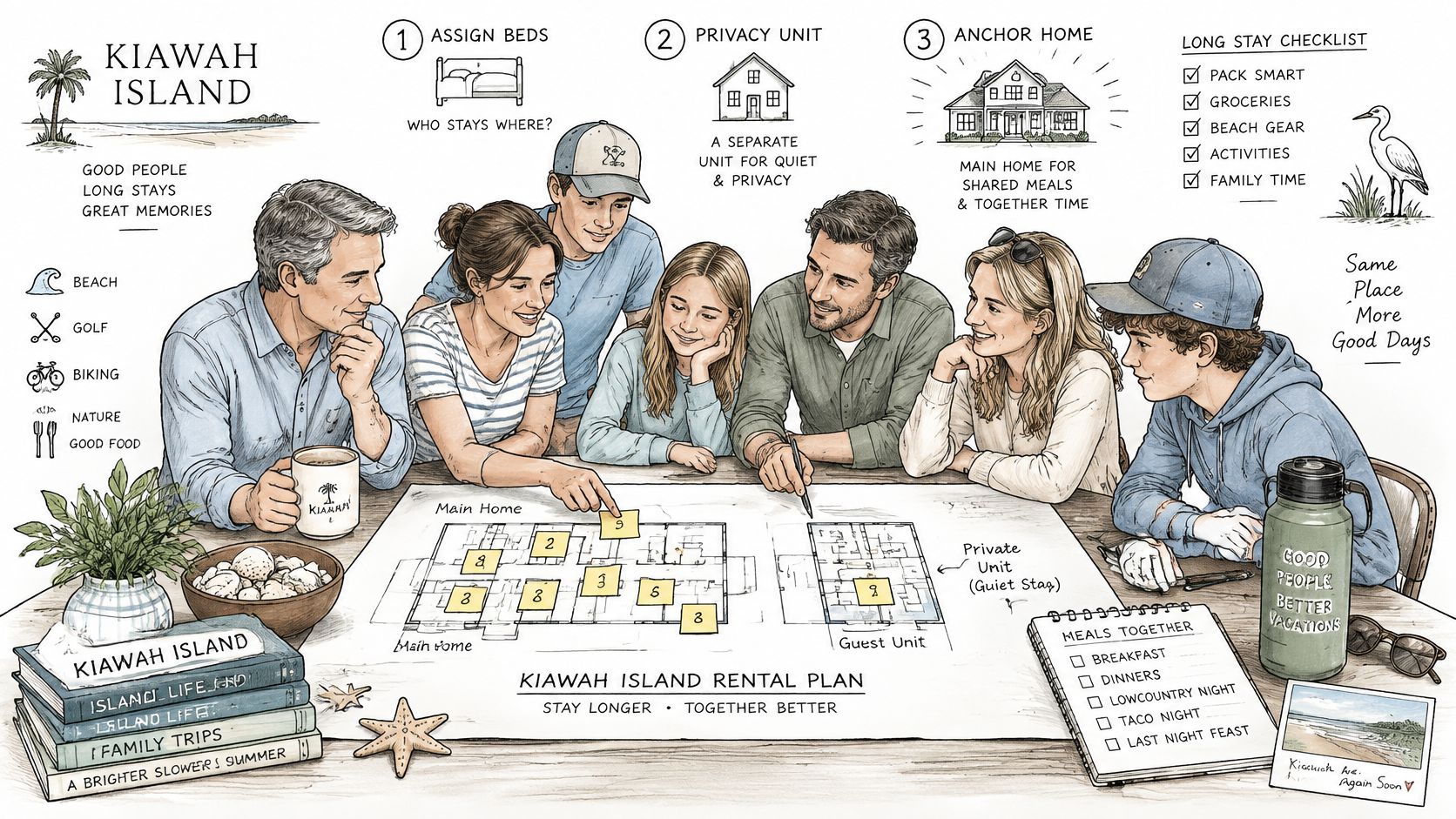
Start with a room map, not a collection of attractive listings. The organizer's job is to make the accommodation, transport and payment plans agree before anyone makes a nonrefundable commitment.
Build one booking record for the group
- Set the headcount and assign actual beds. Draw a room map showing who shares, who needs a private bathroom and who can't manage stairs. Include anyone who needs a separate unit because of sleep schedules, mobility or work calls.
- Choose an anchor home for shared meals, with other units serving primarily as sleeping accommodation. Confirm that the planned gathering is permitted and that the kitchen, table and seating suit the group, rather than assuming overnight capacity also authorizes visitors.
- Check minimum stays and overnight vehicles at every property before comparing dates. Different households may arrive separately, but the organizer needs a combined vehicle plan. Resolve any mismatch before asking relatives to book transport.
- Verify availability for every date, including any extension you're considering. There's no cap on condo-style weeks through our membership, but every week is subject to availability for the member's dates, so an open initial week doesn't reserve the following week.
- Consolidate bookings under one login. Members sign in from our website to book in the Approved Traveler member portal, where hotels, flights, cruises, cars, tours and homes are available together. Use that central access to coordinate the trip, then maintain a clear confirmation list rather than assuming every component shares the same booking reference.
- Request an itemized quote for each property and record its taxable accommodation subtotal, tax, mandatory fees and payment schedule. Keep refundable deposits distinct from trip costs, and check cancellation terms before collecting money from relatives.
- Split costs using complete property totals and store every confirmation in one shared folder. Decide whether costs follow households, bedrooms or another agreed method before payment, particularly when room quality and bathroom access aren't equal.
A dedicated large-group vacation-rental planning guide can help structure the room-allocation conversation. The important outcome is agreement: each household should know what it's paying for and what remains its own responsibility.
Extend the unit, not just the itinerary
For a hypothetical long-stay example, a snowbird couple books three consecutive weeks in one condo. Before adding a fourth week, they check whether that same unit is available for the extension and request the complete revised price.
If it isn't available, they can decide whether moving units is worth the disruption. That decision should account for packing, food storage, checkout timing and any gap between reservations, not just the additional week's rate.
Remote workers should apply the same discipline to the workspace. Ask for a photograph of the actual desk or table, the chair and the room around it; a kitchen counter beside the television may not support a working household.
The common group-planning slip remains simple: booking a hypothetical ten-person home and only afterward asking where everyone's cars can stay. Put transport beside the room map at the start, so the accommodation plan works on arrival as well as on paper.
Confirm the Rental Before You Pay
Check the total, check the capacity, check the access rights. Then request an itemized quote and written property-rule confirmation for the exact rental and dates.
Before committing, make a like-for-like price comparison. Our 110% Best Value Guarantee pays the difference plus 10% if a lower publicly available price exists for the same booking, so keep the competing listing and your quote together. A similar-looking home isn't necessarily the same booking.
For households weighing membership, both plans include unlimited weekly condo-style stays, with each week subject to availability for the member's dates. Reward Credits are earned on every booking and never expire, which matters when the household is consolidating recurring travel rather than arranging a single trip.
Say a family of nine finds a lower advertised rate on a comparable home. They first compare totals after taxes and fees, then establish whether the property and booking terms match before considering the guarantee. They also obtain written vehicle permission before paying.
Use the property-rule checklist and the itemized-budget method to settle unanswered questions, rather than reopening the search because another attractive photograph appears. Today's action is to send one consolidated request for the full quote and written rules for your preferred property.
Approved Experiences Traveler offers wholesale travel access and a member portal for coordinating homes, flights, cars and other trip components under one login. Visit Approved Experiences Traveler to review membership access, then compare available Kiawah accommodation against your room map, vehicle plan and complete lodging budget.