Personal Errands Meaning: What Counts and Where Time Goes
Personal errands meaning explained: what counts, real examples, weekly hours lost, and how a US-based Assistant team takes them off your plate.
9 min read
What counts as a personal errand, and why does a ten-minute pickup stay in your head at 9 p.m.? Personal errands are practical, nonprofessional tasks done for a person or household, including shopping, appointments, and the travel tied to them. OECD data on other unpaid work, which includes shopping, care, and related travel, puts that broader category at about 79 minutes a day, or roughly 9.2 hours a week (OECD). The named task is rarely the whole cost. The rest is the open loop: the text you still owe, the slot nobody confirmed, the receipt you have not checked. For anyone counting hours, personal errands mean coordination work you keep owning until someone else closes it. Sort the list by those loops, not by how far you drive.
What Personal Errands Mean in Plain Terms
Personal errands are practical, nonprofessional tasks completed for a person or a household, including shopping, arranging services, collecting or delivering items, making appointments, household logistics, and the travel tied to those activities.
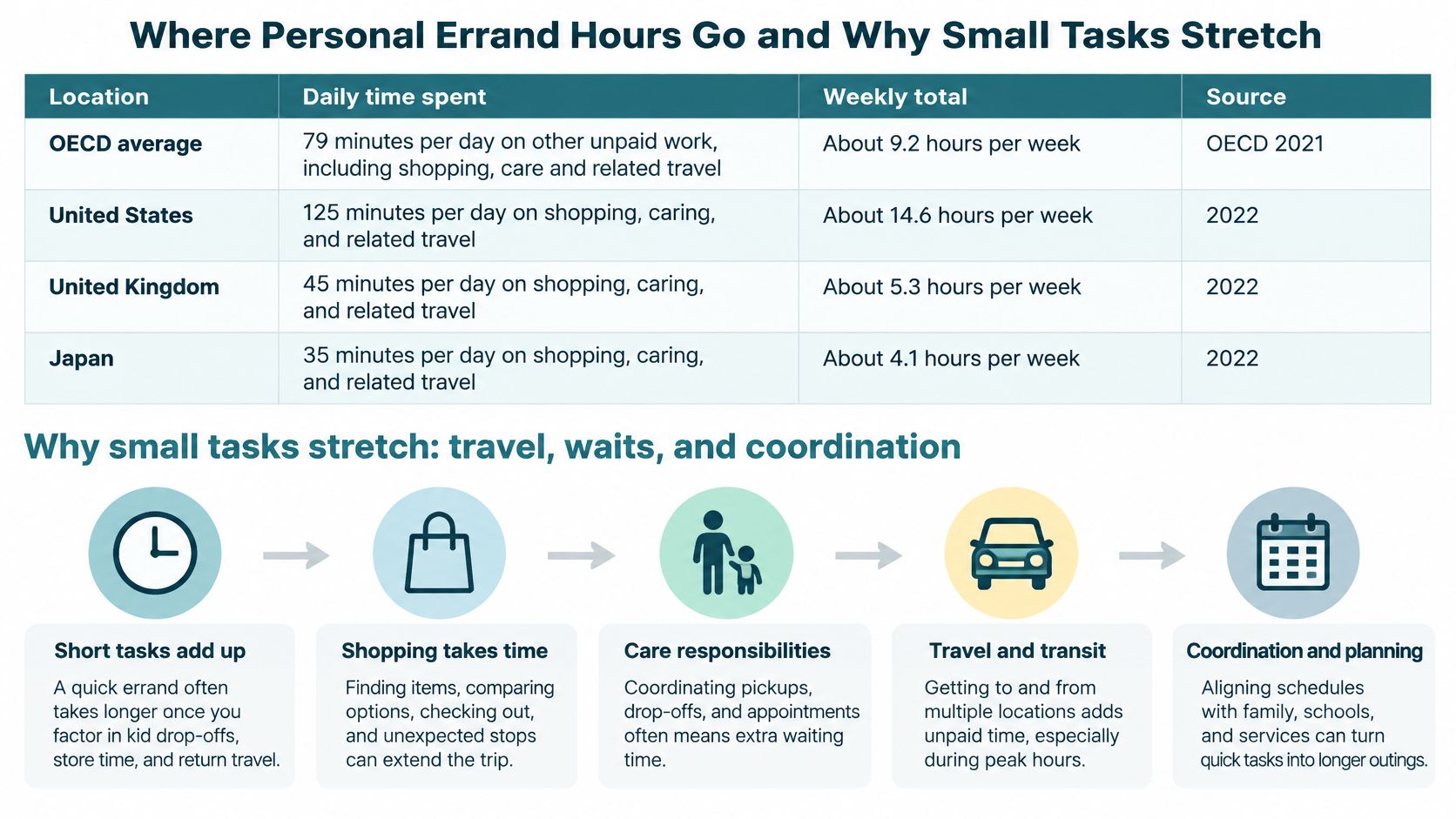
The OECD framework for unpaid household work places shopping and related travel with cooking, cleaning, laundry, gardening, and adult- and child-care. OECD data published in 2021 found that adults in member countries spent an average of about 79 minutes per day, or 6% of available time, on "other unpaid work," including shopping, adult- and child-care, and travel related to household activities. Across a 7-day week, that is about 9.2 hours. It is recurring household administration, not a rare favor.
Two layers on one task
The visible action is collecting dry cleaning or delivering a gift. The workflow behind it is identifying the need, comparing options, scheduling a time, confirming details, and following up. Miss the second layer and the first one looks cheap.
Simple test: If a task needs repeated messages, a judgment call, vendor follow-up, or a calendar check, it is operational work, not a quick trip.
Take one item on today's list. If you could hand someone the outcome and stop checking, it counts as an errand. If it ends when you leave the store, it was only a stop.
Common Personal Errands and the Hidden Work Behind Them
The table lists errand types people hand off, not a full dictionary of chores.
Errand type | Typical example | Hidden steps behind it | Most affected readers |
|---|---|---|---|
Gift sourcing | Birthday gift for a client's child | Set budget, shortlist options, check delivery date, confirm receipt | Founders and dual-career parents |
Dry cleaning and tailoring | Suit pickup and hem before a board meeting | Track drop-off, confirm turnaround, schedule pickup | Solo practitioners and frequent travelers |
Household vendor scheduling | Plumber or HVAC repair | Compare providers, match access window, confirm details, monitor completion | Dual-career parents and high-net-worth households |
Appointment booking | Pediatrician or specialist visit | Find open slots, match to calendar, set reminders, reschedule conflicts | Parents and sandwich-generation caregivers |
Event planning | Child's birthday party or school event | Book venue and vendors, send invitations, track RSVPs | Working parents |
Travel exception handling | Replacement flight and hotel after a cancellation | Rebook, arrange transfer, notify attendees | Frequent business travelers |
Personal shopping | Replacement wardrobe item before a trip | Research sizing, source the item, track return window | Executives and creators |
Gift sourcing names the task as buying. The hidden column is longer: a budget, a shortlist, a delivery date, and proof it arrived. A plumber looks like one booking. You still compare providers, match an access window, confirm who will be home, and watch the job through to done.
Appointment booking follows the same split. Finding a slot is the named task. Matching it to a calendar, setting reminders, and moving a conflict are the hours. Event planning and personal shopping stretch the same way. A party is venue, vendors, invitations, and RSVPs. A jacket before a trip is sizing, sourcing, and a return window you have to remember.
Laundry shows the split cleanly. If you are in Singapore and only need the wash finished, wash and fold services in Singapore cover the machine time. Drop-off tracking and the pickup window stay on your list until someone owns them.
When a row's hidden steps outnumber its named task, that errand is a strong candidate for delegation.
Where Personal Errand Hours Go and Why Small Tasks Stretch
Why does an errand that should take ten minutes consume an hour? The named task is only the visible part. The rest is coordination: noticing, choosing, booking, watching for changes, and closing the loop. An errand works like a small operations desk. The desk stays open until someone confirms the result.
Start with scope. Each measure below answers a different question, so they are separate rulers, not pieces of one total.
Measure | Figure | Source or context |
|---|---|---|
OECD average, other unpaid work (shopping, care, related travel) | 79 minutes per day, about 9.2 hours per week | OECD, 2021 |
U.S. household management, average across population | 0.17 hours per day, about 10 minutes | BLS 2025 activity tables |
U.S. household management, men compared with women | 0.12 hours vs 0.22 hours per day | BLS 2025 activity tables |
U.S. people doing household activities on an average day (2024) | 80% of people, about 2 hours | BLS, broader household activities |
The ten-minute line is only the desk work
The Bureau of Labor Statistics activity tables put household management at 0.17 hours per day, about 10 minutes, across the population in 2025. Men averaged 0.12 hours and women 0.22 hours. That category is arrangements, planning, and managing services, even when someone else does the physical work. It does not include the drive, the wait, or the store.
On a wider cut, the 2024 American Time Use Survey found that 80% of people in the United States engaged in household activities on an average day and spent about 2 hours on housework, cooking, lawn care, and household management. The gap between ten minutes and two hours is scope. One number counts management alone. The other counts the chores plus the management around them.
Why a small task keeps stretching
A small task becomes a chain: prompt, research, compare, book, monitor, close. The booking or purchase is the step you can see. The other steps are coordination work, and each one leaves an open loop until it is closed. The same pattern shows up in cognitive load management when one person holds every thread at home.
- Notice the need. A form is due, a shirt is stained, a flight looks shaky.
- Research options. This stage eats time because each option needs a decision.
- Make the booking or purchase. The named task, often the shortest step.
- Monitor changes. Interruptions live here: a callback, a delay, a conflict.
- Close the loop. Receipt, confirmation, or a note that it is done.
A passport renewal shows the split. The named task is “renew passport.” The work is a photo, a form, a fee, a mailing window, and a tracking number. The visible action might take twenty minutes. The monitoring is five short checks spread across ten days, and each check interrupts something else.
Delegating only the physical step leaves the monitoring with you. Hand off the workflow, research through closure, and the loop can leave your list even when another person makes the trip.
Three Real Errand Scenarios and What Changes
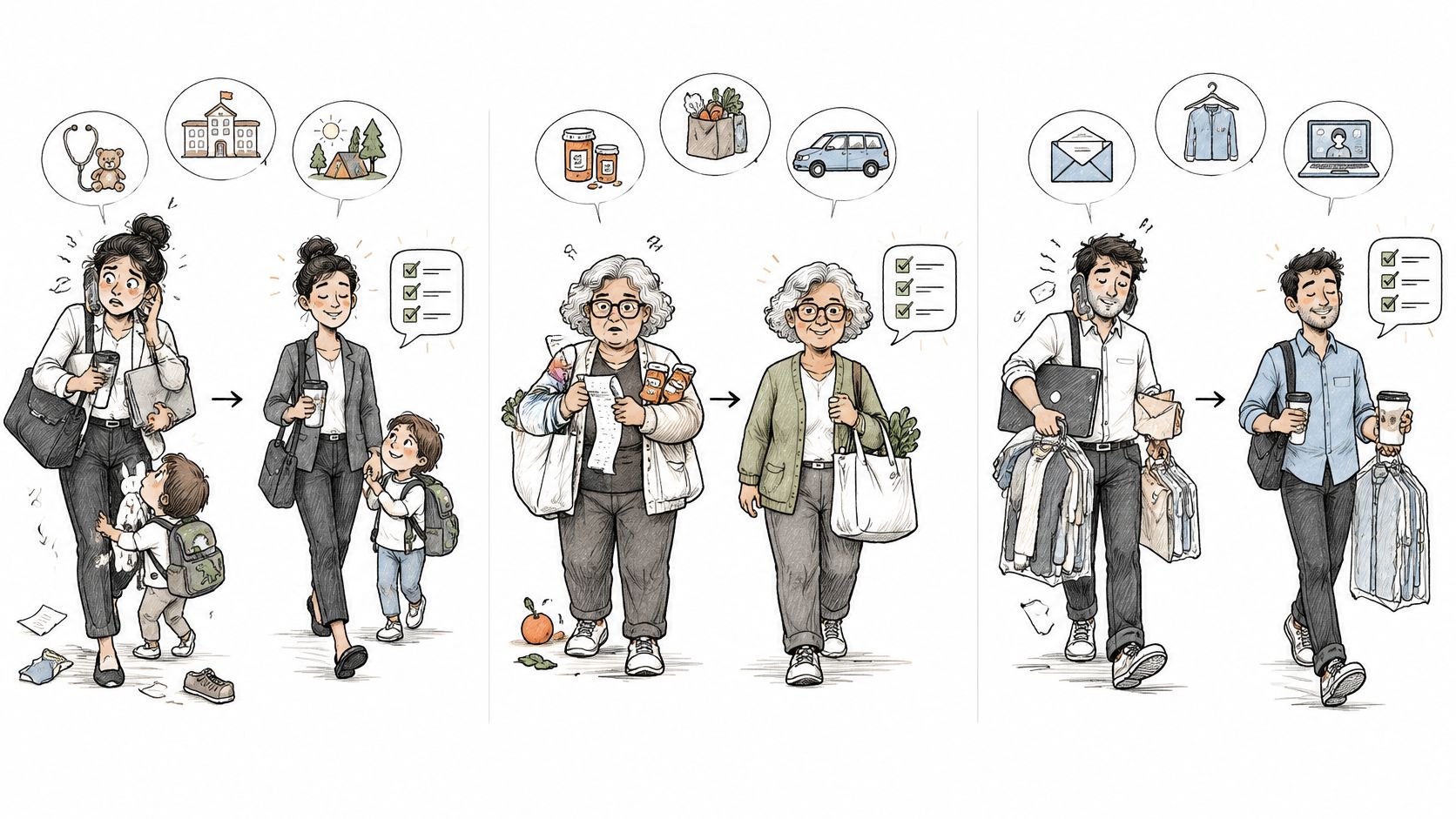
A dual-career parent has a pediatrician visit, a school enrollment deadline, and summer camp registration in the same week. Before the handoff, four threads stay open: slots, a form, a camp waitlist, and a reminder that keeps slipping. After it, one reviewed summary comes back. Handled: open slots matched to the work calendar, the form submitted, camp options narrowed, reminders set. Still decided: which camp and whether a parent attends the visit. Closed without a follow-up call: the enrollment confirmation.
A founder needs a client gift sourced, a home repair on the calendar, and a dinner reservation moved. One request spans three categories, which is why it feels bigger than any single line. Handled: gift shortlist inside a stated budget, two repair windows, and the new reservation time. Still decided: which gift and which repair slot. Closed without a follow-up call: delivery tracking and the restaurant change.
A frequent traveler's evening flight is canceled after the usual desk has closed. A 2025 Perk survey reported that 56% of business travelers had a delay of more than one hour in the prior 12 months, 36% faced cancellations, and 26% missed connections. The same report said the U.S. cancellation-affected share rose to 42% in 2025 from 25% in 2023. Handled: a replacement itinerary, airport transfer, hotel arrival, and a note to the next-day meeting. Still decided: whether to keep the morning session. Closed without a follow-up call: the new confirmation set.
How an Approved Lux Assistant Team Takes Over
A request arrives by phone call, text, or email. Triple-channel access means all three are watched at the same priority, so you use whichever is fastest. You don't wait for office hours. Coverage is 24/7 and US-based.
You get an Assistant team, not one fixed person. Preferences and history stay on the account, so whoever answers already knows how you like things done. If one team member is off, the request is still covered. Proactive Preference Learning is that stored context at work. The second gift, the second repair, and the second rebooking need less re-explaining than the first.
What the team will not do
The team never logs into your email or calendar. It works alongside those accounts, not inside them. It is not a house sitter and not an in-home caregiver. It finds, vets, and schedules people who are. If you need someone in the house in Charleston, Charleston sits with Global Pet Sitter is the kind of on-site help a team can source and book, the same way it lines up other home service scheduling.
Judge the handoff by completed errands, follow-ups avoided, decisions delegated, and hours reclaimed. Don't count phone calls. A dozen calls that leave the loop on you didn't help.
Decide Which Errands to Hand Off First
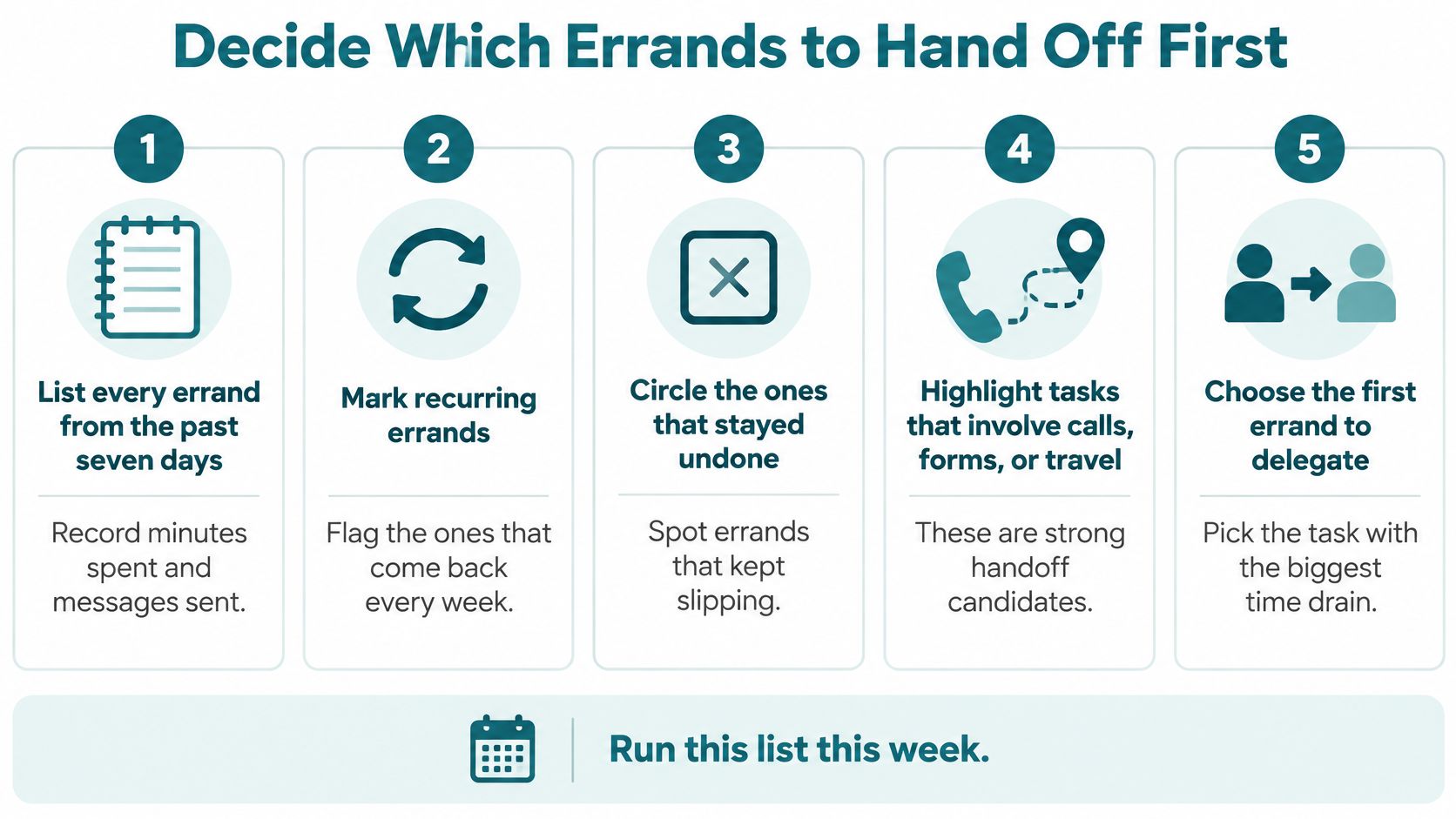
Run this list before the week gets away from you. A fuller pass at the same habit sits in delegation of work.
- List every errand from the past seven days. Write minutes spent and messages sent, not just the task name.
- Mark what recurs weekly and what stayed open more than two days. Those two marks are your time drains.
- Start with clear criteria. Dry cleaning, tailoring, a gift with a budget, and appointment booking hand off cleanly because the rules are already set.
- Hold judgment-heavy work for round two. Vendor vetting waits until the first handoffs are closing.
- Pick the plan that matches the household. Lux Solo is $99.99/month for one person. Lux Circle is $299.00/month for up to 4 people on one account, with requests for anyone on the account handled and appointments for the group booked and de-conflicted.
Errands coverage includes dry cleaning, tailoring, and personal shopping, plus gifts sourced, purchased, and delivered on time. Track hours reclaimed and open loops for 30 days, then compare that log with the baseline week you wrote in step 1.
Approved Lux Personal Assistant gives you a US-based Assistant team for the coordination behind personal errands, from gift sourcing and home services to scheduling and travel changes, on call, text, or email. If those open loops are eating evenings you meant to keep, visit Approved Lux Personal Assistant and hand off the first errand on this week's list.