Mental Load of Motherhood: How to Share the Invisible Work
The mental load of motherhood is the invisible planning behind family life. Learn what it covers, why it persists and how to hand off whole tasks.
13 min read
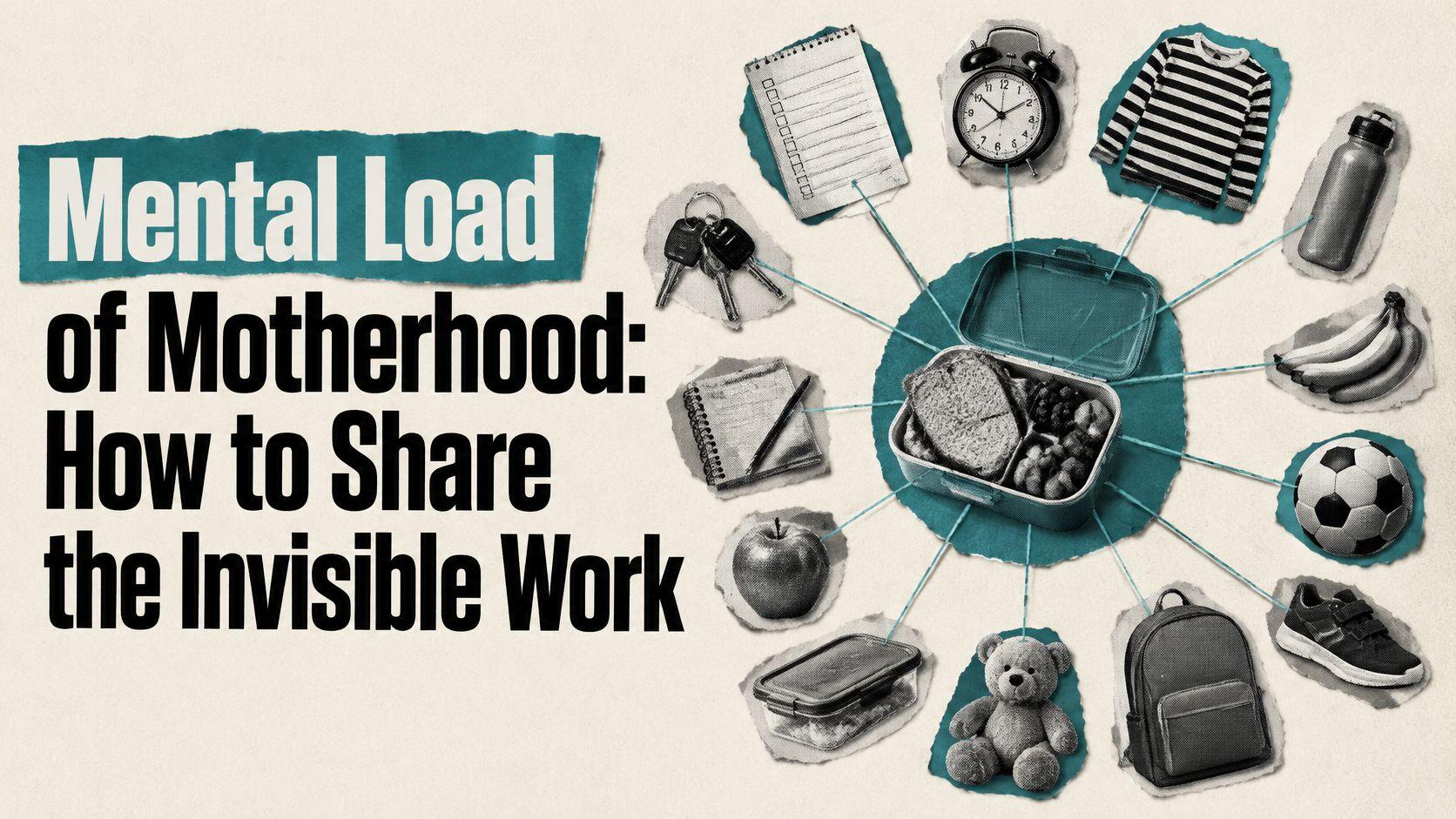
You're in bed at 11:40 on a Wednesday, and your brain is running inventory. The permission slip still at the bottom of the backpack. The dentist appointment you keep meaning to book. Whether there's enough oat milk for tomorrow's lunches. The fact that nobody has bought a present for Saturday's party.
None of those items is difficult. Each one is yours, and each one stays open in your head until someone closes it. That open-inventory feeling is the mental load of motherhood: the continuous work of noticing what needs doing, deciding what matters, scheduling it, tracking the deadline, and confirming it happened.
This isn't a personality flaw or a time-management failure. It's a workload, and it can be counted, delegated and measured. Once you can see it as a workload, you can hand it over in whole pieces and check whether it left your head.
What the Mental Load of Motherhood Really Covers
At 7:12 on a Tuesday morning, you're holding an open lunch box and running a second list while you spread hummus. Picture day is Thursday, so the good shirt has to be clean tomorrow. The dentist reminder for next week is still sitting in your inbox. Summer camp registration opens Monday and you haven't compared programs. Somebody needs a birthday gift by Saturday.
None of those tasks takes more than a few minutes. That's not what makes them heavy. What makes them heavy is that each one stays open in memory until it's resolved, and you're the one holding it open.
The work has a structure. It includes noticing a need before anyone names it, deciding what matters and what can wait, scheduling the thing around work and school, tracking the deadline, communicating with whoever else is involved, and confirming the job is done. Most of it leaves no evidence. There's no receipt for remembering that the prescription runs out on Friday.
A useful picture is a browser with forty tabs open. Every tab keeps using memory even when you're not looking at it, and the machine slows down long before it crashes.
This is why the planning layer and the physical task have to be separated in your mind. Buying the supplies is one step. Noticing that supplies are running low, choosing what to buy, knowing which brand the school allows, and remembering to check the delivery is another job entirely, and it's the one that follows you into the shower.
Parents often can't say when the work stopped, because it never consolidated into one block of time. It arrived in fragments across the day, and each fragment cost a little attention.
Who Carries the Mental Load, by the Numbers
Source | Finding | Who carries most of it |
|---|---|---|
International Labour Organization, 2018 | Women performed 76.2% of 16.4 billion daily hours of unpaid care work | Women |
USC Dornslife summary of a 2024 study | Mothers said they held about 73% of cognitive household labor, against 27% for partners | Mothers |
2025 study of 2,133 partnered U.S. parents | Mothers averaged 13.72 mental to-do items, against 8.2 for fathers | Mothers |
2025 PLOS ONE studies on maternal mental load | Constantly thinking about everyday tasks was the most frequently reported driver of load | Mothers |
Journal of Marriage and Family analysis, 2024 | Mothers managed 71% of mental-load tasks, against 45% for fathers | Mothers |
National survey of mothers | Co-parenting mothers were most often the primary owner of children's doctor appointments | Mothers |
The widest lens comes from the International Labour Organization's 2018 analysis, which estimated that people performed 16.4 billion hours of unpaid care work every day, the equivalent of 2 billion people working eight-hour days without pay. Women performed 76.2% of those hours, about 3.2 times as much as men. That measure covers visible work like cooking and cleaning alongside coordination that never appears on a schedule.
Narrower studies ask a different question: who feels responsible. A 2024 study summarized by USC Dornsife reported that mothers considered themselves responsible for approximately 73% of cognitive household labor, against 27% for their partners, while physical labor sat closer to 64% and 36%. Cognitive labor means identifying what needs doing, deciding how, assigning it and tracking completion. It's the layer that keeps generating overhead even when someone else swings the mop.
Then there's volume. A 2025 study of 2,133 partnered heterosexual U.S. parents found mothers averaged 13.72 items on their mental to-do lists, against 8.2 for fathers, about 67% more. The gap held regardless of the mother's career or financial success, which undercuts the assumption that earning more solves this.
Why the percentages don't line up
They measure different things. Hours, felt responsibility and list items can't be compared to each other, so don't mentally average them. What you can compare is direction, and every method points the same way. A 2024 analysis published in the Journal of Marriage and Family put mothers at 71% of mental-load tasks across a sample of 3,000 U.S. parents.
If that pattern describes your kitchen, the problem isn't effort or willingness. It's ownership of the planning.
Why Sharing Chores Does Not Remove It
Your partner comes home with milk. You're the one who noticed on Sunday that the carton was nearly empty, chose the brand because one child will only drink that one, added it to the order, and checked the bag when it arrived.
That's the whole problem in a single errand. Execution happened. Ownership didn't move.
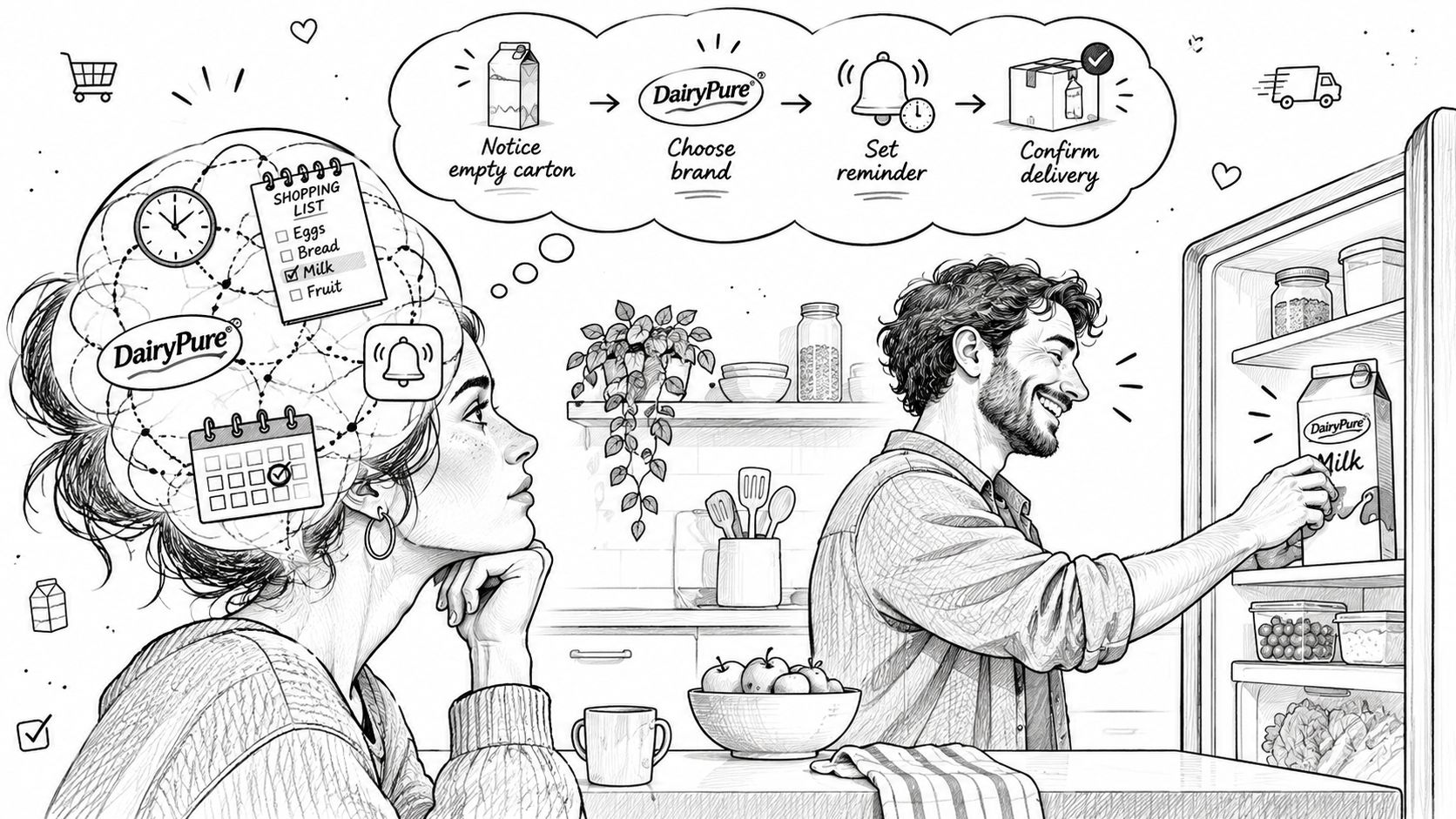
Execution is the visible act. Ownership is anticipating, deciding, assigning and monitoring. A chore chart splits the first one beautifully and leaves the second one exactly where it was, which is why a household can hit perfect parity on dishes and still have one parent who never fully clocks out.
The evidence on what hurts is fairly specific. In two studies summarized in a 2025 PLOS ONE article on maternal mental load, the most frequently reported source of load was constantly thinking about everyday tasks, cited by 68% to 93% of participants, and tasks that never felt finished were cited by 60% to 81%. Note what those numbers describe: not hours, but unresolved attention.
Execution is not ownership
The health cost follows the same pattern. Research on 322 mothers of young children found that mothers carried a disproportionately larger share of cognitive labor than physical labor, and that a greater maternal share of cognitive workload is linked with higher depressive symptoms, stress, burnout, poorer overall mental health and lower relationship quality.
For single mothers, the chore-splitting conversation has no second adult to land on. The answer there isn't better communication. It's capacity: a smaller set of commitments, or an owner outside the household who holds the loop. If you're rebuilding the list from scratch, this household chores list for adults is a decent starting inventory to mark up by who notices, not who lifts.
The one-week test: can you leave this task alone for a week and have it never return to your mind? If it comes back, you still own it, no matter who did the physical part.
How to Open the Handoff Conversation With a Partner
- Bring a moment, not a grievance. Write down the open loops from one ordinary evening, the permission slip, the dentist reminder, the unbought gift. Specific items land; "I do everything" doesn't.
- Name the whole loop you're transferring. "You own pediatric appointments from booking to follow-up, including transport and the prescription question." That's an owner. "Can you help me with the appointment?" keeps you as planner.
- Drop the helper framing. Help implies the work is still yours and someone is assisting. Ask for ownership, then don't supervise it.
- Hand over context once. Deadlines, provider details and preferences in a single note before the first task is due. Without it, the owner has to come back and ask, and the loop returns to you.
- Define what done looks like. The owner reports completion at a weekly checkpoint without being prompted. A partner who books the visit but leaves you to remember the follow-up took execution, not ownership.
If the same argument resurfaces every month, the pattern itself may need attention, and Uptown Psychology offers help when family arguments keep repeating so the conversation stops restarting from zero. The usual slip is negotiating an even chore split, which feels fair and leaves every planning decision with you.
Where the Load Lands Hardest and Who Should Own It
Load area | Typical open loops | Full-loop handoff | Proof the handoff works |
|---|---|---|---|
School and activities | Forms, deadlines, permission slips | Owner tracks deadlines, submits forms and sets reminders | No missed deadline in the term |
Medical appointments | Booking, insurance details, rescheduling, follow-up instructions | Owner books, records details, arranges transport and logs follow-up | Visits are booked and tracked without the parent asking |
Family calendar | Events, conflicts, pickups | Owner maintains the calendar and resolves conflicts | Owner reviews the calendar weekly without prompting |
Household supplies | Replenishment, brand choices, reorder dates | Owner sets reminders, orders and confirms delivery | No emergency supply run in a month |
Childcare and summer planning | Program research, registration dates, backup care | Owner compares options, registers and arranges backup | Booked before registration closes |
Care for aging parents | Appointments, medications, aide schedules | Owner coordinates provider calls and scheduling | Each appointment has one named owner |
The decision rule is simple: delegate first the area that generates the most interruptions in a typical week. Not the biggest task, the most frequent one. Frequency is what fragments attention.
Medical appointments and the family calendar usually top that list because each one bundles several steps. A national survey of mothers found that 87% of co-parenting mothers were primarily responsible for making their children's doctor appointments, including 83% of co-parenting mothers working full time, and that 70% of full-time working co-parenting mothers were primarily responsible for managing the family calendar.
Where shared calendars fall short
A shared calendar helps only if someone owns monitoring and action. Otherwise it's a display, not a system: the event exists, but nobody is watching for the conflict, the missing form, or the canceled appointment.
Household structure changes the assignment. In dual-career homes with several children, give each area a different owner rather than making one person the owner of everything, because a single owner recreates the same bottleneck under a new name. In single-parent households, the owner may need to sit outside the household entirely. Either way, the measure that matters is open loops and interruptions removed, not errands completed.
How to Hand Off a Full Task Loop
The whole process is four moves repeated until your list gets shorter. Here's the visual version, then each step in detail.
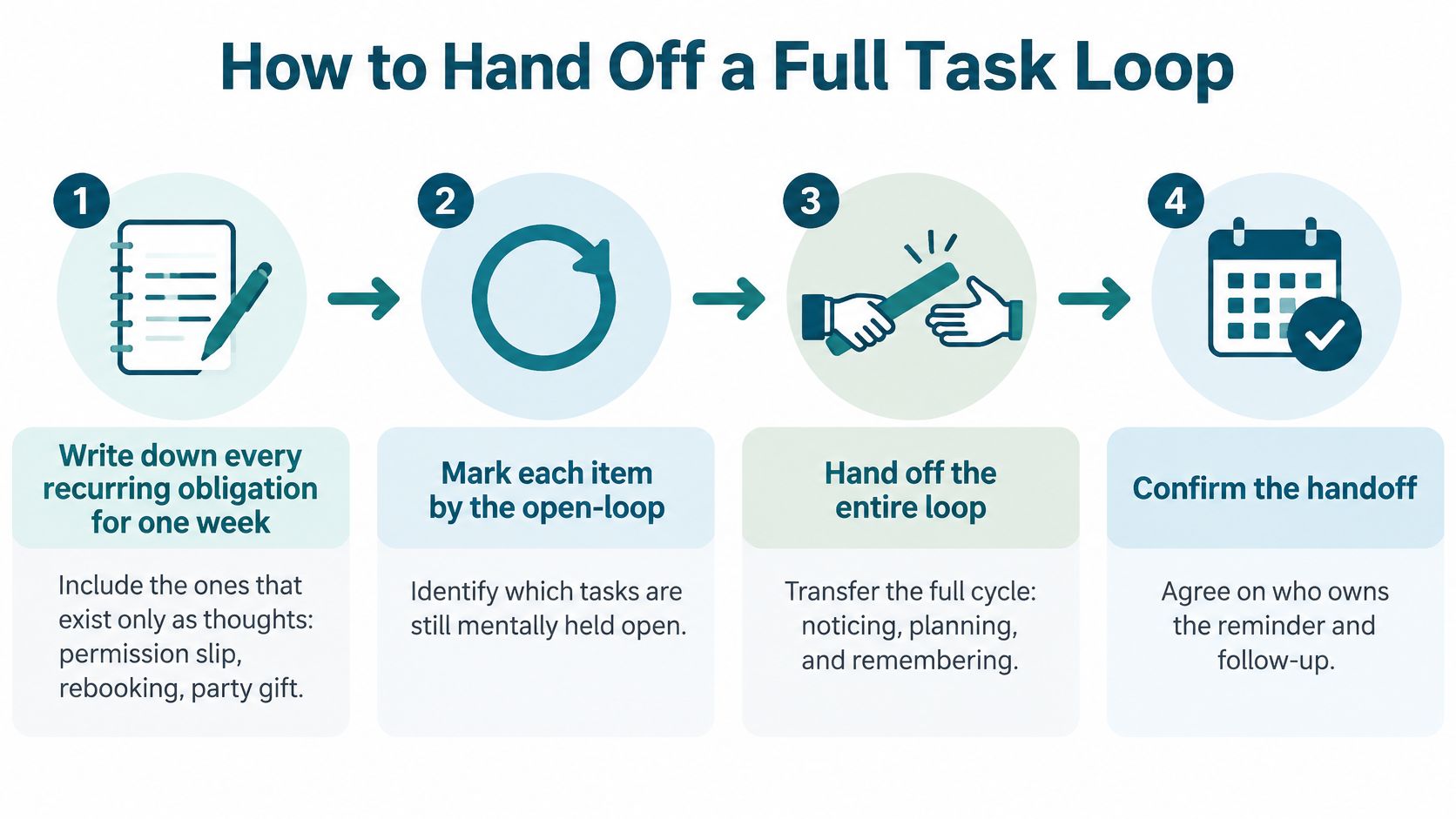
- Log one week of obligations. Everything recurring, including the items that exist only as thoughts: the permission slip, the rebooking, the party gift. You can't hand off what lives in a fog. Write it in one place, on paper or in a note, as it occurs to you.
- Mark each item with the open-loop test. Does it require noticing, deciding, scheduling, communicating or checking completion? Any yes means it's planning work, not just a task. Most parents discover that the errands they thought were chores are a fraction of the list.
- Choose the items that repeat weekly or monthly. Repetition is what creates constant interruption, and a one-time task handed off doesn't reduce daily load. School calendars, prescriptions, grocery replenishment, repairs and travel changes are the usual winners.
- Define the full loop in writing. Identify the need, research options, make the booking or purchase, record the details, confirm completion. If you leave out a step, the missing piece defaults back to you.
- Assign the whole loop to one named owner. Not a list of helpers each taking a piece. Fragmented ownership produces the same number of questions, just spread across more people.
- Hand over context once. Deadlines, preferences, vendor details and reminder dates in a single shared note. This is the step people skip, and it's why handoffs fail in week two.
- Set one checkpoint. Fifteen minutes weekly where the owner reports open items and closed ones. One review beats daily check-ins, which turn into supervision.
- Remove the item from your list after one full cycle. Not when it's assigned, when it's completed once without you. Until then, it's still yours in practice.
Where handoffs usually break
The most common failure is handing over a task without its deadline, so the parent still has to say when it's due. That single missing detail keeps the loop alive in the parent's memory and cancels the transfer.
The second failure is a weekly task nobody schedules. Consider cleaning: a standing visit removes the noticing, booking and quality check in one move, and this guide to every-week housekeeping for busy households shows what a recurring service covers. The third is ownership without authority, where the owner can't change a time or pick a provider without asking.
The broader logic here is the same one behind any good hand-off approach: scope, context and one accountable person. The success test is simple. You are no longer asked about the item.
Two Examples of Handing Off the Load
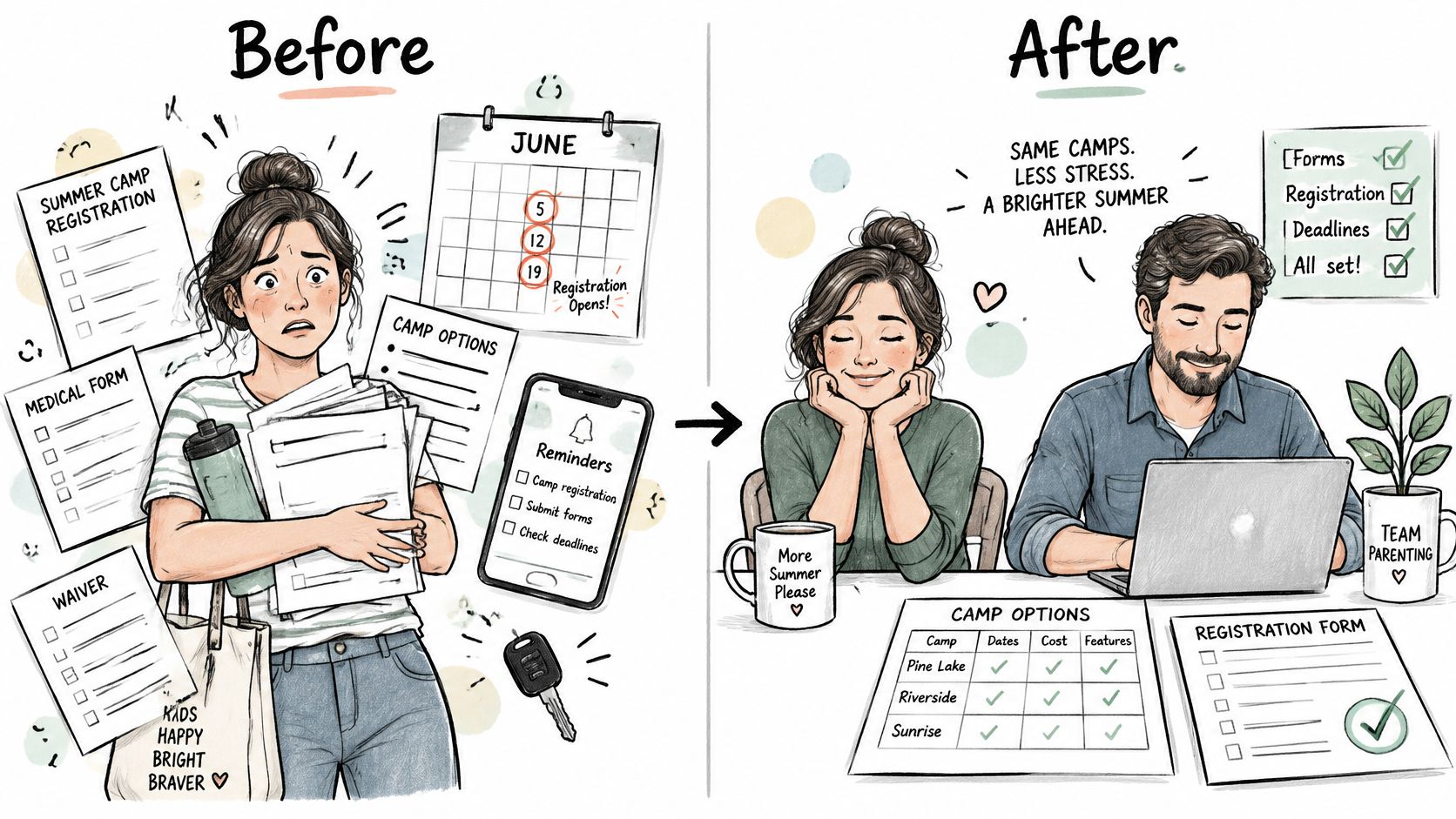
Summer camp, before. One parent researches programs in scattered moments, checks registration dates twice because she doesn't trust her memory, fills in the forms, arranges transport around two work schedules, and keeps the whole sequence alive until the first Monday in July.
Summer camp, after. The partner owns the full loop. In the first week he compares programs against the budget and the calendar, registers before the deadline closes, sends a transport plan, places reminders in the shared calendar, and reports completion at the Sunday checkpoint. Nobody asks the other parent a question, because there's nothing left to ask.
The pediatric visit, before. The mother notices the cough has lasted three weeks, finds a slot that works around school pickup, checks the insurance card, adds it to the calendar, arranges who drives, and remembers the follow-up question about the inhaler.
The pediatric visit, after. The owner notices, books, confirms timing and insurance details, adds the event with a note, arranges transport, and logs the follow-up instructions where both adults can see them.
The partial version is the one that fails. A partner books the appointment, then the parent still has to remember the follow-up, chase the prescription and ask whether the form was sent. That's execution with the planning left behind, and it explains why some families feel no relief after a supposedly successful handoff.
The video below walks through the same shift from the parent's side, and it's worth watching with a partner rather than alone.
Measuring it looks like this, and the numbers here are an illustration rather than a reported result. A parent logs 14 open loops at the start of two weeks and 6 at the end, with follow-ups she handles personally falling from 11 to 4. The household's total task hours barely changed. What changed is how many items kept knocking.
That's the shift worth aiming for. The test is whether you stopped being asked.
Track Your Load for Two Weeks Before You Decide
For fourteen days, log three things each evening: every open loop still in your head, who currently owns it, and how many follow-ups you handled personally. Add the hours you spent on coordination, not just errands.
Judge the result by decisions and follow-ups removed from your head, not by tasks completed. If an item is still yours after the owner has run one full cycle, the handoff is incomplete. Revise the shared note and the checkpoint rather than assuming the person can't do it. The tracking notes are also useful when the pressure shows up as distraction or a short fuse; if you want to rule out attention issues before assuming it's a scheduling problem, Interactive Counselling offers ADHD support for children and adults.
Keep the audit boring. One page, three columns, two weeks. Elaborate systems collapse in the first busy week.
If internal owners can't absorb the volume, outside support becomes a rational comparison rather than a luxury. Approved Lux Personal Assistant is one option to put on the same test: a monthly subscription with an Assistant team reachable by call, text or email, and the team covers family and household management, including school scheduling, childcare and medical appointments. Compare its cost against the hours and open loops it recovers, and keep it only if the tracked numbers fall. If you're still deciding where the calendar itself should live, this comparison of the best family calendar app is a practical place to start, since the tool matters far less than who owns monitoring it.
Approved Lux Personal Assistant gives you a dedicated US-based Assistant team reachable by call, text or email, with shared context that improves through Proactive Preference Learning, which is exactly what a household running on one parent's memory needs. Use it to take ownership of the full loops this article describes: appointments, school and activity deadlines, vendor scheduling, travel details and the follow-ups that currently live in your head. Visit Approved Lux Personal Assistant to see the plans and start measuring what leaves your list.