Logistics vs Transportation: What Each Covers and When
Logistics vs transportation explained: where movement ends and coordination begins, with practical examples for travelers and households.
11 min read

Your flight is booked, your calendar is full, and someone has just asked who's collecting the child while you're away. You've arranged the journeys, but you're still managing hotel messages, pickup changes, and the appointment that no longer fits. Everything has a booking confirmation. Nothing feels finished.
That's where logistics vs transportation becomes a useful diagnostic rather than a vocabulary exercise. The distinction tells you whether to fix a ride or route, or give someone ownership of the decisions around it.
Logistics and Transportation Side by Side
Transportation is the physical movement of people or goods. Logistics is the wider system that plans, coordinates, executes, and monitors that movement, including storage, inventory, documents, customs, handoffs, and payment.
Say your flight lands on time, but your room isn't ready, the driver has the wrong terminal, and your client expects you at dinner before you can reach the hotel. The airline completed its transportation task. Nobody aligned the trip.
Transportation vs logistics at a glance
Dimension | Transportation | Logistics |
|---|---|---|
Core question | How does the shipment or traveler move? | How is the whole flow organized so the right person or item arrives on time and at cost? |
Scope | Movement by truck, rail, air, sea, car, or rideshare | Movement plus inventory, documents, handoffs, timing, and exceptions |
Typical tasks | Mode choice, routing, booking a flight or car, scheduling a pickup | Itinerary building, hotel timing, contingency rebooking, vendor coordination |
Measured by | Cost per shipment, pickup and delivery punctuality, transit time | Order-cycle time, fill rate, perfect-order rate, exception-resolution time |
Failure looks like | A late truck, a cancelled ride, a missed flight | The right item or person in the wrong place, with follow-ups multiplying |
Household example | Airport shuttle for a child's summer camp trip | Camp drop-off, carpool, backup pickup, and lunch timing across two parents' calendars |
Movement is a component, not the whole system
The World Bank's description of logistics services places transportation inside a broader network that supports physical movement and trade, including warehousing, border clearance, payment processes, and information management. That scope explains why a fast vehicle doesn't prove strong logistics.
A shipment can travel quickly after loading yet still arrive too late for its purpose because inventory wasn't available, customs paperwork was wrong, or the receiving warehouse lacked capacity. Paying for faster freight won't necessarily correct those problems. Someone must change how the surrounding work is organized.
The same trade-off applies outside freight. A cheaper airport transfer may be a poor choice if its departure schedule forces you to miss a meeting. Conversely, a more expensive car won't help if nobody has confirmed the meeting address.
Practical rule: Judge the movement by how it runs. Judge the logistics by whether the whole commitment gets completed.
When the vehicle, carrier, route, or ride is the problem, start with transportation. When stock, paperwork, timing, or another person waiting on the movement is the problem, examine logistics.
Most business trips and household weeks contain both layers. Separate them before deciding who should book, who should coordinate, and who should respond when something changes.
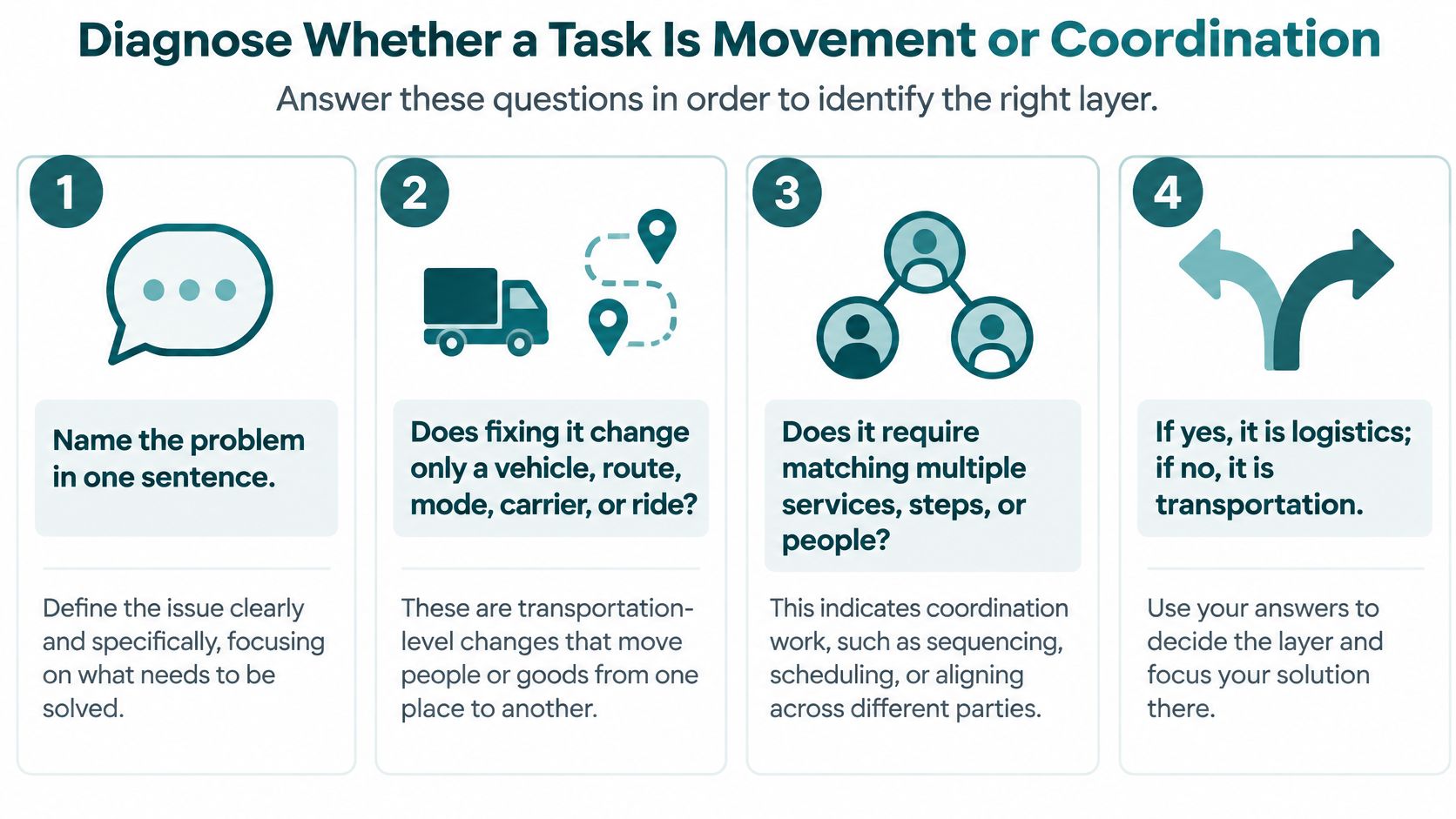
Diagnose Whether a Task Is Movement or Coordination
Start with the failed outcome, not the supplier you're frustrated with. The Association for Supply Chain Management's logistics guidance includes transportation alongside warehousing, fulfillment, inventory, and coordination. In practice, that means the person moving something may not own the process that made the movement necessary.
Use these questions before buying another service or delegating another isolated task:
- What is the problem in one sentence? Write the observable failure. “The driver arrived after pickup closed” is useful. “Travel is a mess” isn't specific enough to assign.
- Would fixing it change only a vehicle, route, mode, carrier, or ride? If another departure, driver, or route resolves the entire issue, you're probably dealing with transportation execution.
- Does it involve stock, documents, a handoff, or another party waiting on a decision? Look for dependencies. Who needs confirmation before they can act, and what happens if they don't receive it?
- Which layer needs ownership? If only the movement needs changing, treat it as transportation. If services, people, or steps must be reconciled, treat it as logistics, with transportation tasks inside it.
Apply the test to the consequence
Freight: A late truck is a transportation problem. When that delay also causes a missed dock appointment and leaves a warehouse crew waiting, the response becomes logistics work: reschedule receiving, notify the crew, and revise downstream commitments.
Business travel: Rebooking a flight is transportation execution. Reconciling its new arrival time with hotel check-in, dinner, and the next morning's departure is coordination. When comparing ground transportation services, specify who updates the pickup when the flight changes, not just which vehicle you want.
Household: Booking a school shuttle addresses movement. Deciding who receives the child, who covers an absence, and whether lunch and equipment travel with them addresses logistics.
Don't turn the test into a debate over labels. Its purpose is to identify the missing owner and the next action.
If the same failure keeps returning, fix the coordination layer first. A better vehicle won't prevent a recurring handoff gap, and another booking app won't decide which parent is responsible when the usual arrangement falls through.
Metrics Each Layer Should Track
Use a two-layer dashboard. Transportation measures should show whether carriers and journeys performed as agreed. Logistics measures should show whether those movements produced a completed order or commitment without avoidable waiting, errors, or recovery work.
The Association for Supply Chain Management's supply-chain logistics overview distinguishes movement activities from the broader work of inventory positioning, order management, warehousing, and distribution. Your dashboard should preserve that distinction rather than compress everything into an average delivery time.
Metrics by layer and what each reveals
Metric | Layer | What it reveals |
|---|---|---|
On-time pickup | Transportation | Whether carriers arrive at the agreed time. A 2024–2025 RXO study of 1,000 shippers and carriers reported an industry standard of 95%. |
Cost per shipment | Transportation | The price of a single movement on a lane |
Tender acceptance | Transportation | Whether carriers accept the loads assigned to them |
Delivery punctuality | Transportation | Whether the final drop lands within its window |
Order-cycle time | Logistics | Total time from order to delivery, including waits between legs |
Fill rate | Logistics | Share of requests fulfilled from available stock |
Perfect-order rate | Logistics | Share of orders delivered complete, on time, undamaged, and correctly documented |
Exception-resolution time | Logistics | How fast delays, cancellations, and errors get fixed |
Read the measures together
A carrier can meet its pickup target while poor consolidation, customs delays, or warehouse bottlenecks extend the total order cycle. The carrier's result isn't false. It's incomplete evidence of whether the wider process works.
Likewise, a lower shipment price isn't automatically a saving. Check whether the change requires extra handling, more stock on hand, or additional staff time before accepting the apparent improvement.
For a traveler, punctual arrival at a meeting is a useful transportation outcome. Completing the trip without duplicate bookings, missed check-ins, or unplanned follow-ups is a logistics outcome. Record both rather than treating a successful flight as proof that the itinerary worked.
A green movement dashboard can coexist with an overloaded person fixing everything between journeys.
For household or travel administration, a shared task log is enough to begin. Record the request, responsible person, deadline, disruption, resolution, and whether you had to intervene.
Review exception-resolution time monthly. If cancellations and errors take longer to settle even while journeys remain punctual, inspect unclear approvals, missing preferences, and unresolved handoffs. Don't respond by tracking more movement detail when the delay is waiting for someone to make a decision.
Business Trip Examples Across Both Layers
Consider a sales executive flying to Denver on Tuesday, with a client dinner on Wednesday evening. They need a hotel near the client and a car from the airport. A useful itinerary must account for when the executive can use each reservation, not just show that each reservation exists.
Before departure
Transportation covers choosing and booking the flight, arranging the airport car, and planning the rideshare to dinner. Compare departure times, airport access, and the route to the destination.
Logistics covers matching arrival to hotel check-in, confirming the dinner reservation, preparing the executive's meeting information, and keeping a backup route available. Put addresses, confirmation details, cancellation conditions, and contact information in an accessible itinerary rather than scattering them across inboxes.

A hotel near the client may reduce local travel but still be unsuitable if its arrival arrangements don't fit the flight. A cheaper flight may create an awkward overnight wait. Evaluate the usable schedule, not each booking in isolation.
Our business travel management guidance addresses this broader coordination need. The practical objective is to let the traveler focus on the client rather than repeatedly reconstruct the plan.
When the flight is cancelled
Suppose the airline cancels the outbound flight at midnight before Tuesday's departure. The transportation fix is another flight. The logistics fix is to check the new arrival against the hotel's policy, move the car pickup, notify the client if necessary, and rebuild Wednesday's schedule.
Don't automatically buy the first available replacement. Establish which commitment is fixed, what can move, and which changes require the traveler's approval. Otherwise, a quick rebooking can create another conflict.
- Flight and hotel work: Our Approved Lux Assistant team handles research, booking, and changes.
- Ground movement: We coordinate car services, rentals, and rideshare arrangements.
- Mid-trip disruption: On Lux Traveler, a problem that arises during the trip can be handed straight to our Assistant team.
Human judgment matters here because an available booking isn't necessarily a workable booking. The team can coordinate the alternatives and associated changes, but rebooking results depend on airline and hotel availability. We don't guarantee a particular flight, room, or reservation outcome.
A useful handoff includes the required meeting, acceptable alternatives, and spending approval. That gives the team a decision boundary rather than another chain of clarification messages.
Household and Caregiver Coordination Examples
A household calendar records commitments. It doesn't necessarily assign responsibility for getting everyone ready, moving them, and handling an absence.
Take a summer camp drop-off split between parents. The ride might be a shuttle, carpool, or parent driving. The logistics include enrollment, forms, deadlines, authorized pickup details, a backup driver, and the lunch and gear list.
Assign the preparation as well as the ride
Don't stop at putting the driver's name beside departure. Give someone ownership of confirming that the child can attend and that the receiving adult knows what's happening.
- Before camp: Confirm enrollment, required forms, equipment, and food.
- At the handoff: Identify who drops off, who collects, and how each person confirms completion.
- If someone is sick: Name the backup and establish who contacts them.
Group travel creates a similar problem. If relatives are arriving together, Airport Vans NYC's guide to airport pickup logistics for 12 passengers is a relevant planning resource. Use that kind of group-pickup checklist to distinguish choosing a vehicle from coordinating passengers, luggage, and a meeting point.
Keep care administration separate from care delivery
For an aging parent's medical appointment, transportation is the ride booking. Logistics includes assembling the current medication list and insurance details, updating siblings, and matching the appointment with the in-home aide's schedule.
Our care coordination services support that administrative work. On Lux Traveler, our Assistant team covers family and household management, including school scheduling, childcare, and medical appointments. Medical decisions remain with the patient and qualified clinicians.
Approved Lux doesn't provide in-person services, such as house sitting or in-home caregiving. We find, vet, and schedule the people who provide those services.
Members work with a team rather than one assigned person, so another team member can pick up a request when someone is unavailable. That supports continuity without guaranteeing a specific provider or outcome.
List the household tasks that generated the most follow-up texts last month. Sort each into transportation or logistics, then identify which coordination responsibilities still have no clear owner.
Choosing Who Owns Each Layer for Your Situation
Delegate according to the work that consumes your attention, not the number of reservations you make. A single complicated appointment can require more coordination than several straightforward journeys.
The right choice depends on whether you need occasional execution, recurring administrative ownership, or Assistant support combined with travel benefits.
Occasional journeys with few dependencies
If you take occasional trips or arrange a single ride a month, handle transportation yourself with a booking tool. Save the confirmation to your calendar, verify the pickup location, and retain the provider's contact details.
There's little reason to delegate a task you can complete cleanly without creating follow-ups. I would start with a better checklist before adding a subscription for a simple, infrequent booking.
Frequent travel or a household coordination backlog
Delegate logistics when the drain comes from chasing confirmations, reconciling calendars, researching alternatives, and handling changes. Give the Approved Lux Assistant team responsibility for a defined outcome, not just a fragment of the work.
Lux Solo suits individual travel and administration. Lux Circle extends travel, scheduling, errands, and research to a small household on one account.
Approved Lux plans compared
Plan | Price | Covers | Best for |
|---|---|---|---|
Lux Solo | $99.99/month | Individual travel, scheduling, errands, and research | One person with frequent travel or errands |
Lux Circle | $299/month | Travel, scheduling, errands, and research for up to 4 people on one account | A small household or family |
Lux Traveler | $1,799.99/year | 24/7 US-based personal assistant, full travel marketplace, coverage for up to 10 household members | Households needing Assistant support and travel benefits together |
Assistant support and travel benefits together
Choose Lux Traveler when you need both ongoing Assistant support and the full travel marketplace. Compare the actual bundle with your needs rather than assuming that buying separate services will be more suitable.
Triple-channel access means members can call, text, or email at any hour of the year, with all channels monitored at equal priority. Use the channel that fits the situation rather than sending duplicate requests through each one.
Onboarding captures preferences and access standards. Proactive Preference Learning helps the team adapt to routines over time, reducing the need to explain the same requirements repeatedly. This is a team-based force multiplier, not another employee whose payroll, benefits, and daily workload you must manage.
Delegation boundary: State the outcome, deadline, approval limits, and circumstances that require your decision.
Evaluate the service by the follow-ups you no longer handle and the decisions you can safely delegate. Subscription access alone doesn't reclaim time if every small choice still returns to you.
Write down the last five tasks that caused a follow-up. Classify each using the movement-or-coordination test, identify where failures repeated, and choose the plan that matches that work. If the problem is a ride, book the ride. If it's everything surrounding the ride, assign ownership of the logistics.
Approved Lux Personal Assistant offers human Assistant support for travel, scheduling, errands, and the coordination that turns separate bookings into a workable plan. Visit Approved Lux Personal Assistant to compare the options and bring a concrete list of recurring follow-ups you want to hand off.