Large Family Travel: Planning Lodging, Flights and Costs
Plan large family travel with the right lodging, flight seating, shared costs and activities. Practical steps for groups of 8 to 10 people.
15 min read

Your group chat has 41 messages, three people saying they don't care where they sleep, one grandmother asking whether the house has a step-free entrance, and a brother-in-law who has already put a deposit on something nobody else agreed to. That's what large family travel looks like before a single booking exists: one organizer, several decision-makers, and two or three people paying.
This isn't a niche anymore. 57% of parents planned to travel with both grandparents and children in 2025, up from 55% in 2023, according to New York University's 2025 Family Travel Survey. The trip is a coordination problem wearing a vacation costume. Treat it that way and the decisions get easier: capacity first, then seats, then access, then money.
Match Lodging to Your Group Size
Large groups often choose vacation rentals for space and privacy, but bedroom count alone will not tell you whether eight people can sleep, eat, and gather comfortably. Start with capacity, then work outward to bathrooms, seating, parking, and who is paying for which unit.
Group size | Bedrooms to look for | Lodging format |
|---|---|---|
4 to 5 people | 2 to 3 bedrooms | Condo or vacation home with one shared kitchen |
6 to 7 people | 3 to 4 bedrooms | Vacation home, or hotel suites that connect |
8 to 10 people | 5 to 6 bedrooms | One six-bedroom vacation home under one roof |
11 or more people | 6+ bedrooms across two properties | Two linked homes or a large villa, with occupancy checked per property |
Read the table as a hard filter, not a wish list. The jump from seven to eight travelers is where searches break. Hotels stop offering one unit that fits, and the group starts pricing four or five rooms instead. A six-bedroom house keeps everyone under one roof, but only if the bed count, bathroom count, and rental occupancy limit all match the group.
A useful rule: give each couple, grandparent, child, and single adult a named sleeping place before any deposit is paid. If two cousins are expected to share a sofa bed, write that down. If the youngest children need a crib or the grandparents need a ground-floor room, write that down too. A floor plan with eight beds and two bathrooms may technically fit ten names, but it will create morning bottlenecks and late-night conflicts.
What the bedroom count hides
Advertised bedroom count does not confirm capacity. Before you commit, verify the actual bed configuration in each room, the number of bathrooms, kitchen seating and cookware capacity, parking spaces, and whether any sleeping space is a sofa bed or bunk. Ask explicitly whether the occupancy limit counts infants, children, and daytime visitors separately, because a house that sleeps ten adults on paper may cap the group at eight once the rental agreement defines who counts.
The test that settles it: write every traveler's name against a specific sleeping place. Any name without a bed means you move up a row in the table or book two linked homes.
Groups of 11 or more should plan on two properties and check occupancy per property, not in aggregate. A six-bedroom home plus a three-bedroom house a short drive away beats one villa that technically holds fourteen people in six rooms with two bathrooms. Keep the closer pair of homes when you can. Short drives still matter when you are moving coolers, luggage, strollers, and early bedtime routines.
Two comparisons worth running before you book
If the group is within a day's drive of the destination, trailer capacity becomes a real alternative to flights plus a rental. This breakdown of three Surveyor Legend models maps bunkhouse layouts to headcount, which is the same bedroom-count logic applied to a towable. For most organizers, though, the decision is between a shared house and hotel rooms, and a direct hotel versus vacation rental comparison is faster than pricing both by hand.
The practical split: if the group needs a kitchen for breakfast and a living room for evenings, take the house. If the trip is two nights and everyone eats out, take connecting hotel rooms. For a large family, the better lodging choice is the one that reduces daily coordination after the booking is made.
Coordinate Flights and Seating for Every Generation
A group of nine rarely flies as one decision. One person buys grandma's ticket, another books the kids, two adults want aisle seats, and nobody wants to pay a family of five four separate seat fees. Before the deposit, put every traveler on one itinerary grid: name, birth date, reservation number, cabin, seat, caregiver, and who can sit where. If the grid only works verbally, it does not work.
The U.S. Department of Transportation's family seating dashboard sets the baseline: airlines must have policies that let a child aged 13 or under sit next to an accompanying adult at no additional charge, to the maximum extent practicable. The conditions decide whether that protection helps your group. The child and adult usually need to be on the same reservation, adjacent seats must exist when you book, both travelers must be in the same cabin, and the aircraft layout must allow it. That framework does not force a free upgrade, extra legroom, or a better cabin.
Use this table as a planning aid, then verify the current rule with the airline before ticketing. Treat each "planning action" as the safer operating procedure, not as a guaranteed seat assignment.
Carrier | Fee-free adjacent seating commitment | Planning action |
|---|---|---|
Alaska | Confirm current family-seating terms with the carrier | Keep child and adult on one booking and select seats together |
American | Confirm current family-seating terms with the carrier | Keep child and adult on one booking and select seats together |
Frontier | Confirm current family-seating terms with the carrier | Keep child and adult on one booking and select seats together |
Hawaiian | Confirm current family-seating terms with the carrier | Keep child and adult on one booking and select seats together |
JetBlue | Confirm current family-seating terms with the carrier | Keep child and adult on one booking and select seats together |
Allegiant | Confirm current family-seating terms with the carrier | Get adjacent seats in writing before paying |
Delta | Confirm current family-seating terms with the carrier | Get adjacent seats in writing before paying |
Southwest | Confirm current family-seating terms with the carrier | Get adjacent seats in writing before paying |
United | Confirm current family-seating terms with the carrier | Get adjacent seats in writing before paying |
For a nine-person group with two children under 15 and one infant, start with the protected pairs. Seat each child 13 or under with an accompanying adult in the same cabin, then place the infant's caregiver beside the infant. Keep those travelers out of exit rows if they are under 15 or are caring for small children. Only after those seats are locked should you place grandparents and other adults around them. Lap-child rules and the age of the adult holding the child vary by carrier, so confirm that detail before the itinerary is ticketed.
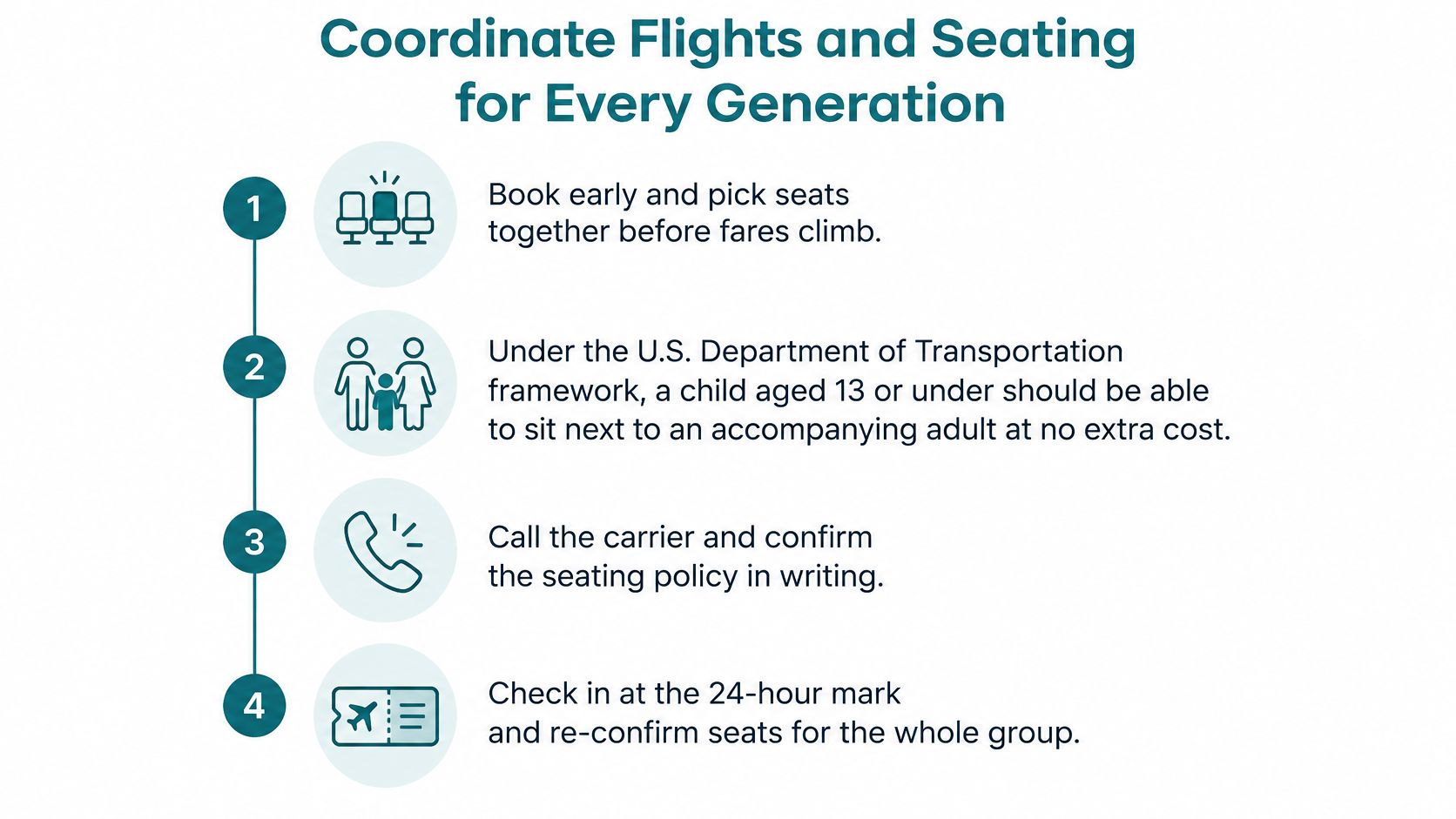
- Link the reservations. Put everyone on one booking or linked bookings at purchase. Add links after payment only if the airline allows it, and save the confirmation.
- Confirm adjacent seats before paying. Select seats for each child 13 or under and the accompanying adult, then check the seat map for side-by-side seats in the same cabin.
- Seat an eligible adult beside each young child. One adult per child is the working standard. Do not plan on one adult managing four children across an aisle.
- Keep exit rows clear. Exclude children under 15 and passengers caring for small children from exit-row seats before the seat map is finalized.
Working rule: keep a written seat map with names and seat numbers, and re-run the check every time the reservation changes. A schedule change from the airline counts as a change.
Ground transport needs the same discipline. A group arriving on three flights needs one confirmed vehicle capacity, one pickup time, and one named meeting point. A private transfer with fixed capacity and a fixed price is easier to audit than three rideshares leaving from different terminals. Operators who handle reliable rides for Cancun wedding parties apply that same group-arrival logic: count every passenger, confirm luggage space, and put the pickup time in writing.
Verify Access Needs Before You Pay a Deposit
Most organizers build the plan around the average traveler and then discover the house has three steps to the front door. Start with the least mobile traveler and the youngest child instead, because their constraints eliminate properties faster than anyone else's preferences.
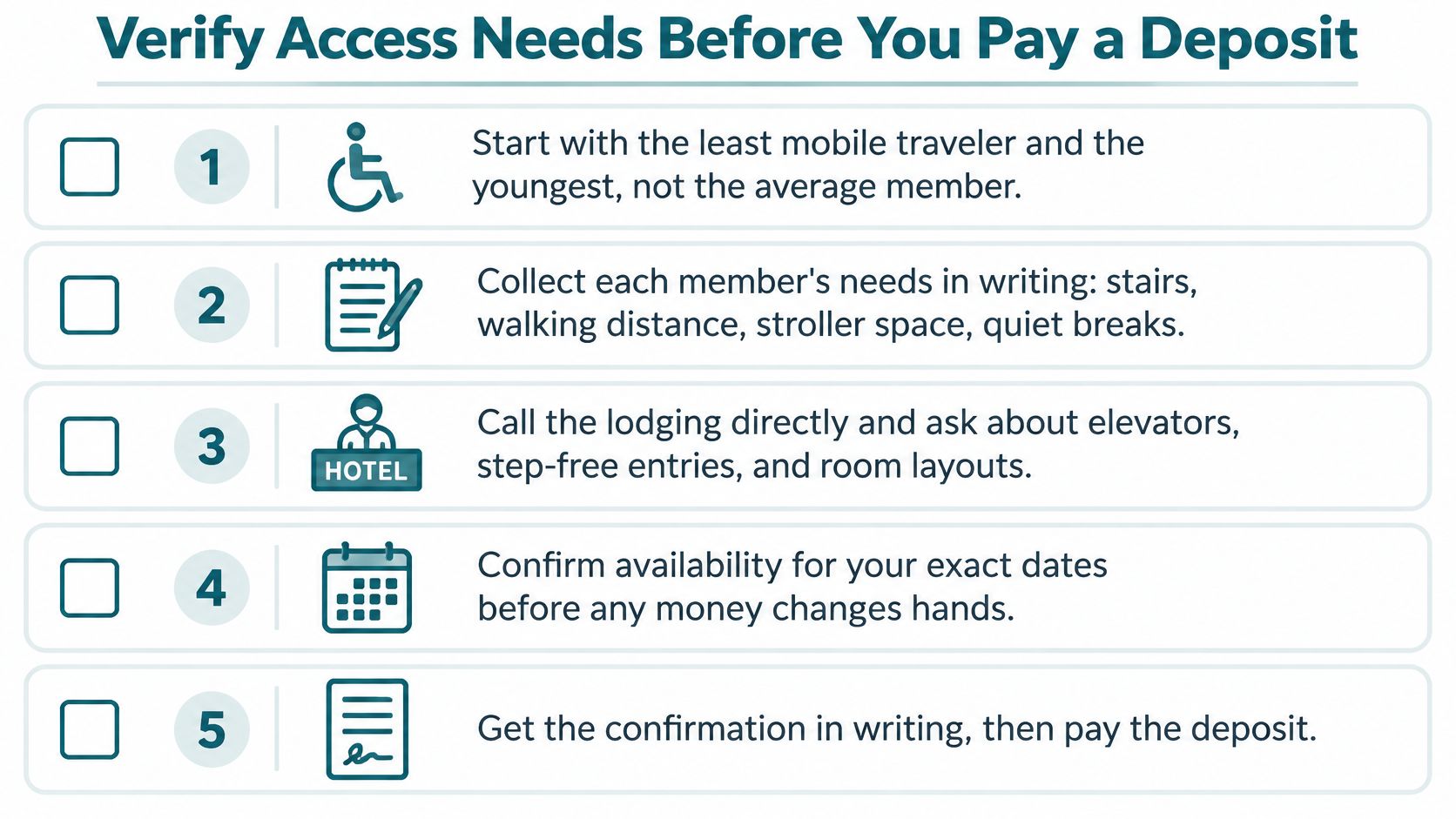
- List every requirement per traveler. Mobility aids, stair tolerance, bathroom access at night, medication refrigeration, dietary restrictions, and any activity a person must sit out. One shared document, one row per person.
- Match each requirement to a physical detail. Step-free entry, a bathroom on the same floor as the sleeping area, a bedroom that doesn't require stairs, a shower with a seat. Generic labels like "accessible" prove nothing; the specific room does.
- Set a transfer limit in advance. Pick a threshold such as 45 minutes from airport to property for a traveler with limited mobility, then test every route, including the excursion pickups, against that number.
- Confirm each excursion with the operator. Ask how a guest with a walker boards the boat, whether the van has a step, and where the accessible restroom is on the route. This is the weakest link in the chain: 47% of travel advisors named excursions one of the hardest categories to research, according to TravelAbility's Vision 2030 accessibility research, and 31% of families reported stress about whether lodging would meet their group's needs.
- Write a backup for every critical need. An alternative property, a rental equipment supplier, a pharmacy and a medical contact near the house.
- Book only after the document is confirmed in writing. Screenshot the email or chat where the property confirms step-free entry and the excursion operator confirms boarding. Then pay.
Traveling with older parents adds one more layer: medication timing, rest breaks, and heat exposure all shape the daily schedule more than any attraction does. These notes on traveling with elderly parents cover the pacing decisions that keep a multi-generation itinerary workable.
When the requirements document is signed off, do the booking itself in the Approved Traveler member portal, which members reach by signing in from the website, and store each confirmation in the same folder as the requirements. One place for both means the access details travel with the reservation instead of living in someone's camera roll.
Split Costs and Assign Payment Roles
Money is the second coordination problem, and it's the one that outlives the trip. The pattern is well documented: adult children organize or co-organize 46% of trips taken with boomer grandparents, and costs are split between generations on 39% of trips, per Skift Research on multigenerational travel. The organizer is often not the payer, and the payer is often not the person choosing the house.
Three payment models cover almost every group. The organizer pays everything and collects from each household afterward, which is simple and puts real float risk on one person. Grandparents cover lodging while each family covers its own flights and activities, which matches how many families already operate. Or every household pays its own share of one shared home, which is the most transparent and the most argumentative.
Run each against a plain example: ten people, one six-bedroom home, $6,000 total.
Split rule | Trade-off |
|---|---|
Headcount split | $600 per person ($6,000 ÷ 10). Simple, but overcharges families with young children who use fewer activities |
Bedroom split | $1,000 per bedroom. Fair for sleeping arrangements, but ignores meals and transport |
Neither rule survives on its own. Headcount splitting punishes the family with a toddler who skips two excursions. Bedroom splitting rewards the household that claims the master suite and ignores that the grandparents paid for every dinner.
The rule I'd write down before booking: lodging splits by bedroom, flights split by household, and shared meals, cars, and activities split by headcount. Three lines, agreed in the group chat, screenshotted.
Then keep one payment tracker with columns for the item, the amount, the due date, who owes what, and who has paid. Update it at every deposit and again at final payment. The tracker is the difference between a reunion and an audit.
Household scale helps here. Up to 10 family members share one account at no extra cost, from grandparents to grandkids, and each one gets the full member rate, so the organizer can hold the bookings while households settle among themselves. A family vacation budget planner gives the tracker its structure if you'd rather not build one from scratch.
Align Cancellation Rules Across Bookings
One late change collapses a trip when the bookings have different deadlines. The fix is a single shared sheet listing every reservation with four fields: deposit amount, deposit due date, final payment date, and cancellation deadline.
A worked example. The six-bedroom home takes a 50% deposit at booking, the balance is due 30 days before arrival, and cancellation is free until 60 days out. The flights sit on a fare that permits changes for a fee. The sunset boat tour has a 14-day cancellation window.
The earliest deadline on that sheet, 60 days out, is now the date the whole group must confirm headcount. Not the deposit date. The deadline that ends the refund is the deadline that governs the decision, because everything after it costs money to change.
Before any non-refundable payment, confirm four things in writing:
- Lodging refund schedule. The exact date free cancellation ends, and what percentage comes back after it.
- Airline fare rules. Whether changes are allowed, what they cost, and whether the credit expires.
- Excursion windows. The cancellation cutoff for each tour, transfer, and activity, in the operator's time zone.
- Insurance terms. One policy covering all members, bought before the first non-refundable deposit, with confirmation that it covers illness of an older traveler or a child.
Then compare the earliest cancellation deadline against the realistic date your group can confirm numbers. If the deadline lands two weeks before the last household commits, move the whole booking to a property with a later cutoff. Store the rules next to the payment tracker so the person chasing money and the person chasing deadlines are reading the same page.
Choose Activities Each Generation Will Enjoy
Decisions are distributed, and children hold more of the vote than most organizers assume. 77% of children influenced daily activities and 62% influenced destination selection, according to the multigenerational travel survey reported by TravelPulse. Build the plan with them in the room rather than announcing it to them.

The structure that survives contact with nine people is three blocks per day. A shared block where the whole group does one thing together, usually a meal or a boat trip. An age-specific block where the group splits into two or three parallel plans, such as a kids' program, a round of golf, and a museum. A rest block with nothing on the schedule, which is the block organizers delete first and regret most.
On a nine-day reunion, that looks like a shared dinner on arrival day, a split day in the middle with two parallel groups meeting back for the evening, and a half-day of nothing after any long transfer. One shared activity per day is the ceiling. Two is how you get a group of nine where four people are resentful by day three.
Place the most physically demanding activity at the start of the day, when the least mobile member has the most energy and the heat is lowest. Afternoon slots go to swimming, naps, or anything that tolerates stragglers.
Conflict rule: each generation gets one choice in the itinerary, and the youngest travelers pick one shared activity for the whole trip. A plan where nobody chose anything is a plan people quietly skip.
Booking the shared activity early matters more than booking it cheaply, especially for anything with capacity limits or a fixed departure. A planning guide to swim with manta rays in Kona shows the shape of that decision: one operator, one time slot, one group size, and a booking window that closes long before the trip does.
The closing check is simple. Ask every member to name one activity they chose. Anyone who can't is the person who will opt out on the day.
Run the Trip Day to Day
The trip runs on one shared daily itinerary, updated each evening with tomorrow's meeting points, transport times, and headcount. Not a printed folder. One document or message thread that everyone checks before bed.
Say it's day four of a nine-day reunion. The morning meeting point is the kitchen at 8:30, with two cars leaving at 8:45 for a 9:15 tour. Grandmother is staying back with the youngest child, so that pair is logged with a named adult and a phone number. Lunch is a confirmed table for ten at 1:00, not a walk-in. The afternoon is unscheduled. The evening message repeats the next day's meeting point.
Decision ownership needs to be explicit before arrival. The organizer approves changes to lodging and budget. Each household leads its own meals and free time. Every minor's schedule routes to a named adult, not to whoever is nearest.
Handoff rule: when something breaks during the trip, one person contacts the provider directly. Problems handled in a group chat get four opinions and no resolution.
Watch the failure points that hit large groups hardest: a missed airport transfer when flights land at different times, a sick child in a house with one bathroom, and a restaurant reservation for ten that was never confirmed. Each one is a five-minute fix in advance and a two-hour disruption on the day.
Build a buffer day into any itinerary longer than a week, and hold one firm rule: no minor stays at the property without a named adult present. Close each day with a ten-minute check-in covering headcount, the next meeting time, and one pending decision. On Lux Traveler, a member can hand a problem during a trip straight to the Lux team, which is the difference between the organizer solving a transfer failure at midnight and someone else doing it.
Pick a Plan and Lock Your Dates
Two decisions remain, and they're smaller than they look. Approved Traveler starts at $899.99 per year and gives wholesale-tier access to hotels, flights, cruises, cars, homes, tours, and activities, with Reward Credits on every booking. Lux Traveler costs $1,799.99 per year and adds the Approved Lux 24/7 Personal Assistant for logistics and household coordination. Both plans cover up to 10 people, so a group of eight to ten fits either tier, and the choice comes down to whether the organizer wants help running the trip or intends to run it personally.
Either tier is backed by the 110% Best Value Guarantee: if a member finds a lower publicly available price, the refund equals 110% of the difference.
Then run the sequence in this order.
- Confirm group size and the lodging format from the first table.
- Confirm flight seating carrier by carrier.
- Complete the access requirements document and get it confirmed in writing.
- Set the payment model and write down the split rule.
- Choose the tier and book in the member portal.
Step 3 comes before step 4 on purpose. No payment model is settled until the access requirements document is confirmed in writing, because a property that fails the step-free check changes the house, the price, and everyone's share.
The first action is the cheapest one: write the full traveler list today, every name and every age.
Approved Experiences Traveler consolidates the whole coordination problem into one place, with wholesale access to more than 1,000,000 hotels, 500,000 vacation homes, flights, cruises, cars, tours, and activities, and up to 10 family members on a single membership. If you're the organizer holding the group chat, the tracker, and the seating map, that consolidation is the point: one platform instead of six, one account instead of a dozen logins, and Reward Credits on every booking you make for the family. Visit Approved Experiences Traveler to compare the Traveler and Lux Traveler tiers and start with the traveler list you wrote today.