How to Value Your Time: A Practical Cost Guide
Learn how to value your time with an opportunity-cost method, a 14-day audit and a buy-back test for recurring tasks.
10 min read

Across nearly 100,000 working adults, people who spent money outsourcing disliked tasks reported more satisfying careers, stronger relationships, and greater happiness, according to Harvard Business School's Time for Happiness. That doesn't mean every errand is worth outsourcing. It means the decision deserves a better calculation than comparing a service fee with the cost of doing it yourself for free.
Learning how to value your time starts with identifying what you're giving up. The appointment booking might look inexpensive, but the messages, calendar changes, and unresolved follow-ups can make the full coordination loop costly.
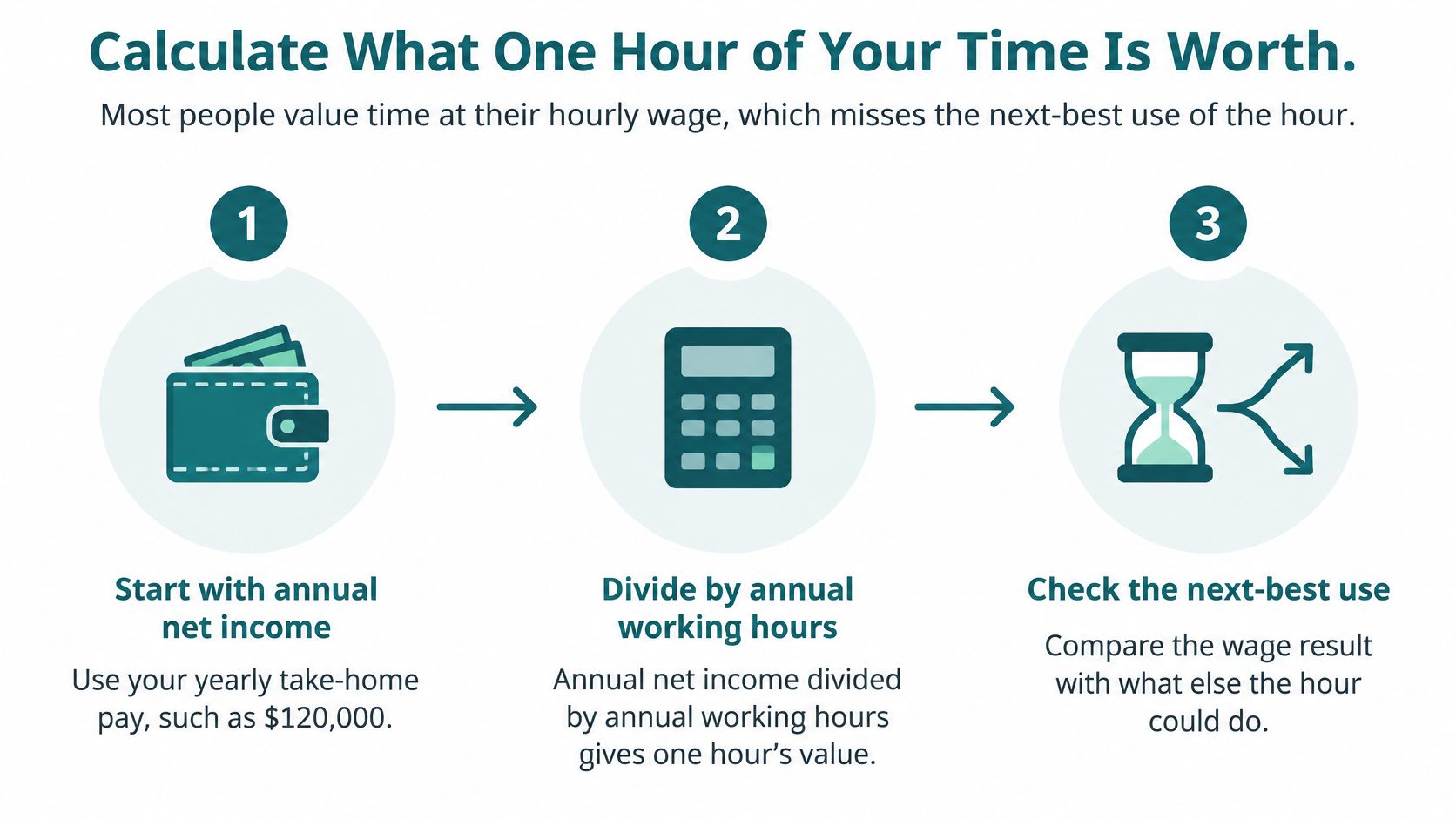
Calculate What One Hour of Your Time Is Worth
You might start with your hourly wage. That's a useful reference, but it misses the next-best use of the particular hour you're considering.
For a hypothetical quick calculation, divide annual net income of $120,000 by 2,080 working hours to get $57.69 per hour. This is an income benchmark, not permission to price every evening, weekend, and interrupted lunch at that rate.
Apply the opportunity-cost test
The economic guide to productivity losses and time costs distinguishes time's next-best alternative from actual earnings lost. Apply that distinction through these steps:
- Define the scarce block. Name the time you'd recover, such as a weekday evening or a school-administration session. Scattered minutes and an uninterrupted afternoon aren't interchangeable.
- Identify the alternative. Would you use that block for billable work, strategic planning, recovery, family attention, or sleep?
- Assign a conservative value. Use expected net earnings for work you could realistically perform. For household tasks, use the cost of a credible replacement.
- Include transaction costs. Account for preparation, messages, switching between tasks, and correcting mistakes. Don't count the same minutes twice.
- Compare recovered value with price. Evaluate what you'd regain, not the entire duration of the task you hand over.
Use this visual as a starting point, then adjust the wage result for the hour's actual alternative.
Worked hourly value cases
These are illustrative calculations, not market-rate estimates or promises of additional income.
Case | Hours | Value per hour | Gross opportunity cost |
|---|---|---|---|
Attorney billing $300 per hour, two-hour logistics task | 2 | $300 | $600 |
Founder valuing time at $150 per hour, monthly inbox and scheduling | 5 | $150 | $750 |
Household work, illustrative replacement cost of $25 per hour | 2 per day | $25 | $50 per day |
The attorney's gross billing rate isn't take-home pay, and the founder's valuation needs a defensible alternative use. Neither calculation proves that more paid work is available.
The household example doesn't require a billable rate. Replace its illustrative amount with a local cleaner, handyman, or errand-service quote that matches the actual work; at the example rate, a hypothetical month containing thirty days would represent about $1,500.
Practical rule: Write down the hour's next-best use and conservative value before looking at the delegation price.
Count the Coordination Work You Already Do
In the 2024 American Time Use Survey, about 80% of people performed household activities on an average day, and participants spent approximately two hours daily, according to the U.S. Bureau of Labor Statistics. Sustained daily, that's roughly 14 hours weekly and more than 700 hours annually. Start your audit with cooking, maintenance, paperwork, and household management, not just paid-work administration.
The burden isn't evenly distributed. OECD analysis of household services puts the average gender gap in non-care housework across OECD countries at about 86 minutes daily, roughly 10 hours weekly.
Separate chores from responsibility
A 2025 study of 2,133 partnered heterosexual parents in the United States, reported by the University of Bath, found mothers reported 67% more household-management responsibilities, averaging 13.72 mental-load tasks versus 8.2 for fathers. Higher-earning mothers didn't escape the mental household labor.
Use the distinction between execution and administrative burden to identify who remembers, organizes, and follows through.
- Family logistics: Pediatrician appointments, school meetings, camp registration, and birthday planning.
- Household operations: Vendor research, repair scheduling, insurance calls, and renewal tracking.
- Travel exceptions: Rebooking transport, changing accommodation, and confirming revised arrangements.
For each loop, record finding times, confirming availability, updating calendars, and handling conflicts. Those are separate pieces of work even when they serve the same appointment.
This household-task visual is a reminder to include work that never appears on a professional timesheet.

Say a 45-minute appointment requires two rounds of messages and one reschedule. In a hypothetical log, the complete commitment could reach 90 minutes. Replace that estimate with your own recorded activity rather than assuming the calendar entry captures everything.
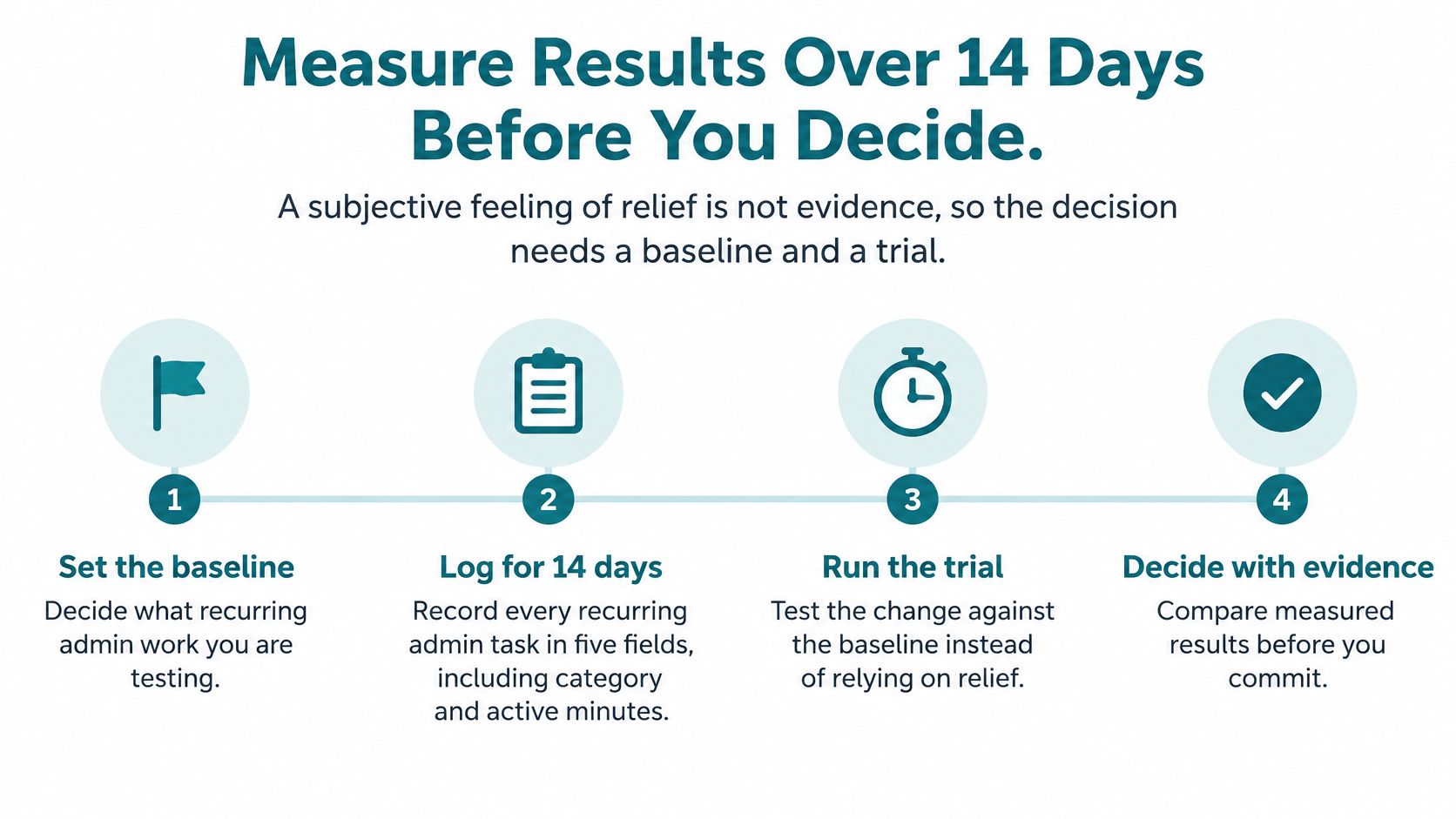
Measure Results Over 14 Days Before You Decide
Relief matters, but it doesn't establish financial payback. You need a baseline, a defined trial, and a consistent way to distinguish work transferred from time recovered.
The measurement sequence keeps those stages separate.
Build a usable baseline
- Log recurring administration for 14 days. Use Google Sheets or Excel with fields for category, active minutes, waiting time, decisions, and follow-ups. Capture activity when it happens rather than reconstructing it at the weekend.
- Calculate the weekly burden. Total active work and separately report any coordination penalty, such as measured time spent reopening a task. Waiting for a reply isn't automatically working time.
- Run a four-week delegation trial. Choose a defined task sample and preserve the same categories. Don't compare an unusually quiet trial with a baseline dominated by an exceptional emergency.
- Measure the outcome. Track hours reclaimed, completion rate, turnaround time, correction rate, and how much recovered time went toward your intended alternative.
- Price the remaining involvement. Include briefing, approvals, escalations, and quality checks. Delegated minutes aren't necessarily recovered minutes.
Keep a separate count of decisions removed and follow-ups closed. A Harvard Business School working paper reviewing time poverty connects time poverty with lower well-being, health, and productivity, supporting a broader assessment than calendar savings alone.
The video below provides a separate viewing option alongside the measurement exercise.
Calculate net return
Use ROI = (H_r × V_t − C − E) / C.
Here, H_r means verified hours reclaimed, V_t is conservative hourly value, C is monthly subscription cost, and E is residual escalation or correction cost expressed in dollars. Keep every input within the same measurement period, and don't subtract correction time twice if it already reduced reclaimed hours.
Count the time you no longer spend, not the time someone else spends for you.
For a hypothetical result, six verified hours at $150 produce $900 of recovered value. With a $100 monthly cost and no additional residual correction cost, the calculation is ($900 − $100) / $100 = 8, an 8x net ROI under those assumptions.
Test Whether a Task Pays Back Its Cost
Monthly recovered value = monthly admin hours × hourly value × recoverable share.
The recoverable share is the part you can redirect. For an initial estimate, test conservative scenarios such as one-third or one-half rather than assuming every delegated hour disappears from your workload.
Monthly buy-back scenarios
These hypothetical cases show how different assumptions change the buying decision.
Monthly admin hours | Value per hour | Recoverable share | Monthly recovered value |
|---|---|---|---|
10 | $300 | one-third | $1,000 |
5 | $150 | one-half | $375 |
20 | $25 | one-quarter | $125 |
In the professional example, 10 monthly hours at $300 represent $3,000 of gross opportunity cost, but recovering only one-third reduces the usable value to $1,000. That's the figure to compare with the delegation cost, not the larger headline amount.
The household-rate example leaves much less room for error. A service could cost less than the original workload's replacement value and still fail the test because you retain most of the work.
Require a margin, not a tie
I'd use recovered value of about three times the cost as a planning hurdle, not an economic law. That gives you room for imperfect utilization, a quiet month, and tasks that need more oversight than expected.
For a fuller comparison, distinguish gross value, net benefit, and return using these ROI calculation methods. A positive ratio doesn't automatically make an unaffordable subscription sensible, and a nonfinancial benefit shouldn't be presented as cash income.
- Prioritize repetition: Start with tasks that recur weekly or monthly so the setup effort can be reused.
- Choose the lower estimate: When you have competing hourly valuations, use the conservative one until actual results justify more.
- Record the destination: Note whether recovered time went toward revenue, rest, family attention, or another intended use.
- Check the cash constraint: Keep household affordability separate from theoretical opportunity cost.
A hypothetical $20-per-hour task rarely justifies a managed handoff on its own if setup and oversight consume the saving. The case becomes stronger when the underlying errand is only a small part of a recurring coordination loop.
Buying discipline: Pay for an outcome you can verify, not for the satisfaction of moving something off your list.
Compare Hiring Staff With Buying Support
A salary and a service fee aren't comparable until you account for the employer's full cost. In March 2025, private-industry employers paid an average of $45.38 per hour, comprising $31.89 in wages and salaries and $13.49 in benefits, with benefits representing 29.7% of total compensation, according to the U.S. Bureau of Labor Statistics employer-cost report.
At a hypothetical 20 hours weekly, or about 1,040 annually, those benchmarks imply roughly $33,165 in wages versus $47,195 in total compensation. They're broad private-industry benchmarks, not an assistant salary quote; the gap illustrates why payroll taxes, paid leave, insurance, and retirement contributions matter.
Compare the operating models
Decision factor | Direct employee | Flexible support |
|---|---|---|
Workload | Sustained role with dependable utilization | Variable coordination demand |
Management | You own recruitment, training, and coverage | Evaluate the provider's operating process |
Cost test | Fully loaded employment cost | Service cost plus your retained oversight |
Best-fit question | Is there enough continuous work? | Can discrete responsibilities transfer cleanly? |
For a founder running a hypothetical business with $1M to $50M in revenue, revenue alone doesn't settle the decision. A steady, integrated workload may justify hiring; episodic scheduling and research may not.
Use a personal assistant cost comparison to structure the staffing decision. If you're also evaluating executive development, Acheloa Wellness's discussion of six-month coaching package pricing belongs in a separate capability-building budget: coaching develops judgment, while operational support handles execution.
The deciding number is fully loaded cost per productive hour reclaimed. Flexible support can avoid paying for idle capacity, but it isn't automatically cheaper; a well-utilized employee can make sense when the work is continuous.
Decide Which Tasks to Hand Off This Month
Task type | Test | Action | Example |
|---|---|---|---|
Judgment-heavy, high-value | Only you can make the call | Keep | Choosing a hire or negotiating a contract |
Repeatable, low-judgment | Same steps every time | Streamline with a template or standing rule | Monthly expense categorizing |
Coordination loop | Many calls, confirmations, and follow-ups | Delegate | School enrollment, pediatrician scheduling, travel rebooking |
Rare, low-value | Happens less than once a month and earns little | Drop or batch | One-off browsing for a gift |
Don't delegate everything that annoys you. Keep decisions where your judgment changes the outcome, simplify predictable work, and transfer the loops where another person can own execution within clear boundaries.
Turn the log into assignments
- Select the five most frequent coordination loops from your baseline. Favor repeatable responsibilities over an unusually frustrating one-off incident.
- Mark each keep, simplify, or delegate. Use the table's test rather than sorting by dislike alone. If something belongs in the drop-or-batch group, remove it from the delegation queue.
- Set standing rules for simplified work. Create a saved email response, an expense-category mapping, or a monthly calendar block. Automation won't resolve every exception, but it can eliminate repetitive setup.
- Transfer the loop with the most verified hours first. Give the person handling it an objective, deadline, constraints, approval boundary, and definition of completion.
For a hypothetical example, a school-enrollment loop that consumed six verified hours monthly takes priority over occasional gift browsing. The assignment might cover collecting requirements, organizing documents, confirming deadlines, and preparing submissions, while you retain final authorization.
Monthly expense categorizing is a different problem. If the same merchants map to the same categories, a saved template may solve it without adding another person to the process.
Define ownership before starting
A usable handoff says more than book an appointment. Specify acceptable dates, location limits, calendar access, what can be confirmed without permission, and when an exception must come back to you.
Include a stopping rule for research. A shortlist with relevant trade-offs is more useful than an open-ended search that generates more decisions for you.
A task is transferred only when responsibility for the next action is clear.
A managed service such as Approved Lux can provide the operational capacity for this test. Lux Solo includes travel, scheduling, errands, and research for one account holder at $99.99 per month, about $3.33 a day; its 7-day trial costs $9.99, after which the plan becomes $99.99 per month.
Keep the trial narrow enough to evaluate. Compare the selected loop's owner involvement and turnaround with your baseline, and commit only if the verified results justify continuing rather than treating a successful isolated booking as proof of recurring value.
Approved Lux Personal Assistant offers a US-based human Assistant team to handle recurring coordination, with Triple-channel access through phone, text, or email. Visit Approved Lux Personal Assistant to test a defined handoff and measure whether it returns usable hours, removes decisions, and closes follow-ups.