How to Reduce Mental Load: Audit, Delegate, Set Rules
Learn how to reduce mental load in 2026 with a one-week audit, end-to-end hand-offs and if-then rules that clear recurring household and work tasks.
10 min read
It's Tuesday evening. The dishes are done, but you're still holding a dentist reminder, an unsigned school permission form, a birthday gift order and a contractor's promised callback in your head. You sit down, open your laptop and remember something else you haven't chased.
Learning how to reduce mental load starts with those unfinished commitments, not with a better chore chart. Each needs a named owner, a next action and a clear point when you can stop thinking about it.
What Mental Load Is and What It Costs You
Mental load is the planning, remembering, scheduling, researching and follow-up behind a task. Taking a child to the dentist is visible work. Finding an appointment, checking the school calendar, arranging transport and remembering the paperwork are the administrative work surrounding it.
An open loop is any commitment without a dependable next step or confirmed finish. A clean kitchen doesn't close an unanswered school email. Even after someone orders the birthday gift, you may still be tracking delivery and wondering whether it needs wrapping.
That invisible coordination sits alongside a substantial household workload. In 2025, 81% of U.S. people aged 15 and older engaged in household activities on an average day, spending about 2 hours on them, according to the U.S. Bureau of Labor Statistics American Time Use Survey. Household activities include management and organizational work, such as paperwork and event planning, not just cleaning and cooking.
The visible workload can end while the coordination continues.

Count the cost beyond chores
Look for repeated context switching, rework after missed information, dread about forgotten deadlines and resentment when you're always the reminder. If caregiving responsibilities dominate your list, Guiding Growth's resource on ways to prevent caregiver burnout at home offers a useful companion to reorganizing the logistics.
Practical rule: A task isn't off your mind if you still have to remember to ask whether someone completed it.
The practical response is to audit unfinished commitments, transfer complete outcomes, batch incoming requests and turn recurring problems into rules. Measure success in open loops and follow-ups removed, not hours of chores shared.
Audit Your Open Loops in One Week
Parents reported spending more than 30 hours per week planning and coordinating family schedules and household tasks in a survey of more than 2,000 parents cited by Skylight and reported in the Times Recorder. That's a survey finding, not a time budget to assign to every household. Your own interruptions will tell you what to change.
Use a running note in Apple Notes, Google Keep or a shared spreadsheet. Don't spend the audit week designing a dashboard.
- Capture each unfinished commitment. Write it down when it surfaces: reply to the teacher, reorder a refill, check a refund or chase the plumber. Include things you remember while doing unrelated work.
- Identify the current holder. At day's end, mark who is tracking each item. Separate work requiring your judgment from work requiring execution.
- Group and score domains. Cluster related items under school, medical, maintenance, travel, gifts or work administration. Record interruptions and follow-ups beside each category.
- Apply the transfer test. Can you state the outcome with a due date and a done condition? If not, clarify the request before delegating it.
Recurring domains, open loops and transfer tests
Treat the owner column as a diagnostic prompt, not a prescription for who should carry the work.
Domain | Typical open loops | Usually held by | Transfer test |
|---|---|---|---|
School and childcare | Enrollment forms, pickup changes, camp registration deadlines | The parent who tracks the calendar | Can each item be stated with a due date and a confirmation step? |
Medical appointments | Scheduling, referrals, insurance follow-up, refill reminders | Whoever answers the phone | Is the booking and follow-up repeatable without your input? |
Household maintenance | Repair quotes, vendor booking, service reminders | The homeowner who remembers | Can a vendor be chosen against a stated budget and time window? |
Travel | Flight changes, hotel bookings, ground transport, itineraries | The traveler | Can exceptions be resolved without you reopening the trip? |
Gifts and events | Gift sourcing, party planning, vendor coordination | The person who remembers dates | Can the outcome be defined as delivered and confirmed? |
Work administration | Inbox triage, expense tracking, meeting prep | The executive or founder | Can triage rules be written and followed by someone else? |
For a crowded work queue, use a consistent method for triaging incoming tasks rather than answering whichever message arrived last.
Keep specialist judgment separate from administration. A property-related tax question, for example, might warrant reviewing INTELLI's explanation of how productivity valuation lowers taxes, while document collection and appointment scheduling can be assigned separately. Don't turn a general helper into your tax adviser.
The audit fails if you count only completed chores. Record the comparison shopping, reminders, unanswered questions and confirmation checks, even when they take little time individually.
How to Hand Off a Task From Start to Finish
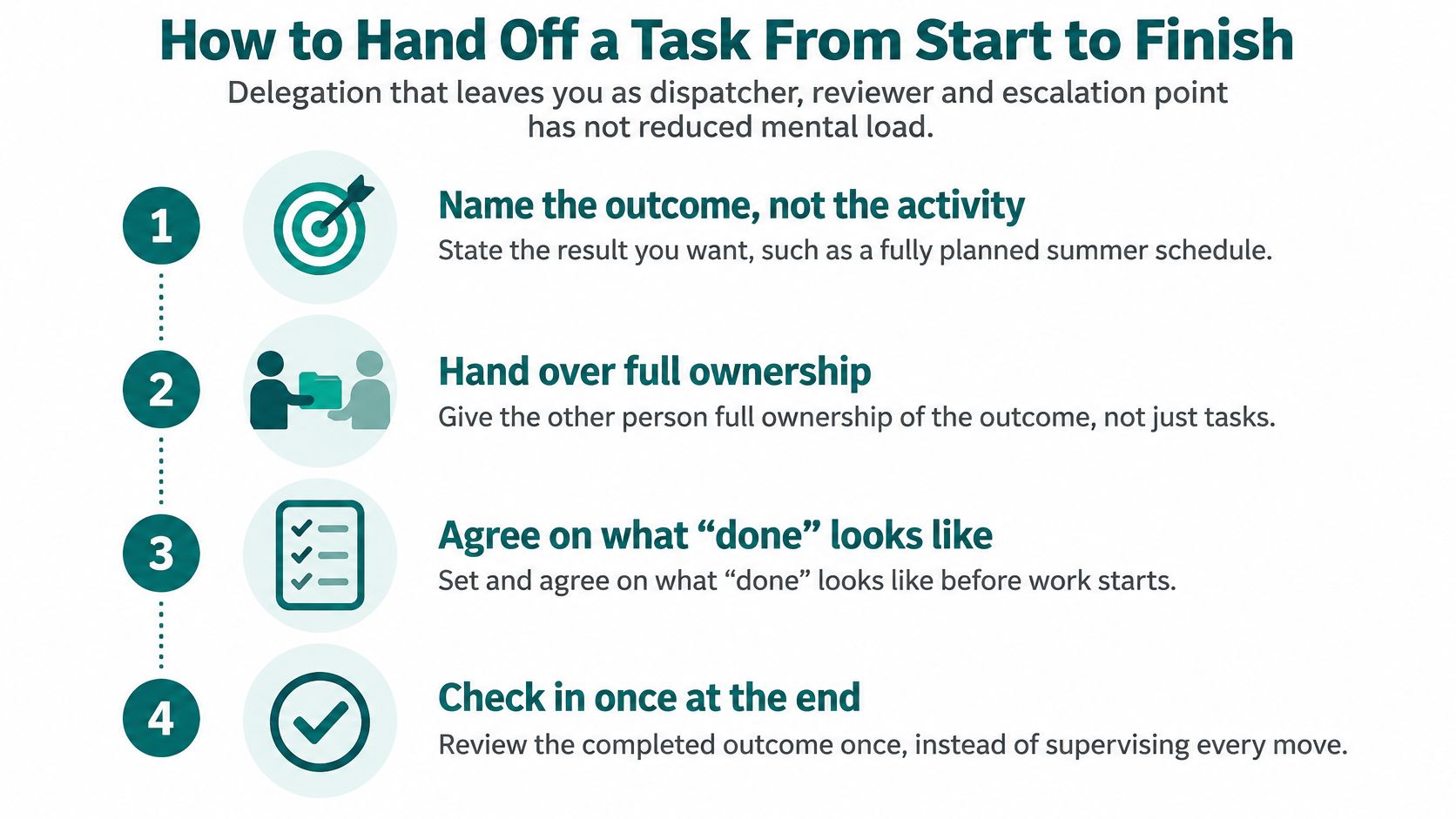
Delegation that leaves you as dispatcher, reviewer and escalation point hasn't removed the management work. It has changed who performs the final action.
This distinction matters for household equity. In a study of 681 participants published in Archives of Women's Mental Health, greater maternal cognitive workload was associated with higher depressive symptoms, stress and personal burnout, alongside poorer mental health and relationship quality. The finding concerns associations, not proof that any particular hand-off will improve health.
Write the hand-off before assigning it
Use these six elements to make responsibility executable.
- Name the outcome, not the activity. In a hypothetical camp brief, specify enrollment completed, deposit paid and confirmation saved by May 1, rather than asking someone to find a camp. A result gives the owner a finish line.
- Set constraints. Include the actual budget, eligible dates, acceptable locations and firm requirements, such as a hypothetical journey limit of 20 minutes from home. Constraints prevent avoidable option lists and repeat questions.
- Grant decision authority. State whether the owner may book any qualifying option within budget and which exceptions need approval. Without that permission, every choice comes back to you.
- Define done. Require the confirmation, calendar entry and relevant reminder to be saved in agreed locations. Clicking submit isn't enough when acceptance remains unconfirmed.
- Create an escalation path. Specify how to raise a sold-out session, changed deadline or missing eligibility document. Exceptions need a route that doesn't turn routine progress into constant messaging.
- Set a single completion check-in. Agree when you'll receive the final status, with earlier contact only for defined exceptions. Daily updates can recreate supervision.
Use this visual as a compact reminder of the ownership transfer.
Leave room for a different method
Agree on standards, then let the owner choose the route. A different spreadsheet layout or vendor-search method isn't a failure if the agreed result meets your constraints.
Professional administration needs the same preparation. Stewart Accounting Services bookkeeping advice is a relevant starting point when separating outsourced bookkeeping work from records and approvals you must supply. For broader delegation, this guide to handing off tasks effectively can help structure the brief.
For school enrollment, the new owner researches eligible options, identifies required documents, requests anything only you can provide, submits the application, confirms acceptance and sets reminders. You retain signatures, consent and genuine parental decisions where needed, but you don't chase the application's status. Receiving a final confirmation is the hand-off's endpoint, not receiving a shortlist to manage yourself.
Batch Requests to Stop Constant Switching
An exploratory study of focused computer work found that participants deviated from their main task every 3.5 minutes on average, while self-initiated interruptions produced nearly 60% of off-task time, according to the ACM study. This isn't a universal interruption rate, but it highlights a useful target: the checks you initiate yourself.
Don't try to eliminate necessary communication. Separate receiving a request from deciding what to do about it.
Use a defined intake routine
- Choose a destination for nonurgent requests. For example, put household administration in a shared Todoist project. Tell family members to add requests there instead of scattering them across texts and conversations.
- Choose fixed triage windows. A workable example is checking at 9:00 a.m. and 4:00 p.m. Publish the schedule so people know when a routine request will be seen.
- Classify before executing. Mark each item decide, delegate, schedule or delete. A repair quote may need a decision, while a confirmed appointment only needs a calendar entry.
- Protect a focused work block. Silence routine notifications while drafting a proposal or reviewing a contract. Don't keep the intake list open beside the document you're trying to finish.
- Define urgent exceptions. A changed school pickup or flight cancellation may justify a call. A gift suggestion usually doesn't. Specify the urgent channel and who monitors it.
A shared list doesn't replace reliable communication. Requests still need enough context for someone to act without an immediate conversation. Apply asynchronous communication practices by including the desired result, deadline, constraints and relevant documents.
Batching fails when everyone agrees when to read requests but nobody agrees who must finish them.
Track the friction, not just the inbox
Keep a weekly record of daily switch count, average uninterrupted block length, minutes spent in triage and tasks returned for missing information. Use a tally rather than trying to reconstruct the day from memory.
Watch for parallel inboxes that each demand checking. You can accept requests through several communication methods, but route their status and ownership into a common working record. Otherwise, batching adds another place to monitor.
Turn Recurring Problems Into If-Then Rules
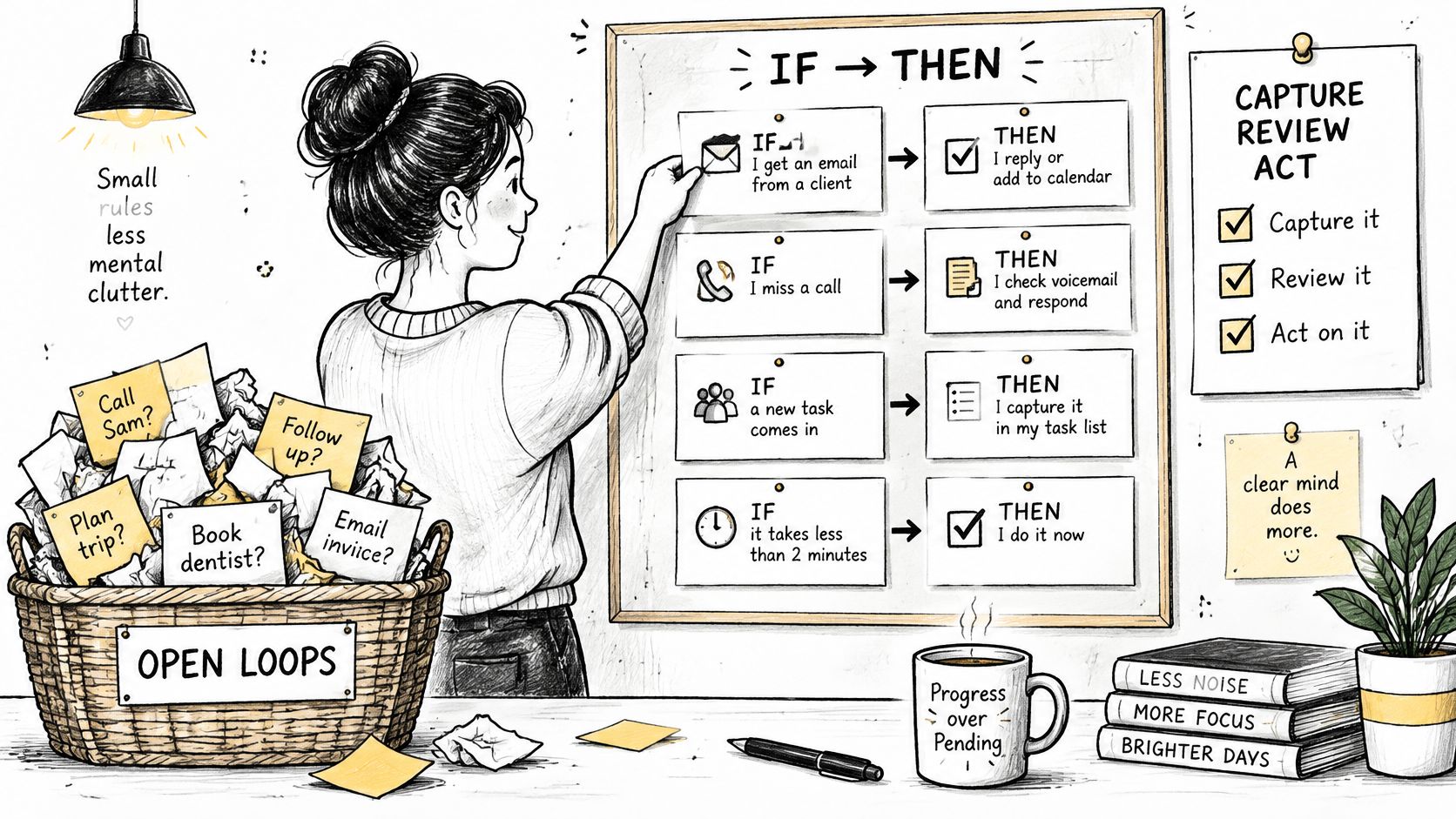
An if-then rule connects a predictable trigger to a predefined response. Instead of reopening the question whenever a reminder arrives, the assigned person follows an agreed action.
A meta-analysis of 94 independent studies on implementation intentions found that specific if-then plans improved goal achievement with a medium-to-large effect size of d = 0.65. That result supports explicit planning, not a promise that a household rule will produce a particular time saving.
Make the trigger and response visible where the owner works.
Write rules someone can execute
Start by capturing the item in your trusted system. Add an owner, deadline, dependency and next physical action, such as uploading a document rather than progressing enrollment.
Then write the response to the predictable trigger:
- School paperwork: If a school form arrives, forward it to the household queue with its due date. The named school-administration owner completes it, obtains necessary consent and records submission confirmation.
- Prescription refill: If a refill reminder appears, the authorized owner requests the refill within an agreed window, for example within 24 hours, and records pickup arrangements. Clinical questions go to the pharmacist or prescriber.
- Camp registration: If registration opens, the camp owner adds the application deadline and closing condition to the shared list, then proceeds within the approved budget and dates.
Compare those rules with a vague instruction to handle summer camp. That instruction has no trigger, accountable owner or completion condition. It invites another conversation instead of execution.
This video offers an additional format for thinking through task management.
Review exceptions rather than rewriting everything
Review unresolved items weekly. Check whether the trigger was missed, the owner lacked access, a dependency blocked progress or the rule didn't cover the situation.
Don't write a procedure for every possible household event. Start with predictable problems that repeatedly cause delays. Too many rules create maintenance work of their own.
Watch the ownership: A rule that tells you to remind somebody else still leaves you responsible for remembering.
Track open-loop count, overdue items, weekly follow-ups and minutes spent re-deciding the same issue. If execution still returns to you, change the authority or access, not just the wording.
Pick One Domain to Hand Off This Week
Choose the domain producing the most interruptions and follow-ups, not the easiest chore to remove. Appointment coordination may be a better candidate than grocery delivery if you repeatedly stop work to compare calendars, return calls and chase confirmations.
Keep the initial transfer bounded. Assign routine dental scheduling before handing over every medical administration task, or transfer household maintenance bookings before asking someone to manage a renovation.
Make the experiment measurable
Write a hand-off brief containing the outcome, constraints, decision authority, definition of done, escalation path and check-in date. Include the practical access the owner needs, using shared calendars and appropriate permissions rather than casually sharing sensitive credentials.
For a two-week trial, record:
- Open loops at day's end: Count unresolved items still requiring your attention.
- Preventable follow-ups: Mark reminders you had to send because an agreed action didn't happen.
- Work-hour context switches: Tally administrative interruptions during paid work.
- Coordination hours: Record time spent assigning, clarifying, checking and chasing.
Compare those measures with your audit. Include time spent preparing the hand-off so you don't mistake setup effort for ongoing overhead, or ignore it entirely.
Compare in-house ownership with outside support
A partner, colleague or paid team can own a domain. The choice depends on available capacity, access, cost and whether the work requires personal judgment or repeatable administration.
Our Approved Lux monthly subscription offers 24/7 access to a US-based human Assistant team through equally prioritized calls, texts and email. Lux Solo covers an individual, while Lux Circle covers up to 4 people on an account; Lux Traveler's Assistant team also covers family and household management, including school scheduling, childcare and medical appointments. Shared context and Proactive Preference Learning support recurring work, but the evaluation remains practical: count unresolved items and coordination time after the trial.
This week, choose the category, write the brief and name the owner. Keep or adjust the arrangement based on what leaves your attention.
Approved Lux Personal Assistant offers a human Assistant team for scheduling, household logistics and recurring administration, with Triple-channel access by call, text or email. Visit Approved Lux Personal Assistant to compare that support with your highest-friction domain, then use a defined hand-off and a two-week measurement to judge the value.