How to Plan a Family Vacation: Budget to Backup Plans
Learn how to plan a family vacation step by step: set the budget, book in the right order, and plan for kids and backup days.
13 min read

It's Thursday night, the kids are finally down, and you're sitting with three browser tabs and a group text nobody has answered. One tab is a beach that looked cheap until you added four plane tickets. One is a cabin that sleeps six but has a staircase. The third is a resort whose "family room" may or may not fit a crib. Nobody has written down a number you can spend, and school break ends in six months whether the plan is ready or not.
How to plan a family vacation stops being a pile of ideas when you run it like a project. One person owns the plan. A timeline has named deadlines. A verification loop catches the detail that looked fine on a website and fails at the curb. Attractions come after the budget, the dates, and the constraints of every traveler.
I would name that owner before anyone opens a booking site. If the name is blank, every later decision lands on whoever happens to be holding the phone.
The Planning Timeline From Six Months Out to Departure
Most families only notice the missing deadline after it has passed. Refundable rooms are gone, the timed ticket sold out, and the car seat was never reserved. Put six checkpoints on one page the whole household can see, from six months out to 72 hours before you leave.
Window | Core task | Who decides | Done when |
|---|---|---|---|
6 months out | Set total budget ceiling and fixed dates | Parents | Budget ceiling written down |
4 months out | Shortlist destinations and check accessibility needs | Parents, with children's input | Two options fit budget and dates |
3 months out | Book flights, lodging and timed tickets | Parents | Confirmations saved, refundable rates where justified |
6 to 8 weeks out | Book ground transport and restaurant reservations | Parents | All confirmations in one shared document |
2 weeks out | Packing and readiness check for each person | Each family member | Documents, medication and car seats verified |
72 hours out | Verify every booking, check-in rule and transfer window | Decision owner | Confirmation numbers and check-in rules confirmed |
What each window is for
Six months out, parents write the total ceiling and lock the travel dates around school, work, and any care schedule. Four months out, they shortlist two destinations that fit that ceiling and the needs of every traveler, including a child's sensory limits or a grandparent's diet. Three months out, they book flights, lodging, and timed tickets, and they pay the refundable rate when the premium is small next to a cancelled week.
Six to eight weeks out is ground transport and restaurants. Every confirmation goes into one shared document, not five inboxes. A simple family travel planner template keeps those rows in one place so nobody rebuilds the list from screenshots.
Two weeks out, each person runs a readiness check: passports, medication, and car seats. At 72 hours, the decision owner rechecks every booking, check-in rule, and transfer window.
Ownership test: If any row has no named owner, that task will surface at the airport, usually while someone is already holding a toddler.
How to Set a Budget Before Choosing a Destination
The familiar slip is picking the destination first, then discovering the flights ate the trip. In the 2023 Family Travel Association survey, 59% of parent respondents called affordability a challenge, while 81% said they were likely to travel with their children in the following year. Set the ceiling before you compare hotels.
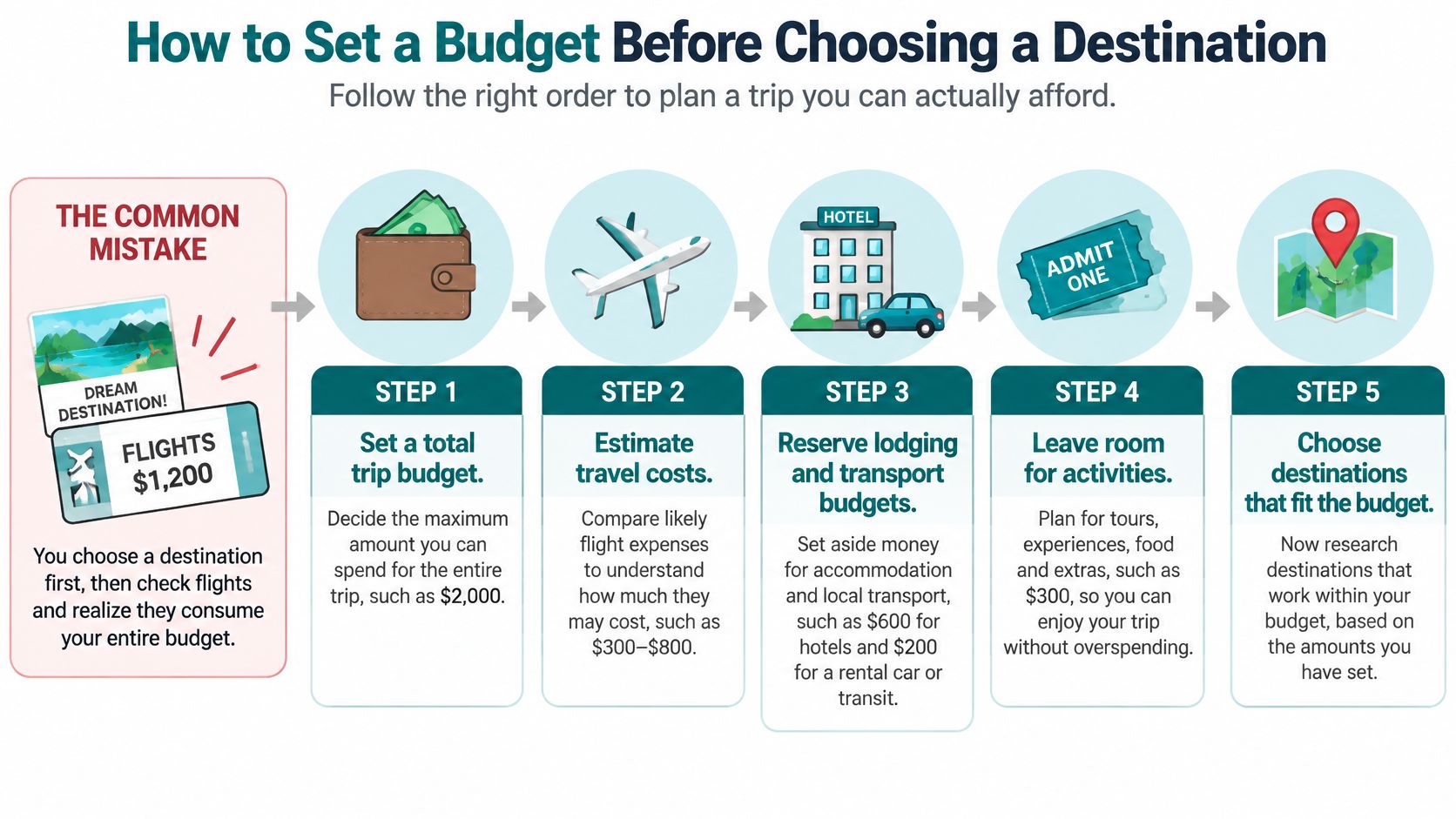
Say the ceiling is $4,000. Split it before any destination research: $1,600 transportation, $1,200 lodging, $600 food, $400 activities, and $200 for unexpected costs. Then run these five steps.
- Write the ceiling. This is the number you can spend without a second debate. Everything else is a test against that number, not a reason to raise it.
- Split the five buckets. Transport and lodging are the large fixed costs. Food, activities, and the reserve are what get raided when a child asks for one more ticket.
- Price the essentials first. Round-trip airfare for every traveler, lodging for the nights you need, and a daily food baseline. If airfare alone is $1,900, that destination fails the $1,600 transport line.
- Name one cheaper substitute for each major cost. A shoulder-season week, a rental with a kitchen, or a single-day pass instead of a multi-day ticket. If you are weighing a ship against hotels, compare cruise ships on the full fare, not the headline cabin rate.
- Label the reserve off-limits. It is not activity money and not an unplanned rideshare fund. It covers a missed connection or a pharmacy run.
Full landed cost, one page
Families compare a nightly hotel rate and forget taxes, resort fees, parking, and the airport transfer. Price the landed cost: what you pay from your front door back to your front door.
The one-page budget shows the ceiling, the five lines, the substitute for each big cost, and the name of the parent who must approve any change above the ceiling. Children's activity requests do not move that line.
Settling Family Preferences Without Trip-Long Arguments
The old assumption is that parents pick a kid-friendly place and the children tag along. That no longer matches how trips get built. Hilton reports that 73% of people traveling with children or grandchildren expect to involve them in planning, and 78% say children inspire them to seek new experiences. The same reporting, citing Priceline's 2026 travel trends, puts active child participation at 87%. The shortage is not destination ideas. It is a method for goals that do not fit together.
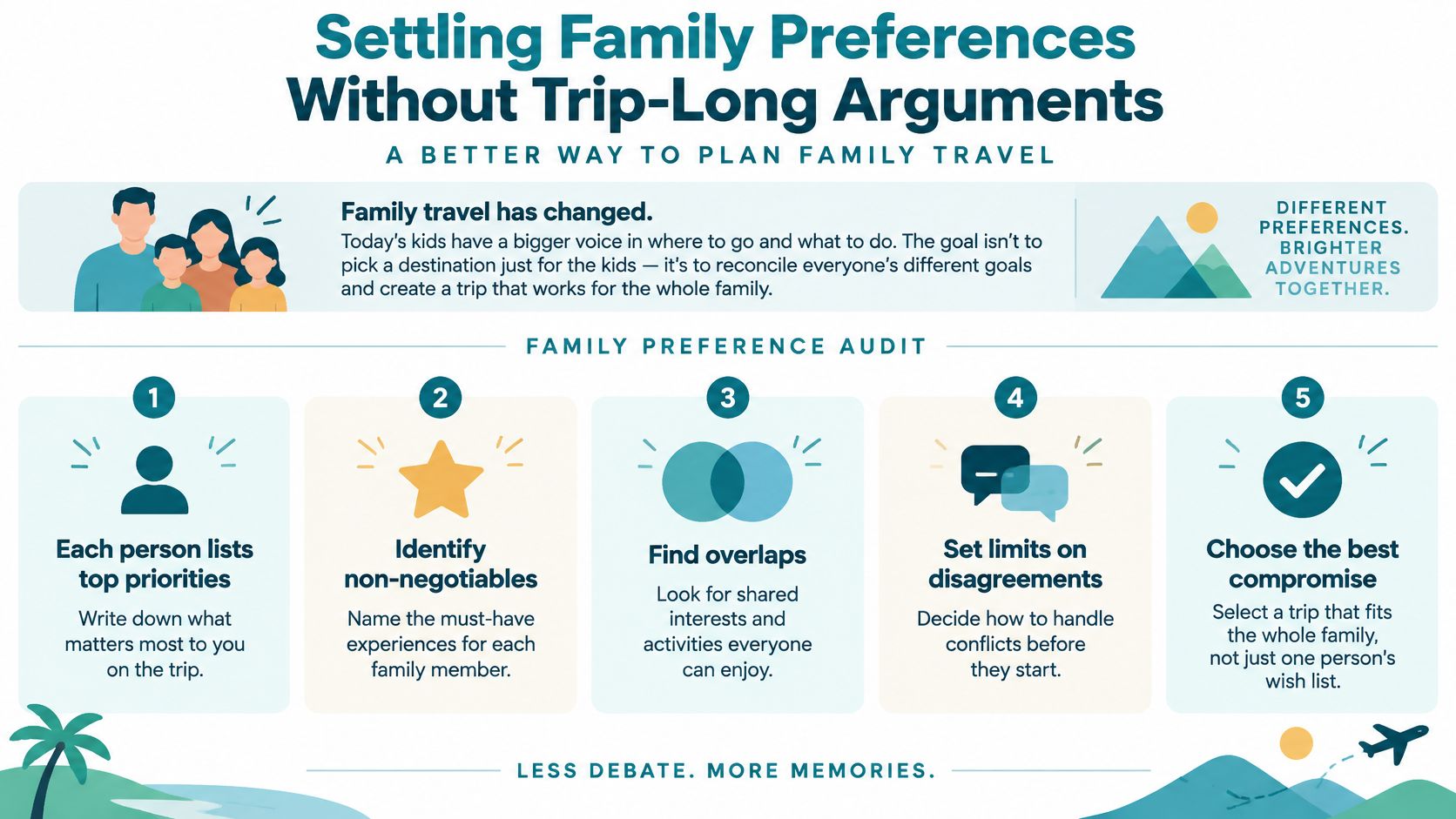
A short preference audit
Each person writes two priorities and two nice-to-haves. Adults then sort that list against budget and travel time. A beach day can be a priority. A specific theme park three hours away is a nice-to-have if the transfer blows the day's rest.
Children get bounded choices, not an open map. A seven-year-old picks one museum from three that already sit inside the budget and the neighborhood. A teenager picks one excursion from two. The family picks one restaurant from a shortlist. If you want a wider pool of options before you cut it down, start from a set of kid-friendly destinations and then throw out anything that misses the ceiling or the dates.
Rules that stop the argument
Alternate the days so one child's interest does not own the week. Monday is a whole-family day. Tuesday is a split: one parent takes one child on a half-day outing, and the other parent stays with the rest. Hilton also reports that 50% of parents use travel for bonding time with an individual child, so put that hour on the schedule instead of hoping it appears.
Write three rules before anyone argues about a swap.
- Who can approve a change: one named parent, not a group vote in a text thread.
- When requests close: 14 days before departure. After that, the schedule stands.
- When an activity ends: two meltdowns in one day, and you leave. Name a tie-breaker for anything the rules do not cover.
Adults set the limits, children choose from the options, and the named tie-breaker settles what is left.
Group plans stall when every relative has a veto and nobody has a deadline. Set a response date and a default that applies if nobody objects. Silence is a yes for the default, not a reason to reopen the list.
Booking Flights, Lodging and Ground Transport in Order
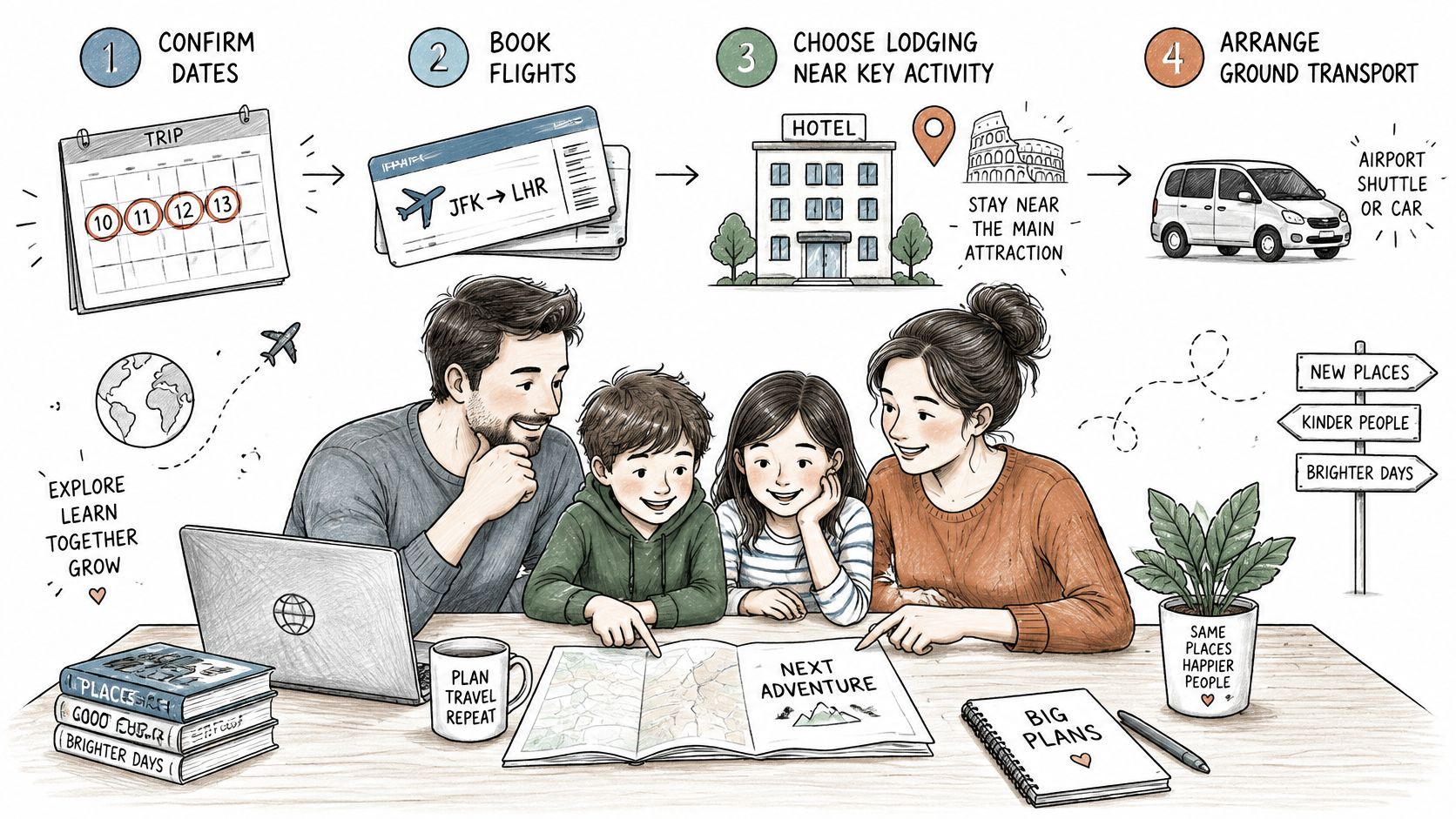
Dates first, then flights, then lodging near the one anchor activity, then ground transport. Book in any other order and the pieces lock against each other. A flight chosen before the hotel can leave you 40 minutes from the only thing the kids asked to see.
Option | Best for | Main risk to check | Verify before paying |
|---|---|---|---|
Hotel with adjoining rooms | Families with children of mixed ages | Adjoining rooms may be limited or not guaranteed | Room type and adjoining status confirmed in writing |
Vacation rental with full kitchen | Multi-day stays with young children or dietary needs | Entrance steps, bathroom layout and cleaning fees | Photos of entrance and bathroom, cancellation terms |
All-inclusive resort | Families who want meals handled | Restricted dining times and excursion access | Meal plan details and excursion surface access |
Rental car with car seats | Road trips and rural areas | Seat availability and installation | Seat type and number reserved in writing |
Airport transfer or rideshare | Late arrivals and short hops | Vehicle size for luggage and car seats | Vehicle capacity and child seat provision confirmed |
What to confirm in writing
Do not pay on a filter that says "family" or "accessible." Ask each provider, in email, for the specific fact: adjoining rooms held for your dates, a car seat in the transfer, luggage space for a stroller plus four bags. A photo of the entrance and the bathroom beats a star rating.
Fora's 2026 accessible-travel report found that 55% of families planning a multigenerational trip expect someone to need an accommodation, including mobility support, dietary requirements, or autism-friendly activities, and 78% would pay more to have those needs met. Yet 90% of surveyed travel advisors said online accessibility information can be incomplete, outdated, or contradictory, and 46% said it is often or always inaccurate.
An accessible room is not end-to-end access. Check the transfer vehicle, the entrance, the bathroom, the queue, how the kitchen handles a stated diet, and the surface of any excursion. Ask for step-free access to the pool deck in writing, or a short description of how a meal is prepared. Build a fallback if that confirmation never arrives.
Rideshare and a prebooked car service cover late landings and short hops. A rental car makes more sense once you leave the city for rural stretches, and only after the seat type and count are reserved in writing. If relatives are joining and you need them on the same dates, it helps to know when to send announcement emails so the decision deadline is in the message, not buried in a chat.
The cost of skipping the order shows up on night one. The flight is nonrefundable, the hotel is across town from the anchor, and the transfer you never checked cannot take the car seat. That is the first problem of the trip, and it happens before anyone sees the attraction.
Building Days Around Recovery Instead of Attractions
Poor preparation is the main cause of trip regret for 14% of travelers, including unsuitable accommodation, underestimated travel times, and overpacked itineraries, according to Travel Guard. A day with four stops looks productive on a map and fails by midafternoon.
Start with the fixed points: arrival, departure, timed tickets, children's meals, and any medication or care time. Add one major anchor activity per day. Cluster the other stops so you are not crossing the city twice. Put slack after flights, long drives, and late nights. Treat the first day and the last day as logistics unless the arrival is early and reliable.
One Saturday that actually works
You hold a 9:00 ticket, the drive back is two hours, and a four-year-old naps at 13:00. Keep the ticket and the nap. Move the pool to Sunday. The second activity was the thing that would have broken the day, not the thing that made it.
Run every segment through the same check: door-to-door time, a restroom, a meal, a weather backup, whether a stroller or a walker can use the route, and the cancellation deadline. Long flights also leave adults stiff and puffy. Reading why ankles swell after traveling is a useful nudge to leave the afternoon empty instead of booking a second site.
Age band | Pacing rule | Packing focus | Planning flag |
|---|---|---|---|
Under 3 | One anchor activity, nap window protected | Sleep kit, spare clothes, stroller | Stroller feasibility on every route |
3 to 6 | One anchor and one short optional stop | Comfort items, snacks, sun protection | Restroom and meal access on every transfer |
7 to 12 | Two activities with built-in downtime | Entertainment, medication, layers | Pool, queue and excursion access checked |
13 to 18 | Choice-driven days with free afternoons | Own documents and charging gear | Independent plans and check-in rules agreed |
If a day has no slack after the longest transfer, cut the second activity.
The same Travel Guard piece cites a Kayak finding that 84% of group trips stall during planning, often for one to three months. One decision owner, a response deadline, and a default if nobody objects keep that stall from eating the week you meant to rest.
Packing, Backup Plans and the 72-Hour Check
Skip the master list that lives in one parent's head. Use three containers: one carry-on per person, one documents folder, and one medication kit. A delayed checked bag is annoying. Missing medicine or a car seat stops the trip.
Bag | Contents | Packed by | Check before leaving |
|---|---|---|---|
Carry-on | Medication, chargers, documents folder, change of clothes | Each traveller, parent reviews | Medication and passports in hand before the car leaves |
Checked bag | Clothing by day, toiletries, sleep kit | Parent packs, child checks own items | Weight and allowance confirmed with airline |
Car seat or stroller | Car seat, stroller, travel cot | Parent | Seat type and installation confirmed in writing |
Child's day bag | Snacks, comfort item, sun protection, layers | Each child, with adult review | Matches the day's restroom and meal plan |
Pack the flight bag first
Pack the carry-on before the checked bag. Passports, medication, chargers, and one change of clothes ride in the cabin. A parent reviews every carry-on. Children pack their own day bag, and an adult checks that it matches that day's meals and restrooms. A travel packing checklist template keeps those four rows from turning into a last-night scramble.
Two weeks out, each traveler runs a personal readiness check: documents, doses, and anything that has to be reserved, such as the seat.
One fallback, not a second vacation
Write one fallback for each major booking, as a decision rule.
- Rain closes the outdoor site: the indoor backup is already named, with its hours and ticket rule.
- A child melts down: the quiet afternoon replaces the second stop, and nobody renegotiates it in the parking lot.
- The restaurant is full: the second choice is on the same block, already checked for the diet you stated.
Put those lines in the same document as confirmation numbers, cancellation rules, transfer times, and emergency contacts. Documentation is not redundancy. Do not pay for two full alternatives unless the cancellation terms let you drop one. Keep the critical reservations refundable when the premium is justified.
The 72-hour pass
The decision owner confirms each reservation by phone or email, matches traveler names to passports, checks check-in rules, and rechecks pickup times. Only three kinds of news need a family decision, and they need it inside an agreed window: a flight change, a closed attraction, or a lodging problem. The owner surfaces those items. Everyone else does not get a play-by-play of routine updates.
Decide Who Owns the Plan Before You Book
Every row above fails the same way if nobody owns it. Name one decision owner before the first booking. That person holds the timeline, the budget ceiling, the preference rules, and the 72-hour check. They can hand off repeatable work. They cannot hand off the decision.
For a working parent, the repeatable pile is large: school schedules, childcare, camp dates, flight changes, hotel changes, and an itinerary that already includes the backup. On the Lux Traveler plan from Approved Lux, the Assistant team covers family and household management, including school scheduling, childcare, and medical appointments, and also flight and hotel changes. Full itineraries are built with backup options. A problem that comes up mid-trip can be handed straight to the Assistant team instead of the parent who is standing at the rental counter.
Lux Traveler is $1,799.99 per year, with a 24/7 US-based personal assistant, the full travel marketplace, and coverage for up to 10 household members. Lux Circle is $299.00 per month and covers up to 4 people on one account. I would pick Lux Traveler when the household is larger than four or the trip load sits on top of school and camp logistics all year. I would pick Lux Circle when four people on one account is enough and you want the same travel, scheduling, errands, and research without the annual travel marketplace.
Write one page tonight: the owner's name, the budget ceiling, and which timeline rows you will keep versus hand off.
That page is the plan. Booking comes after it, not before.
Approved Lux Personal Assistant gives working parents a US-based Assistant team on call, text, or email, so the timeline, the changes, and the mid-trip problems do not all sit with the parent on site. If you want that operational load off your week, visit Approved Lux Personal Assistant and see which plan fits the household that has to travel.