How to Plan a Family Reunion: A Step-by-Step Guide
Learn how to plan a family reunion step by step, from timeline and lodging to accessibility, fair cost splits and activity scheduling.
13 min read
The family chat is full of enthusiasm, but nobody has booked anything. Your sibling wants a house with a pool, your parents need a bedroom without stairs, and someone has already suggested dates that don't work for the cousins. Meanwhile, you're wondering whether you'll have to put the deposit on your own card.
Learning how to plan a family reunion starts with treating it as a booking operation, not an endless conversation. Give people clear choices, put commitments in writing, and verify that the property works before anyone pays. The activities are the enjoyable part. The headcount, payment rules, and access checks make them possible.
Headcount, Household List and Decision Owner
Build a household list before you browse properties. Use Google Sheets or Excel, with a row for each household rather than separate entries scattered across messages. A household representative can confirm who's coming, who needs a bed, and who's sharing transportation without every relative answering every question.
Multigenerational planning deserves that level of detail. The U.S. Census Bureau counted 6.0 million multigenerational households in 2020, defined as households containing at least three generations, up from 5.1 million in 2010. For a reunion organizer, different generations mean different sleeping arrangements, meal schedules, mobility needs, and caregiving responsibilities.
Set up the working list
- Name a primary organizer and a backup. Someone must be accountable for accepting a quote, communicating changes, and handling a supplier question when the lead is unavailable.
- Create the household rows. Record adults, children, older relatives, arrival and departure times, dietary restrictions, accessibility requirements, sleeping preferences, preferred activity intensity, and an emergency contact.
- Get written headcount confirmation. Ask each household representative to confirm their row so an enthusiastic message doesn't become an assumed reservation.
- Mark shared arrangements. Identify households sharing a room, car, or bathroom, because those relationships determine which lodging layouts work.
- Publish decision rules. Give each choice a response deadline, identify the default when consensus fails, and authorize the organizer to make bookings within the agreed budget.
Don't give the whole family unrestricted editing access to sensitive information. Keep medical details and hardship requests private, while sharing the rooming plan and operational requirements with the people who need them.
Count usable arrangements, not just people
Say siblings are happy to share a car but won't share a bedroom. Their transport allocation can stay together while their lodging allocation stays separate. A single household label shouldn't force relatives into arrangements they haven't accepted.
Likewise, record a child's sleeping requirement explicitly. Bringing a travel cot is different from needing a separate bed, and neither should be guessed from the child's age. Ask who will provide equipment and whether the property permits the proposed setup.
Working rule: The confirmed headcount in the spreadsheet, not the invitation list or the group chat, drives the budget and booking.
Keep tentative households visible, but label them clearly. That lets you investigate expandable options without promising beds to people who haven't committed.
Planning Timeline from 12 Months Out to Arrival
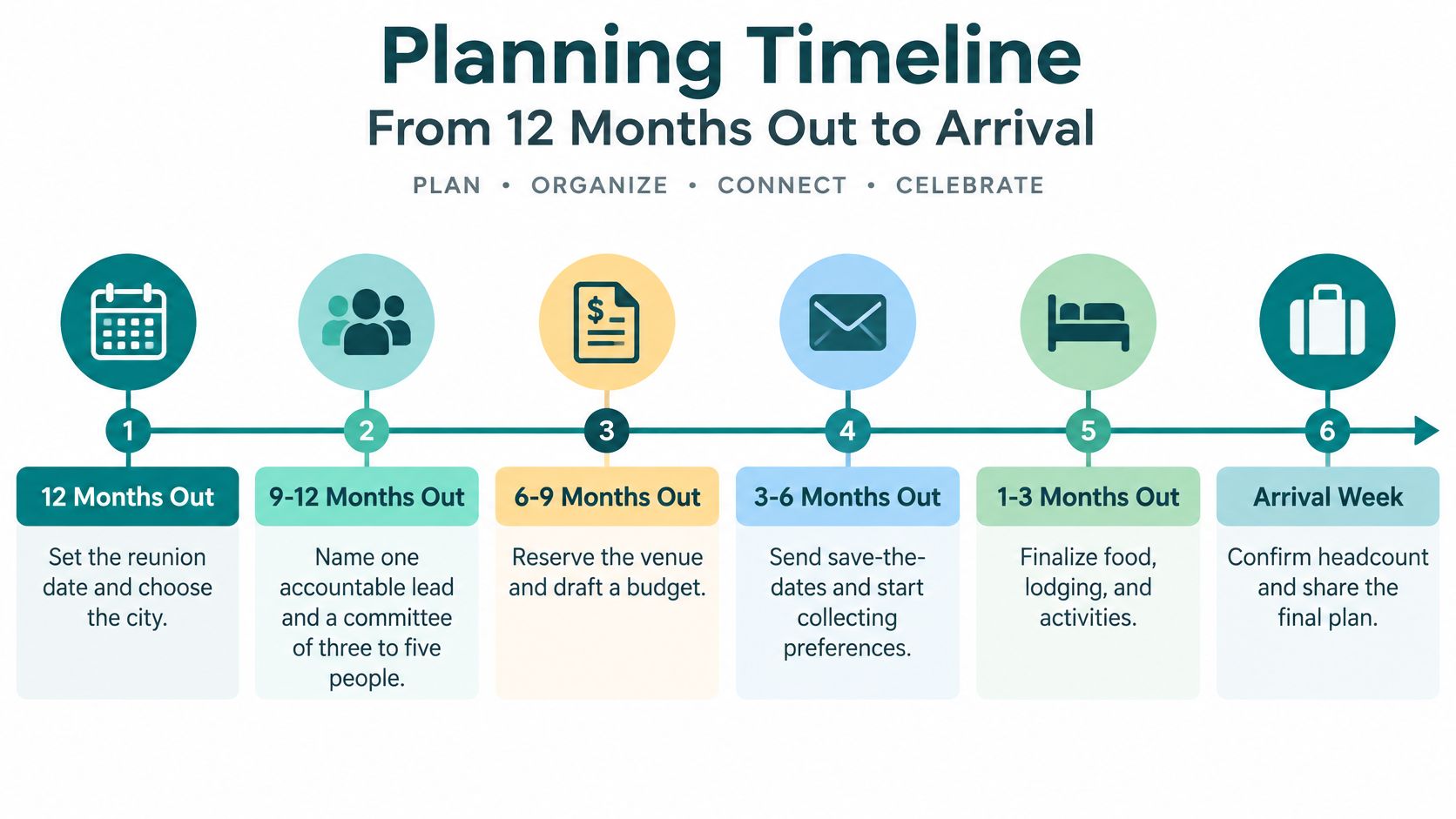
Use a shared calendar with an owner, deadline, and status for each task. A deadline without an owner is just a reminder everyone can ignore. Work backward from the reunion date and the supplier's payment deadlines, not from when relatives happen to answer.
The PulseRevOps reunion-planning guide recommends starting 9-12 months out with an accountable lead and a 3-5-person committee, then sending roughly eight survey questions with three weeks for responses and a 50-65% response benchmark. Ask about three date windows, budget, travel mode, lodging preference, accessibility, household size, and volunteer capacity; use a final question for nonnegotiable constraints.
Send a midpoint reminder and a final reminder. After that, ask family-branch representatives to contact missing households directly instead of repeatedly broadcasting to everyone.
Reunion planning timeline by months out
Use this operating calendar alongside the reservation and vendor sequence in Genealogy.com's reunion-planning framework, which places room blocks and activities 6-9 months ahead, vendor confirmation about 5 months ahead, and facility checks 2-4 months ahead.
When | Decision or task | Why it comes then |
|---|---|---|
9-12 months out | Appoint one lead and a 3-5 person committee | Gives one decision owner before any booking |
9 months out | Send an 8-question survey on dates, budget, travel mode, lodging and accessibility | Gives three weeks for replies, with a 50-65% response benchmark |
6-9 months out | Reserve room blocks or the vacation home and lock group activities | Large-group lodging and activity inventory needs early attention |
About 5 months out | Confirm caterers, photographers and tour operators | Vendors need the expected headcount before the final count |
6-8 weeks out | Collect RSVPs and deposits from each household | Deposit-backed commitments track attendance better than informal yeses |
2-4 months out | Verify facilities, accessibility and equipment at the property | Leaves time to fix gaps before arrival |
Last 30 days | Send the final logistics brief covering parking, arrival windows and assignments | Answers last-minute questions in one place |
The visual overview makes the major milestones easy to share.
Separate supplier deposits from final RSVPs
The household deposit milestone doesn't mean you can wait until then to fund the property reservation. If a supplier requires money earlier, collect an initial contribution from participating households before committing, then reconcile balances at the final RSVP deadline.
Copy the table into your shared document and replace each planning window with a calendar date. If you need a method for assigning dependencies and responsibilities, Tuff's guide to build a project implementation plan provides a useful structure.
Make every status concrete: awaiting quote, awaiting payment, confirmed, or blocked. “In progress” won't tell the backup organizer whether the house is reserved.
Splitting Costs Without Budget Conflict
Set the lodging ceiling before falling in love with a property. The Emerald Coast By Owner venue guide estimates accommodation at 35% to 45% of a reunion budget, which would allocate $3,500 to $4,500 from a hypothetical $10,000 total.
Lodging ceiling check | Hypothetical allocation |
|---|---|
Total reunion budget | $10,000 |
Lower lodging allocation | $3,500 |
Upper lodging allocation | $4,500 |
Selected lodging target | $4,000 |
Remaining budget at that target | $6,000 |
Treat those figures as a planning example, not a price quote. Your actual ceiling must include mandatory cleaning charges, property fees, taxes, and any required equipment rental.
Separate shared essentials from optional spending
Collect each household's honest spending ceiling privately. The Tineo family reunion coordination checklist recommends building around shared lodging and a group dinner while leaving additional activities opt-in and pay-your-own.
Compare required household cost, not just total event cost, against the lowest ceiling. If the core plan excludes a branch, change the duration, destination, or lodging model before asking that household to stretch.
Shared essentials might include the house, the main meal, and an agreed airport transfer. Premium rooms, restaurant outings, excursions, and extra nights should belong to the households choosing them. Don't distribute an optional expense across relatives who declined it.
A worked allocation
For the hypothetical budget above, assign:
- Lodging: $4,000 for the shared property.
- Anchor dinner: $1,500 for the main group meal.
- Shared transport: $1,000 for agreed transfers.
- Contingency: $1,000, released only with group agreement.
- Optional activity allowance: $2,500, funded only by households joining those activities.
That creates a $7,500 shared envelope if the full contingency is collected. It doesn't make the optional allowance a compulsory payment, and unused contingency should be reconciled rather than carelessly spent.
Divide occupancy-based expenses by the people and nights using them. In this example, a branch of four occupying equivalent beds for the same duration contributes more than a branch of two. Allocate unusually expensive private rooms separately if the family agrees.
The Reunly planning guide places basic reunion costs around $75-$150 per adult, before more complex lodging and destination logistics. That's a scope-limited starting point, not an all-in destination budget or a guarantee of affordability.
Nobody should discover their compulsory contribution after the organizer has paid a nonrefundable deposit.
Name a payer to hold and remit funds, but don't make that person the family's involuntary lender. Collect cleared contributions before payment is due and maintain a shared ledger showing amounts received, amounts committed, and balances outstanding.
Every deposit request needs a cancellation deadline, a refund rule tied to recoverable supplier funds, and an explanation of who bears a departing household's share. Offer a confidential hardship route, such as agreed installments or voluntary sponsorship, without publishing anyone's circumstances.
Use a family vacation budget planner to keep travel, shared costs, and personal spending separate. A household's airfare still affects affordability even when it never passes through the reunion ledger.
Choosing Between a Vacation Home and Multiple Rooms
Lodging model | Works best when | Shared space | Main risk |
|---|---|---|---|
One large vacation home | Two or more family branches want to eat, gather and sleep under one roof | Full kitchen, dining room and living room | Too few bathrooms or bedrooms reachable for older relatives |
Adjoining or block hotel rooms | Branches want private rooms and a short walk to the venue | Lobby and meeting room only, unless other space is reserved | Meals cost more and group space is limited |
Hybrid house plus hotel rooms | A larger group or solo travelers need different sleeping arrangements | Shared house for meals, hotel rooms for overflow | Two check-in points and split transport |
Choose the lodging model before shortlisting properties. Otherwise, you'll compare a house's nightly rate with hotel room rates without accounting for meals, gathering space, transport, or the work someone must do.
The Approved Experiences group-trip planning guide recommends checking occupancy limits, bathrooms, stairs, parking, kitchen capacity, laundry, workspace, and internet reliability. A listing's sleeping capacity doesn't establish whether your particular family can live there comfortably.
Test the layout against a real household mix
Consider a hypothetical 10-person reunion across three branches, including a grandparent who cannot climb stairs. A large house wins only if that grandparent can reach a suitable bedroom, bathroom, dining area, and gathering space without steps.
A ground-floor bedroom alone isn't enough. If everyone gathers on an upstairs deck, the property still separates that relative from the reunion. For hotel alternatives, request a lobby-level room and verify the route to the meal venue rather than assuming the room's location solves every access problem.
In this scenario, I'd choose the house if its confirmed layout supports the grandparent, gives each branch acceptable sleeping privacy, and seats everyone together. I'd choose hotel rooms if the house requires relatives to surrender essential privacy or use unsuitable bathrooms.
The hybrid wins when some relatives want the shared-house experience while others need a quieter private room. But verify that the house permits visiting hotel guests and that its dining and parking capacity accommodates them.
Compare the whole stay
Build a candidate scorecard with concrete answers:
- Sleeping plan: Assign names to actual beds and bedrooms, including anyone expected to use a sofa bed.
- Kitchen and dining: Check refrigerator space, cookware, dishwasher capacity, and seating for the anchor meal.
- Gathering space: Confirm an indoor option that works during bad weather.
- Cancellation terms: Record deadlines, recoverable amounts, and whether room reductions change the rate.
- Arrival route: Compare travel time from the largest arrival point, parking arrangements, and late check-in access.
A full kitchen can reduce reliance on restaurant meals during a long stay, but only if someone buys groceries and prepares food. Agree on a grocery owner, cooking volunteers, and a cleaning rule before choosing the house on presumed meal savings.
A kitchen is useful infrastructure. It isn't a promise that the organizer will cook every meal.
Hotels shift housekeeping away from the family, but shared gathering space may require a separate reservation. Request written confirmation of adjoining or connecting room arrangements; a room block doesn't automatically place everyone beside each other.
Use the large family vacation rentals guide to assess house configurations, then compare the final candidates using total required cost and usable layout, not the most attractive lead photograph.
Verifying Accessibility Before You Book
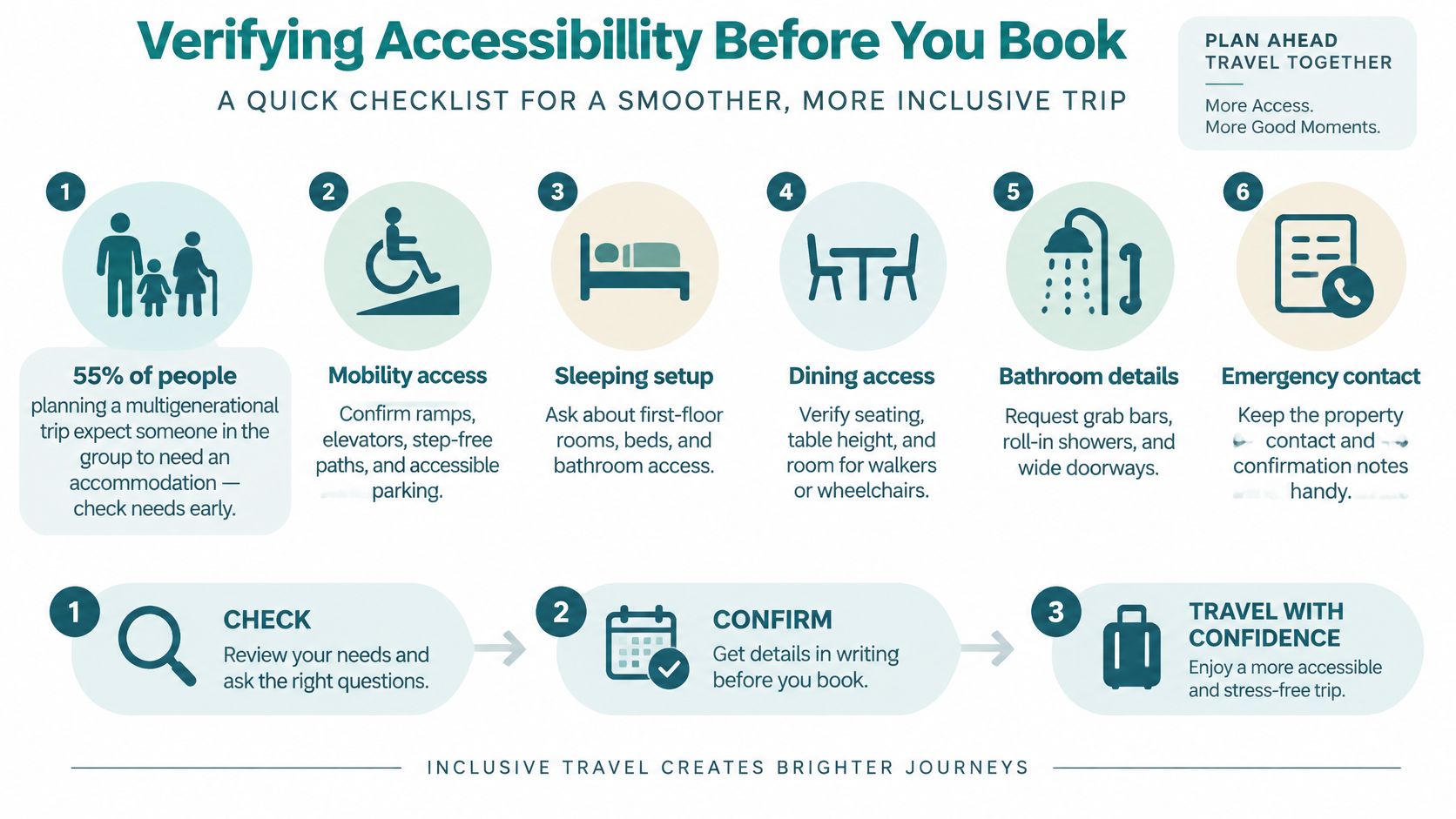
55% of people planning a multigenerational trip expect someone in their group to need an accommodation, and 78% of those families would pay more to ensure the need is properly met, according to Fora's accessible travel report. The same report found that 90% of surveyed travel advisors said online accessibility information can be incomplete, outdated, or contradictory, while 46% said it is often or always inaccurate.
The operational lesson is straightforward: an accessibility label isn't a verified route through the property. Ask the traveler what they need, with their permission, and translate that into questions the property can answer.
Use this checklist to organize the conversation before comparing prices.
Ask for evidence, not reassurance
- Continuous step-free route: Request details from parking or drop-off through the entrance, bedroom, bathroom, dining area, and main gathering space. Ask about thresholds, slopes, surfaces, and narrow turns.
- Bathroom usability: Obtain doorway measurements, clear floor space, shower-entry details, and grab-bar locations. Let the traveler assess whether the arrangement works for their walker, wheelchair, or transfer needs.
- Sleeping access: Confirm a suitable ground-floor bedroom or a functioning elevator, plus bed height and the route to the bathroom.
- Equipment support: Ask about refrigeration and reliable power for medication or equipment. Confirm oxygen-related arrangements directly with the property and relevant supplier.
- Quiet space: Identify a room suitable for sensory breaks, naps, or nursing that won't also be the main entertainment area.
- Medical access: Identify nearby appropriate care and check the actual driving route. Don't rely on a vague statement that a hospital is nearby.
Request current photographs, a floor plan, measurements, and written confirmation. A photograph of the front entrance won't establish whether the bathroom door clears a mobility device.
Let the traveler approve the fit
Keep the traveler involved instead of deciding on their behalf. Someone who can manage a short step may still be unable to repeat it throughout the day, and a caregiver may need additional maneuvering space.
Use the guide to travel with elderly parents to prepare the broader support plan, including rest and transport arrangements. For food allergies or other dietary accommodations, confirm preparation and cross-contact procedures with the meal provider rather than assuming a menu label is sufficient.
Save the property's answers with the reservation record and recheck that the confirmed room or unit hasn't changed. For your shortlist, set a firm one-week response rule: remove any property that won't provide written confirmation within that window.
Scheduling Activities Every Generation Can Join
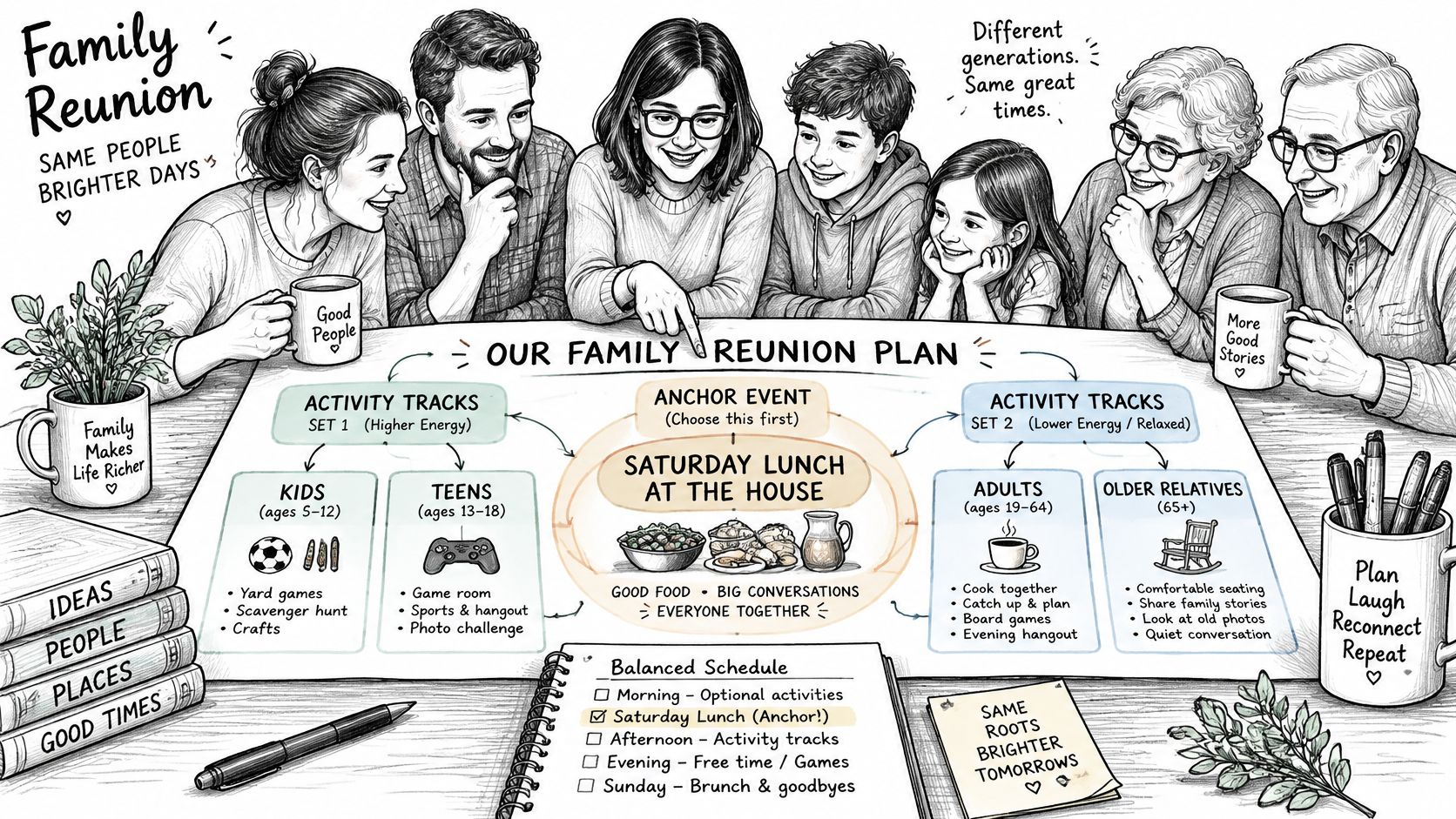
Choose the anchor event first, such as Saturday lunch at the house. Everything else should either work for everyone or remain an optional track, not become another compulsory group decision.
Keep the shared plan visible while relatives choose their activities.
A weekend schedule you can adapt
- Friday arrival: Flexible dinner at the house, with food available for delayed travelers.
- Saturday morning: Optional adult hike, with a low-key alternative at the house.
- Saturday lunch: Protected anchor gathering, followed by the family photograph.
- Saturday afternoon: Optional pool time for children with a designated supervising adult.
- Sunday morning: Breakfast, a quiet rest block for grandparents who need it, and staggered departures.
For relatives extending their stay, offer buffer days before and after the anchor rather than extending the compulsory program. Don't schedule a paid outing immediately after the main arrival window.
Make opting out easy
Record the time, cost, accessibility, organizer, and payer for each activity. Set a response deadline and a default, such as staying at the house when an excursion doesn't attract enough participants.
This video offers another planning reference to share with household representatives.
For your working schedule, publish the program two weeks before arrival, while leaving unpaid optional tracks adjustable until headcount is settled. Protect unstructured time; relatives shouldn't need permission to rest or talk.
Confirm Your Lodging Shortlist and Book This Week
- Shortlist properties against the actual household requirements. Choose two or three candidates for this week's comparison, then send each the same questions about step-free routes, bathrooms, sleeping access, refrigeration, and nearby medical care.
- Reserve the anchor dates after written confirmation. Select the property that satisfies the requirements and responds within your one-week decision window. If you're consolidating inventory through Approved Traveler, our membership provides access to hotels, vacation homes, flights, cars, and activities; up to 10 family members share one account at no extra cost, and each receives the full member rate.
- Record the commitment before moving on. Enter the supplier deposit, household contributions, cancellation terms, and outstanding balance in the ledger. Put the final RSVP and payment milestones on the shared calendar and assign responsibility for collecting them.
Check the reservation, not just the platform
For condo-style stays, we don't cap the number of weeks, but every week is subject to availability for your dates. Don't promise consecutive weeks or a particular unit until the inventory is confirmed.
Review current terms and eligibility for Reward Credits and Boomerang Member Share before including either in your planning assumptions. Confirm how family members are added and which reservations are covered, without treating membership access as a substitute for the property's written terms.
Your target this week is a usable reservation with funded obligations, not a complete entertainment program. If none of the candidates passes the access and affordability checks, change the shortlist rather than forcing the family into the wrong property.
Approved Experiences Traveler offers consolidated travel-booking access so you can coordinate reunion lodging, transportation, and activities without treating each as an isolated task. Visit Approved Experiences Traveler to compare available inventory against your household list, lodging ceiling, and verified accessibility requirements before committing family funds.