How to Choose a Gift: A Five-Step Method That Works
Learn how to choose a gift that fits the recipient, budget and occasion, with a clear checklist, budget guidance and common mistakes to avoid.
13 min read
The gift is due Sunday. The group chat has gone quiet, three browser tabs are open, and none of them contains anything you believe in. One is a candle. One is a gadget you'd never use yourself. The third is a gift card you're mildly embarrassed to send on its own.
Almost every disappointing present starts in that gap between the deadline and the decision. The fix isn't more browsing, and it isn't a bigger budget. It's a sequence: match the gift type to the person's situation, set the money before you look at products, then land on one verified gift with a return route attached.
The hardest judgment call in how to choose a gift is deciding how much choice to hand back to the recipient. Hand back too little and you're guessing on their behalf. Hand back too much and the present turns into unpaid homework. The method below moves in one direction, from recipient situation to budget to a single verified gift to timing.
Gift Types Matched to Each Recipient Situation
A silk scarf works for a sister whose style you know and falls flat for a manager whose taste you barely understand. The object is rarely the problem. The fit is. Before comparing products, decide how much discretion the recipient needs: none when they have named the item, some when you know a stable interest, and nearly all of it when their preferences or size remain uncertain.
Consumers expected to buy an average of eight gifts in 2025, down from nine in 2024, and 47% planned to give experiences such as restaurant visits, event tickets, or spa outings, according to Gallup's holiday shopping poll. In the same poll, 72% of consumers said wish lists make holiday shopping easier for everyone, and 64% said they like receiving gifts from a wish list because they can be confident the item will be used.
The useful conclusion is not that experiences suit everyone. It is that evidence beats intuition. A named product leaves you little discretion. A known hobby gives you a narrow lane. An uncertain recipient calls for cash, a card, or a planned choice. Keep one recovery route attached in every case: a receipt, an exchange window, or a provider that lets the recipient make the final selection.
Recipient situation | Gift that usually fits | Why it works | Avoid |
|---|---|---|---|
Explicit wish list | The requested item in the correct version or size | Recipient has already confirmed the fit | Swapping in a better-looking item |
Close partner with a known hobby | A specific item tied to the hobby or a booked session | Matches a stated interest | Buying gear they already own |
Colleague or boss, low closeness | Quality consumable or a flexible gift card | Easy to use, low pressure | Clothing without a confirmed size |
Hard-to-buy adult, uncertain tastes | Cash or gift card with a short note | Lets the recipient choose something useful | An open-ended gift with no explanation |
Busy parent or overloaded household | A service that removes a recurring errand | Gives back time on a known inconvenience | Another object to store or maintain |
Frequent traveler | A durable accessory that solves a known problem | Earns repeated use | Novelty gadgets |
Teenager | An experience with friends or a flexible gift | Fits their social schedule | Items that reflect the giver's taste |
Cash beat every other requested category in KPMG's 2025 consumer pulse survey: 57% of respondents named cash as the most desired gift, ahead of gift cards at 48% and apparel at 39%. For the hard-to-buy adult, add one sentence about what you hope it helps them do rather than apologizing for the format.
Fragrance belongs in the high-knowledge lane. It can suit a partner whose preferences you know, but it is too personal for most colleagues unless they requested it; this guide to how to gift a signature scent handles that distinction. If the recipient should keep the final choice without doing all the research, a personal shopping gift session offers a narrower alternative to an unrestricted card.
Work down from the row that fits: confirm the version, size, date, or location, choose one candidate, and attach a return or exchange route. The right amount of choice is the smallest amount that protects the recipient from a confident wrong guess.
Setting a Budget Without Awkward Guesswork
Start with the total, not the product. Write down every person you buy for, count the occasions across the year, divide the total across them, then assign each name a range based on relationship and occasion. A sibling's birthday and a coworker's farewell shouldn't come out of the same slot.
Expect the uncertainty to be shared rather than personal. A 2024 survey of 2,000 U.S. adults found 51% did not know the etiquette-appropriate amount to spend on each person on their list, and 56% felt reluctant to establish a gift-giving budget with family and friends (2024 survey data on gift budgets and etiquette). The same study reported average seasonal spending above $1,430, including $766.50 on gifts, $424.80 on travel, and $239.08 on holiday meals and parties. Treat the gift number as a reference point, not a target you owe anyone.
The direction of travel in 2025 was down, which makes a tighter range feel normal rather than stingy. PwC's 2025 holiday outlook found average planned U.S. holiday gift spending fell 11%, from $814 in 2024 to $721.
Recipient | Relationship | Occasion | Range |
|---|---|---|---|
Adult siblings | Family | Birthday | $40 to $75 |
Coworker | Colleague | Farewell | $20 to $35 |
Partner | Close | Anniversary | $150 to $300 |
Whole gift list | Total budget | Full year | Split the total across recipients |
Make the Group Agreement Explicit
Say four adult siblings agree on a $40 cap for birthdays. The cap removes the quiet competition of matching each other's spending, and it removes the guilt of the year someone's budget is thin. In friend groups and workplaces, the same logic works with a category rule (consumables only, books only) or a draw, so nobody shops for eight people in December.
Practical rule: the range gets written down before the product gets opened, or price will quietly do the choosing for you.
A constrained budget doesn't require a smaller-feeling gift. Strengthen relevance instead of spend: pick timing that matters, like the day after a move when the household is drowning in boxes, or turn the gift into a shared experience such as a home-cooked dinner at their table rather than a restaurant neither of you needs.
Close the section by writing one line per recipient, name and range, before you shop anything.
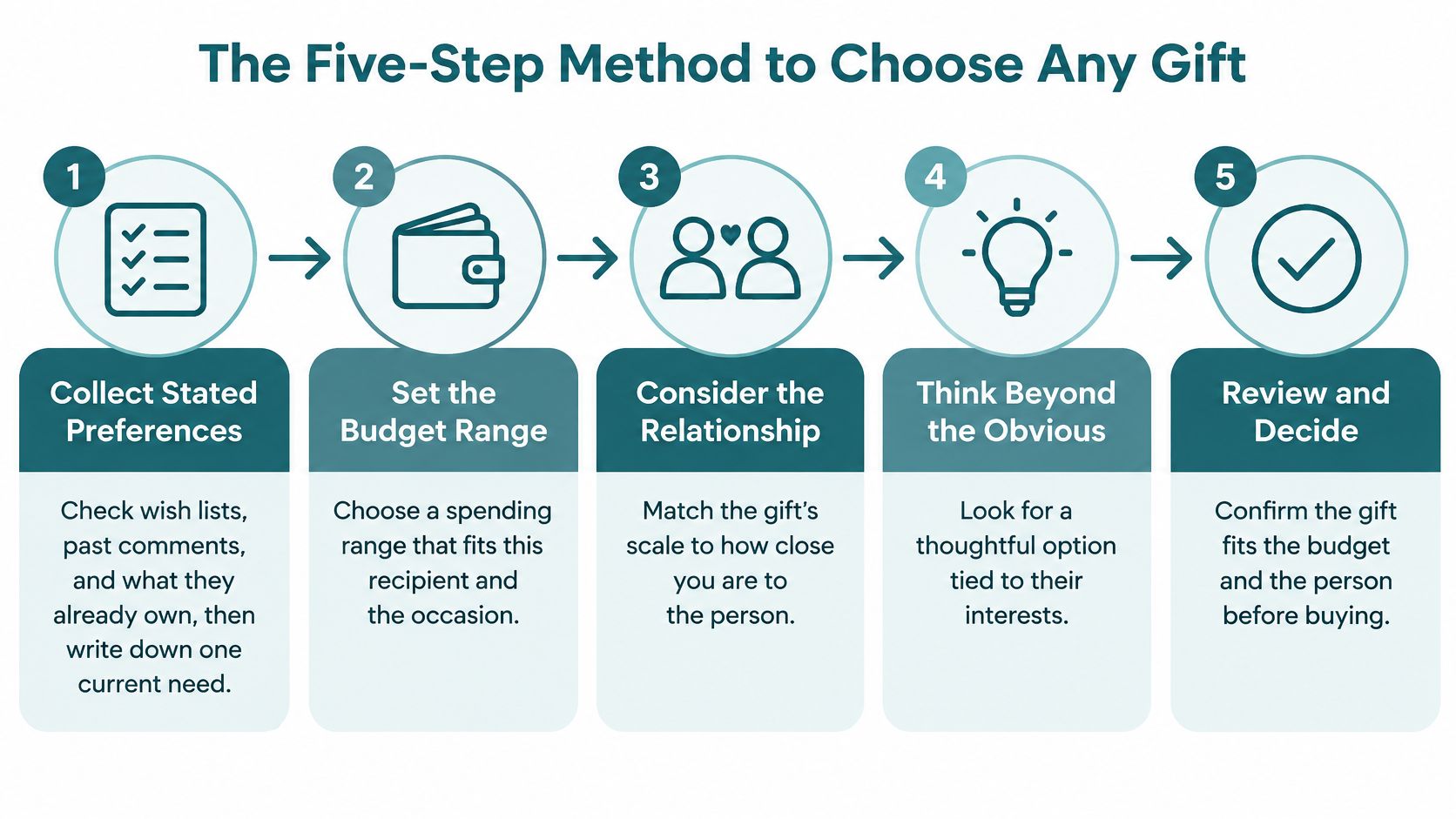
The Five-Step Method to Choose Any Gift
Run these five steps in order. The sequence is the method, and step two run late is where most of the damage happens.
Collect What They Have Already Said
Check three sources: any wish list, throwaway comments from the last few months, and what the person already owns. Write down one current need and one current constraint. The distinction matters because givers default to personality rather than present circumstances. Wharton research on gift personalization found recipients more often preferred versatile gifts, including cash or a broadly usable card, over the highly specific options givers believed were more thoughtful. Someone who loves cooking may still prefer a general home-goods card if the need right now is a replacement pan or a pantry restock.
Fix the Range Before You Look
Set the ceiling for this recipient and occasion, then shop inside it. Discounts are persuasive: discounts and promotions influenced 62% of surveyed consumers' gift purchases in 2025, and product reviews influenced 55% (Morning Brew's 2025 holiday shopping survey). A 40% reduction on something outside your range is still the wrong purchase. Range first, discount second.
Match the Scale to the Relationship
The giver-recipient gap shows up most clearly with the people closest to you. Research on gift-giving asymmetry describes close givers rejecting registry choices to signal relational closeness, even though the registry item fits the recipient's preferences better. A nine-study program in that body of work found givers tend to choose gifts more specific and personalized than recipients want, which makes "highly customized" a risk signal rather than a quality marker. Raise specificity only when the evidence is strong: a named hobby, an exact model requirement, something asked for out loud.
Think Beyond the Obvious
The best gifts sit one step past the obvious, close enough to be verifiable and far enough to feel chosen. If a known interest is specific and well documented, a curated set beats a generic kit, and this guide to whiskey gift sets for bourbon lovers shows how much range exists inside one narrow interest. Then apply the filter:
Would the recipient independently choose, use, or consume this within the next 90 days?
If the answer is no, switch to a verified preference, a flexible option with an exchange route, or an experience with dates and logistics already confirmed.
Verify Before You Pay
Run the constraint check: size, dietary restrictions, allergies, accessibility, existing ownership, delivery date, return window. Returnability is the cheapest insurance in gifting and the one people skip most often.
Here's how that plays out. A coworker mentions a long commute twice in one week. The right answer is a well-made travel mug that seals, not a decorative candle and not a personalized desk sign. One gets used on Monday morning; the others get stored in a cupboard and donated in spring. You should end this exercise holding four things: one verified gift, one backup option, a return route, and a two-line note explaining why you chose it.
When Flexible Gifts Work and When They Backfire
A gift card gets described as the safe option. In close relationships it's frequently the option that reads as the least effort, and recipients notice the difference even when they don't mention it.
That judgment gets made long before anyone opens anything.

Research on gifts with choices found recipients can perceive selectable attributes as less thoughtful, because flexibility suggests the giver invested less time, and givers consistently underestimate that effect. The perception softens when the giver explains which attributes were already considered. A short note does more work than a long apology for not knowing.
"Chosen for the compact size, neutral design, and compatibility with your setup" preserves the recipient's agency without handing the entire decision back to them.
So decide how much choice to hand back, in order. Recipient first: a partner, close friend, or family member expects you to know them, so narrow the choice to something specific. Budget second: at a modest spend, one well-chosen useful item beats a thin card, while a larger budget can carry a broad card without looking lazy. Then land on a single gift with a working exchange route, so a wrong read costs a swap rather than a cupboard.
Redemption mechanics matter as much as the sentiment. University of Cincinnati research on gift card giving found recipients take longer to redeem cards restricted to one store or product category than cards usable across more merchants, and that givers pick more specific, less versatile cards for romantic partners while recipients prefer versatility regardless of closeness. A card locked to a single clothing retailer works when the recipient named that retailer and has a purchase planned. Otherwise the general-purpose card wins.
Unwanted gifts don't vanish. They end up donated, passed on, or stored rather than used, so a bad guess costs a return trip or a permanent spot in a storage bin.
Check three mechanics before you buy:
- Where it can be used. A one-retailer card only makes sense with a stated intent to shop there.
- Whether it covers their likely spending. A beauty card is dead weight for someone who buys skincare elsewhere.
- How narrow the redemption is. If using the gift means picking a specific product from a specific range, you've handed back the research you were meant to do.
Delivery is a mechanic too. If the card arrives by email, confirm the timing and the recipient's inbox before you promise it, and how e-gift cards handle scheduling and redemption covers that side properly.
For anyone you can't read, skip the clever guess: a moderately priced useful item or a broad card with the exchange route left open beats a gift that leaves them researching your choice the week after they open it.
Experiences or Useful Objects and How to Decide
Two people can open the same concert ticket and feel opposite things. Experiences earn their reputation on fit, not on category, and that's the whole test.
The upside is real. In a Nature Portfolio study on experiential gifts, participants were randomly assigned to receive or recall experiential or material gifts, and experiential gifts produced greater gratitude, with gratitude positively associated with social connection. Related work found experiences can strengthen connection to the giver whether or not the giver attends. None of that makes a badly chosen experience better than a well-chosen object.
Three versions that tend to land:
- Tickets for someone who already follows the performer. The desire is documented, so the gift only has to solve logistics.
- A class built on a stated hobby. A stated interest, not an assumed one, is what separates this from a hobby you've projected onto them.
- A planned meal somewhere convenient. Convenience matters more than prestige, because prestige adds travel time the recipient pays for.
Reduce execution friction before you book: confirm dates, check the location and accessibility, read the cancellation terms, and ask whether the recipient has to coordinate anything else to use it. An experience fails when it creates a new obligation, or when the interest was yours rather than theirs.
Objects fail differently, and the failure is measurable. Research cited by Snopes on gift-giving taboos from studies by Ernest Baskin and colleagues found givers emphasize how desirable or fun a gift appears, while recipients weigh how easy and useful it is to use, and the gifts people rated as the best they'd received were more useful than the ones they believed they'd given. Run the utility check: name a repeated task, an existing inconvenience, or a consumable the recipient already buys.
If you're leaning toward food or travel, culinary travel experiences show how to pick one that fits a schedule instead of fighting it.
The test that settles it: does this gift create a meaningful memory with manageable effort? If the effort lands on the recipient, buy the useful object or the flexible option.
Timing Your Order and Confirming the Gift
Work backwards from the date the gift needs to be in someone's hands, then subtract the shipping window. Getting this right matters because misses are common: in 2025, 74% of surveyed Americans reported having received a gift they disliked, and 43% of Gen Z respondents said they struggle with gift giving (SurveyMonkey's 2025 holiday shopping trends).
Clothing is the category where confirmation earns its keep. 53% of Americans who gave gifts reported purchasing clothes or shoes, making it the most commonly purchased gift category (YouGov's 2025 holiday shopping data). Confirm the size from a garment they already own, or buy where the return is free.
When | Action | Why |
|---|---|---|
Deadline under one week | Order now, use delegated sourcing if needed | Little room to fix mistakes |
A few days before | Place the order | Room to fix a wrong size or stock problem |
Before ordering | Run the checklist | Catches preference, size and delivery gaps |
After delivery | Keep the return window open | Allows an exchange if the gift misses |
Run one pass before you hit buy:
- Preference confirmed. A list item, a stated interest, or a documented need, not a hunch.
- Size or dietary need verified. Especially for clothing, food, and anything worn against the skin.
- Delivery date confirmed. In writing, with the address double-checked.
- Return route noted. Where it goes back, how long you have, who pays postage.
- Note written. Two lines, tied to something you observed.
If the deadline is too tight to shop it yourself, Approved Lux Personal Assistant's errands service includes gifts sourced, purchased, and delivered on time. Then move to the next name on the list, run the five steps again, and put a firm order date next to it so the decision doesn't drift back to the week before the occasion.
Gift sourcing is the kind of task that looks small on a list and eats an entire evening, which is why Approved Lux Personal Assistant handles it as part of the errands service: gifts sourced, purchased, and delivered on time, with member preferences and history stored on the account so whichever team member picks up already knows how you like things done. Lux Solo at $99.99/month covers one person, and Lux Circle at $299.00/month covers up to 4 people on a single account, which suits a household running several birthdays and holidays a year. Visit Approved Lux Personal Assistant to see how the Assistant team works across call, text, or email.