How to Book Multi City Flights Without Missed Connections
See how to book multi city flights on one protected ticket, compare open-jaw and stopovers, and check connections before you pay.
12 min read

The usual advice on how to book multi city flights starts too late: select the multi-city tab, enter your destinations, and choose a fare. That gets you search results, not necessarily a protected trip. A multi-city display can still contain separate tickets, leaving you responsible for a missed onward flight even though you bought everything in the same checkout.
For a family group, the better starting point is deciding who pays when a connection fails. Choose the ticket structure, calculate the cost of disruption, and then enter the cities. A lower fare isn't much help if you must replace flights for parents, children, and grandparents while rearranging accommodation.
Pick the Ticket Structure Before You Search
Default to one protected ticket when several people need to travel together. Compare the alternatives before comparing fares, because the same destinations can produce very different obligations.
Multi-city structures and what each one protects
Structure | If the first flight is late | Checked bags | Use it when |
|---|---|---|---|
One multi-city ticket | Airline rebooks the missed onward flight | Usually checked to the final city | Tight connections or a group that must stay together |
Separate tickets | Next airline has no duty to rebook you | Collect bags and check in again | Savings cover a hotel night plus a new fare and you add hours of buffer |
Open-jaw on one offer | Protected across the ticketed flight segments | Through-checked when issued as one ticket | You arrive in one city and fly home from another |
Stopover over 24 hours | Protection follows that fare's stopover and ticket conditions | Often collected during the stay | You intend to remain more than a day, not just connect |
These are planning defaults, not promises that every bag will transfer or every hotel expense will be covered. Rebooking protection and reimbursement for disruption expenses are different questions. Read the applicable ticket conditions before assigning either value to an itinerary.
Start with the route shape
Write the trip as ordered segments: home airport, each city where you'll stay, and the final flight home. Don't add an airport merely because a search engine proposes a connection there. Your destination list and the airline's transfer points serve different purposes.
An open-jaw avoids returning to an arrival airport just to fly home. IATA's retailing guidance describes multi-city or open-jaw offers with different inbound departure and outbound arrival airports, with those segments priced as a round trip within a single offer.
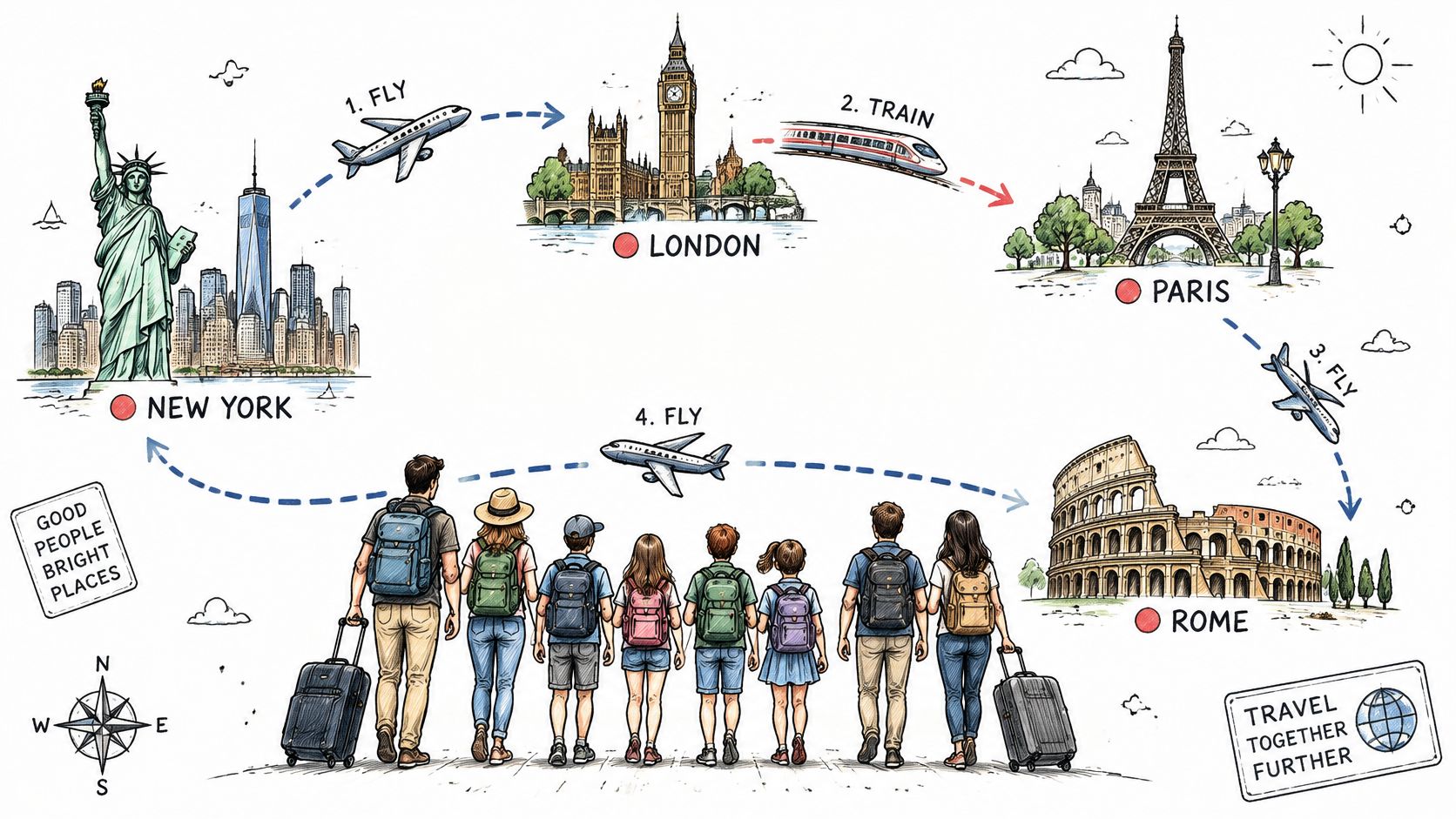
For example, enter New York to London, Paris to Rome, and Rome to New York, then arrange London to Paris independently by rail. The missing flight between London and Paris is intentional. The ticket doesn't protect that independent rail journey.
When another structure earns its place
Separate tickets can work when the onward journey isn't immediately dependent on the inbound arrival. An overnight stay may make that arrangement practical, but include the hotel, ground transport, meals, and a replacement fare in your comparison. For a group, calculate the exposure for everyone, not just the person whose fare you searched.
Practical rule: Keep separate tickets only when you can afford both the recovery plan and the time it consumes.
For an intentional Dubai stay, include local transport in that calculation too. Uptown Rent A Car's guide to skip parking with a Dubai rental is useful context when deciding whether to keep a vehicle through an airport visit.
A planned stopover needs its actual onward departure date entered in the search. Don't buy a connection intending to turn it into a stay afterward. Use the international flight booking checklist alongside your route plan to check the wider international booking requirements.
How to Book Each Segment in Order
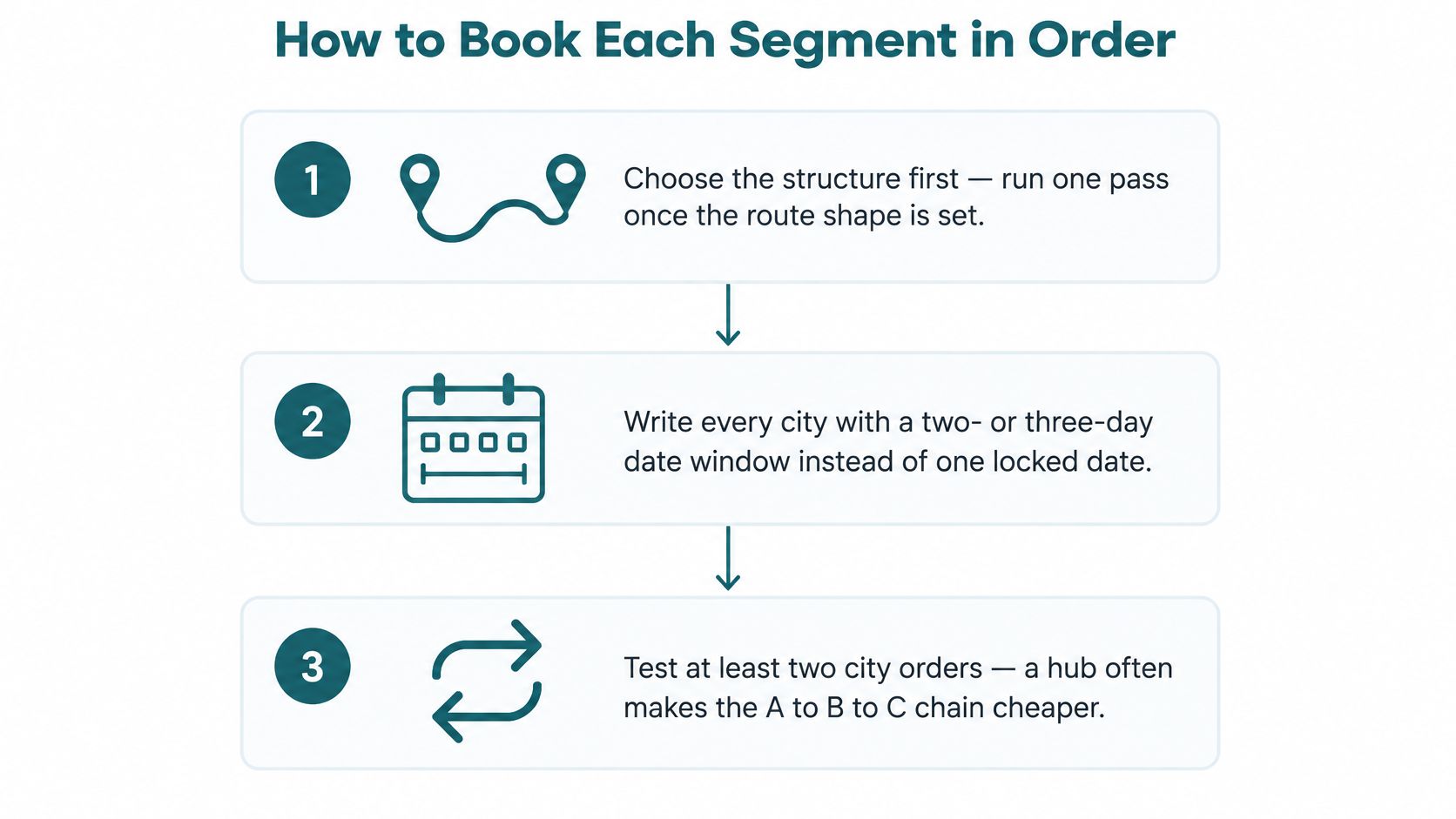
Build the search from your destination list, not from an airline preference. Tineo's multi-city routing guide sets out a six-step workflow covering city order, ticket comparison, connection validation, fare rules, and ticket confirmation.
Use this process graphic as a starting checklist, then complete the operational checks below.
Build and price the route
- List each city and its date window. In a hypothetical family trip, give flexible stops a two- or three-day window instead of fixing every departure immediately. Mark the commitments that can't move, such as a cruise departure or reunion. The mistake is treating a preferred museum day as rigid while leaving the flight into a cruise port vulnerable.
- Test alternative city orders. Compare the sequence geographically, then compare the actual flights. A route that looks shorter on a map can require an awkward connection, while a different order follows an airline's established hub. Keep arrival time and usable time at the destination beside the fare, so an overnight airport wait doesn't disappear inside a low headline price.
- Price the complete chain first. Select the multi-city option and enter each required flight journey in travel order. Search the open-jaw version before adding independent regional flights. Only then compare separate one-way tickets, using the same passenger count, cabin, baggage requirements, and disruption allowance.
Airline networks explain why the obvious geographic order doesn't always win. A historical hub-and-spoke network comparison illustrates that directly connecting 20 cities requires 190 city-pair routes, while one hub can reduce the network to 20 spoke-to-hub routes. Search the workable network, not just the straightest line.
Validate what the search produced
- Record every transfer. Note the airport code, operating carrier, arrival and departure terminals where available, and any airport change. Compare the connection with the airport's published minimum connecting time or have the airline validate it. A self-transfer involving baggage collection and check-in isn't equivalent to walking between gates.
- Inspect every fare component. Open the detailed fare conditions rather than relying on the fare's marketing name. Check permitted stopovers, baggage, changes, cancellation, and combinability rules. If one flight uses a different fare type, record that difference rather than assuming the first flight's conditions apply throughout.
- Verify ticketing before treating the trip as finished. The review screen must show every intended city in the right order, the operating carriers, and the promised ticket structure. After purchase, confirm that ticket numbers have been issued for every traveler and every required segment. A reservation acknowledgment alone isn't enough.
Ticket numbers identify individual passengers' tickets, so a family won't share one ticket number. What matters is that each person's connected flights are issued on the intended through-ticket, with the group kept on the same reservation where possible.
A search result is an offer. A ticketed itinerary is the document you can use to verify what was actually issued.
If a stopover won't price, don't buy an incomplete version and hope to repair it later. Ask the airline to construct the intended itinerary, including the actual dates and all required destinations. Save the final route summary separately so another adult can manage it if the main organizer is unavailable.
Judge Each Connection Before You Accept It
A connection can be permitted by a reservation system and still be unsuitable for your family. Minimum connecting time is a selling threshold, not a promise that you'll reach the gate. Judge the proposed transfer against the work your group must complete between aircraft.
For U.S. flights, use the Bureau of Transportation Statistics on-time performance records to review scheduled and actual times, cancellations, diversions, and delay causes by airport and airline. Identify the operating carrier, not just the airline name displayed most prominently on the booking page. Review recent relevant operations rather than treating an airport-wide average as the prediction for your particular flight.
Read the schedule as a transfer operation
Start with the inbound arrival, then work forward through the tasks required before the next departure. Immigration, baggage collection, customs, security, terminal transport, and an airport change can all consume the apparent gap. Boarding and bag-drop deadlines also mean you don't have the entire interval between published arrival and departure times.
For a family, use the pace of the traveler who needs the most assistance. A connection that works for an adult carrying a backpack may not work for grandparents, a stroller, and checked bags. Check assistance arrangements and walking requirements before accepting the route.
If the itinerary sits on the minimum, search nearby dates or another hub. In a hypothetical New York search, compare departures a couple of days either side and test Kennedy against Newark as alternative departure airports. Don't turn those alternatives into an airport-change connection without separately budgeting the road transfer and its uncertainty.
Connection pitfalls and the fix before ticketing
Pitfall | What actually happens | Fix before you pay |
|---|---|---|
Minimum connection treated as a guarantee | The system will sell a link you can still miss | Check carrier and airport on-time data and add buffer |
Stopover confused with a connection | Fare and handling rules can change once the stay passes 24 hours | Enter the real next departure date as its own segment |
Separate-ticket miss | The onward airline need not rebook you | Buy one ticket or add hours plus a backup fare |
Bags assumed to transfer | You may need to collect, meet entry requirements, and recheck | Verify baggage handling before purchase and the city on the bag tag at check-in |
Later schedule change | A downstream segment can become disconnected or disappear | Recheck every segment before departure |
Account for limited recovery options
Full flights make a missed connection harder to repair. IATA's December 2024 passenger market analysis recorded a full-year passenger load factor of 83.5%, the highest in that series; December revenue passenger-kilometers rose 8.6% year over year, and international passenger traffic rose 13.6% that month.
Those global figures don't predict whether your flight will arrive late. They explain why you shouldn't assume the next departure will have seats for the whole family. Review the remaining departures that day and whether a recovery would require splitting the group.
For London to Doha to Singapore on a through-ticket, ask at check-in whether the bag tag prints Singapore, and retain the receipt. The multi-city ticketing and baggage explainer describes the usual through-checking and missed-connection handling on connected tickets, while noting that long stays can change baggage collection arrangements.
Don't rely on a marketing airline's code to identify who operates each flight. A reference such as the airline code AZ guide helps decode itinerary labels, but the operating-carrier field is what you need for check-in and operational checks.
Price the failure before accepting the fare
Put a replacement flight and an overnight stay beside any separate-ticket quote. Include ground transport and the cost of losing a prepaid activity or accommodation night. You don't need to predict a delay probability to recognize that the household can't comfortably absorb the consequence.
Leave room for recovery, not just room to make the scheduled connection.
Keep parents and children together on the reservation where possible, with compatible fares and baggage arrangements. After any schedule-change email, inspect the entire itinerary: arrival times, onward departures, airports, and ticket status. Don't assume the flight named in the subject line is the only part affected.
Three Itineraries and What to Enter
These hypothetical bookings show how to translate a travel plan into search fields. Use your actual travel dates in each entry, then inspect the resulting itinerary rather than assuming the form preserved everything.
A family trip needs an entry list that another adult can understand and check.
A family open-jaw with independent rail
Say eight relatives want London, Paris, and Rome without returning to London. Enter these flight journeys:
- Outbound New York to London on the family's departure date.
- Regional flight Paris to Rome on the date the Paris stay ends.
- Return Rome to New York on the final departure date.
Book London to Paris by rail separately. The confirmation should show London as the first arrival, Paris as the next flight's departure, then Rome and New York in sequence. Check that the apparent gap is intentional and that every traveler has the intended flights ticketed.
Dubai as a connection or a destination
For New York to Dubai to Bangkok, TBO Academy's complex-itinerary guidance generally distinguishes transfers below 24 hours from stopovers exceeding 24 hours, illustrating an 18-hour Dubai connection versus a four-day stay.
For the connection version, search New York to Bangkok and inspect the proposed Dubai transfer. For the stay version, enter New York to Dubai, then Dubai to Bangkok on the actual date you'll leave Dubai. Compare the fare conditions for permitted stops, charges, and maximum stays rather than assuming the extra visit is free.
If other transport determines your timing, check that schedule before fixing flights. For a Puerto Rico trip involving vehicle shipment, National Car Transport's próximas salidas hacia Puerto Rico can help coordinate that separate movement with your arrival plans.
For a visual companion to entering multiple destinations, use the video below.
A split ticket that doesn't survive the check
Suppose London to Doha and Doha to Singapore appear as separate tickets with a hypothetical 90-minute gap. Entering both flights in a trip planner doesn't make that a protected connection.
Before buying, work through baggage collection, entry eligibility, recheck, and the second carrier's deadlines. Price a replacement onward flight and possible hotel. I would reject that short self-transfer for a family and compare a through-ticket or an intentional overnight instead.
If the engine can't construct the Dubai stay correctly, have an airline agent build it. The correct result is the itinerary you intend to fly, not the closest result the form happens to accept.
Confirm the Ticket and Choose Where to Pay
Choose the payment channel by who will service the ticket, not just who displays the itinerary clearly. For a single-carrier chain, I would start with the airline's website so the seller and operating airline are aligned. For an open-jaw or mixed-carrier trip, compare a consolidated offer, but require an explicit explanation of ticketing and disruption responsibility.
In IATA's 2025 Global Passenger Survey, covering more than 10,000 travelers across over 200 countries, 54% wanted to deal directly with airlines; airline websites were the preferred booking channel for 31%, down from 37% in 2024. That's a channel preference, not evidence that every airline website will construct your particular route best.
Choose access without assuming protection
A multi-city search is a search format, not a separate booking channel. An airline or intermediary can offer it, and either result still needs a ticket-level check. Reject a result that omits a city or converts the connections you need protected into separate tickets.
With us, bookings are made in the Approved Traveler member portal, reached by signing in from the website. Hotels, flights, cruises, cars, tours, and homes are available under one login; our 110% Best Value Guarantee pays the difference plus 10% if a lower publicly available price exists for the same booking. Consolidated access helps organize the trip, but it doesn't replace checking each flight's ticket conditions.
Read the airline ticket insurance guide before relying on insurance as your fallback. Check the policy's actual coverage rather than assuming it repairs an intentionally short self-transfer.
Run the payment check
- Match the route. Compare every city, date, airport, and operating carrier against your written plan.
- Verify the ticket structure. Confirm which flights will be protected together, keep the group on one reservation where possible, and check each passenger's issued ticket afterward.
- Save the conditions. Retain baggage, change, cancellation, and stopover rules for every fare component.
- Prepare the recovery file. Save confirmations, ticket numbers, seller contact details, and a backup for the most vulnerable connection.
Finish accommodation, car, and cruise arrangements only after the flight ticket numbers are saved. That prevents a reservation acknowledgment or incomplete flight chain from becoming the foundation for the rest of the family's spending.
Approved Experiences Traveler provides consolidated access to flights, hotels, cruises, cars, tours, and homes, so you can organize the wider trip without scattering its components across unrelated accounts. Visit Approved Experiences Traveler to explore that infrastructure, then bring your ordered route, ticket-protection requirements, and recovery budget to the booking process.