Cruise Vacation Planning: Decisions, Costs and Timing
Cruise vacation planning explained: when to book, how to budget the full trip cost, and which cabin, port and itinerary decisions matter most.
14 min read
Eight people, four cabins, three generations, and one group chat full of screenshots of an advertised fare. That's how most group cruises begin. Someone finds a price, everyone replies with a thumbs up, and the decisions that matter, cabin cluster, sailing date, flights, get made in the wrong order six weeks before the ship leaves.
The fare is one line in a per-traveler budget. Everything else is timing. A sailing holds a fixed number of cabins in each category, and the group that books in the right sequence keeps the cabins together, the dates intact and the total cost predictable.
The market keeps rewarding that discipline with more inventory to choose from. 34.64 million passengers sailed on ocean-going cruise lines tracked by CLIA in 2024, up 9.3% from 31.69 million in 2023, according to CLIA's State of the Cruise Industry Report, and the association projected 37.7 million for 2025. More cabins exist than in 2019, and more travelers compete for the ones that connect, sit mid-ship or hold a balcony.
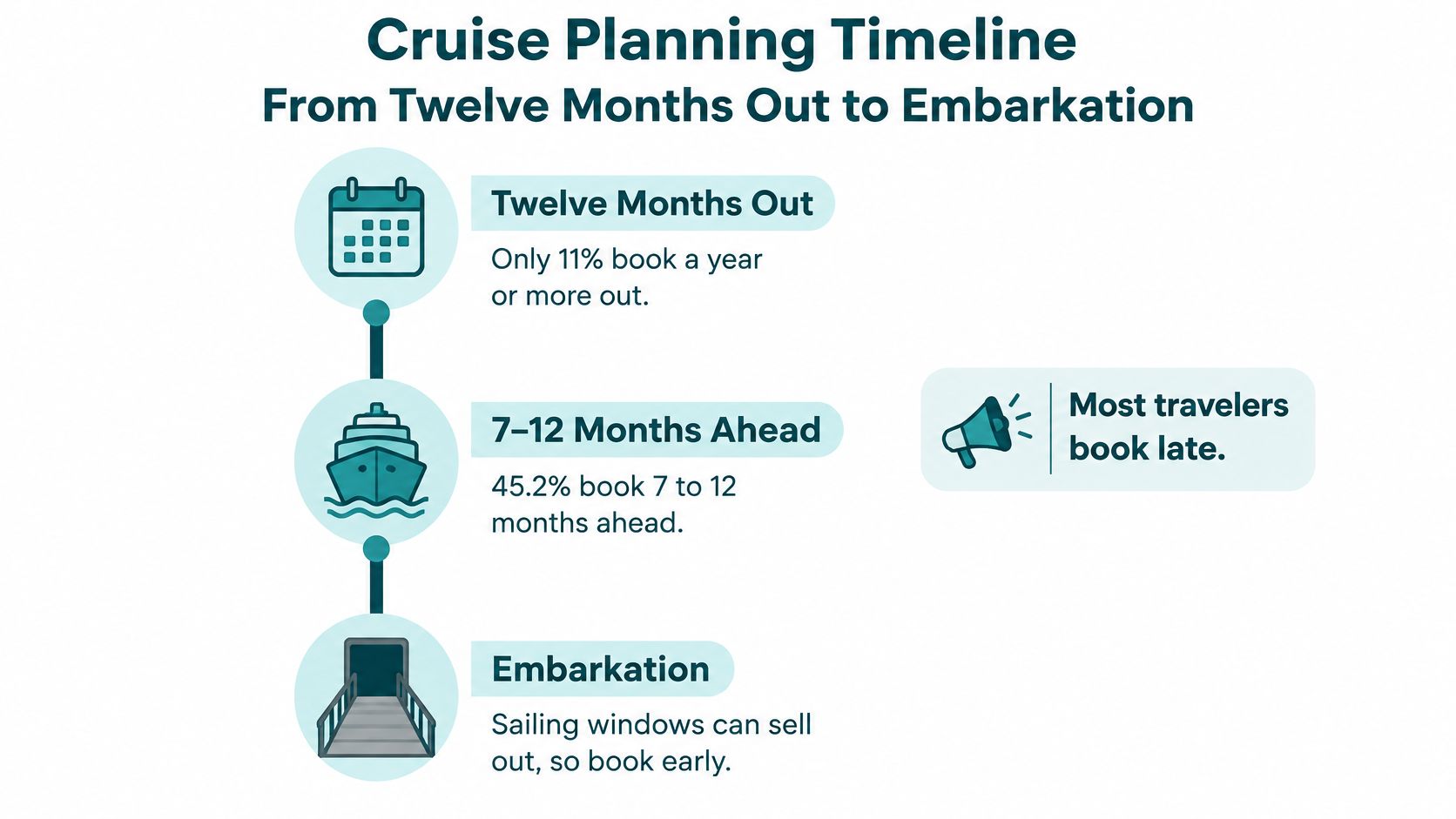
Cruise Planning Timeline From Twelve Months Out to Embarkation
Booking order drives most of the regret in cruise vacation planning. Only 11% of cruise travelers book their sailing at least a year before departure, according to the 2025 State of the Cruise Industry Report, and those early bookers do it to secure a specific ship, cabin category, itinerary or travel date. The middle of the curve is crowded: 45.2% of the more than 7,100 travelers surveyed by Cruiseline.com and Shipmate book 7 to 12 months ahead. School-holiday sailings, Alaska summer departures and accessible cabins disappear first, usually inside that band.
The Sequence and the Deadline Behind Each Step
- Twelve months out, fix the window, the headcount and a ceiling per person. Choose a two-to-three week sailing window rather than one date, confirm who is going, and set the total each traveler can spend including fare, taxes, gratuities and airfare. Every later choice, cabin category, excursion spend, whether you fly in a day early, is a subtraction from that number. Departure month moves both price and availability, and this breakdown of the best time to book cruises shows where each season's window tightens.
- Nine to twelve months out, clear documents and reserve cabins together. Check passport expiry against your return date and the entry rules for every country on the itinerary, then decide on travel protection before non-refundable money moves. Book the cabins in one transaction: two connecting pairs for a group of eight, not four singles you hope to link later. Adjoining and connecting inventory splits across categories fast, and a group that books in separate batches loses the ability to dine and disembark on the same schedule.
- Six to nine months out, book the flight for the day before and one hotel night. A missed embarkation costs far more than a hotel room, and the buffer absorbs a canceled connection. Pick the hotel near the airport or near the terminal depending on your transfer plan, and confirm the check-in window at the same time.
- Three to six months out, take the items that need lead time. Shore excursions, specialty dining reservations, and any accessibility arrangement that requires a specific cabin layout or written confirmation from the line. Book excursions only once arrival and departure times are published, and schedule returns at least an hour before all-aboard, more at tender ports where the last boat runs earlier than you expect.
- One to two months out, fix the money details. Confirm your gratuity setting with Guest Relations, update traveler documents, and re-read the final itinerary for port substitutions. Every booking, cabin, air, transfer, excursion, needs the name printed on the passport. A mismatch between a reservation and a passport is the kind of error that surfaces at the terminal, where fixing it costs time you no longer have.
- Final two weeks, handle the last mile. Compare the line's transfer with a private shuttle on price per person and pickup time, confirm the pickup point and check-in window, label luggage with the cabin number, and print the documents you'd want if your phone dies.
What actually goes wrong: groups book the cabin last. The fare looked fine in month ten, the connecting pair was gone by month seven, and eight people ended up in four cabins across three decks.
Copy the six milestones into one shared sheet with an owner and a due date on each row, then check it weekly. The sheet is what turns a group chat full of opinions into a sequence of decisions, and it forces the hard conversation about budgets in month twelve instead of month four. One person owns flights, another owns excursions, and nobody wonders whether the passports were checked. If your family already runs a month-by-month checklist for another big event, the same format carries over directly; a couple planning a wedding in Puglia can find your Italy wedding deadlines laid out in the same style, locking dates well before the day rather than scrambling after it.
Matching the Itinerary and Ports to Your Group
The Caribbean is the reference point for mainstream cruise capacity. CLIA's 2025 global market report puts the region at 44% of all ocean-going cruise passengers that year, more than 16 million guests, per the CLIA global market overview. That concentration makes route and date the first filters a group should apply.
Two sailings of identical length can feel nothing alike. A Western Caribbean route through Mexico and Belize differs from an Eastern Caribbean route through the Bahamas, U.S. Virgin Islands or Puerto Rico on sea days, passport requirements, excursion pricing and weather exposure. Map every port against the ship's published arrival and departure times, then reserve only excursions that return comfortably before all-aboard.
The embarkation port matters as much as the destination list, especially when the cruise anchors a longer stay. Miami, Fort Lauderdale, Port Canaveral and Galveston each need different airport, hotel and ground-transport arrangements, and the difference shows up in transfer time as much as in airfare.
Route region | Typical embarkation ports | Planning check |
|---|---|---|
Western Caribbean | Miami, Fort Lauderdale, Galveston | Compare Mexico and Belize port days and tender status |
Eastern Caribbean | Miami, Fort Lauderdale, Port Canaveral | Check sea days and passport needs for the Bahamas, U.S. Virgin Islands and Puerto Rico |
Alaska | Seattle, Vancouver | Confirm the seasonal sailing window and excursion return times |
Mediterranean | Barcelona, Civitavecchia, Athens | Check pier versus tender status at each port |
Flag tender ports before you book anything else. Tendering adds transfer time on both ends and creates real constraints for anyone with limited mobility, so a group with a walker or wheelchair should weigh an itinerary's tender count as heavily as its ports. Alaska runs inside a limited summer window, and Mediterranean ports vary between pier and tender, so route comparison without those checks is guesswork. Pick the sailing whose sea-day pace suits the group, because a port-heavy itinerary exhausts three generations faster than a schedule with two slow days built in.
Choosing a Cruise Line, Ship and Cabin
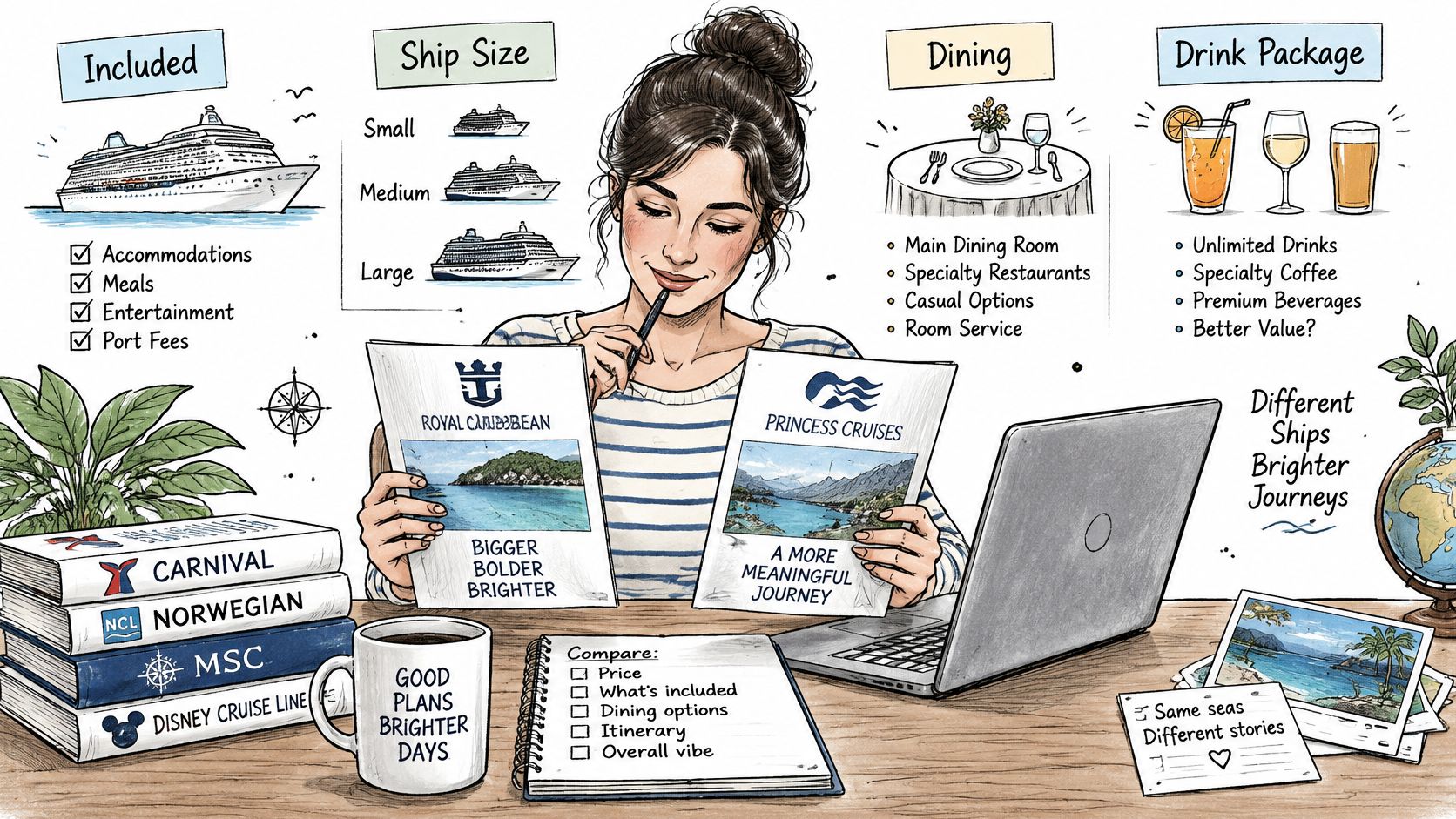
Line first, ship second, cabin third. Each line sets its own ship sizes, itinerary styles, dining structure and drink packages, so deciding on the cabin before the line means comparing prices for things that aren't the same. Compare on what the fare includes, the age and size of the ship, which itineraries run on your dates, and whether a loyalty tier from a past sailing changes cabin access or onboard credit. That comparison is where how the major cruise lines differ pays off, because inclusions vary more than headline fares do.
Cabin Categories and What Each One Costs You
A family of eight needs four cabins, and the practical question is whether two connecting pairs beat one larger suite plus a balcony. Price both. Then check cabin position on the deck plan: a stateroom under the buffet or beside the elevator lobby changes how well anyone sleeps, and that matters more than an extra square meter of floor space.
Cabin type | Best for | Main trade-off | Booking note |
|---|---|---|---|
Inside stateroom | Travelers who spend most days ashore | No natural light | Usually the lowest fare in each category |
Oceanview stateroom | Travelers wanting daylight without balcony cost | Window does not open | Check for obstructed views |
Balcony stateroom | Couples and families wanting private outdoor space | Higher fare | Check cabin position under busy decks |
Suite | Groups wanting more room and priority services | Highest fare per cabin | Daily gratuity is $21 per guest |
Accessible cabin | Guests with mobility needs | Limited availability | Confirm layout with the cruise line |
Adjoining or connecting | Multigenerational groups | Limited inventory | Reserve together before categories split |
Put every cabin on the same booking reference so the group dines at one table, disembarks together and receives the same documents. Splitting cabins across separate reservations is the single most common mistake for groups of eight or more, and it's rarely fixable once the sailing fills.
This walkthrough covers the deck and cabin decisions that come up most often when a group books together:
The Real Cost of a Cruise Per Traveler
Start with a number most travelers never write down: the total per person, per night, with every layer the fare excludes. Port taxes and fees follow the itinerary and each passenger record, gratuities follow the cabin category and night count, and everything else follows the choices you make. A low base fare can produce a materially different total once the mandatory and discretionary layers land on the statement.
Cost layer | How it is charged | What changes it |
|---|---|---|
Advertised fare | Per person, by cabin category | Cabin, sailing date and occupancy |
Port taxes and fees | Per passenger, set by itinerary | Ports visited and passenger record |
Daily gratuities | $18.50 per guest per day; $21 per guest in suites | Cabin category and number of nights |
Percentage gratuities | 18% on beverages, specialty dining, room service and minibar; 20% on spa and salon | Onboard spending |
Transfers to port | Quoted per booking | Airport distance and transfer type |
Pre-cruise lodging | Quoted per night | Arrival time and group size |
Shore excursions | Priced per excursion | Destination and activity intensity |
Internet | Per device or package | Usage and package choice |
Travel protection | Quoted per trip | Trip cost and coverage level |
Currency conversion | Card fee per transaction | Card use abroad |
Gratuities are the line item groups underestimate most. Royal Caribbean's published policy sets automatic daily gratuities at $18.50 per guest for non-suite staterooms and $21 per guest for suites, and adds an 18% gratuity on beverages, beverage packages, specialty dining, room service and minibar purchases, plus 20% on spa and salon services, per the onboard service gratuity policy. The policy also allows guests to adjust or remove daily gratuities through Guest Relations before the morning of disembarkation.
Run the arithmetic before you fall for a fare. Two guests in a standard stateroom on a seven-night sailing accumulate $259 in daily gratuities before a single drink, specialty meal or spa visit. Four travelers hit $518 on the same basis, and the percentage charges keep stacking on whatever the group spends.
Build the worksheet with one row per traveler and one column per cost layer, then compare sailings on total cost per traveler and per cabin rather than on the fare alone. For families, calculate child, adult and third- or fourth-passenger rules separately, because occupancy pricing changes the marginal cost of each extra berth. Normalize inclusions before you rank anything: a higher fare that bundles drinks, Wi-Fi or specialty dining can beat a lower fare that prices each one separately. Ways to save money on cruises are real, but they only show up after the layers are on the same page. Finish by dividing the total by the number of nights, which gives you a per-person daily cost the group can hold against the budget ceiling you set at month twelve.
Practical rule: if two sailings differ by less than the cost of one specialty dinner per person per day, choose the itinerary and cabin position you actually want.
Deposits, Payments and Cancellation Terms
Before any money moves, read the payment schedule on the invoice and copy the dates into the shared sheet. Deposit and final-payment dates are the key deadlines in the timeline, and everything else gets planned around them.
- Deposit. Record the amount per guest, the date it falls due, and whether it's refundable. A non-refundable deposit changes how much flexibility you have if the group's headcount moves.
- Final payment. Put the balance due date in the sheet with a reminder a week earlier. Groups miss this date because the person holding the reservation isn't the person watching the calendar.
- Cancellation. Read the penalty schedule by cabin and date band, because charges rise as departure approaches. Compare those schedules when you're choosing between two sailings, not after you've paid.
- Changes. Ask whether a cabin, date or guest name can be changed, and what the fare difference would be. Name changes are usually easier than date changes, and both are easier before final payment.
- Insurance. Match coverage to the non-refundable total, including deposits, flights and pre-cruise lodging, not just the cruise fare. A policy that only covers passage leaves the airfare exposed.
- Group holder. Confirm which person holds the reservation for all cabins, because that account holder controls changes and refunds. If that person is also the one flying in from another city, name a backup.
Keep every confirmation email in one folder linked from the sheet, and confirm in writing that the group holder knows the cancellation bands before anyone books a non-refundable flight.
Checking Accessibility and Roles for Multigenerational Groups
One organizer, three generations, and a set of requirements that don't fit in a packing list. Recent family-travel research shows multigenerational travel is common, and many families report accessibility and accommodation concerns. Treat the cruise fare as one line in the full per-traveler budget, then set the booking sequence around the lead times that protect cabins, dates and costs. Accessibility checks belong early, before a lower fare pulls the group toward a sailing that cannot serve everyone.
The practical question is whether the whole chain works, from the airport transfer to the gangway to the tender dock to the excursion terrain. Verify each item with the cruise line directly and in writing, then assign an owner so nothing sits in a group chat waiting for someone to volunteer. A ship can be accessible on paper while a terminal, tender operation or excursion surface creates the main constraint.
The Pre-Booking Verification Checklist
- Gangway and boarding access. Ask about the boarding bridge at the specific terminal, not just the ship.
- Tender ports and transfer procedures. Tendering is the most common access failure, and it can't be resolved on the day.
- Excursion terrain and walking distance. Read the activity level and the surface, then check whether a shorter version exists.
- Dining procedures for dietary and sensory needs. Confirm who on board handles the request and when.
- Medication storage and refrigeration. Request a cabin fridge in writing if one isn't standard in the category.
- Cabin proximity. Put the cabins needing the most support closest to the elevators and to the rest of the group.
- Childcare and youth programs. Check age bands, ratios and registration deadlines.
- A contingency plan for a missed excursion. Name the meeting point and the person who waits.
Split the roles before anyone pays a deposit. One owner for cabins and proximity, one for excursions and tender ports, one for medical and dietary needs, and one for communication and the group calendar. That division keeps the work tied to the decisions that affect the budget and the booking order, rather than leaving every detail with the person who found the fare.
Set a confirmation date ahead of the deposit deadline, and record in the sheet who confirmed what, with the date. If one answer changes the room setup, transfer plan or excursion choice, price that change before the group commits. A clear role map makes the next cost comparison cleaner, because each traveler's needs are already attached to the sailing being considered.
Ask for it in writing. A verbal assurance at a cruise desk doesn't survive a terminal change or a substituted port.
Confirm the Sailing Before You Book
A sailing is ready to book when every decision is recorded, not when the fare looks right. Run this readiness check first.
- The cost worksheet is complete, with identical inclusions compared across every sailing on the shortlist.
- The cabins are reserved together, on one booking reference, in the categories the group needs.
- The itinerary is mapped against every port's arrival and departure times, with tender ports flagged.
- Flights and transfers are booked in sequence, with the arrival buffer holding a day before embarkation.
- Accessibility checks are confirmed in writing, not promised verbally.
- Each role has a named owner, with the date their items were verified.
- Deposit and final-payment dates sit in the shared sheet, with reminders a week ahead.
If any item is open, book the cabins and the sailing dates first, because those are the two things that sell out while the rest of the list gets finished. Hotels, flights, cruises, cars and tours sit under one login in our member portal, inventory spans 44+ cruise lines and 30,000+ itineraries, both plans cover up to 10 people with identical travel benefits, and bookings carry the 110% Best Value Guarantee, which makes a cabin cluster for eight easier to price and hold in one place.
The habit that protects a group is confirming a slot before building the day around it, the same way you'd check daily escape room availability before committing eight people to a time. Price the sailing with the worksheet's inclusions, hold that total against the ceiling you set twelve months out, and book the cabin cluster inside the window rather than after it.
Approved Experiences Traveler consolidates 44+ cruise lines and 30,000+ itineraries with the flights, hotels, transfers and pre-cruise nights that surround them, all under one login in the member portal. Both plans cover up to 10 people at identical travel benefits, which is about the size of the group this sequence is built for, and members earn Reward Credits on every cruise booking that redeem toward the next trip rather than a single sailing date. Take the cabin cluster and sailing window you priced here and compare them against live inventory at Approved Experiences Traveler before the preferred category sells out.