Boston to Bermuda Cruise: Itineraries, Ports and Timing
Compare Boston to Bermuda cruise itineraries, sea days, port time at Royal Naval Dockyard and hurricane-season timing before you choose a sailing.
13 min read

The usual advice for a Boston to Bermuda cruise is to book a longer sailing for more island time. That's an unreliable shortcut. A longer itinerary can add another destination rather than another beach day, and a calendar day labeled Bermuda might include only an afternoon ashore.
Compare docked hours, not just cruise nights. Then check how those hours fall across arrival day, overnight stays and the final all-aboard deadline. That approach separates a cruise that visits Bermuda from one that gives your group enough time to enjoy it.
Boston to Bermuda Itineraries at a Glance
Boston to Bermuda sailing lengths and time in port
Itinerary | Nights | Sea days each way | Bermuda days (docked) | Extra port |
|---|---|---|---|---|
5-night round trip | 5 | 1.5 to 2 | 1 to 2 | None |
7-night round trip | 7 | 1.5 to 2 | 2 to 3 | None, sometimes a second Bermuda stop |
8-night with Halifax | 8 | 1.5 to 2 | About 2 | Halifax, Nova Scotia |
Bermuda sits about 750 miles from Boston, with a crossing of roughly 36 to 40 hours each way, according to Bermuda Attractions' Boston cruise guide. Its schedule examples support the crossing ranges above, although its Halifax example is an eight-day, seven-night itinerary, not an eight-night sailing. Treat the eight-night Halifax row as a comparison scenario to verify against an actual departure, not a guaranteed recurring schedule.
For the Bermuda-only options, GoToSea's Boston-to-Bermuda listings describe typical seven-night sailings with roughly three full Bermuda days, while five-night sailings generally offer one to two island days. Those are useful search ranges, not promises about every sailing.
Read the crossing before the cruise length
Start with sea days each way. The crossing consumes much of a short vacation regardless of how enthusiastically the itinerary describes the destination. If you mainly want beaches and sightseeing, assess the island time left after that travel commitment.
Next, inspect Bermuda days docked. Arrival afternoon, a full middle day and departure morning aren't equivalent to uninterrupted shore days. Overnight docking creates options for dinner ashore, but it doesn't turn sleeping hours into usable sightseeing time.
Finally, examine the extra port column. Halifax can be a reason to choose a sailing, but it shouldn't be mistaken for additional Bermuda access. Likewise, if a listing advertises another Bermuda stop, confirm the actual port and call times rather than assuming a transfer-free stay.
Planning test: Ask what your group can finish comfortably ashore, not how many destination labels appear on the itinerary.
For example, a hypothetical family of eight comparing the shorter and longer Bermuda-only options should map its beach outing, heritage visit and shared meals onto the actual port schedule. If the shorter option forces everyone into a single tightly coordinated outing, the longer option may buy useful breathing room.
Confirm every table entry against the cruise line's published itinerary for your departure. Port order, arrival times and sailing times can change by season.
Boston Departure at Flynn Cruiseport
Flynn Cruiseport Boston is the departure point to verify on your booking documents. Treat embarkation as a timed process with separate deadlines for arrival, bag drop, check-in and boarding, not as a journey to the waterfront.
The port handles substantial traffic: Massport reported more than seven million cumulative passengers since 1986, and more than 373,000 passengers across 149 vessels during 2023. In that announcement, its subsequent-season forecast was 169 vessels from 25 cruise lines, an increase of 15% over 2023. Those historical figures justify allowing terminal-processing time, but they don't predict the queue for your departure.
Build a departure-day sequence
- Read the booking confirmation. Confirm the terminal, assigned check-in window and boarding instructions. Share the same document with everyone arranging transportation.
- Find the all-aboard deadline. Don't treat the printed sailing time as your arrival deadline. Use the earlier reporting time specified by the cruise line.
- Plan the luggage handoff. Decide who keeps medication, documents and essential clothing in carry-on bags, and allow room for security and bag drop.
- Protect the flight connection. If you're flying to Boston, plan to arrive the day before rather than relying on a same-day flight.
Request mobility assistance or group check-in arrangements in advance where available. For a family arriving in separate vehicles, nominate a coordinator and a meeting point that doesn't depend on everyone clearing check-in together.
Packing also affects how easily the group moves between transportation, the terminal and the ship. California Cowboy's guide to packing for connection, not trips offers a useful starting point for choosing adaptable clothing rather than separate outfits for every transition.
Keep documents and essential medication with the traveler who needs them, not in another relative's checked suitcase.
Check the cruise line's pre-cruise instructions again a week before departure. Terminal procedures and reporting arrangements can change.
Comparing Sailings by Docked Hours
A longer sailing isn't automatically a better Bermuda sailing. The Cruising Insider's Bermuda guide highlights the underlying trade-off: sea days and added Halifax calls can leave travelers with less island time than the headline cruise length suggests.
Use the itinerary in front of you to calculate destination access.
Count the hours consistently
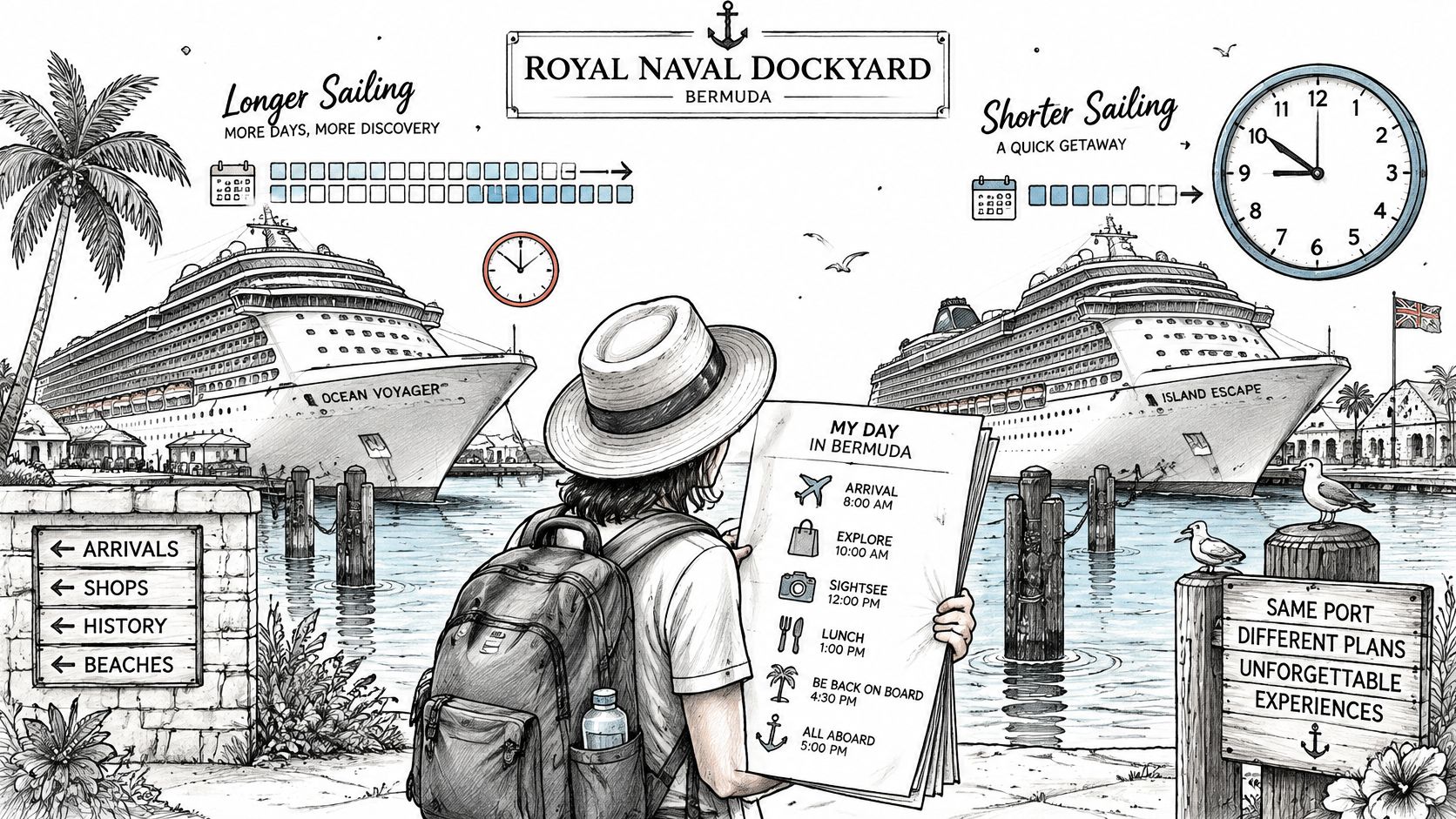
For this comparison, docked hours means the interval from scheduled arrival at Royal Naval Dockyard to the final Bermuda all-aboard deadline. Exclude Boston embarkation and disembarkation days. If the ship leaves Bermuda between calls, count each docked interval separately rather than including time underway.
Arrival isn't necessarily permission to go ashore immediately. Record the scheduled arrival as the comparison baseline, then allow for clearance, getting off the ship and reaching transportation when planning activities.
Use this repeatable audit:
- List every itinerary day. Copy dates, ports, arrival times and departure times into a spreadsheet. Keep missing call times visibly marked as unconfirmed.
- Classify each day. Label it sea, Bermuda or other port. This reveals whether added cruise length buys island access or another destination.
- Calculate the Bermuda window. Count docked calendar days, then flag late arrivals and early departures. Don't give a partial day the same planning value as a full shore day.
- Subtract shore logistics. Estimate transfers to the beaches or attractions you intend to visit, plus your return buffer.
Say one hypothetical sailing arrives in the morning and another arrives late in the afternoon. Even if both touch the same number of Bermuda calendar days, the first may support an additional excursion. Conversely, a longer continuous stay that falls mostly overnight may not add another practical beach outing.
The cruise itinerary planning guide can help organize the broader trip, but keep the port-time calculation visible beside the fare.
Score every sailing against the same needs
Use a worksheet with a column for each departure. Record pass, compromise or fail, plus the supporting itinerary detail.
Criterion | What to record for each sailing |
|---|---|
Bermuda access | Docked hours, docked days and partial-day limitations |
Sea time | Outbound and return sea days |
Halifax | Included or absent, and whether the group wants the call |
Month | Tropical-weather exposure and tolerance for changes |
Berth | Assigned or unconfirmed, with access to shops and restaurants |
Booking terms | Cruise cancellation terms and excursion change deadlines |
Accessibility | Walking, boarding and transfer requirements |
Family cabins | Cabin locations and whether the group can stay nearby |
Flight buffer | A slack day before the fixed return flight |
Don't collapse everything into an unexplained total score. An inaccessible transfer is a disqualifier for some travelers, not a minor deduction that a larger cabin can offset.
Sea days aren't wasted by definition. A family with children or older relatives may prefer recovery time and shared dining after an active island stay. Mark that preference explicitly rather than penalizing every hour underway.
Decision rule: If island access is the priority, choose more docked hours even when the sailing is shorter. If docked hours tie, prefer the itinerary spread across more docked days.
Docking at Royal Naval Dockyard and Getting Around
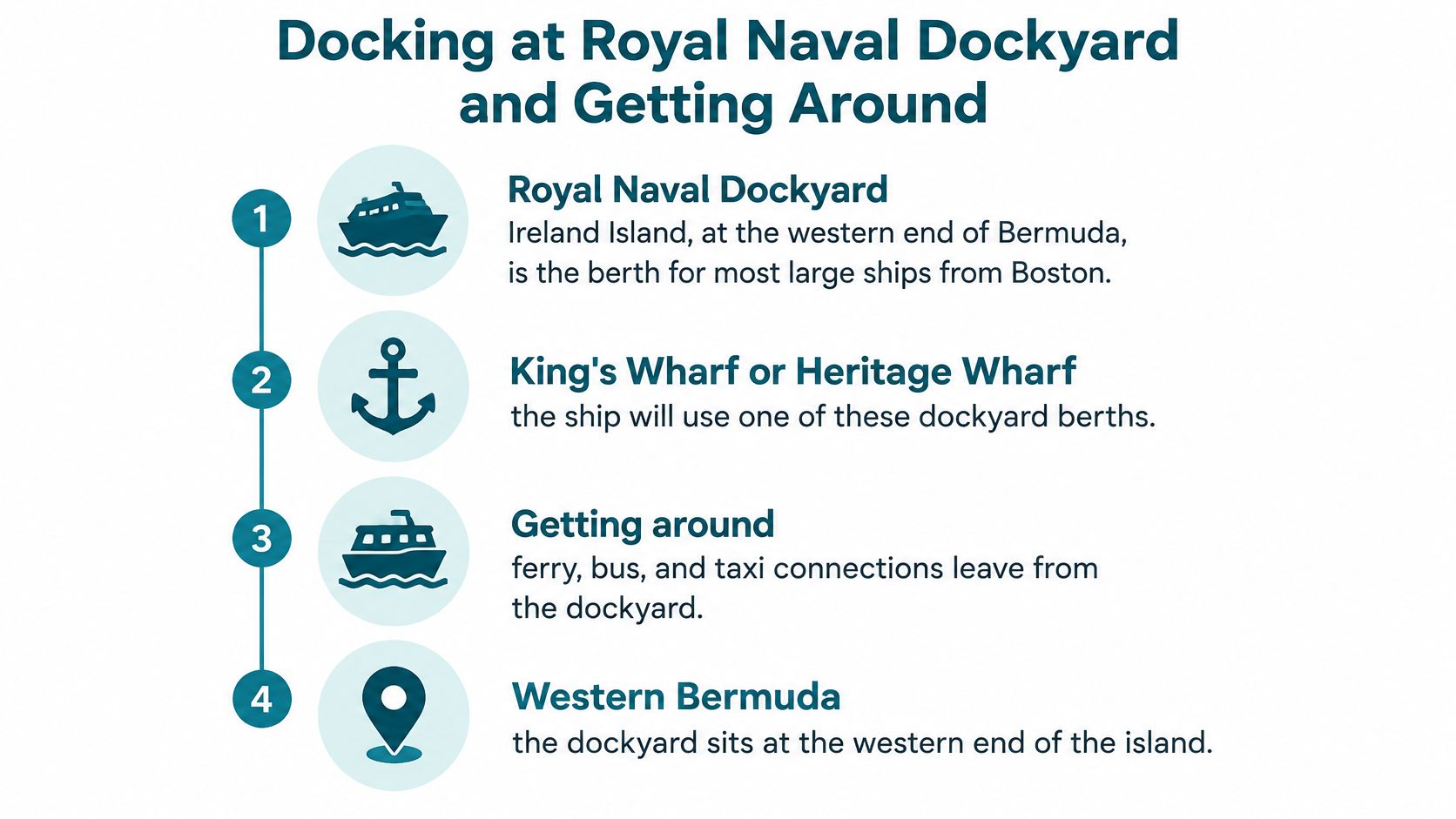
Most large ships from Boston use Royal Naval Dockyard, on Ireland Island at Bermuda's western end, rather than docking in Hamilton or St. George's. The Dockyard's West End port information identifies King's Wharf and Heritage Wharf as its cruise berths and explains that Heritage Wharf, constructed in 2009, added capacity for a second ship.
That distinction matters when booking transportation. A tour beginning in Hamilton isn't automatically a dockside excursion for your ship, and a meeting point described only as the cruise port needs clarification.
Organize the first shore departure
- Check the berth in the daily program. Match the ship's location to your excursion instructions. Save the meeting-point details offline.
- Choose transport for the first leg. Compare ferry, bus and taxi options against your destination, mobility requirements and the current operating schedule.
- Confirm where the excursion begins. Establish whether you meet beside the ship, elsewhere within the Dockyard or after an independent transfer.
- Set an earlier return target. As a conservative planning rule, aim to reach the ship at least an hour before all-aboard, with a larger margin when your route warrants it.
The Dockyard has shops, restaurants and attractions within walking distance. That makes a local first outing useful when you don't want to commit to a transfer immediately after arrival.
For beaches, Hamilton and St. George's, plan the outward and return journeys separately. Don't assume that the transport you use outward will be equally convenient when you're ready to leave. Check service times, pickup locations and how much walking each connection requires.
Match the outing to the traveler
For older relatives or anyone with mobility needs, assess the complete route: ship exit, walk to transport, boarding, destination access and return. A short-looking map distance doesn't establish whether the outing is manageable.
A practical split is to let independent travelers take a longer excursion while others stay around the Dockyard, then reunite for a meal. Give each subgroup its own return plan so nobody depends on another party finishing early.
Check the ship's program the evening before arrival. Berth assignments can change, and your final meeting-point instructions should match the ship's actual location.
Picking a Sailing Month Around Hurricane Season
Sailing month trade-offs for Boston to Bermuda
Month | Beach and water conditions | Tropical-weather exposure | Planning note |
|---|---|---|---|
May | Beaches opening, water warming | Low, before season opens June 1 | Strong balance of conditions and lower risk |
June | Warm water, full beach access | Early season, rising | Favorable starting window; keep return flights flexible |
July | Warmest summer conditions | Rising | Monitor forecasts before departure |
August | Warm water | High from mid-August | Build in extra schedule slack |
September | Warm water | Highest; climatological peak September 10 | Avoid nonrefundable excursions |
October | Warm but cooler | High through mid-October | Watch forecasts closely |
November | Cooler; limited beach use | Low, season ends November 30 | Check sailing schedule and cancellation terms |
These are qualitative planning categories, not water-temperature measurements or monthly cancellation probabilities. Traveling with Celeste's Bermuda season guide places Atlantic tropical-cyclone season between June 1 and November 30, identifies NOAA's climatological peak as September 10, and describes the greatest concentration of activity from mid-August through mid-October.
The important distinction is between seasonal exposure and the forecast for your particular departure. A lower-exposure month doesn't guarantee calm seas; a peak-season booking doesn't guarantee disruption.
Treat port time as planned, not guaranteed
A captain can change speed, routing or port order when forecasts threaten safe navigation. Understand the practical consequences through this guide to cruise ship itinerary changes, then examine what your independently booked activities allow if the ship doesn't arrive as scheduled.
Recent disruption demonstrates why flexibility matters. Bermuda's 2025 National Economic Report records 467,525 cruise passengers in 2025, down 12.7% from 2024, alongside 22 weather-related cruise cancellations. The report also identifies non-weather constraints, so the passenger decline shouldn't be attributed entirely to storms.
Use practical controls rather than trying to predict a storm months ahead:
- Choose several Bermuda days. This gives you more scheduling options if an activity must move, although it can't protect against cancellation of the entire call.
- Keep independent excursions refundable. Check what happens after a missed port, changed arrival or shortened stay.
- Preserve a flight buffer. Leave at least a flexible day before a fixed flight home.
- Monitor official updates. Follow weather advisories and cruise-line communications before departure.
For a hypothetical family of eight or ten, a lost port day can affect transportation, activities and meal reservations simultaneously. Late spring or early summer is a sensible starting preference when the group values schedule stability over a particular school-holiday date.
Three Sample Sailings and How Each Plays Out
These hypothetical cases apply the comparison method to different priorities. The itinerary labels describe options to investigate, not confirmed departures.
Family planning works best when shared activities leave room for different energy levels.
The Morgan family reunion
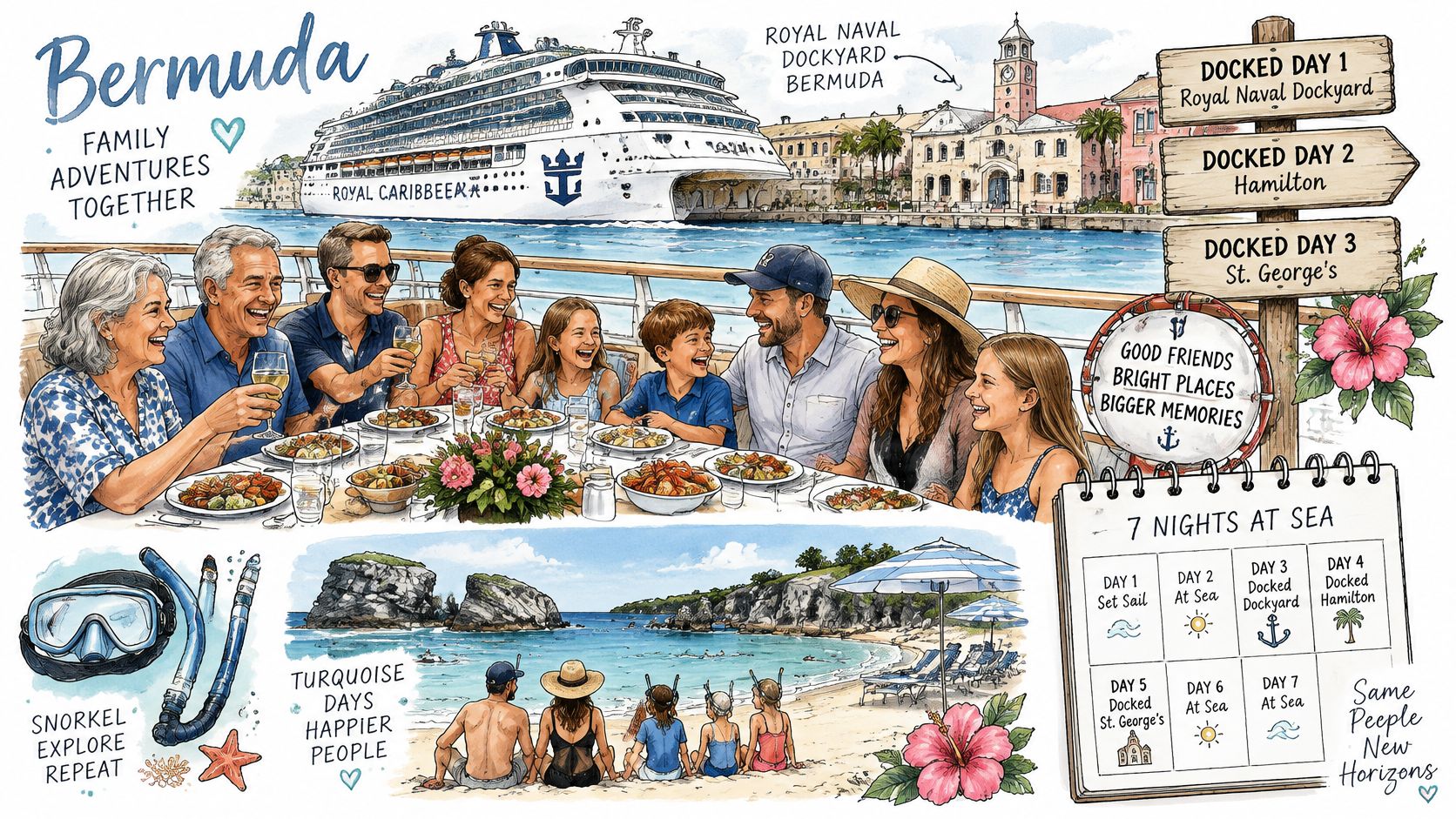
The Morgans are a hypothetical group of nine spanning children, parents and grandparents. They choose a seven-night Bermuda-focused sailing, provided its published call times support separate beach and Dockyard heritage outings without rushing.
They target June, keep the beach transportation refundable and reserve a sea-day dinner for everyone. An additional shore window stays lightly scheduled so relatives can rest or pursue separate interests.
Trade-off accepted: They commit more vacation time to the ship in exchange for less compressed family logistics.
The Patel couple's first cruise
The Patels, a hypothetical couple, choose a five-night sailing because their leave allowance is limited. They target May and prioritize a Dockyard-based excursion rather than trying to cross the island for every outing.
They select a beach close to their berth after checking access and agree on the return arrangement before going ashore. If they consider diving, Divegrade's guide to Bermuda dive conditions and marine life provides activity-planning context, but they keep the operator booking flexible.
Trade-off accepted: They narrow their sightseeing ambitions to protect a relaxed short break.
Use the following video as destination context, not as confirmation of a sailing's port schedule.
Alex's second-country itinerary
Alex, a hypothetical solo traveler, wants Canada as well as Bermuda. An eight-night Halifax option is worth considering only after the actual departure confirms the Canadian call and a satisfactory Dockyard window.
Alex targets early summer, keeps the Halifax excursion changeable and avoids packing every Bermuda hour with prepaid activities. The Canadian stop is a deliberate priority, not a bonus assumed to be free of scheduling costs.
Trade-off accepted: Alex accepts less Bermuda immersion for a broader trip.
Confirm Docked Hours Before You Book
A longer cruise is not automatically a longer Bermuda visit. Settle what the group wants from the trip, then compare the port schedule against that priority: more time for beaches and sightseeing, a shorter overall absence, or a second country. A ship's description cannot tell you how much usable time you will have ashore.
For an island-focused family, rank departures by docked hours first and docked days second. Hours show the total available window; days show whether activities can be spread across separate stretches, with room for meals, rest and different mobility needs. Keep both figures visible when comparing sailings.
Use a firm booking order
- Validate the itinerary. Save the cruise line's published call times. Identify any all-aboard deadline that has not been confirmed.
- Match the month to the group. Decide which seasonal conditions everyone can accept before comparing fares. For planning context, review this guide to the best time to book cruises.
- Check practical fit. Compare cabin locations with accessibility needs, and check what transport your planned shore activities require.
- Keep arrangements flexible. Look for excursions with change terms that suit your plans, and allow a buffer around return flights.
- Reconfirm operational details. Check the ship's daily program for the berth before setting meeting points.
The berth may not be firmly assigned when you book. Choose excursions with suitable change terms rather than assuming the daily program will be available months in advance.
Compare the complete trip cost
Assess the fare after the itinerary passes those checks. Include the Boston arrival stay, transfers, excursion transport and any added cost of flexible flight arrangements. The relevant comparison is the full trip cost against the shore time you can use.
Approved Traveler provides wholesale-rate access to hotels, flights, cruises and cars. Members also get wholesale rates on homes, tours and activities, consolidating travel inventory through one membership. This access does not replace checking the cruise line's schedule or booking terms.
A lower fare with fewer usable shore windows can suit a ship-focused traveler. For a family whose main purpose is Bermuda, assess that fare against the activities that fit within the confirmed port schedule. Rank by docked hours first, then docked days, then month, then price, after confirming that the docked-hour calculation supports the activities you intend to book.
Approved Experiences Traveler provides wholesale-rate access to cruises and the hotels, flights, cars, homes, tours and activities around them. Compare available inventory against your Bermuda docked-hour shortlist, then consolidate the arrangements that fit your group.