Birthday Party Planning Checklist: A Busy Parent's Guide
Busy parents, delegate it all. This birthday party planning checklist breaks down budget, invitations, vendors, and cleanup in 10 steps.
15 min read

It is six weeks before your child's birthday. The venue is still unbooked, three parents have already asked about dietary needs, and the cake order is due Friday. You are staring at a group chat, a half-written guest list, and a calendar that has no empty Saturday left.
Ten steps, one timeline. This birthday party planning checklist puts every task in the order it has to happen, shows how far ahead each one needs to start, and marks what you keep versus what a helper can run. The point is not a prettier party. The point is a party that does not eat the next six weekends.
Treat the date as a project with a critical path. If you want a fuller view of how a longer event gets sequenced, plan your event timeline for 2026 the same way, with gates instead of a floating to-do list. Venue and headcount come before invitations. Invitations come before food quantities. Food quantities come before the supply order. Confirmations come before the day-of sheet.
Each step below has a lead time, a single owner, and a handoff line. Keep the judgment calls, which are budget, guest policy, safety, and the final yes or no on a vendor. Hand off the chase work, which is RSVP nudges, price checks, delivery tracking, and reminder texts. A simple home party can compress this into two or three weeks. A hosted weekend party often needs six to eight. Start at step 1 even if the cake deadline is already yelling at you.
1. Set a Fixed Budget and Guest Count First
Lead time: the day you decide to host, ideally eight weeks out. Owner: you. Hand off: ledger updates only.
A 2024 What to Expect survey of 404 mothers found average birthday-party spending of $314, before gifts. Celebrations for children ages 1–2 averaged $279, and parties for children ages 6–9 averaged $344. 20% of parents spent more than $500. Attendance stayed small. The average party included nine children, and roughly one-third of respondents invited fewer than five.
Write the ceiling and the headcount before any vendor gets a call. Guest count drives venue size, catering volume, rental quantities, favors, and extra hands.
Say you are hosting 20 children on a $450 ceiling. Put $120 toward food, $90 toward entertainment, $60 toward favors, and hold $45 in reserve. A 40-adult gathering works the other way. Price catering per head, then add a 10% buffer before you book a capacity tier.
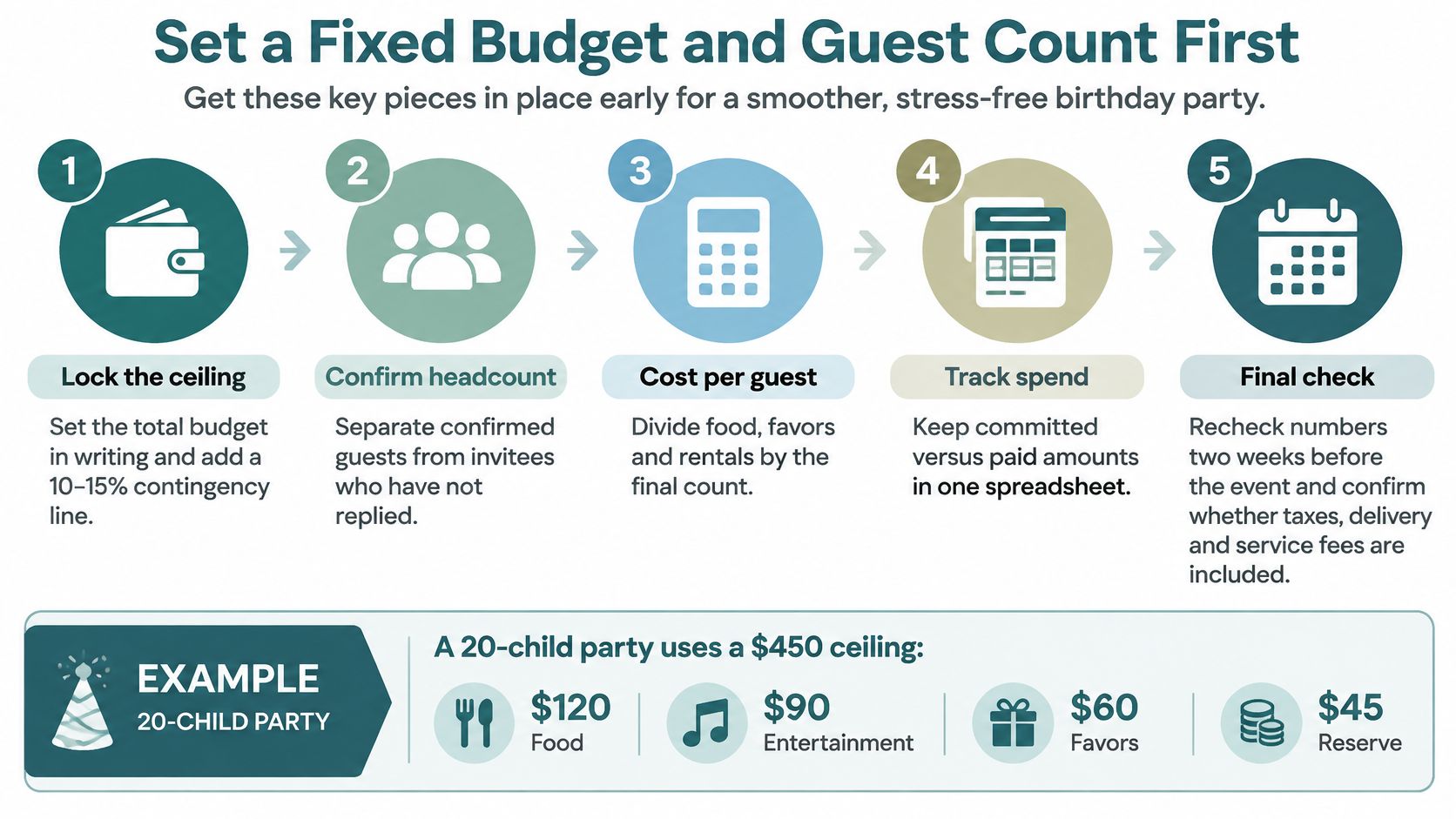
- Write the ceiling once: Share it with anyone who can approve a purchase.
- Ask what the quote hides: Taxes, delivery, and service fees often sit outside the number you first hear.
- Freeze the count two weeks out: Caterers and rental companies usually need final numbers around then.
One shared sheet of committed versus projected spend stops late guest adds from blowing the plan. The same sequence sits inside a wider family event planning workflow when the party is only one date on a crowded household calendar.
2. Choose the Date and Send Invitations on a Set Schedule
Lead time: invitations at four to six weeks for a children's party, six to eight for an adult event. Owner: you pick the date. Hand off: RSVP tracking.
A global survey of 5,013 parents of children aged 2–12 found that 52% planned their most recent birthday party more than four weeks in advance. Popular weekend venue dates may book six to eight weeks ahead, while home parties generally need two to three weeks.
Skip major holidays, school testing weeks, and the cousin's wedding. Then send one invitation that states date, start time, end time, location, and the RSVP deadline. An RSVP tool beats a thread of "are we coming?" texts.
A schedule that actually closes
Say the party is a Saturday. Send the invite through an online service, set a 10-day RSVP deadline, and fire one reminder on day seven. For a school-age party, the class messaging group can carry the invite, with a separate form so parents, not kids, reply.
Practical rule: Set the RSVP deadline about one week before vendors need the final headcount.
Put a phone or text number on the invite. Keep one shared response list so every adult in the house sees the same count. On that form, ask about allergies, mobility needs, and whether a quieter corner would help, without asking for a diagnosis. Families can tell you what the room should do. They do not owe you a medical file.
3. Book the Venue and Secure a Backup Plan
Lead time: six to eight weeks for a hosted weekend slot, two to three for home. Owner: you sign. Hand off: policy checks and the insurance upload.
Match the room to the format before you compare prices. In a 2026 international study of 4,985 parents of children ages 2 to 12, 35% called their typical celebration somewhat simple and 17% called it very simple, only immediate family at home, while 34% called it somewhat elaborate and 14% called it large-scale. A home checklist can stay lean. A hosted party needs paperwork.
Before the deposit, confirm capacity, what is included, setup and cleanup windows, insurance, noise rules, decoration limits, parking, restrooms, and step-free entrances for grandparents or strollers. Ask who resets the room, what time vendors may enter, and when final payment is due. Photograph the space at setup so before-and-after condition is obvious.

Outdoor parties need a written weather call, often a forecast check 48 hours out, plus a reserved indoor alternative. A backyard plan might mean a tent plus a rain date two weeks later. A community center might require a certificate of insurance 14 days prior. Put the decision deadline on the calendar, not in your head.
Compare a few real rooms in this roundup of places to celebrate a birthday before you fall in love with the first available Saturday. If the kids want to move, evaluate sports party themes for active kids like any other hosted package: capacity, supervision, setup window, weather fallback, and refund terms. A theme does not fix a bad cancellation clause.
4. Plan Food, Drinks, and Cake with a Dietary Checklist
Lead time: menu with the RSVP close, custom cake two to three weeks out. Owner: you approve the menu. Hand off: the grocery or caterer order.
Build the menu from the confirmed headcount plus the allergy list you already collected. Decide now whether food is catered, cooked at home, or bought as platters. Each path changes equipment and clock time.
The U.S. Department of Agriculture says to hold hot food at 140°F or above and cold food at 40°F or below. Perishable food should not sit out more than two hours, or one hour when the air is above 90°F.
A platter plan that survives a long party
Say 25 guests are coming. Book a catered buffet, a separate gluten-free dessert tray, and a custom cake 18 days ahead, with a firm pickup window. A simpler kids' party can use grocery platters, a labeled allergen card, and a nut-free cake from a specialty bakery.
The FDA buffet guidance is to set out small platters, keep cold backups in the fridge, and hold hot backups in an oven at 200°F to 250°F. Swap trays instead of leaving one dish out for the whole party. A food thermometer beats guessing.

Label every dish with main ingredients. Confirm the venue allows outside food. Put ice and disposable servers on the same order so you are not paying a second delivery fee.
5. Book Entertainment and Activities with a Run-of-Show Schedule
Lead time: book performers with the venue, finish the run of show two weeks out. Owner: you pick the activities. Hand off: sending the schedule to vendors.
Among parties planned more than a month ahead, 51% of parents in a survey of 4,949 parents named family and friends as the highlight, versus 29% among parties planned less than one week ahead. Cake or food led for 51% of last-minute planners and only 34% of families who planned a month or more out. 34% said more games and activities would have improved their child's last party.
Match the activity to age and group size, then get the booking in writing. A 90-minute kids' party can run like this. Arrival at 0:00, crafts from 0:15 to 0:45, a performer from 0:45 to 1:05, cake at 1:10, pickup at 1:30. An adult hour might be a short speaker, one game block, then open time.
More entertainment is not automatically better. A loud prize rush can shut some kids out. A quiet corner and a backup low-energy game often beat a second attraction.
Send the one-page run of show to every vendor who has a slot. Confirm arrival time and parking the day before. Keep the page on a phone and on paper.
This short walk-through shows how a host can turn that page into a calm afternoon.
6. Arrange Favors, Gifts, and Party Supplies in One Order
Lead time: place the consolidated order once headcount is stable, delivery four days out. Owner: you approve quantities. Hand off: checkout, tracking, and the unboxing count.
Splitting balloons, plates, and favor bags across five carts creates five delivery windows and five things to forget. One order, built from final headcount plus a small buffer, is the version that survives a workweek.
Say you need 30 favor bags, balloons, and tableware. Put them on one bulk order with delivery four days before the party. If coworkers are chipping in on a gift, one group purchase link beats twelve separate shipments to your porch.
What to lock before you pay
- Custom printing takes longer: Personalized tags and shirts need a longer lead than plain bags. Decide that early or drop it.
- Order about 10% over headcount: Treat the extras as a reserve for siblings who were not on the list.
- Read the return window first: Open packages only after someone has checked counts against the inventory list.
- Name the receiver: One person signs for the boxes and marks what arrived short.
Assembly is the hidden task. Bags, labels, and tape belong on a weeknight, not on party morning. If something is back-ordered, cut the item. Do not start a second scavenger hunt the day before.
7. Confirm Every Vendor 48 to 72 Hours Before the Event
Lead time: 48 to 72 hours before start. Owner: you if a vendor wobbles. Hand off: the first confirmation sweep.
This is the step hosts skip, and it is the one that catches a wrong address while you can still fix it. Contact each vendor and confirm date, time, address, arrival window, and what is still owed.
A caterer who moves a delivery 48 hours out gives you time to change the venue access window. An entertainer who ignores a confirmation text gets a phone call the same hour, and a backup booking the same day if the answer is no.
Ask for the reply in writing. Keep the balance payment method ready so you are not hunting a card while guests walk in. The contact sheet should list name, phone, email, and a backup person for every vendor.
Share that sheet with one trusted helper. If your phone dies in a pocket during cake, someone else can still reach the bounce-house driver. A non-answer is a decision. Do not wait until the morning of the party to discover the slot was never held.
8. Prepare Guest Communication and Day-Before Reminders
Lead time: one reminder the day before, a weather note at 36 hours if you are outside. Owner: you approve the wording. Hand off: sending it.
Parents miss parties because the address lived in an invite they opened three weeks ago. One short reminder fixes that. Include start time, address, parking, the weather plan, and anything guests should bring. For a kids' party, say who may drop off, who may pick up, and what time pickup is.
Say you text the evening before. The message names the address, notes the lot behind the building, and states that the party is indoors. For a backyard date, a 36-hour weather note can confirm you are staying outside or moving to the rain plan you already reserved.
Send a second message only if something changes. Name one contact for questions so you are not the default responder while you are setting tables. Put a link or a phone number in the note for a last-minute shift.
Use the channel people already answer, whether that is text, email, or the class group. Keep the wording identical across channels. Two versions create two arrival times.
9. Build a Day-Of Run Sheet with a Named Helper
Lead time: brief the helper 24 hours out. Owner: you greet guests. Hand off: vendors, deliveries, and the clock.
You should not be the person chasing a truck while children arrive. One run sheet lists setup, vendor arrivals, the guest window, food, activities, cake, and cleanup. One named helper owns vendors.
A relative can take the bounce-house delivery and the cake pickup while you stand at the door. At a venue, that helper confirms the caterer is on site 90 minutes before service.
The USDA party guidance treats 40°F to 140°F as the range where bacteria multiply fast, and says perishable food left out past two hours should be discarded, or one hour above 90°F. On a three-hour party starting at 1:00 p.m., put out small amounts at 1:00, mark a 3:00 replacement, and hold hot food at 140°F or cold food at 40°F.
Venue-style handoff notes, like this external birthday party checklist, push you to name which adult may collect each child, where medication sits, and who watches the bathroom line. Home, staffed venue, and drop-off parties do not share the same liability. Write the roster for the one you are running.
A printed kit with tape, scissors, wipes, a charger, and basic first aid stays with the helper. If you want a blank you can reuse, start from an event planning checklist template and strip it to one page.
10. Close Out the Event with Cleanup, Thank-Yous, and a Review
Lead time: review within 48 hours, thank-yous inside the week. Owner: you write the short post-mortem. Hand off: trash, returns, and invoice checks.
The party is over and the house looks like a juice box exploded. Do a light reset the same day, refrigerate what is still safe, and set aside the jacket someone will text about tomorrow. Deep cleaning can wait.
Within 48 hours, note what failed while you still remember it. A rental that arrived late means a different vendor next year, not a vague feeling that the day was "stressful." A $30 overage on ice goes into next year's reserve line so you stop being surprised by the same bag.
Thank the helper, the vendors who showed up on time, and guests who brought gifts. Short and specific beats a generic blast. If you want wording that does not take an evening, use these notes on how to write birthday thank-you messages and send them before the week closes.
Save the run sheet and vendor contact list as next year's template. Confirm final invoices before the due date so a late fee does not become part of the memory. That file is the lasting souvenir. Next birthday starts from a record, not from a blank page and a group chat.
How the 10 Birthday Party Planning Steps Compare on Lead Time and Delegation
Item | Key Lead Time | Main Deliverable | Delegation Fit |
|---|---|---|---|
Set a Fixed Budget and Guest Count First | Before contacting vendors | Budget ceiling, confirmed headcount, and spending ledger | High: maintain ledger, compare quotes, and flag budget limits |
Choose the Date and Send Invitations on a Set Schedule | Send 4–6 weeks ahead for children's parties; 6–8 weeks for adult events | Invitations and a tracked RSVP list | High: draft invitations, send reminders, and track responses |
Book the Venue and Secure a Backup Plan | Book early; popular weekend slots fill weeks ahead | Venue booking with written terms and a weather backup | High: research venues, compare terms, and track permits |
Plan Food, Drinks, and Cake with a Dietary Checklist | Order custom cake or specialty items 2–3 weeks ahead | Menu, dietary checklist, and confirmed food orders | High: compile dietary needs, request quotes, and confirm orders |
Book Entertainment and Activities with a Run-of-Show Schedule | Book performers in advance | Activity plan and event schedule | High: confirm vendors and distribute the run-of-show |
Arrange Favors, Gifts, and Party Supplies in One Order | Allow for shipping and customization lead times | Consolidated supply order and inventory checklist | High: source, order, track, and verify supplies |
Confirm Every Vendor 48 to 72 Hours Before the Event | 48–72 hours before the event | Vendor contact sheet and written confirmations | High: contact vendors, log replies, and escalate issues |
Prepare Guest Communication and Day-Before Reminders | Send reminder the day before | Guest reminder with event details and instructions | High: send reminders and handle routine guest questions |
Build a Day-Of Run Sheet with a Named Helper | Prepare before event day; brief helper 24 hours ahead | Timed run sheet, helper assignment, and emergency contacts | High: monitor arrivals and relay changes to the helper |
Close Out the Event with Cleanup, Thank-Yous, and a Review | Complete review within 48 hours after the event | Final budget, thank-yous, and reusable event notes | High: coordinate pickups, reconcile invoices, and prepare notes |
Hand Off the Checklist and Reclaim Your Party Weekends
Run the sequence in order. Set the budget and the headcount first. Lock the venue and the invitations on their lead times. Then hand off the repetitive work: RSVP follow-up, vendor confirmations, supply tracking, and the day-before reminder.
You keep the calls that need a parent. Who is invited, what the child can handle in a loud room, which foods are off the table, whether the contract is acceptable. A helper, a partner, or a relative can own the chase. The checklist only works if each row has a name on it. A row that says "someone should confirm the caterer" is how Saturday morning falls apart.
Approved Lux gives busy parents 24/7 access to a US-based Assistant team reachable by call, text, or email, with all three channels monitored at equal priority. That team plans events from intimate dinners to large gatherings, runs errands like gift sourcing and personal shopping, and sends deadline reminders before a deposit or an RSVP window closes. Start the handoff with the booking schedule and the consolidated supply order. Those two rows return the most time, because they stop the rework that comes from a double-booked afternoon or a missed delivery window.
Onboarding is a step-by-step intake, so the next party does not begin with a blank brief. Proactive Preference Learning means the team keeps the standing preferences, from nut-free cake to the grandparent who needs a step-free entrance, instead of asking you to retype them every March. Research support like vendor vetting and price negotiation rides along too, so the caterer quote and the entertainer's references arrive already compared.
For a household where more than one adult is carrying the calendar, Lux Circle handles requests for anyone on the account and books and de-conflicts appointments for the whole group. The second shift shrinks when the follow-ups leave your phone. You still show up for cake. You stop spending the week before it inside a spreadsheet.
Approved Lux Personal Assistant is a 24/7 US-based Assistant team you can call, text, or email when the party admin starts stacking up. The team covers event planning, scheduling, errands, and research, so you keep the decisions on this birthday party planning checklist and drop the second shift. See how it works at Approved Lux Personal Assistant.