Advantages for Outsourcing: ROI, Costs and Hours Saved
Advantages for outsourcing, measured in hours and dollars: cost vs a W-2 hire, break-even math, scaling, and the risks that erase the gains.
13 min read

80% of executives planned to maintain or increase investment in third-party outsourcing, according to Deloitte's 2024 Global Outsourcing Survey. That's a stronger signal than a simple preference for cheaper labor: organizations continue to buy external capacity even when the challenge is coordinating work, protecting focus, and maintaining coverage.
For time-starved professionals, the useful question isn't whether an outside provider costs less than an employee. It's whether outsourcing removes more work than it creates, including the invisible work of briefing, checking, remembering, and following up. The strongest advantages for outsourcing appear when you price coverage and net hours reclaimed, not salary alone.
The Core Advantages of Outsourcing, With Benchmarks
Outsourcing's advantages cluster into five measurable gains: lower unit costs, less internal effort, faster delivery, broader capability, and lower overhead elsewhere. Choose the outcome you need before choosing the provider.
Core outsourcing advantages and their benchmarks
Advantage | What changes | Benchmark |
|---|---|---|
Lower cost per unit of work | Vendor-service costs fall | 26% reduction in vendor-service costs, Deloitte 2024 |
Less effort per task | Internal effort drops | 49% effort reduction, measured as efficiency and productivity gain, Deloitte 2024 |
Faster delivery | Cycle time shortens | 28% improvement in cycle time or time to market, Deloitte 2024 |
Wider capability | Skills you don't staff become available | 29% improvement in capabilities, Deloitte 2024 |
Lower overhead outside the outsourced function | Coordination and administrative costs fall elsewhere | $121.14 million lower operating costs associated with each $96.14 million added IT outsourcing spend, MIT Sloan, approximately 300 U.S. companies, 1999–2003 |
The cost, effort, speed, and capability benchmarks come from Deloitte's 2024 Global Outsourcing Survey, which also found that 34% of organizations identified cost savings as their primary outsourcing reason, down from 70% four years earlier. The overhead benchmark describes a separate historical association, not a forecast for an Assistant arrangement.
Match the model to the bottleneck
These are reported survey benchmarks and historical findings, not guaranteed returns. A provider can complete tasks inexpensively while still leaving you responsible for every reminder and exception.
Compare staffing models as well as prices. For professionals considering a dedicated remote hire, LatHire's resource on how to hire latin american virtual assistants provides a relevant alternative to evaluate against team-based support.
Identify where your business or household loses the most time, then read the matching row first. If delayed approvals cause the backlog, cheaper execution won't fix it. If repeated research consumes your afternoons, capability and effort reduction may matter more than delivery speed.
Where Outsourcing Saves Money Beyond the Salary Line
Salary is the visible tip of the hiring iceberg. Recruiting, onboarding, supervision, equipment, and uncovered days sit below the waterline, where a salary-versus-subscription comparison can miss the actual cost.
Use the iceberg to separate the visible expense from the work required to maintain coverage.
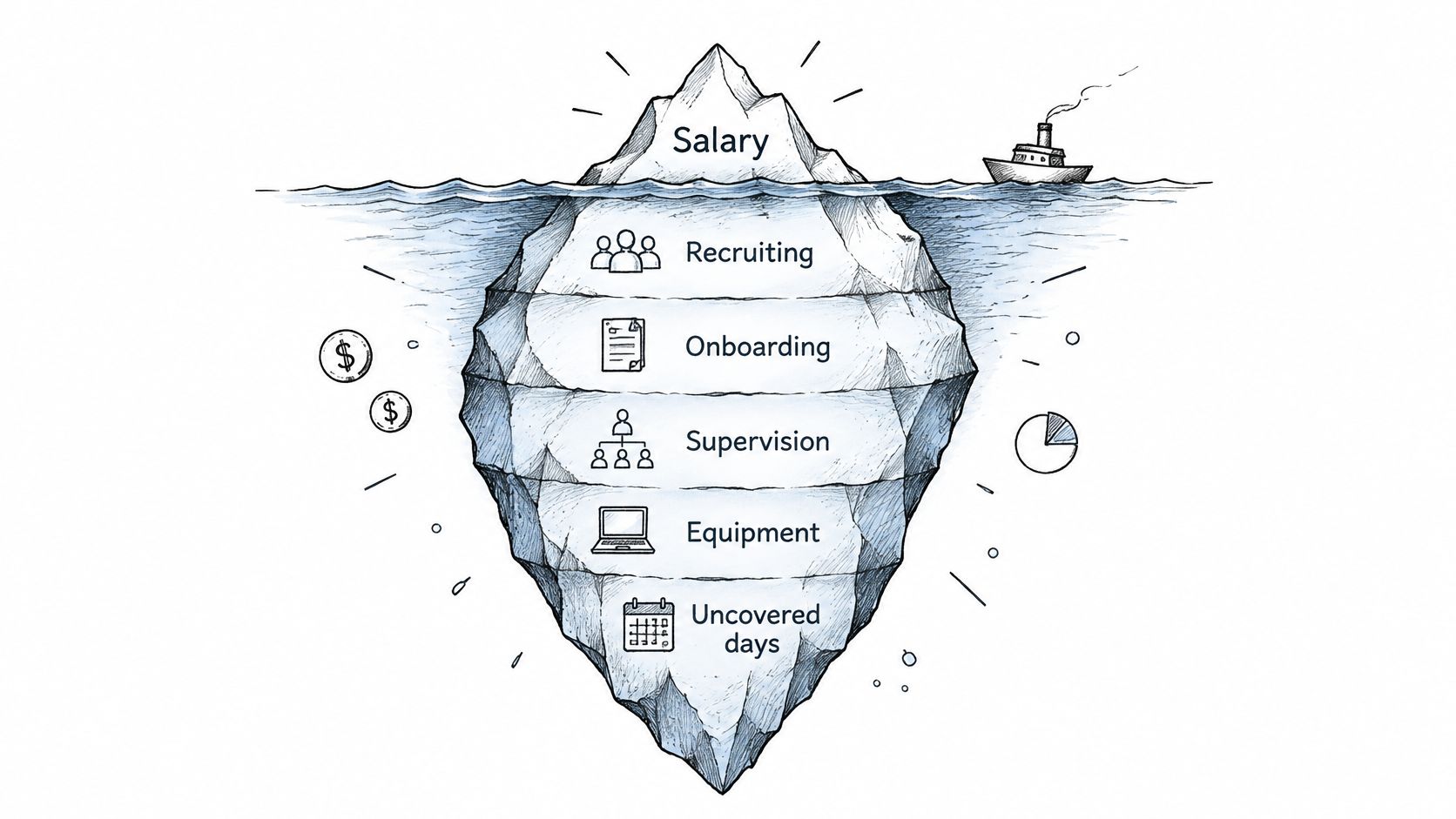
The historical study discussed in MIT Sloan Management Review matters because sales, general, and administrative expenses were often four to five times larger than IT costs. Savings could therefore appear outside the department being outsourced, through reduced internal support and coordination.
Our team-based coverage addresses a similar operational problem: requests don't depend on one assigned person being available. Say you send a travel-change request late in the evening while your usual contact is off. Another team member can handle the request rather than leaving it tied to that individual's return.
Shared context addresses a different cost. We keep preferences and history with the account, so the responding Assistant already has established instructions, such as your preferred seat or regular restaurant. You aren't rebuilding the brief with every handoff.
Price the work of maintaining coverage
- Recruiting time: Record the calendar delay before someone can start.
- Onboarding effort: Count the hours you spend explaining tasks and standards.
- Supervision: Include check-ins, corrections, and quality review.
- Uncovered days: Identify who absorbs requests during leave or vacancies.
Use these categories to identify genuine cost-reduction opportunities, rather than moving expenses between budget lines.
For another perspective on the outsourcing decision, consider the following video.
List last month's coordination tasks and mark every fresh briefing. That count identifies repeated handoff work; the time attached to it is your hidden coverage cost.
Outsourcing Versus a W-2 Hire, Line by Line
Annual cost of a W-2 hire versus an Approved Lux subscription
Cost item | W-2 hire at $80,000 | W-2 hire at $120,000 | Lux Solo ($99.99/month) | Lux Circle ($299.00/month) |
|---|---|---|---|---|
Base wages | $80,000 | $120,000 | Not applicable | Not applicable |
Employer Social Security and Medicare (7.65%) | $6,120 | $9,180 | Not applicable | Not applicable |
Benefits, estimated at 30% of total compensation | $34,286 | $51,429 | Not applicable | Not applicable |
Recruiting, onboarding, and supervision | Agency fees plus logged management hours | Agency fees plus logged management hours | Briefing time at setup | Briefing time at setup |
Annual subscription fee | Not applicable | Not applicable | $1,199.88 | $3,588 |
The employer Social Security and Medicare amounts use the combined 7.65% rate described in IRS employer guidance, applied to the hypothetical wages shown. They exclude unemployment taxes and other employment expenses.
The benefits estimates use the compensation-share benchmark detailed in the break-even analysis below. Because benefits are a share of total compensation, the calculation is wages divided by the remaining wage share, minus wages, not wages multiplied by the benefits percentage.
Don't double-count the statutory layer
Benefits accounting can include legally required employer costs. Before adding every row into a total, reconcile your payroll-tax categories with your benefits estimate so you don't count the same expense twice.
Replace the illustrative benefits amounts with your actual insurance, retirement, leave, and statutory-cost figures. Equipment, software, recruiting fees, and management time still need their own entries.
The subscription fees describe access to support, not the equivalent of a full-time employee's labor capacity. Lux Circle covers up to four people on one account; it doesn't represent four employees.
A W-2 hire can provide daily in-house presence, company-specific knowledge, and sustained ownership inside your organization. A subscription fits variable, coordination-heavy work better than duties requiring someone physically present throughout the day.
Separate coordination from physical execution
Office cleaning illustrates the distinction. A resource covering commercial cleaning by Sweet Home Cleaning Service helps define the local service requirement, while an Assistant can coordinate provider research and scheduling.
Before deciding, add:
- Coverage costs: Recruiting delays, onboarding, supervision, and absence cover.
- Idle capacity: Paid employee time during quieter periods.
- Residual subscription effort: Clarifications, approvals, and checking that still fall to you.
A subscription avoids a separate wage bill for idle employee hours, but its fee remains payable when you use it lightly. Neither option is efficient just because its price is predictable.
How to Measure the Focus Time You Get Back
A study of computer-based administrative work published through ACM observed 696 window switches per working day and a mean window-focus duration of approximately 34 seconds; longer switches increased task-completion time even after switching duration was excluded. The relevant loss isn't just clicking between windows. It's reconstructing what you were doing.
Delegation can help when it removes an entire coordination loop from your working environment. Forwarding a request but continuing to monitor every reply doesn't accomplish that.
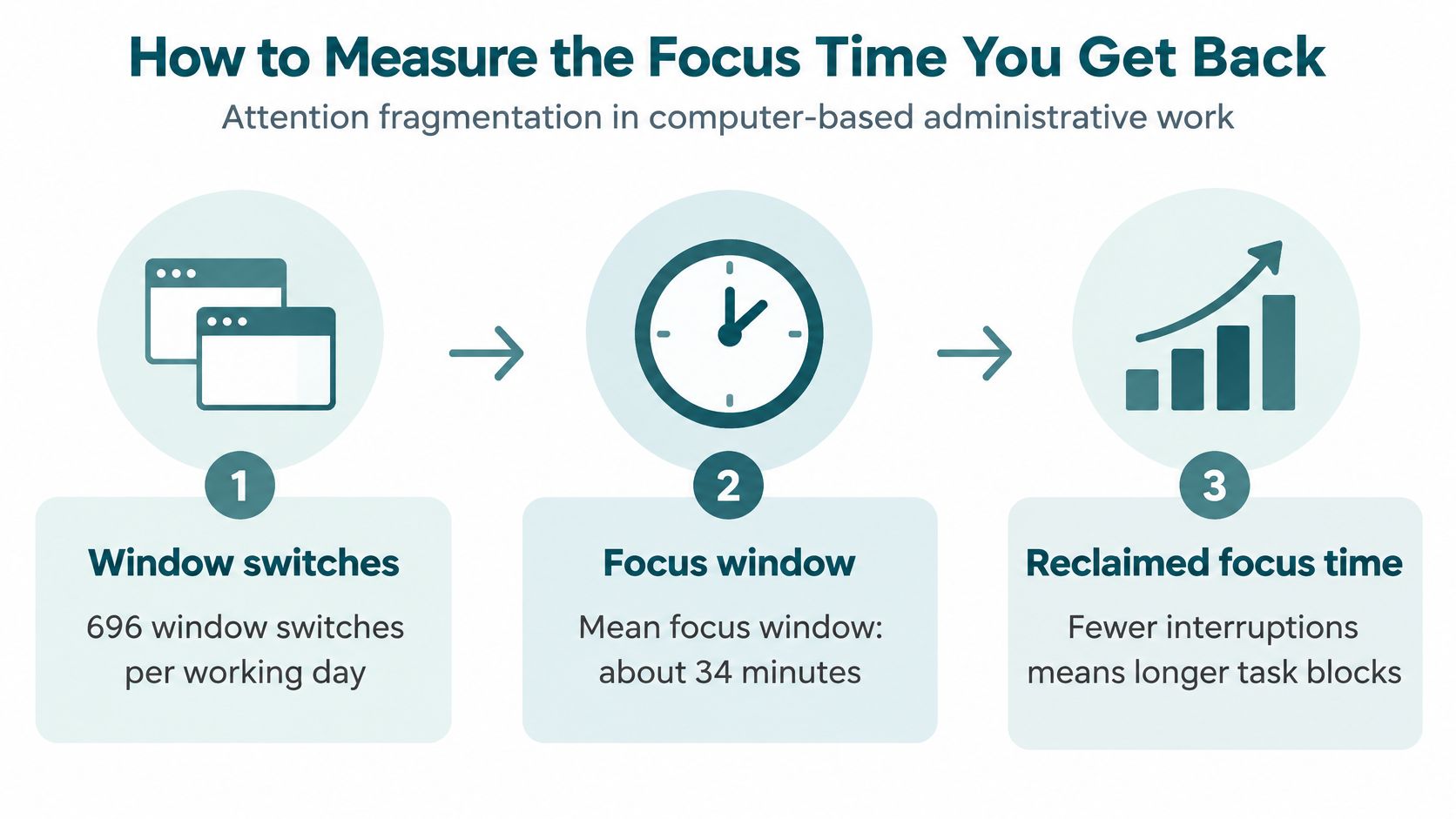
Use seconds, not minutes, for the study's mean focus duration. Apply the following measurement schedule as an experiment, not as a promised performance timeline.
Run a 30-day delegation test
- Week 1, tally interruptions. Keep a simple spreadsheet of administrative interruptions and window switches during comparable client or creative work. This establishes your baseline; the common error is comparing an unusually quiet baseline day with a demanding delegation day.
- Week 1, record sustained work. Log uninterrupted blocks of 60 minutes or more, noting what you completed. This tests whether reclaimed capacity becomes usable focus; don't count a meeting as deep work merely because you stayed in one application.
- Week 2, transfer recurring requests. Hand over the three highest-frequency categories, such as itinerary changes, appointment conflicts, and vendor research. Repetition makes handoff quality observable; don't begin with unrelated one-off tasks that each require a new explanation.
- Weeks 3–4, track independent closure. Count follow-ups completed without your intervention and log briefing, approval, and correction minutes. This distinguishes ownership from message forwarding; don't label a task delegated if you still chase everyone involved.
- Day 30, calculate net recovery. Compare interruption counts and focus blocks with the baseline, then subtract briefing and rework from administrative time avoided. The common error is reporting gross hours saved while treating your management effort as free.
Value the recovered capacity honestly
Use a time-value calculation to distinguish billable opportunity from personal value. A protected afternoon may support revenue, strategic thinking, or recovery, but those aren't interchangeable financial outcomes.
Measurement rule: Count the work you no longer manage, not just the tasks someone else touches.
If focus blocks haven't grown after two weeks of delegation, inspect the handoffs first rather than assuming the provider is the problem. Check whether instructions, approval boundaries, or your own monitoring habits keep pulling the work back. If execution remains unreliable after those fixes, reassess the provider too.
Break-Even Math and Scaling Capacity Up or Down
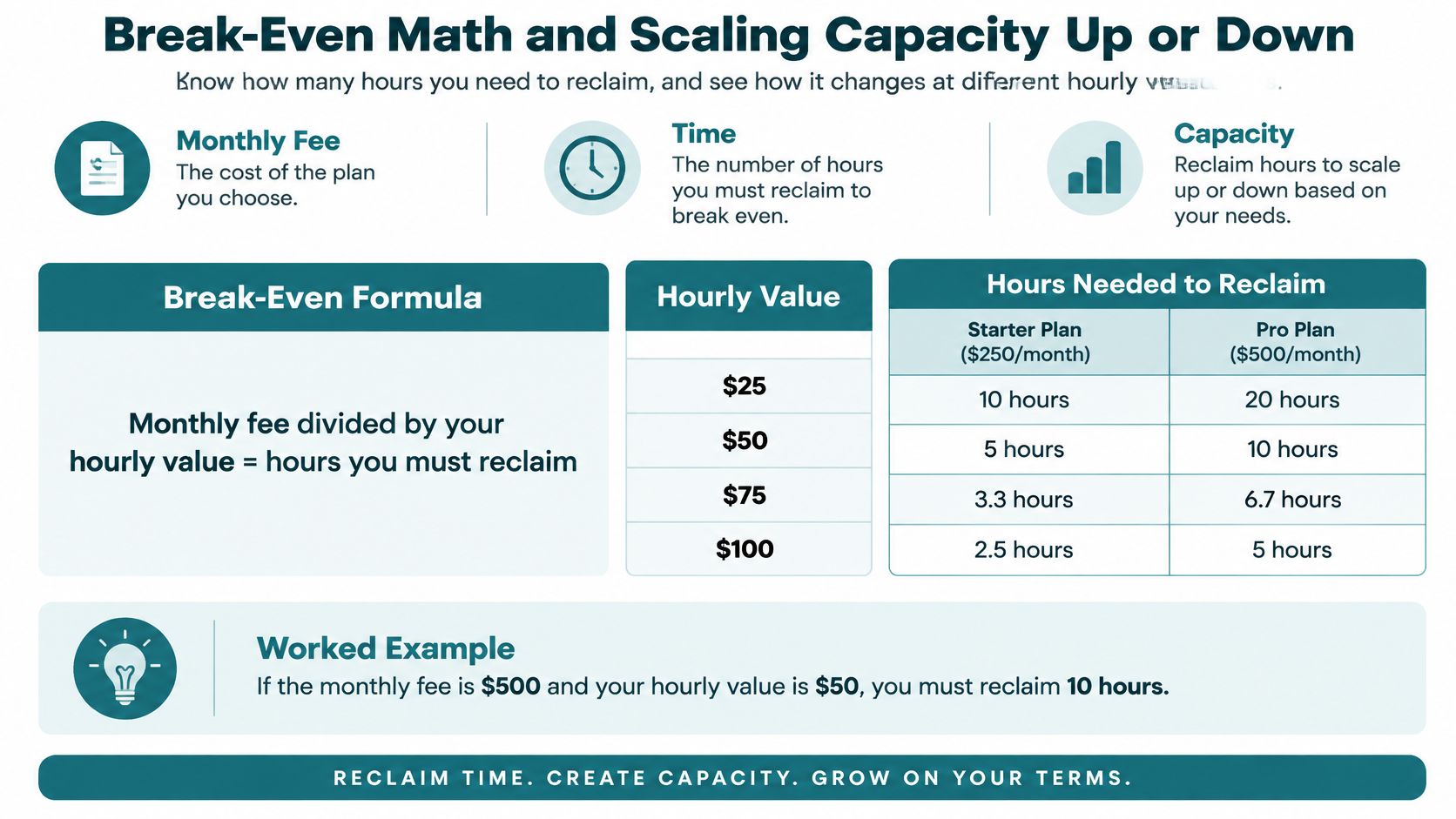
Monthly fee divided by your hourly value equals the hours you must reclaim. Use net recovered time after briefing, checking, and corrections.
The employee-cost calculator's cited Bureau of Labor Statistics benchmark puts benefits at 30.0% of private-employer compensation costs, illustrating why salary alone understates employment cost. The subscription calculation answers a different question: how much useful time must you recover to justify the fee?
Break-even hours by hourly value of your time
Your hourly value | Lux Solo break-even | Lux Circle break-even |
|---|---|---|
$25 an hour, hypothetical | 4.0 hours | 12.0 hours |
$50 an hour, hypothetical | 2.0 hours | 6.0 hours |
$75 an hour, hypothetical | 1.3 hours | 4.0 hours |
$100 an hour, hypothetical | 1.0 hour | 3.0 hours |
$300 an hour, hypothetical | 20 minutes | About 60 minutes |
Calculations use the listed monthly fees and are rounded. Lux Circle figures assign the full fee to one person, rather than spreading the required recovery across account members.
Billing value isn't automatically cash recovered
Say a solo practitioner bills $300 an hour. Recovering approximately 20 billable minutes covers Lux Solo's monthly fee, but only if the practitioner can sell and collect payment for that additional time.
A founder using a hypothetical $100 hourly value needs approximately one hour of useful recovery. That isn't necessarily revenue. Identify the selling conversation, hiring decision, or product work that would occupy the cleared space.
Reclaimed time has financial value only when you can explain what you'll do with it. Rest can be valuable without pretending it's billable revenue.
Match capacity to demand, not optimism
Variable support can fit travel-heavy periods, launch preparation, or a household coordinating several schedules. For example, a consultant traveling 50–150 nights in a hypothetical year may need concentrated logistical help during trips rather than a permanent on-site role.
Don't size a recurring commitment solely around an exceptional peak. Test whether the arrangement can handle busy periods, then check whether normal-month use still justifies its cost.
Proactive Preference Learning can reduce repeated explanations by carrying established preferences forward. Measure that benefit through fewer clarification messages, not an assumed productivity multiplier.
The break-even calculation fails if you spend the recovered time rechecking delegated work. Before purchasing capacity, answer one question: What is the first task, or deliberate period of rest, you would protect with each hour saved?
Personal ROI for Busy Households
Household ROI starts with a substantial workload: in 2024, adults living with children under six averaged 2.57 hours daily caring for and helping household members, versus 0.88 hours where the youngest child was aged 6–17, and 2.15 hours on household activities, according to the U.S. Bureau of Labor Statistics. Those activities exceed four hours combined for the younger-child group, but only part is remotely delegable.
The planning layer matters separately. University of Bath and University of Melbourne findings summarized in Wishup's executive-assistant guide involved 2,133 partnered U.S. parents: mothers averaged 13.72 mental to-do-list tasks, versus 8.2 for fathers, or 67% more.
Measure ownership, not just chores
The 2024 American Time Use Survey found 5.2 hours daily of secondary childcare among adults in households with a child under 13. This means care overlapped with another activity; it isn't an additional block to add to primary-care hours.
Meanwhile, BLS primary-childcare tables show 1.79 hours daily for women and 1.11 for men among adults with children under 18. Neither measure captures every reminder, deadline, or scheduling decision.
- Log planning ownership: Record who notices, books, confirms, and follows up.
- Separate remote coordination: Delegate appointment scheduling or maintenance research, not hands-on care.
- Track relief: Look for fewer evening catch-up sessions and unresolved decisions.
For role definition, Virtustant's guide to hire a virtual personal assistant can help distinguish remote support from physical delivery. Our guide to a personal assistant for families applies that distinction to household coordination.
Run a two-week planning log, then transfer recurring administrative work. Check whether divided-attention episodes shrink, but don't assume outsourcing scheduling reduces the need for supervision or resolves unequal domestic responsibility.
Quality Risks That Can Erase the Gains
Outsourcing can reduce productivity when you repeatedly explain context, repair mistakes, or approve every minor action. Completed requests aren't enough if you remain the operating system behind them.
Quality and risk controls for outsourced work
Risk | Typical cause | Control to set |
|---|---|---|
Vague requests sent to the wrong queue | No standing brief | Write one brief per category: travel, scheduling, errands, research |
Same context re-explained each time | Preferences not on file | Record preferences at onboarding and update them after changes |
Commitments made without your sign-off | No approval rule | Set spending and commitment thresholds in writing |
Concern about access to private accounts | Assumed system access | Confirm the team works alongside your email and calendar rather than inside them |
Tasks needing physical presence left uncovered | Expecting in-person delivery from a remote team | Use the team to find, vet, and schedule local providers |
Quality slips over time | No review cadence | Review missed or redone requests monthly and adjust briefs |
Define access and responsibility precisely
Our Assistant team never logs into customers' email or calendar accounts. We work alongside those accounts rather than inside them, so design handoffs around the relevant information you provide, not assumed inbox or calendar access.
We also don't provide house sitting or in-home caregiving. We find, vet, and schedule people who deliver those services; physical execution still requires a local provider.
Say you need help arranging care appointments for a parent. The Assistant can research availability and coordinate scheduling, while the household retains medical decisions and approval of sensitive arrangements.
Set controls before expanding scope
Write approval thresholds for spending and commitments before the first request. Specify which options the team may research independently and which actions require your confirmation.
Create a standing brief for each recurring category. A travel brief should state timing preferences, acceptable alternatives, spending boundaries, and the point at which you want an exception escalated.
Review missed or redone requests monthly. Classify each failure as missing context, unclear authority, execution error, or unsuitable scope, then change the relevant instruction rather than adding another general reminder.
Stop condition: If rework takes longer than the work you avoided, pause expansion and repair the arrangement.
Human judgment helps with exceptions, but it doesn't remove your accountability for sensitive decisions. Keep approval authority where the consequences sit, and delegate the research, coordination, and follow-through around it.
Decide Whether Outsourcing Pays Off for You
Outsourcing is a reasonable investment when you can identify recurring coordination work, transfer it with clear boundaries, and demonstrate positive net time recovery. A low subscription price doesn't excuse a poorly defined role.
Proceed when the work fits
- Recurring administration: Scheduling, travel changes, errands, and research repeatedly interrupt your day.
- Useful recovered capacity: You can name work or rest worth more to you than the break-even requirement.
- Shared coordination: Several people depend on the same schedules, vendors, or reminders.
- Variable demand: Travel, launches, or school terms make permanent staffing difficult to justify.
Hold off when ownership is unclear
- Daily physical presence is essential: You need someone on-site, not remote coordination.
- Every assignment starts from scratch: The work lacks a reusable process or category.
- You can't write the brief: Expectations and approval rights aren't clear enough to transfer.
Run the 30-day test before treating outsourcing as a permanent operating expense. Judge it using net hours after briefing and rework, alongside fewer open loops and better protected focus.
Lux Solo covers one person at $99.99 per month; Lux Circle covers up to four people at $299.00 per month. Both include travel, scheduling, errands, and research.
Our US-based Assistant team is available 24/7/365. Triple-channel access means call, text, and email reach the team at equal priority, so you don't need to adopt another communication system.
Count the people the account must cover, choose the matching plan, and start the measurement test this week with a clearly defined set of recurring requests.
Approved Lux Personal Assistant provides human, team-based support for travel, scheduling, errands, and research without creating a W-2 position. Visit Approved Lux Personal Assistant to choose individual or shared access, then measure the result in net hours reclaimed and coordination you no longer have to manage.