All Articles
The Journal
How Much Do Private Jets Cost An Insider's Guide
December 29, 202519 min readprivate jet charterjet ownership cost
Curious how much do private jets cost? Our guide breaks down chartering, ownership, and membership costs with real-world numbers and expert insights.

So, you’re wondering how much it costs to fly on a private jet. It’s one of the most common questions I get, and the honest answer is… it depends. There’s no single price tag.
You could be looking at $4,000 an hour to charter a light jet for a quick trip, or you could be shelling out over $70 million to purchase a brand-new, long-range aircraft. The final bill hinges entirely on how you choose to fly: chartering on-demand, joining a membership, or buying the jet yourself. Each path offers a completely different balance of convenience, commitment, and cost.
The True Cost of Flying Private: A Clear Overview
Think of it like getting around town. You can grab an Uber for a single ride (that’s chartering). You could lease a high-end car for regular, predictable access (that’s a jet card or membership). Or, you can buy the car outright and have it ready 24/7 (that’s ownership).
Each option serves a different purpose at a wildly different price.
If you only fly private a few times a year for a family ski trip or a critical business meeting, on-demand chartering makes the most financial sense. You get all the benefits without the massive financial headache. As your travel needs grow to 50-100 hours a year, memberships and jet cards start to look more attractive, offering better pricing and a smoother experience.
And for those who are constantly in the air—we’re talking over 150 hours a year—the numbers might finally start to favor full ownership, despite the eye-watering initial investment and hefty ongoing expenses.
Navigating Your Access Options
Choosing how to fly private is a big decision. It’s a strategic move that balances what you’re willing to spend against the convenience and control you want. This little decision tree breaks down the main ways people get into private aviation.
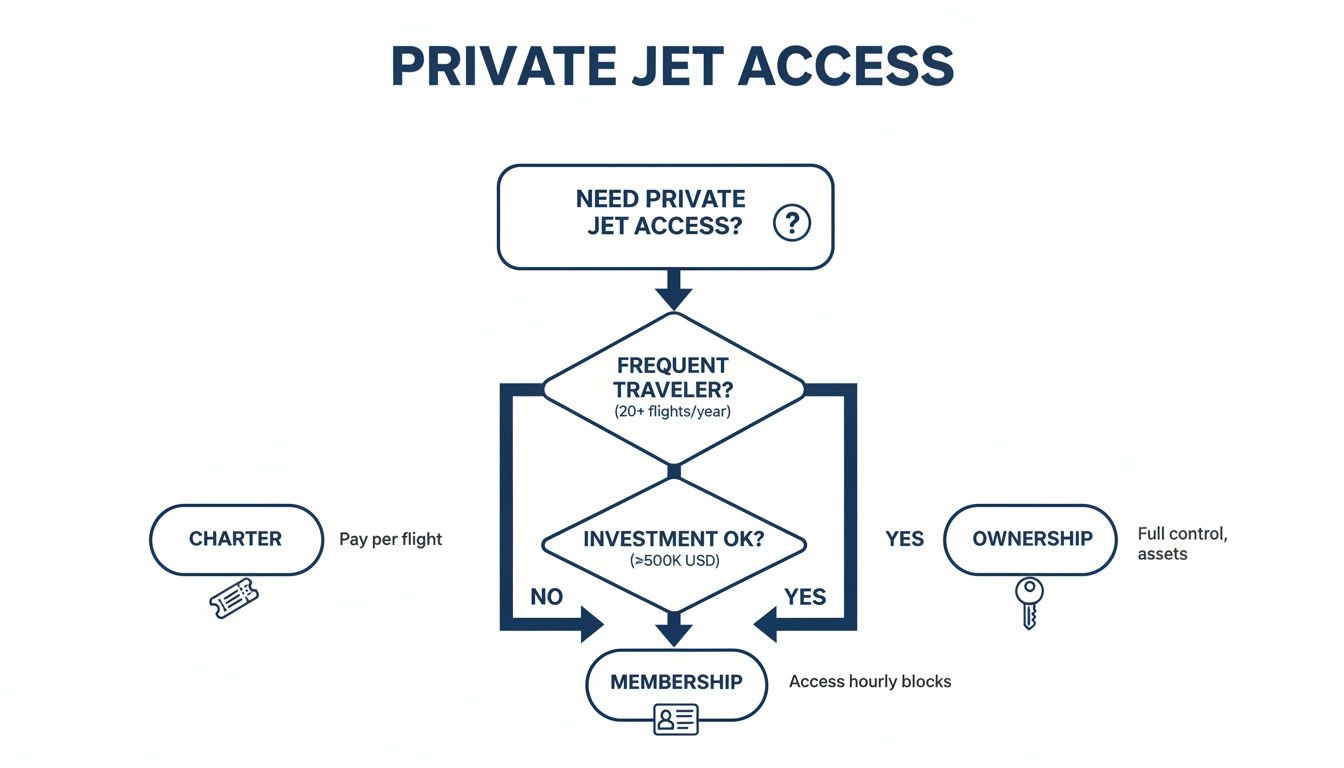
As you can see, the right path for you is all about your travel habits and financial picture. It’s a spectrum, from the pure flexibility of paying as you go all the way to the ultimate control of having your own jet on standby.
The real question isn't just "how much does it cost?" It's "which cost structure actually fits my life?" The most expensive option isn't automatically the best, and the cheapest might not give you the reliability you need.
To make this even clearer, let's put some numbers to these options. This table gives you a quick snapshot of the kind of financial commitment you can expect from each method.
Private Jet Access Cost At A Glance
| Access Method | Typical Hourly Rate | Upfront Investment | Annual Commitment |
|---|---|---|---|
| On-Demand Charter | $4,000 - $18,000+ | $0 | Pay per trip |
| Jet Card/Membership | $6,000 - $15,000 | $100,000 - $500,000+ | Annual fees or hour blocks |
| Full Ownership | Varies (Operating Costs) | $2M - $70M+ | $500K - $4M+ annually |
Looking at it this way, you can see how the financial commitment escalates. Chartering is purely transactional, while ownership is a massive, ongoing financial undertaking. Jet cards and memberships sit right in the middle, offering a hybrid approach for the frequent, but not constant, flyer.
Decoding Private Jet Charter Costs By The Hour
If you’re looking to charter a private jet, the hourly rate is the first number you'll see. Think of it like the meter in a taxi—it's the core cost for every hour the plane is in the air, but it’s definitely not the full story. It’s the starting point, not the finish line.
This rate isn’t set in stone. The biggest factor, by far, is the size of the jet. Smaller aircraft are more fuel-efficient and simply cost less to operate, making them easier on the wallet. The larger, long-range jets, on the other hand, command a premium for their incredible space, speed, and luxury amenities.
Even the jet's age and the time of year can make a difference. A brand-new jet fresh from the factory with the latest tech will naturally cost more per hour than a well-maintained older model. And just like with commercial flights, expect prices to jump during peak seasons like major holidays or for big events like the Super Bowl or Art Basel. For example, a flight to Aspen in December will cost significantly more than the same flight in May.
Estimated Hourly Charter Rates By Jet Category
To get a real sense of the numbers, you need to look at the different classes of private jets. Each one is built for a different purpose, and the pricing reflects that.
Here's a quick breakdown of what you can generally expect to pay per hour for different categories of aircraft.
| Jet Category | Average Hourly Rate | Passenger Capacity | Common Use Case |
|---|---|---|---|
| Turboprop | $1,500 – $2,500 | 4-8 | Short-haul flights (under 2 hours), accessing smaller airports |
| Light Jet | $3,000 – $4,000 | 6-8 | Regional business trips, quick family getaways (2-3 hours) |
| Midsize Jet | $4,000 – $6,000 | 7-9 | Coast-to-coast travel, more cabin space and amenities |
| Super-Midsize Jet | $6,000 – $10,000 | 8-12 | Longer-range domestic flights, some international routes |
| Heavy Jet | $10,000 – $20,000+ | 10-16+ | Transcontinental and international travel, ultimate luxury |
Keep in mind, these are averages. For a deeper dive, it's worth exploring the nuances of private jet charter costs to see how specific aircraft models and trip distances affect the final price.
Let's ground these numbers in a few real-world examples:
- A quick business hop? A one-hour flight from Teterboro (NYC) to Boston on a light jet like a Phenom 300 will probably land you in the $8,000 - $12,000 range.
- Taking the family on vacation? Flying six people from Los Angeles to Cabo San Lucas on a midsize jet could be anywhere from $25,000 - $35,000.
- Crossing the pond? A trip from London to New York on a heavy jet like a Gulfstream G650, designed for a larger group in total comfort, can easily top $120,000.
These all-in estimates show just how quickly costs can scale with the size of the aircraft and how long you're in the air.
Remember, the advertised hourly rate is just the starting point. The final charter quote will include several additional fees that are crucial for understanding the true cost of your trip.
Beyond The Hourly Rate: The Other Costs
So, the hourly rate covers the plane's time in the sky. But what about everything else? This is where first-time private flyers often get surprised. These aren't hidden charges, but they are standard, necessary costs for a safe and smooth flight.
Here are the most common additions you’ll see on a charter quote:
- Repositioning Fees: The jet you need might not be parked at your local airport. If it has to fly in empty to pick you up, you’ll be billed for that "repositioning leg" at the standard hourly rate. Actionable Insight: Ask your broker if there are any "floating fleet" aircraft nearby, which don't have a fixed home base and can sometimes reduce or eliminate these fees.
- Crew Overnight Costs: On multi-day trips, you're responsible for the crew's lodging, meals, and expenses. This typically adds $800 - $1,500 per night. A practical example: for a 3-day trip, this could add $3,000 to your bill.
- Landing and Handling Fees: Airports charge for everything from landing to parking and using their private facilities (FBOs). This can be a few hundred bucks at a small airport or thousands at a major international hub like LAX or JFK.
- Federal Excise Tax (FET): Flying within the United States? A 7.5% tax is applied to all domestic flight legs and fuel. On a $20,000 charter, that's an extra $1,500.
You might also see charges for international customs and permits, de-icing in cold weather (which can be shockingly expensive), and any special requests like premium catering or chauffeured ground transport. A good, transparent charter broker will always itemize these costs for you, so you know exactly what you’re paying for before you commit. No surprises.
So, you’ve moved past chartering and the dream of owning your own aircraft is calling. This is the pinnacle of private aviation, but let's be crystal clear about something from the start: buying a private jet isn't like buying a Rolls-Royce. It’s more like buying a very complex, highly regulated, and incredibly expensive business that just happens to fly.
The financial commitment is staggering, and it hits you in two waves. First, there's the purchase price. Then come the relentless, never-ending costs to keep it in the air.

Think of the purchase price as just your ticket to the game. It’s the number that grabs all the headlines, but honestly, it’s only a small part of the story when it comes to the total cost of ownership over the aircraft's lifetime.
The Initial Acquisition Cost
First things first, you have to buy the jet. The sticker price swings wildly depending on whether you’re buying a factory-fresh model or a pre-owned aircraft. Going brand-new gets you the latest avionics, a full warranty, and that unmatched "new jet" smell, but you'll pay a serious premium for it.
The pre-owned market, on the other hand, is a much more accessible entry point. It's where you can find incredibly capable aircraft for a fraction of what they cost new.
The price range is vast. A new business jet will typically run you between $5 million and $30 million, while the top-of-the-line, ultra-long-range flagships can soar to $60–$80 million or even higher. For a look at the pre-owned market, you can find solid aircraft for as little as $1–$2 million, though this depends heavily on its age, flight hours, and how well it's been maintained. To get a better feel for specific models, you can find great insights into the current market for private jets.
Here’s the hard truth: The real challenge isn't just affording the purchase price. It's being able to comfortably absorb an annual operating budget that can easily reach 10-20% of the jet's original value, year after year.
The Never-Ending Annual Upkeep
Once the title is in your name, the real spending begins. This is the part that catches so many new owners by surprise. Your annual budget is a mix of fixed costs you pay whether the jet flies or sits in a hangar, and variable costs that tick up with every hour you’re in the air.
These ongoing expenses are exactly why most aviation pros will tell you that unless you fly 150-200 hours per year, full ownership just doesn't make financial sense compared to charter or a membership program.
Let's break down where that money goes.
1. Crew Salaries and Training Your jet can’t fly itself. You’ll need a professional flight crew, which at a minimum means two pilots. For larger jets, a flight attendant is also standard.
- Captain: A seasoned captain for a Gulfstream G550 will command a salary from $150,000 to over $300,000 a year, based on their experience and the aircraft type.
- First Officer: You can expect to pay your co-pilot between $100,000 and $200,000.
- Annual Training: Both pilots require recurrent simulator training to stay certified and sharp. Budget $30,000 to $50,000 per pilot, every single year.
2. Hangar Fees You don't just leave a multi-million dollar asset out on the tarmac. A private hangar is non-negotiable for protecting the jet from the elements, providing security, and having a base for maintenance. Depending on the airport and hangar size, this will set you back $5,000 to over $15,000 a month. That's $60,000 to $180,000 a year... just for parking. For example, a hangar at a high-demand airport like Van Nuys (KVNY) will be on the higher end of this range.
3. Aircraft Insurance Insuring a jet is a major line item. You need two types of coverage: hull insurance to protect the physical aircraft and liability insurance for passengers and third parties. Annual premiums are a serious expense, often running from $50,000 to $500,000 a year, influenced by the jet’s value, where you fly, and your crew's experience.
4. Scheduled Maintenance and Inspections The entire aviation industry is built on a foundation of obsessive, mandated maintenance. These checks aren't optional. They range from routine daily walk-arounds to massive, multi-million-dollar engine overhauls. Even if nothing breaks, you'll still need to budget hundreds of thousands of dollars annually for scheduled programs just to keep the aircraft safe, legal, and airworthy.
Calculating The Annual Cost To Operate Your Jet
So, you’ve bought the jet. That’s the easy part. Now comes the real financial commitment: keeping it ready to fly. Owning a private aircraft means the sticker price is just the cover charge; the real story is in the annual operating costs. These are the relentless, non-negotiable expenses required to keep your multi-million dollar asset safe, legal, and primed for takeoff at a moment's notice.

The best way to get your head around these numbers is to split them into two buckets. First, you have your fixed costs—the bills you pay every year whether the jet flies one hour or 400. Then there are the variable costs, which are tied directly to how much time you spend in the air.
Your Annual Fixed Costs: The Price of Readiness
Think of fixed costs as the subscription fee for jet ownership. It’s the baseline price you pay just to have the aircraft on standby, and these predictable bills keep your entire flight operation running smoothly.
These are the big ones you can’t avoid:
- Crew Salaries: A professional flight crew, usually two highly skilled pilots, is your largest fixed expense. Expect this to run anywhere from $250,000 to $500,000 a year, or even more.
- Hangar Rental: You need a secure, climate-controlled space to protect your investment. A good hangar is non-negotiable and will cost you between $60,000 and $180,000 annually.
- Aircraft Insurance: Comprehensive hull and liability insurance is a massive line item, often ranging from $50,000 to $500,000 per year.
- Crew Training: Your pilots need to stay sharp. Recurrent simulator training is mandatory to maintain their certifications and typically costs $60,000 to $100,000 for the crew.
- Software & Subscriptions: This covers the essentials like navigation chart updates, premium weather services, and scheduling software, adding another $20,000 to $50,000.
These costs stack up fast, forming the financial bedrock of your annual budget before you even fire up the engines.
Variable Costs: Expenses Per Flight Hour
Variable costs are exactly what they sound like—they go up the more you fly. This is where you feel the direct cost of propelling a sophisticated machine through the sky at 500 miles per hour.
Owning and operating a private jet carries substantial recurring costs. Conservative industry estimates place annual fixed and variable operating costs from roughly $300,000–$3,000,000+ for light to midsize aircraft up to $3,000,000–$7,500,000 or higher per year for large long‑range jets. The total depends largely on utilization, fuel prices, maintenance cycles, and management fees. You can find more insights about annual jet operating expenses on simpleflying.com.
The primary variable expenses are:
- Fuel: This is your biggest variable cost by a long shot. A midsize jet can easily burn 200-300 gallons per hour, which translates to $1,200 to $2,100 every hour you're in the air. A practical tip: fuel prices vary dramatically by airport, so planning fuel stops at less expensive FBOs can save thousands on a long trip.
- Maintenance: This includes both scheduled inspections and funds you set aside for major engine and airframe overhauls. It’s typically budgeted on a per-flight-hour basis.
- Landing & Handling Fees: Every time you touch down, you’re paying fees for using the airport and private terminals (FBOs).
- Catering & Supplies: From gourmet meals to a well-stocked bar, every onboard service adds to the trip’s final bill.
Case Study: Cessna Citation Latitude
Let’s put some real numbers to this. We'll use the popular Cessna Citation Latitude, a workhorse in the midsize jet category, and assume you fly a pretty standard 200 hours per year.
Annual Fixed Costs Estimate
- Crew Salaries & Training: $400,000
- Hangar & Insurance: $150,000
- Subscriptions & Miscellaneous: $50,000
- Total Fixed Costs: $600,000
Annual Variable Costs Estimate (at 200 hours)
- Fuel (at $1,500/hr): $300,000
- Maintenance Programs (at $1,000/hr): $200,000
- Landing/Handling/Catering (at $500/hr): $100,000
- Total Variable Costs: $600,000
In this scenario, your total annual cost to own and operate the jet is a cool $1.2 million. This breaks down to an "effective hourly cost" of $6,000.
But here's where it gets interesting. Let's say you fly double that, or 400 hours. Your fixed costs stay the same at $600,000, but your variable costs double to $1.2 million. Your new total is $1.8 million. The magic, however, is that your effective hourly cost plummets to just $4,500. This perfectly illustrates a key principle of jet ownership: the more you fly, the more efficient your investment becomes.
Smarter Ways To Fly Private: Memberships and Empty Legs
What if you could get the full private jet experience without the astronomical price tag of ownership or the guesswork of on-demand chartering? Good news: you can. The world of private aviation has evolved, and a couple of brilliant strategies have emerged for savvy travelers: leveraging empty-leg flights and joining a smart travel membership program.
Think of these as the intelligent middle ground. They deliver all the luxury and convenience you expect from a private flight but sidestep the complexities and staggering expenses that usually come with it. These are the go-to options for travelers who value both their time and their budget.
The Secret of Empty Leg Flights
Here’s a scenario that plays out every day. A jet is chartered for a one-way trip, say from Miami to New York. After it drops off its passengers, that perfectly good aircraft has to fly back to its home base in Miami—completely empty. This return journey is called an empty leg, and it's one of the best-kept secrets in private aviation.
Operators are desperate to put someone—anyone—on these flights. Any money they make helps cover the cost of fuel and crew for a trip that would otherwise be a total loss. The result for you? Unbelievable discounts, sometimes slashing the standard charter price by up to 70%.
Empty legs are the ultimate travel hack for the flexible flyer. You get the same jet, the same crew, and the same incredible experience for a fraction of the cost. The only catch is that the destination and timing are already set, so they’re perfect when your plans can align with the plane’s schedule.
For instance, a typical one-way charter from Los Angeles to Las Vegas could easily run you $15,000. But if you snag an empty leg on that same route, you might book the entire aircraft for as little as $5,000. It’s an unbeatable deal.
Finding and Booking Empty Legs
So, where do you find these hidden gems? It’s all about knowing where to look and being ready to move quickly when a deal pops up.
- Charter Broker Apps & Websites: Most modern brokers feature a dedicated section on their site or app listing available empty legs in real-time. Actionable insight: Set up alerts for your favorite routes (e.g., "NYC to South Florida") so you get notified instantly.
- Mailing Lists: Get on the newsletters for a few charter companies. You’ll often be the first to know when a new empty leg becomes available.
- Travel Memberships: This is often the easiest route. Premium clubs like the Approved Experiences Traveler program do the work for you, providing members with curated access to these flights as a core benefit.
Your biggest advantage here is flexibility. If you can shift your travel dates by a day or two or are open to nearby airports, you can unlock some truly phenomenal value.
The Membership Model: A Predictable Approach
For frequent flyers who want more consistency than the occasional empty-leg hunt, a membership model is the answer. It’s less like booking one-off trips and more like subscribing to a smarter, more elevated travel lifestyle with predictable costs and exclusive perks.
Instead of getting hit with fluctuating prices every time you want to fly, a membership offers a structured—and often much more affordable—way to access private aviation. It’s the perfect solution for those who fly often but have no interest in the headaches that come with owning a multi-million dollar asset.
A membership like Approved Experiences Traveler was built to solve this very problem. It’s a smarter way to travel, combining wholesale pricing on hotels and cruises with exclusive aviation benefits, including access to empty-leg charters for its top-tier members.
This completely changes the conversation around how much private jets cost. The focus shifts from a high per-trip price to a predictable annual fee that unlocks a world of savings and opportunities. You’re no longer paying a premium for every flight; you’re investing in a system that makes luxury travel simpler and far more cost-effective in the long run.
Common Questions About Private Jet Costs
Once you start digging into charter, ownership, and memberships, a few specific questions always seem to pop up. Think of this as the practical guide to the little details—the kind of things that can make a real difference when you're planning a trip.
We get these questions all the time. From the real cost of in-flight Wi-Fi to bringing your pets along for the ride, let's clear up the finer points so you know exactly what to expect before you book.
Can I Bring My Pets Onboard and What Does It Cost?
Absolutely. This is hands-down one of the best parts of flying private. Your pets get to be right there in the cabin with you, treated like the valued passengers they are—a world away from being treated like cargo on a commercial flight.
For the most part, you won't see a separate "pet ticket" on your invoice; the cost is usually just part of the charter. What you should be prepared for is a potential cleaning fee, which can run anywhere from $250 to over $1,000. This usually comes up if your pet sheds a lot or has a little accident. Actionable insight: Always inform your charter provider in advance about the pet's breed and size to ensure the aircraft's owner allows pets and to avoid any day-of-travel issues.
Is Wi-Fi Free on a Private Jet?
This is a big one that catches a lot of first-time flyers by surprise. Unlike your favorite coffee shop, in-flight Wi-Fi on a private jet is almost never free, and it can get expensive fast. While some of the newest jets might offer basic connectivity as a courtesy, most operators have to pass the high cost of satellite data straight to you.
Expect to be billed based on how much data you use, often between $2 and $9 per megabyte. A few hours of streaming or a video conference call could easily tack thousands of dollars onto your final bill. If you know you'll need to be online, make sure you confirm the pricing structure before you take off. Actionable insight: Download movies and large files before you board. If you just need to send emails, ask the crew if basic text-based messaging is available at a lower cost.
How Much Does Catering Cost?
Standard snacks and a basic selection of drinks? That's usually included in the charter price. But if you're dreaming of a fully customized dining experience—like sushi platters, a bottle of premium champagne, or a multi-course meal from your favorite restaurant—that’s going to be an extra charge.
Custom catering costs can be all over the map:
- A simple spread of high-quality sandwiches and salads might add $200 to $500.
- A gourmet meal for a larger group paired with fine wines could easily push past $2,000.
The key is to talk to your provider about what you want. They can get you an accurate quote so there are no surprises when it comes to your in-flight service.
Are One-Way Flights Cheaper Than Round Trips?
Not always. In fact, a one-way charter can sometimes be more expensive per hour than a round trip. It all comes down to what the plane has to do after it drops you off. If the aircraft has to fly empty back to its home base or on to its next booking, you're the one who covers that repositioning cost.
A round trip is often the smarter financial move, especially if you’re coming back within a few days. The operator can just have the jet and crew wait for you at your destination, which completely avoids a costly empty return flight. This makes round-trip pricing way more efficient for weekend getaways or quick business trips, and it's a huge factor in the final cost of your flight.
Ready to experience the convenience and luxury of private travel without the complexities of chartering or ownership? Approved Experiences Traveler offers a smarter path. Our membership provides exclusive access to empty-leg charters and wholesale pricing on over a million hotels and resorts, making elevated travel surprisingly affordable. Discover a better way to fly at https://www.approvedexperiences.com.
Want the wider view?
Ten categories. One report. Every quarter. The Approved List tracks what's rising and what's fading: data-backed signals, not opinions.
Free to join · Delivered by email